TL;DR:
- Effective keyword research focuses on understanding search terms your audience genuinely uses to match content with their intent. It involves ongoing analysis of search volume, difficulty, and intent to develop targeted, non-competitive clusters that support realistic ranking goals. Regularly updating your strategy ensures your content remains aligned with evolving search behaviors and competitive landscapes.
Most business owners assume keyword research means finding words with big search numbers and targeting those. That instinct is understandable, but it leads to wasted effort and content that never ranks. What is keyword research, really? It’s the practice of finding and analyzing search terms your potential customers actually use so you can prioritize the ones worth going after. The real work isn’t volume chasing. It’s matching your content and pages to what your audience genuinely wants to find.
Table of Contents
- Key Takeaways
- What keyword research actually means
- Types of keyword research and intent categories
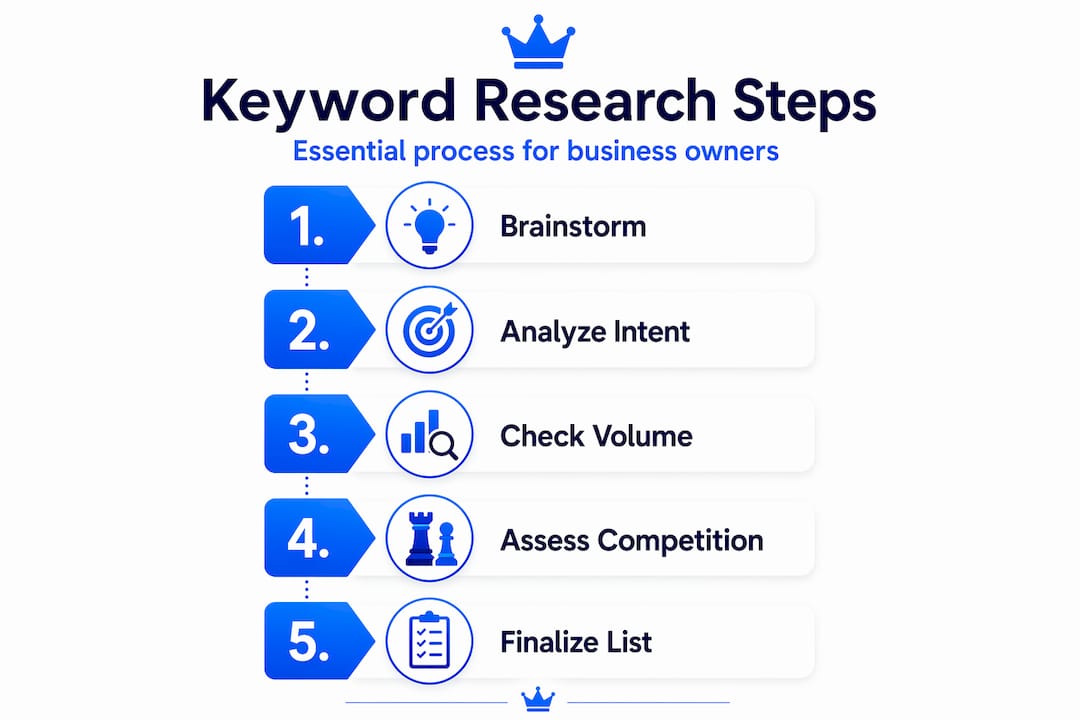
- How to do keyword research step by step
- Mistakes to avoid and expert best practices
- Keyword research for SEO and paid search
- My honest take on keyword research
- How King Digital Marketing Agency can help you rank smarter
- FAQ
Key Takeaways
| Point | Details |
|---|---|
| Intent beats volume | Choosing keywords by search volume alone ignores whether the searcher is actually ready to buy or engage. |
| Research is ongoing | Keyword research is a continuous process, not a one-time setup task your team checks off and forgets. |
| Clustering prevents waste | Grouping related keywords onto a single page avoids competing against your own content. |
| Long-tail wins early | Small or newer sites build authority faster by targeting specific, lower-competition keyword phrases first. |
| Tools plus judgment | No keyword research tool replaces understanding your business goals and your customer’s actual search behavior. |
What keyword research actually means
At its core, keyword research bridges your business topics with the words real people type into Google when they need something you offer. It’s not about guessing. It’s about evidence.
Think of it this way. Your customers don’t know your internal product names or industry jargon. They search in plain language. A plumber in Albuquerque might call their service “water heater replacement,” but their customers type “water heater not working” or “how much does a new water heater cost.” Keyword research closes that gap.
There are three core metrics you need to understand before doing anything else:
- Search volume: How often a keyword is searched per month. Higher isn’t always better. A keyword with 100 searches from people ready to buy outperforms one with 10,000 searches from people just browsing.
- Keyword difficulty: How hard it is to rank for a term based on the strength of pages already ranking. This tells you whether a keyword is even winnable for your site right now.
- Search intent: The reason behind the search. Are they looking for information? Comparing options? Ready to purchase? Intent shapes everything.
You’ll also hear the term “keyword clusters.” These are groups of closely related keywords that all point to the same topic and are best served by a single page. Understanding how to decode digital marketing terms like these upfront saves a lot of confusion later.
Pro Tip: Don’t build your keyword list from your own perspective. Start by writing down every question your best customers have asked you over the past year. Those questions are seed keywords in disguise.
Types of keyword research and intent categories
Not all keywords are created equal. The biggest separator is intent, and getting this wrong is expensive. Intent determines what kind of page best satisfies the search, whether that’s a blog post, a product page, a comparison guide, or a contact form.
Here’s how the four main intent categories work in practice:
| Intent Type | What the Searcher Wants | Best Content Match |
|---|---|---|
| Informational | Learning or researching a topic | Blog posts, guides, FAQs |
| Navigational | Finding a specific website or brand | Homepage or brand pages |
| Commercial | Comparing options before buying | Reviews, comparisons, case studies |
| Transactional | Ready to take action or purchase | Service pages, product pages, landing pages |
A search for “what is keyword research” is informational. Someone searching “best SEO agency Albuquerque” is commercial. “Hire SEO company near me” is transactional. You need a different page, different tone, and different call to action for each.
Beyond intent, you need to assess keyword opportunity. This is the intersection of search volume, keyword difficulty, and your site’s current authority. A brand-new website has almost no chance ranking for “digital marketing” (massive competition), but it can realistically rank for “local SEO for HVAC companies in Albuquerque” with quality content.
One concept that sharpens clustering decisions: SERP overlap. If more than 30% of the top-ranking pages for two keywords are the same, those keywords belong on the same page, not two separate ones. Splitting them dilutes your ranking potential.
Pro Tip: Run a quick Google search for your target keyword before writing a single word. The format of the top results tells you exactly what kind of content Google thinks satisfies that intent. Match it.
How to do keyword research step by step
This is where understanding keyword research turns into action. The process follows a clear workflow, and skipping steps leads to either content that never ranks or pages that compete against each other.
-
Start with seed keywords. These are the broad, foundational terms that describe your business, services, or topics. A local bakery might start with “custom cakes,” “wedding cakes,” and “gluten-free pastries.” Write down 10 to 20 seed terms without overthinking volume yet.
-
Expand your list using keyword research tools. Enter your seed keywords into tools like Google Keyword Planner, Ubersuggest, or similar platforms. These tools surface related terms, questions, and variations you wouldn’t have thought of. Pay attention to the “People also ask” section in Google search results. That’s organic intelligence from real searches.
-
Filter by intent and opportunity. Not every keyword your tool surfaces is worth targeting. Remove keywords that don’t match what your business actually offers. Then eliminate terms where the keyword difficulty far exceeds what your current site authority can compete with. What’s left is a realistic working list.
-
Cluster your keywords into topic groups. Group related keywords together. If SERP overlap data shows keywords share more than 30% of top results, they belong in one cluster served by one page. This prevents keyword cannibalization, where two pages on your own site compete against each other and both rank poorly.
-
Map clusters to specific pages. Each cluster gets assigned to an existing page or a page you plan to create. A service page, a blog post, a location page. Every page on your site should have a clear keyword focus. This is where local keyword research becomes particularly powerful for businesses serving a specific geographic area.
-
Monitor and update regularly. Keyword research is not a one-time task. Search behavior shifts, new competitors appear, and your own site authority grows. Teams that refine keyword targeting consistently outperform those who set it and forget it.
Mistakes to avoid and expert best practices
The most common and costly mistake in keyword research is choosing keywords based on search volume and nothing else. Effective keyword research balances relevance, ranking opportunity, and intent alignment. Volume is just one input.
Here are the pitfalls worth knowing before you learn them the hard way:
- Targeting head terms too early. If your website is new or small, targeting lower-competition long-tail keywords first builds the topical authority you need before you can compete for broader terms. Trying to rank for “SEO services” from day one is like entering a marathon without training.
- Ignoring Google Search Console. Once your site has any traffic at all, Google Search Console query data shows you exactly what searches already bring people to your site. These are real keywords, not estimates. Use them to find opportunities hiding in plain sight.
- Skipping the mapping step. Keyword clusters mean nothing if you don’t assign them to specific pages. Without a clear map, teams create overlapping content and dilute their own rankings.
- Treating intent as optional. Mismatched intent renders even the most perfectly optimized page useless for business goals. A page built for an informational keyword won’t convert someone who already wants to buy.
Pro Tip: Filter your keyword list by asking one question for each term: “Does someone searching this have a reason to care about my business?” If the answer is no, remove it regardless of the search volume.
Good keyword research tools to know include Google Keyword Planner (free, integrated with Google Ads), Google Search Console (free, shows real queries), and third-party platforms that surface keyword difficulty scores and competitor data. No tool replaces your judgment, but they all speed up the process significantly.
Keyword research for SEO and paid search
The role of keyword research stretches across both organic search and paid advertising, and the two channels use keyword data differently.

For organic SEO, keywords guide your content strategy, on-page optimization, internal linking, and site structure. The goal is to rank naturally in search results and attract consistent traffic without paying for each click. Getting your website design built for SEO from the start makes implementing your keyword map dramatically easier.
For paid search, keywords determine when your ads appear and who sees them. Google Ads uses keywords plus intent signals to optimize bids and match real queries, which means your keyword choices directly affect your ad spend efficiency and conversion rates. The stakes are higher because every click costs money.
Here’s how keyword intent shifts between channels:
- In organic SEO, you can profitably target informational keywords because content that educates builds authority and drives traffic that converts over time.
- In paid search, transactional and commercial keywords typically deliver faster ROI because the searcher is closer to making a decision and each click must justify its cost.
- Google Ads automation can expand beyond your exact keyword list using intent signals, but your keyword choices still define the boundaries of who you reach.
Understanding this distinction helps you allocate budget and content resources where they’ll perform best across both channels.
My honest take on keyword research
I’ve worked with enough business owners to recognize a pattern. They come in either fixated on ranking for the most competitive keyword in their industry or overwhelmed by long lists of terms they found in a tool and have no idea what to do with. Both situations are versions of the same problem: missing the forest for the trees.
In my experience, the single biggest shift that changes outcomes is treating keyword research as a decision-making tool, not a data dump. Every keyword on your list should answer one question: “Does targeting this move my business forward?” If the intent doesn’t match what you offer, or the competition is so high that ranking would take years, cross it off.
What I’ve found actually works is building your keyword strategy around what you can realistically win right now, while keeping an eye on the bigger terms you want to compete for later. That’s not settling. That’s how you build authority without burning your content budget on pages that will never rank.
The other thing I’d push back on is the idea that keyword research is something you do once, hand off, and move on from. Search behavior changes. Your competitors shift their strategies. Your site authority grows. I’ve seen clients who did thorough keyword research three years ago and never revisited it, now ranking for terms no one searches anymore while missing the questions their customers are actually typing today. Make it a quarterly habit, even if it’s just a light review.
— Bernadette
How King Digital Marketing Agency can help you rank smarter
If you’ve worked through this article and you’re thinking “I get the concept, but I need someone to actually do this with me,” that’s exactly where King Digital Marketing Agency comes in. We work with small and medium-sized businesses in Albuquerque and beyond, building keyword strategies that connect to real business goals rather than vanity metrics.
Our team handles everything from identifying the right keyword clusters for your market to building out SEO-friendly site structures that give your content the best possible foundation. If paid search is part of your growth plan, we also manage campaigns built on solid keyword research so your ad budget works efficiently rather than bleeding on mismatched terms. Ready to stop guessing and start ranking? Explore how we help businesses improve search rankings with strategy that’s built around your specific market and goals.
FAQ
What is keyword research in simple terms?
Keyword research is the process of finding the words and phrases your potential customers type into search engines so you can create content and pages that show up when they search. It prioritizes terms based on relevance, search volume, and realistic ranking opportunity.
Why does search intent matter more than search volume?
Intent alignment determines whether a keyword can actually drive conversions for your business. A high-volume keyword that attracts the wrong audience generates traffic but no revenue, making intent the more important filter.
How often should you do keyword research?
Keyword research is an ongoing process, not a one-time task. Revisiting your keyword strategy quarterly keeps your content aligned with how search demand and competition evolve over time.
What are the main types of keyword research methods?
The most common types of keyword research methods include seed keyword brainstorming, competitor keyword analysis, keyword tool expansion, and Google Search Console data mining. Each method surfaces different opportunities and works best when used together.
What keyword research tools should small businesses start with?
Google Keyword Planner and Google Search Console are both free and give you solid foundational data. Search Console query data is especially valuable because it shows the real searches already bringing traffic to your site, which third-party tools often underestimate.
Recommended
- Local SEO keyword research: Unlock 2025 Success
- Local keyword research: Power Up in 2025!
- How to find youtube keyword competition score and seo 10x Boost
- What is search engine ranking? Guide for Albuquerque SMBs
