Why Hotel Review Software Matters for Bookings and Visibility
Hotel review software helps hotels collect, monitor, analyze, and respond to guest feedback from sites such as Google, Tripadvisor, Booking.com, and Expedia in one place.
| What it does | Why it matters |
|---|---|
| Centralizes reviews | Teams spend less time switching between review sites. |
| Automates review requests | More recent guest feedback can build trust with future bookers. |
| Flags negative sentiment | Staff can spot recurring problems and act faster. |
| Supports faster responses | Guests are more likely to book when management responds to reviews. |
| Tracks reputation trends | Hotels can connect feedback about service, cleanliness, check-in, and amenities to real operating fixes. |
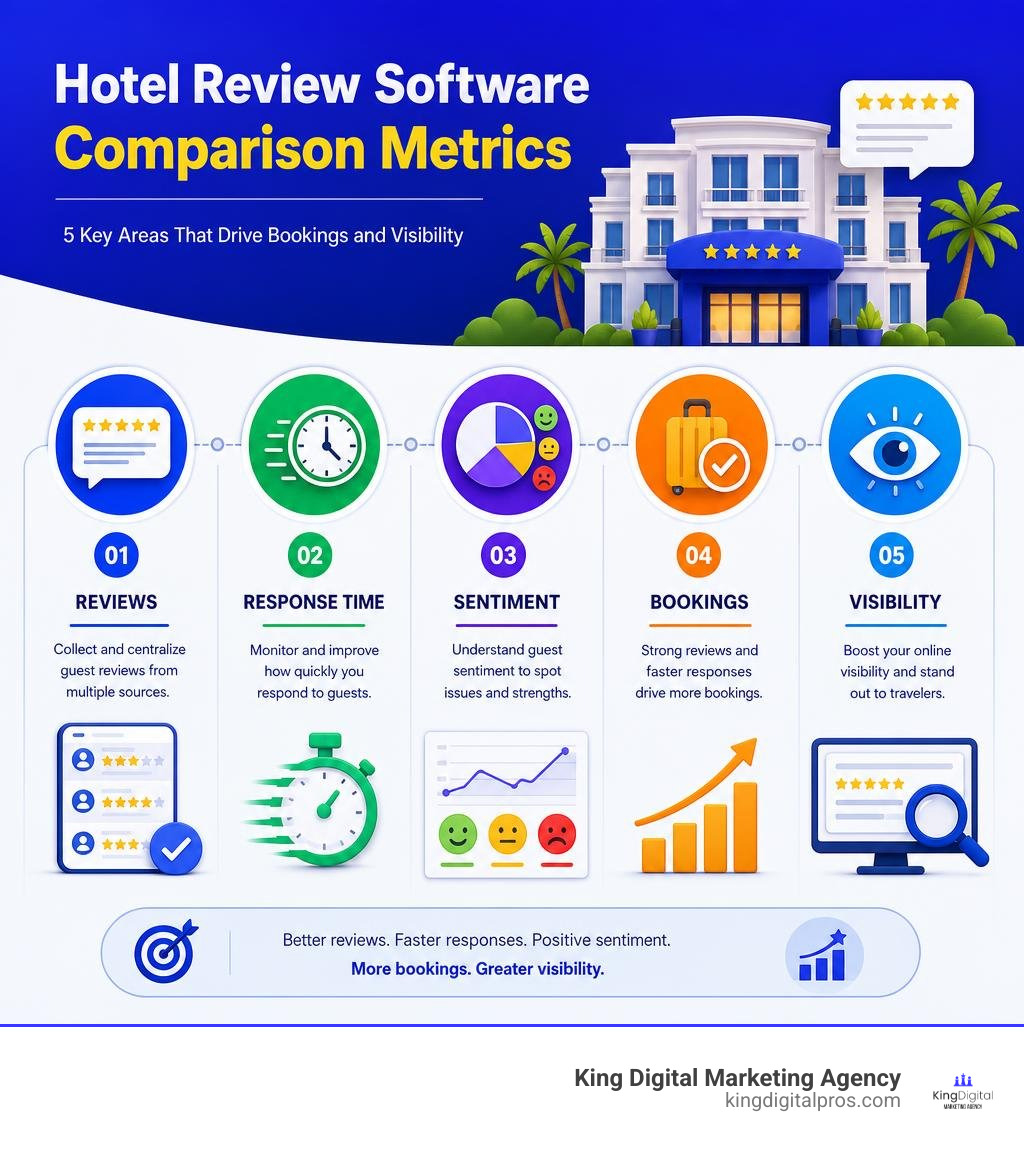
Reviews are not just a customer service concern. They are part of a hotel’s digital storefront. Research cited in this guide shows that 81% of travelers always or often read reviews before booking, while 49% will not book a hotel with no reviews. A stronger review profile can also support rate power and booking performance: a one-star improvement has been associated with a 5% to 9% revenue lift.
For busy hotel teams, the real question is not whether reviews matter. It is which platform fits the property, staff workflow, systems, budget, and number of locations. This comparison guide helps you evaluate the essential features, AI tools, integrations, response workflows, and multi-property controls without getting lost in vendor claims.
I’m Bernadette King, a digital marketing strategist and founder of King Digital Marketing Agency. My work helping businesses improve search visibility, customer trust, and conversion-focused marketing informs this practical look at choosing hotel review software.
Discover more about hotel review software:
Core Features of Modern Hotel Review Software
Managing feedback manually across dozens of online travel agencies (OTAs) and review portals quickly turns into an administrative bottleneck. Modern hotel review software replaces fragmented daily tasks with a streamlined, centralized dashboard. By consolidating incoming feedback from channels like Google Business Profile, Tripadvisor, Booking.com, Expedia, and Airbnb into a single inbox, hospitality teams can monitor sentiment without constantly logging in and out of different vendor portals.
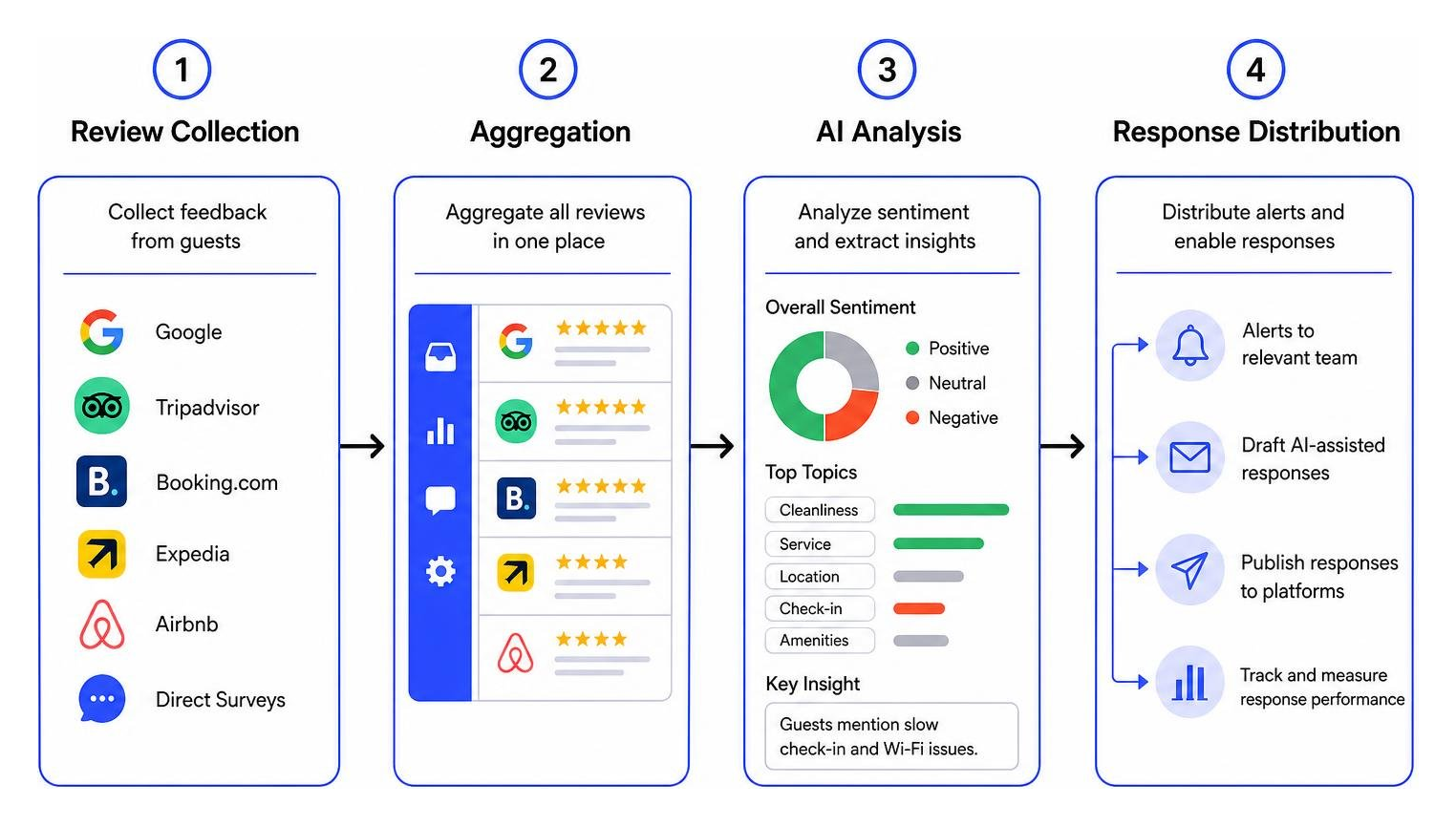
Beyond simple monitoring, top-tier platforms actively capture fresh guest feedback right when satisfaction levels are highest. Automated outreach via email and SMS messaging triggers post-checkout surveys within 24 to 48 hours after departure. When guests receive a frictionless request while their stay is still fresh in mind, response volume jumps dramatically – 76% of consumers leave a review if explicitly asked.
To explore how centralized feedback tools streamline daily administrative operations, see our customer review management software complete guide.
Essential Capabilities of Hotel Review Software
When auditing software options, you need core functionality that drives real efficiency rather than superficial metrics. Essential capabilities include:
- Multi-Channel Tracking: Real-time feedback aggregation across 20+ global and regional travel review channels, ensuring no guest comment slips through the cracks.
- Automated Collection & Distribution: Strategic post-stay outreach that routes satisfied guests directly to public platforms while directing negative sentiment to internal resolution forms before public posting.
- Response SLAs & Notification Alerts: Instant SMS or email triggers for low-score reviews (1 or 2 stars) so front-office managers can execute rapid service recovery.
- Customizable Response Templates: Pre-approved brand templates combined with dynamic fields that allow staff to write tailored, professional replies quickly.
- Review Distribution Balancing: Automated settings that allocate review collection percentages across platforms (e.g., 50% to Google, 50% to Tripadvisor) to maintain balanced visibility.
PMS and System Integrations
A platform’s true utility depends on how well it communicates with your existing hospitality tech stack. Connecting your hotel review software directly to your Property Management System (PMS), Customer Relationship Management (CRM) platform, and channel manager eliminates double data entry and enables precise post-checkout triggers.
When integrated with leading systems like Cloudbeds, SiteMinder, or Daylight PMS, the review system automatically reads departure statuses. It then sends personalized survey invitations matching guest language preferences, room types, and stay duration. Furthermore, pulling review history into guest CRM profiles gives front-desk staff real-time visibility into returning guest preferences, enabling VIP treatments that prevent past service friction from recurring.
Comparing Standalone vs Integrated Reputation Platforms
Hoteliers generally face a key architecture decision: choosing a dedicated standalone review management tool or adopting an all-in-one guest experience platform bundle. Each approach offers distinct advantages depending on your operating structure and tech complexity.
| Evaluation Metric | Standalone Review Software | Integrated Guest Experience / PMS Bundle |
|---|---|---|
| Core Focus | Deep review analytics, specialized AI responses, multi-OTA tracking | Broad operational coverage (check-in, PMS, messaging, reviews) |
| Setup Time | Rapid deployment (often under 30 minutes) | Moderate to long setup requiring full tech stack configuration |
| Data Synchronization | Syncs via API connectors or direct platform logins | Native internal data sharing across booking and stay lifecycles |
| Pricing Structure | Flat monthly subscription per key or property | Tiered package pricing bundled into broader platform fees |
| Customization Depth | Highly granular sentiment filtering and custom survey logic | Standard review handling tightly integrated with core PMS functions |
Evaluating Hotel Review Software Solutions
Choosing between options requires looking beyond basic feature checklists. High-performing properties evaluate tools across five operational dimensions:
- Feature Parity: Ensure the tool tracks all channels relevant to your guest demographics, including niche platforms or regional OTAs.
- Setup Time & Ease of Use: Front-desk teams turnover periodically; the interface must be intuitive enough for new staff to master without lengthy training cycles.
- Pricing Transparency: Look for transparent subscription models based on room counts without hidden charges for review volume or additional user seats.
- Vendor Support & Training: Confirm the vendor offers 24/7 technical support and structured onboarding tools to keep your response workflows running smoothly.
- Custom Branding: Verify that all post-stay survey microsites, email outreach, and review widgets fully support your hotel’s direct visual branding and custom domains.
For additional independent technical overviews, leading industry sources like Customer Alliance offer practical breakdowns of contemporary reputation software categories.
Multi-Property Management Workflows
For hotel groups, management companies, and multi-property operators across regions like Santa Fe, Albuquerque, or Taos, managing individual property accounts in isolation is impractical. Enterprise-grade tools supply a multi-location overview that centralizes performance monitoring within a single master interface.
Regional directors can compare Global Review Index (GRI) scores, monitor response rate SLAs, and benchmark property performance side-by-side. Role-based access permissions allow property-level general managers to respond to local feedback while granting corporate leadership full visibility into brand compliance, franchise SLA requirements (such as Medallia benchmarks enforced by major brand chains), and recurring operational pain points across portfolios.
How Review Automation and AI Drive Revenue and SEO

Integrating artificial intelligence and operational automation transforms reputation management from a reactive administrative chore into an active revenue engine. Modern hotel review software leverages machine learning to draft custom responses, translate feedback in real time, and detect emerging sentiment trends before they harm booking performance.
Research highlights the tangible commercial impact of active response strategies: 63% of travelers say they are more likely to book a hotel if management responds to the majority of reviews, while 77% note that personalized responses increase their booking intent. Furthermore, responding to negative feedback with a personalized message within 24 hours leads 33% of users to upgrade their original rating.
Hoteliers interested in hands-off outreach workflows can reference the lazy persons guide to automated review management for additional operational automation ideas.
AI Sentiment Analysis and Automated Outreach
Basic star ratings rarely explain why a guest was delighted or dissatisfied. Advanced AI sentiment analysis extracts actionable intelligence by scanning text across review channels, categorizing comments into dynamic operational themes such as cleanliness, check-in speed, noise levels, or Wi-Fi reliability.
AI tools also simplify response workflows by drafting context-aware, empathetic replies tailored to your property’s tone of voice. Staff can review, edit, and publish draft responses in seconds, cutting management response times down dramatically while ensuring complete language translation for international guests.
To read more about how AI engines process guest sentiment and calculate room rate pricing power, examine the technology features documented by Cloudbeds Reputation Management.
Local SEO Impact and Rich Snippets

Guest reviews serve as a foundational local SEO ranking factor for search engines like Google. Search algorithms prioritize hotel listings with high review volume, strong average star ratings, and consistent recency. When management regularly responds to reviews, it signals an active, trustworthy business profile, boosting local map pack visibility for high-intent searches.
Furthermore, implementing structured data markup (schema.org) using direct website review widgets enables rich snippet star ratings directly on your Google search engine results pages. Displaying verified reviews on direct booking engines builds immediate guest trust, driving an average 34% increase in direct conversions and boosting organic search click-through rates by up to 28%.
For an in-depth strategy on leveraging review signals to capture top local map positions, check out our guide on how to boost local seo effective review management.
Hotels showcasing social proof on direct websites also avoid losing potential guests back to high-commission OTAs. Specialized direct booking tools, such as those detailed by Revyoos for Hotels, illustrate how embedded review widgets protect direct conversion margins.
FAQ: Key Considerations for Hospitality Review Tools
What is the average ROI and cost of hotel reputation tools?
Software costs typically range from $19 to $50 per month for core property plans, while enterprise multi-property platforms scale based on room count and feature requirements.
The financial return on investment is substantial. Academic research from Cornell University indicates that a 1-point increase in a hotel’s review score allows operators to raise Average Daily Rates (ADR) by up to 11% without sacrificing occupancy rates. Additionally, boosting review scores and response speeds directly improves organic search visibility and direct booking conversion rates, yielding rapid payback on software subscription costs.
How do hotels handle negative or fake online reviews?
When facing negative feedback, establish a systematic, professional protocol:
- Acknowledge and Apologize: Respond promptly (within 24 hours), thanking the guest for their feedback while offering an empathetic, non-defensive apology.
- Take it Offline: Provide direct contact details for a senior manager to resolve specific grievances privately.
- Show Concrete Solutions: Outline operational steps taken to fix the issue (e.g., servicing an air conditioner or retraining staff).
For clear policy violations or demonstrably fake reviews, submit a flagging request through your Google Business Profile or OTA management portal, backed by PMS reservation logs proving the reviewer was never a guest. If platform removal appeals are declined, drown out isolated negative reviews by deploying automated post-checkout campaigns to generate a steady stream of genuine, high-rating feedback.
How quickly should hoteliers respond to guest feedback?
Hotels should aim to respond to all guest reviews within 24 to 48 hours. Quick responses build consumer trust – businesses that actively reply to reviews are perceived as 1.7 times more trustworthy than those that do not. Furthermore, failing to respond to guest feedback risks increasing overall customer churn by up to 15%, whereas rapid service recovery converts dissatisfied travelers into loyal brand advocates.
Conclusion
A well-executed review strategy is no longer optional for hotel operators seeking sustainable growth. Investing in dedicated hotel review software provides the centralization, automation, and analytical depth needed to protect brand reputation, streamline staff workflows, and unlock dynamic pricing power. By combining automated post-checkout requests, AI-assisted responses, and integrated PMS triggers, hotels can consistently turn guest feedback into higher search visibility and increased direct revenue.
At King Digital Marketing Agency, we specialize in helping local hospitality businesses maximize their search engine presence, optimize Google Business Profiles, and turn guest trust into direct bookings. Explore our full range of reputation management services to discover how our team can elevate your property’s digital visibility and revenue performance.
