A good Performance Max strategy starts before you spend a dollar. Get your conversion tracking right, bid toward one clear outcome, build asset groups around real services, and review the results by qualified leads instead of clicks. Do those four things and Google’s automation has something useful to learn from. Skip them and it will happily spend your budget on cheap, low-value form fills.
This guide is written for Albuquerque owners and managers who run a service business, a storefront or a professional practice and want to know how to use Performance Max without handing over the keys.
TL;DR
- Performance Max is an automated, goal-based campaign that runs across Google’s channels. It works as a reach layer on top of local SEO and Search, not as a replacement for them.
- Tracking comes first. Define one qualified-lead outcome, track it, and feed offline results from your CRM back to Google Ads.
- Start with Maximize Conversions, and add a target CPA only after the account has usable history.
- Build separate asset groups for each service, with landing pages that match, and review search terms and placements on a schedule.
- Google is also rolling out pay-per-lead Performance Max for some US local service categories. Check eligibility in your account before you plan around it.
Table of Contents
- What Performance Max does for a local business
- Step 1: Build the measurement before you spend
- Step 2: Pick a bid strategy that matches your data
- Step 3: Structure asset groups around real services
- Step 4: Set your Albuquerque service area carefully
- Step 5: Govern what the automation is doing
- The new pay-per-lead option for local services
- Is Performance Max worth it for a small business?
- Our perspective: strategy first, automation second
- Get help building it right
- FAQ
- Sources
What Performance Max does for a local business
According to Google’s documentation, Performance Max is a goal-based campaign type. One campaign reaches Search, YouTube, Display, Discover, Gmail and Maps. Google’s AI adjusts bids, placements, audiences and creative toward the conversion goal you select, and the budget moves dynamically toward the inventory Google predicts will deliver that goal.
That is the upside and the trade-off in one sentence. You gain reach and save the work of managing separate channel campaigns. You give up some placement-level control compared with a tightly segmented Search campaign.
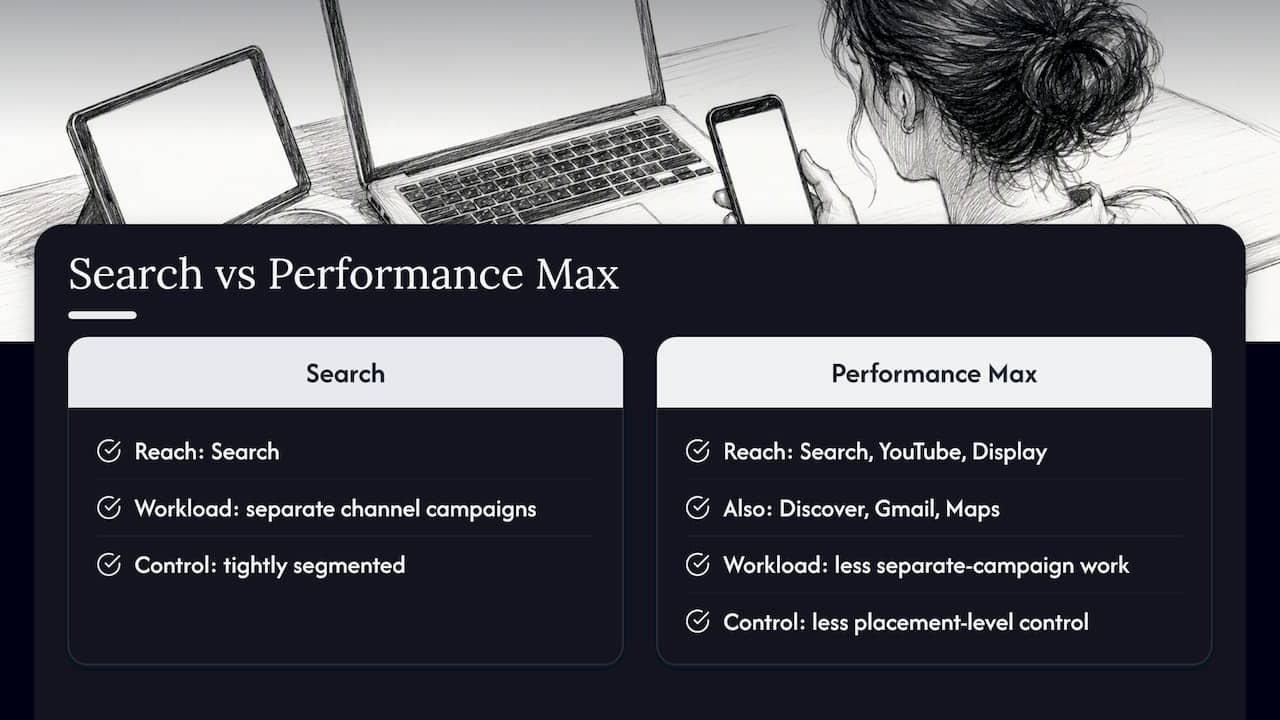
Think of it this way. A Search campaign is a sign on the exact street where someone is already looking for a plumber. Performance Max is a sign on that street plus a billboard on the highway, a spot before a video and a mention in an inbox, all placed by software that learns who tends to call. Software can only learn from what you tell it counts as a win.
Where it fits next to your other marketing
Performance Max sits on top of your foundation. It does not replace it.
- Your Google Business Profile still drives most of your map visibility. If it is incomplete, fix it first with our Google Business Profile audit checklist.
- Local SEO earns the clicks you do not pay for. Our guide to optimizing local search covers that groundwork.
- Search campaigns give you tight control over high-intent keywords. If you want to understand how that side is managed, see our overview of paid search ads management.
A reasonable order for most small businesses is a solid profile and website, then a controlled Search campaign, then Performance Max as a test of incremental demand.
Step 1: Build the measurement before you spend
Conversion tracking is required for Performance Max, and it is the highest-leverage setup step. Google’s own lead generation guidance says automation is only as good as its inputs: trustworthy conversion data, clear goals, strong assets and human review.
For a local service business, that means tracking each of these separately:
- Phone calls from the ad and from your website
- Form submissions
- Booked consultations or estimates
- Qualified opportunities
- Closed revenue
Track all of them, but bid toward only one. Google advises choosing a single funnel stage for the bidding strategy. Mixing site visits, raw leads and qualified leads under one target can send the system chasing the cheapest event. This explains the familiar pattern where cost per lead drops while real opportunities fall.
If your tracking setup is shaky, start with our walkthrough on lead conversion tracking.
Close the loop with offline conversions
Most Albuquerque service businesses close deals by phone, at the counter or through a sales rep. Google can’t see that unless you tell it. Google recommends importing offline conversions, including records that did not originate from Google Ads, so bidding learns what a valuable customer looks like.
For leads, enhanced conversions for leads improve matching. They use normalized, hashed first-party data such as email, phone and address, and Google recommends including the GCLID when available.
Before launch, agree on a written definition of a qualified lead. Is it a caller who describes a job you actually do, in an area you actually serve, with a budget that fits? Whoever updates the CRM needs to apply that definition the same way every time.
Step 2: Pick a bid strategy that matches your data
Standard Performance Max supports Maximize Conversions with an optional target CPA, and Maximize Conversion Value with an optional target ROAS. Google’s guidance on choosing between them is simple.
| Your situation | Bid strategy to start with |
|---|---|
| Lead volume is the goal and every lead is worth about the same | Maximize Conversions, no target CPA |
| You have reliable values for leads or sales | Maximize Conversion Value, optionally with a target ROAS |
| Little conversion history | Maximize Conversions, add a target CPA later |
Two cautions from Google deserve your attention:
- A target CPA set too low can limit delivery. It sounds efficient. In practice it can throttle impressions and conversions. When data is thin, begin without it.
- Value-based bidding needs data. Google recommends a conversion goal closest to a sale or closed deal, with at least 15 conversions in the last 30 days.
If your business is B2B and you are weighing which channels deserve lead budget, a practical playbook for B2B lead generation on LinkedIn is a useful companion read for deciding how much volume and value you can expect before choosing a goal.
Step 3: Structure asset groups around real services
Asset quality is a strategic lever, not an afterthought. Google’s lead generation best practices call for building asset groups around distinct services or customer problems. An HVAC company, for example, should not run furnace repair, AC installation and duct cleaning through one asset group. Each has a different customer, urgency and price.
For each asset group:
- Write strong, specific headlines and descriptions that name the service and the Albuquerque area you serve.
- Use authentic local imagery: your crew, your trucks, your storefront, your finished work. Stock photos of generic smiling people rarely earn trust.
- Add your logo and video where you have them.
- Send traffic to a landing page that matches the service, location, offer and conversion action in that asset group.
That last point is where many campaigns leak money. If the ad promises a same-week roof inspection in Albuquerque and the page is your generic homepage, the visitor leaves. Our piece on web design that builds credibility and grows leads explains what a converting service page needs.
About video
If you do not upload video, Performance Max may assemble one automatically from your other assets. A short, honest video you control is better. If filming is the obstacle, tools for conversion-focused user-generated-style video ads can help you produce short clips for YouTube placements. Review them the way you would any creative, and make sure they show real work you actually do.
Audience signals are hints, not fences
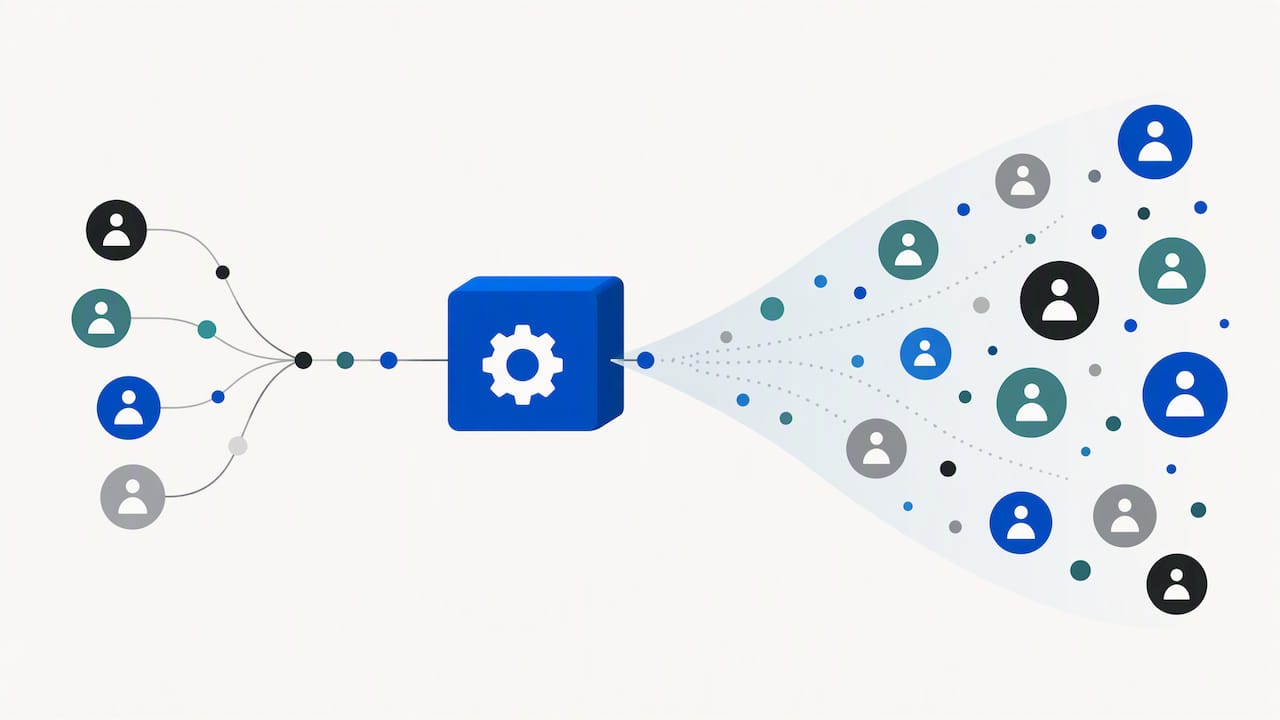
Audience signals point the system toward the people you already know convert, such as customer lists or past site visitors. They do not restrict who sees your ads. Treat them as a starting suggestion, and let results tell you where the automation found new demand.
Step 4: Set your Albuquerque service area carefully
Location settings are easy to get wrong. Decide where you can actually serve a customer profitably. For many Albuquerque businesses that means Bernalillo County and perhaps Rio Rancho, not the whole state. If you run a storefront, tighter is usually better. If you travel to jobs, map the area to your real drive times.
Then watch where the leads come from. Calls from outside your service area waste your staff’s time. Our guide to understanding local search ranking explains how proximity shapes who sees you, which helps you set realistic expectations for each neighborhood.
Step 5: Govern what the automation is doing
Handing the work to automation does not mean looking away. Google’s guidance points to several reports for ongoing review:
- Search terms insights to see what people searched, and to add irrelevant searches as negative keywords
- Asset-level reporting to see which headlines, images and videos carry the weight
- Placement reports and account-level placement exclusions to remove poor inventory
- Demand forecasts and bid-strategy reports to see where new demand is appearing
Cheap leads from broad inventory can look like success in platform reports while burning your sales capacity. Judge the campaign by qualified leads, booked jobs and revenue. Impressions, clicks and raw form volume are not the finish line.
Also note that standard Performance Max lead campaigns leave lead-quality control with you. Google’s credit system for spam, wrong numbers and duplicate callers applies to the pay-per-lead product, not to standard campaigns.
A simple review rhythm
- Weekly: check spend pacing, search terms and any spike in junk leads. Add negatives.
- Every two weeks: compare CRM outcomes with Google Ads conversions. Confirm uploads are flowing.
- Monthly: review asset-level reporting, refresh weak creative and check landing pages.
- Quarterly: revisit the goal, the bid strategy and the service area.
Give Smart Bidding time to learn. Changing targets every few days resets the picture and makes it impossible to tell what worked.
The new pay-per-lead option for local services
Google is moving Local Services Ads into Google Ads through Performance Max campaigns with pay-per-lead goals. Search Engine Land reports a phased rollout that began in August 2026.
According to Google’s pay-per-lead documentation, you are charged for valid customer connections instead of clicks. Ads appear on Search and Maps, and targeting uses your service categories and areas rather than keywords. You need at least one verified Google Business Profile, and availability depends on supported business categories and geography.
This is a different product from standard cross-channel Performance Max, so evaluate it separately. If you are a home-service or storefront business, check your Google Ads account for eligibility rather than assuming it. If you are a professional-service firm, availability is described as coming later in the rollout. Because a verified, accurate profile is a prerequisite, our guide to optimizing your Google Business Profile for visibility and leads is the right first step either way.
Is Performance Max worth it for a small business?
Sometimes. It is worth testing when:
- Conversion tracking is reliable and tied to a qualified-lead definition
- You have a conversion-focused landing page for each service
- Your budget and lead volume are big enough for automation to learn
- Your Search campaign and Business Profile are already in good shape
It is a poor fit when you have no tracking, a single catch-all page, or a budget so thin that the system gets only a handful of conversions a month. In that case, a focused Search campaign and better local SEO will do more for you. Our PPC management pricing guide can help you think through what a realistic budget looks like.
Our perspective: strategy first, automation second
We started King Digital because we were business owners ourselves, frustrated by big agencies that sent reports and little else. That shapes how we look at Performance Max.
The pitch for automation is seductive: one campaign, every channel, let the AI handle it. But the AI optimizes whatever you point it at. If you point it at form fills, it finds people who fill out forms. If you point it at booked jobs, it learns to find people who book. The strategy, meaning what counts as a good lead, which services deserve their own asset group and where you really want to work, is human work.
So we put measurement and offer clarity ahead of spend. We want clients to have direct communication, transparent numbers and full access to their own accounts, with no long-term lock-in. A campaign should be judged by whether the phone rings with the right people, and you should be able to see that for yourself.
— Bernadette
Get help building it right
If you would like a second set of eyes on your tracking, your campaign structure or your budget, our team manages paid search and related advertising for Albuquerque small and mid-sized businesses. We can also audit what you have running now and tell you plainly whether Performance Max belongs in your mix. Talk with King Digital about where to start.
FAQ
How does Performance Max work?
You choose a conversion goal, set a budget and supply assets such as text, images, logos and video. Google’s AI then decides where to show ads across Search, YouTube, Display, Discover, Gmail and Maps, and adjusts bids toward your goal. The quality of your conversion data and assets largely determines the results.
What is the best bid strategy to start with?
For most local lead campaigns, start with Maximize Conversions and no target CPA. Add a target once the account has usable history, since a target set too low can limit delivery. Move to Maximize Conversion Value when you have reliable lead or sales values and at least 15 conversions in the last 30 days.
Is $20 a day enough for Google Ads?
It can work for a tightly focused Search campaign in a small market, but it is thin for Performance Max, which needs conversion volume to learn. Google does not publish a minimum that guarantees results. Judge any budget by whether it produces enough qualified conversions for the system to optimize.
Can Performance Max replace my Search campaigns?
No, and we would not try. Search campaigns give you keyword-level control over high-intent queries, while Performance Max trades some of that control for reach. Treat it as a test of incremental demand next to a well-run Search campaign.
Does every Albuquerque business qualify for pay-per-lead Performance Max?
No. Google limits it to supported business categories and geographies, requires a verified Business Profile and is rolling it out in phases. Check eligibility inside your Google Ads account.
Sources
- About Performance Max campaigns, Google Ads Help
- Performance Max best practices for lead generation, Google Ads Help
- Performance Max, Google Ads API
- Get started with Performance Max, Google Ads API
- Manage offline conversions, Google Ads API
- Implement Enhanced Conversions for Leads, Google Ads API
- Local Services Ads transition to Performance Max campaigns with pay-per-lead goals, Google Ads Help
- About pay-per-lead goals for Performance Max campaigns, Google Ads Help
- Supported business verticals for pay-per-lead goals, Google Ads Help
- Local Services Ads come to Google Ads via Performance Max, Search Engine Land
Recommended
- PPC Management Albuquerque: 7 Powerful Success Tips 2025
- How to Boost Local Visibility for Albuquerque SMBs
- Boost your local SEO with expert best practices in 2026
- Local Search Intent Optimization for Albuquerque Businesses
