TL;DR:
- Google is actively rewriting 76% of title tags in Q1 2025, which can diminish your local visibility and click-through rates. Crafting accurate, locally relevant, and rewrite-safe titles aligned with your page content helps prevent unwanted rewrites and attracts Albuquerque customers. Regularly auditing and updating your title tags based on performance data ensures sustained SEO effectiveness and lead generation.
Google is quietly overwriting your hard work. Google changed 76% of title tags in Q1 2025, keeping only 35% of original words when it made changes, which means the headline you spent time crafting may never actually appear in front of Albuquerque customers. For small and medium-sized business owners, this is not a minor technical glitch. It is a direct threat to your click-through rates (CTR), local visibility, and lead pipeline. The good news is that understanding exactly how Google rewrites titles, and designing around it, gives you a real competitive edge right here in the Albuquerque market.
Table of Contents
- What is a title tag and why does it matter for SEO?
- Why title tag optimization is more crucial than ever
- How to craft title tags that Google (and locals) keep
- Common pitfalls and edge cases: Avoiding rewrites and lost clicks
- Optimize, monitor, and adapt: Building an ongoing title tag strategy
- Why most title tag guides miss the mark and what actually works in Albuquerque
- Let Albuquerque experts help you optimize and grow
- Frequently asked questions
Key Takeaways
| Point | Details |
|---|---|
| Title tags affect clicks | Optimizing your title tags directly impacts how many people click through from search results. |
| Google often rewrites tags | Align your tags closely with page content and intent to minimize rewrite risk. |
| Local keywords boost leads | Including service and location keywords in your tags increases your visibility to local searchers. |
| Short, accurate titles win | Keep titles concise—50-60 characters—and accurately matched to the page to avoid truncation and rewrites. |
| Ongoing monitoring is essential | Regularly use tools like Search Console to track performance and update title tags as needed. |
What is a title tag and why does it matter for SEO?
A title tag is a short HTML element that tells both search engines and users what a web page is about. You see it every day without thinking about it: it is the blue clickable headline that appears in Google search results. It is also the text that shows up in your browser tab.
“Title tags are the clickable headline shown in search results, helping both users and search engines understand what a page is about, making them a core on-page SEO lever for relevance and CTR.”
Here is why this matters so much for your Albuquerque business:
- Search relevance: Google reads your title tag to understand what your page covers and decides when to show it to searchers.
- User decision-making: A well-written title compels the right customer to click. A vague or cluttered title sends them to your competitor.
- Local intent: When a searcher types “plumber in Albuquerque” or “best HVAC service near me,” a title tag with those exact signals dramatically improves your chances of ranking and getting clicked.
- First impression: Your title tag is often the very first line of text a potential customer reads about your business.
Strong local marketing SEO starts at the title tag level. If your titles are generic, misaligned with what is on the page, or missing Albuquerque-specific signals, you are leaving qualified leads on the table every single day. This is the foundation, and getting it right pays dividends across every page on your site. Just like businesses invest in tools to optimize ad campaigns for better returns, your title tags deserve that same strategic attention.
With the basics clarified, let’s examine why optimizing title tags matters more than ever in 2026.
Why title tag optimization is more crucial than ever
The rules of the game have shifted. Google is no longer passively reading your title tags. It is actively evaluating them and rewriting them when it decides your version does not match the page well enough.
76% of title tags were rewritten by Google in Q1 2025. That is not a glitch. That is a signal.
When Google rewrites your title tags, it pulls language from your page headings, body content, and even anchor text from links pointing to your page. The result? A title you did not write, may not love, and possibly one that waters down your local Albuquerque keyword signals.
Here is a quick comparison of what this looks like in practice:
| Scenario | Your original title | Google’s rewritten version |
|---|---|---|
| Misaligned with H1 | "Affordable Prices | Best NM Service Co." |
| Too long (over 60 chars) | “Top Rated Plumbing Repair and Installation Services in Albuquerque, NM 87102” | “Plumbing Services in Albuquerque” |
| Well-aligned and concise | "Albuquerque Plumber | Fast Repairs & Installs" |
| Generic, no local signal | “Our Services Page” | "Services |
The impact is measurable. Title tag changes directly affect click behavior, and when a rewritten title better matches local searcher intent, you can gain clicks even before you see any ranking shifts. That means you could be losing clicks right now simply because your current titles are triggering rewrites.
Pro Tip: Run a quick check in Google Search Console. Go to “Search Results” and compare the page titles you set versus how Google actually displays them in search. If they differ, you have a prioritization opportunity.
Our team regularly conducts SEO audits for Albuquerque businesses and consistently finds title tag misalignment as one of the top issues holding local companies back from the clicks and leads they deserve.

Now, let’s demystify how to craft titles that minimize rewriting and actually drive more clicks.
How to craft title tags that Google (and locals) keep
The goal is not to outsmart Google. The goal is to give Google a title so accurate, clear, and locally relevant that it has no reason to change it. Here is a step-by-step approach built specifically for Albuquerque SMBs.
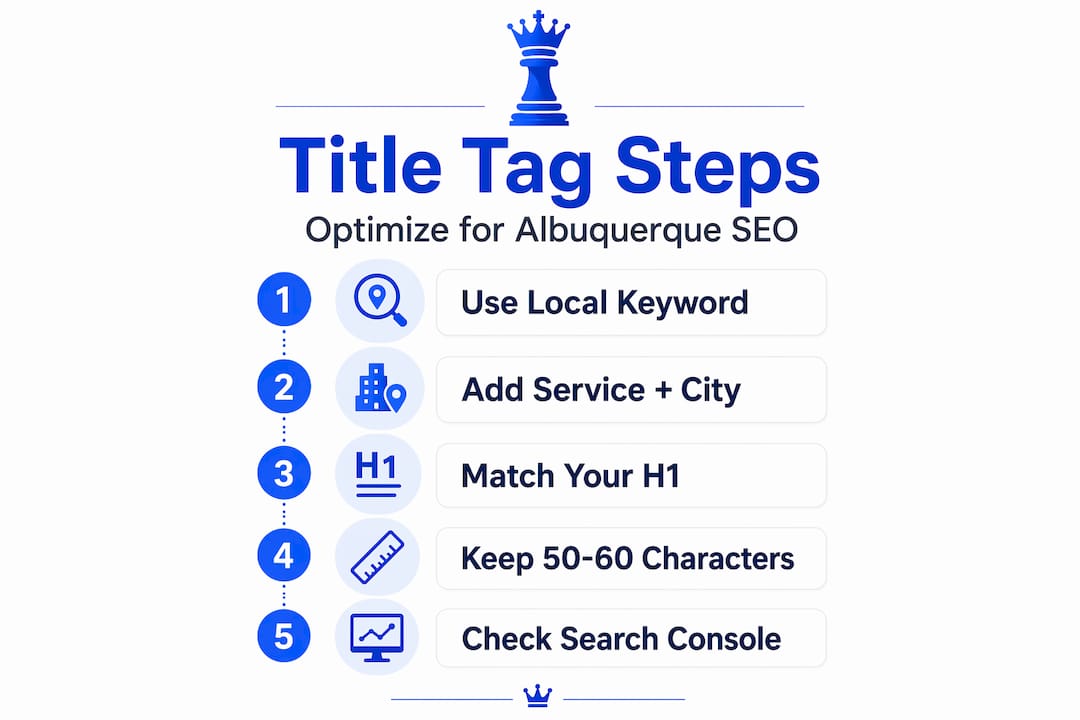
Step 1: Use a proven local title tag template
Start with a structure that front-loads your primary keyword and includes your location. A solid formula looks like this:
Primary Service + Location | Brand Name
For example: “Roof Repair Albuquerque | ABC Roofing Co.”
Step 2: Align your title with your H1 heading
Your page’s main heading (H1) and your title tag should tell the same story. They do not need to be identical, but they must be consistent. If your H1 says “Expert HVAC Repairs in Albuquerque” and your title tag says “Affordable Heating Solutions NM,” Google sees a mismatch and rewrites.
Step 3: Keep it between 50 and 60 characters
Anything over 60 characters risks truncation in search results. Anything under 30 characters wastes prime real estate. Count every character, including spaces. There are free tools online to check this in seconds.
Step 4: Match user search intent
Ask yourself what your ideal Albuquerque customer types into Google when they need your service. That phrase should appear naturally in your title. As Search Engine Land’s title tag guide confirms, the better your original title matches the page’s content and intent, the more likely Google is to keep your wording.
Step 5: Write a before-and-after comparison
| Version | Title tag | Character count | Issues |
|---|---|---|---|
| Before | “Welcome to Joe’s Plumbing Services in the Greater Albuquerque New Mexico Area!” | 78 | Too long, no clear keyword priority |
| After | "Albuquerque Plumber | Fast Repairs | Joe’s Plumbing" |
Consistent affordable local SEO practices like this compound over time. You do not need a massive budget. You need precision and consistency. Pairing this with thoughtful crafting of local content across your pages makes your site far more cohesive in Google’s eyes. Just as businesses use proven frameworks to boost efficiency with templates, applying a reliable title tag structure removes guesswork and speeds up the entire optimization process.
Pro Tip: Use your H1 as a reference anchor every time you write a title tag. If the two are not telling the same story, rewrite one of them before you publish.
Having learned how to craft titles, let’s tackle the common mistakes and edge cases that can undermine your efforts.
Common pitfalls and edge cases: Avoiding rewrites and lost clicks
Even business owners who understand title tags make these mistakes. Knowing what to avoid is just as important as knowing what to do.
The most common title tag mistakes we see in Albuquerque:
- Content mismatch: Your title promises one thing, but the page delivers another. This is the number one trigger for Google rewrites. If your title says “Albuquerque Landscaping Services” but the page is actually about a single product, Google will rewrite it. Avoid mismatches between title tags and visible headings to stay in control of your snippet.
- Oversized titles: Going past 60 characters means truncation in search results, which means customers see an incomplete, confusing headline. Google often steps in to fix this, and its version may not include your most important keywords.
- Undersized titles: A title under 30 characters tells Google almost nothing about the page and signals a missed optimization opportunity.
- Missing local signals: This one hurts Albuquerque businesses the most. If your title tag does not mention Albuquerque, NM, or a specific neighborhood, you are invisible to location-specific searches. “Plumbing Services” competes nationally. “Plumbing Services Albuquerque” competes locally and wins more often.
- Keyword stuffing: Titles crammed with multiple keywords look spammy to both Google and users. “Best Cheap Affordable Albuquerque Plumber Pipe Repair Service NM” will be rewritten, flagged, or ignored.
- Using the same title tag on multiple pages: Every page on your site serves a different purpose. Each title tag must be unique. Duplicate titles confuse search engines and dilute your relevance.
Expanding your local marketing expertise means staying on top of these details. Small missteps compound quickly, and what looks like a minor oversight can quietly drain your CTR month after month. Strong brand visibility strategies always start with the fundamentals, and title tags are exactly that.
Pro Tip: Open Google Search Console and sort your pages by impressions. Look at the pages with high impressions but low CTR. That mismatch almost always points to a weak or misaligned title tag.
Now let’s bring it all together with a practical action plan and ongoing monitoring approach.
Optimize, monitor, and adapt: Building an ongoing title tag strategy
Title tag optimization is not a one-time task. Google’s algorithm evolves, user search behavior shifts, and your local Albuquerque market changes throughout the year. Treating title tags as a living, breathing part of your SEO strategy is what separates businesses that grow steadily from those that plateau.
Here is a repeatable process you can follow:
- Audit all existing title tags. Start with your top 20 highest-traffic pages. Check them against the template and best practices outlined above. Note which ones Google is already rewriting.
- Prioritize rewrites by business value. Fix your highest-revenue service pages first. A rewritten title on your main “Albuquerque HVAC Repair” page costs you more than one on a blog post.
- Set a 90-day review cycle. Return to Search Console every three months and check CTR trends for pages where you updated title tags. Look for patterns.
- Iterate based on CTR data. If a page has strong impressions but low CTR, test a new title with a different angle. Try adding urgency, a benefit, or a more specific local reference.
- Monitor local trends and seasonal search patterns. Albuquerque businesses see distinct seasonal peaks. A roofing company might update titles ahead of monsoon season. A restaurant might adjust for Balloon Fiesta traffic in October.
- Stay rewrite-safe, not rewrite-proof. As practitioners increasingly recognize, the smarter goal is “rewrite-safe alignment,” meaning accurate, specific, intent-matched titles, then validate via Search Console impressions and CTR, then iterate.
Revisiting your SEO audits in Albuquerque regularly ensures your title tags stay aligned with both Google’s expectations and your customers’ evolving search habits.
Pro Tip: Every time Google updates its algorithm, check your highest-impression pages in Search Console within two weeks. Algorithm shifts often coincide with increased title rewriting activity.
With the practical recommendations above, let’s reflect on what most guides miss and how Albuquerque SMBs can truly stand out.
Why most title tag guides miss the mark and what actually works in Albuquerque
Here is an uncomfortable truth most SEO content will not tell you. Chasing the “perfect” title tag is a losing strategy. Google changed more than three quarters of title tags last quarter alone. No amount of perfectionism protects you from that.
What actually works is a shift in mindset. Stop trying to write the ideal title and start writing the rewrite-safe title. That means your title should be so accurate, so aligned with your page content and headings, and so clearly matched to what an Albuquerque customer is actually searching for that Google looks at it and decides rewriting would not improve anything.
We have seen this play out with local clients here in Albuquerque. Businesses that obsessed over keyword density in their titles but ignored alignment with their page headings kept getting rewritten. The businesses that matched their title to their H1, used plain language that matched real search queries, and included a clear local signal? Google kept their titles far more often, and their CTR climbed as a result.
The other piece that most guides skip entirely is the emotional connection of local content that connects with Albuquerque readers. A title tag that references a specific Albuquerque neighborhood, a local event, or a regional need does not just signal relevance to Google. It signals familiarity to the person searching. That familiarity builds trust before the customer even reaches your site.
My take? The businesses that will dominate Albuquerque local search in the next 12 months are not the ones with the biggest budgets. They are the ones who treat title tags as a precision tool rather than an afterthought, iterate based on real data, and stay genuinely aligned with what their local customers are actually searching for.
Let Albuquerque experts help you optimize and grow
Title tag optimization is one of the highest-leverage moves you can make for your local SEO, and you do not have to figure it out alone.
At King Digital, we help Albuquerque small and medium-sized businesses cut through the noise and build search strategies that actually generate leads. From deep Albuquerque SEO trends analysis to hands-on implementation, our in-house team handles the details so you can focus on running your business. Whether you need to improve your search ranking across key service pages or want a fully integrated SEO and website strategy, we build customized solutions that match your goals and your budget. Ready to stop losing clicks to rewritten title tags? Let’s talk.
Frequently asked questions
How often does Google rewrite website title tags?
Google changed 76% of title tags in Q1 2025, keeping only about 35% of original words when changes occur, making rewrite-safe alignment a top priority for any local SEO strategy.
What is the ideal length for a title tag to avoid truncation?
Aim for 50 to 60 characters so your title tag displays fully in search results, since overly long titles significantly increase the likelihood of Google rewriting or cutting off your headline.
Should I include my city and service keyword in every title tag?
Yes, including your primary service and city name directly targets local search intent and improves relevance for Albuquerque customers who are actively looking for nearby solutions, giving you a measurable advantage over generic competitors.
Can changing a title tag raise my website’s click-through rates?
Absolutely. Title tag changes affect click behavior directly, and a well-optimized title that matches local searcher intent can lift your CTR even before any ranking improvements occur.
What tools can help monitor and optimize title tag performance?
Google Search Console is the most reliable tool for tracking impressions and CTR by page, and practitioners validate their title tag updates by checking this data regularly and iterating based on what the numbers reveal.
Recommended
- Boost leads in Albuquerque: on-page SEO best practices
- SEO content creation guide for Albuquerque local leads
- Top Website Design Tips to Boost Albuquerque Service Businesses
- Website content optimization steps for Albuquerque SMBs
