Why Small Businesses Can’t Survive Without Going Digital

Digital marketing for small businesses isn’t just nice to have anymore—it’s literally the difference between thriving and closing your doors. Here’s what you need to know:
Essential Digital Marketing Channels for Small Businesses: • SEO & Google Business Profile – Get found when customers search “near me” • Social Media Marketing – Connect with customers where they spend their time • Email Marketing – Nurture leads and keep customers coming back • Content Marketing – Show expertise and build trust • Online Reviews – Build credibility and social proof • Paid Advertising – Get immediate visibility with targeted ads
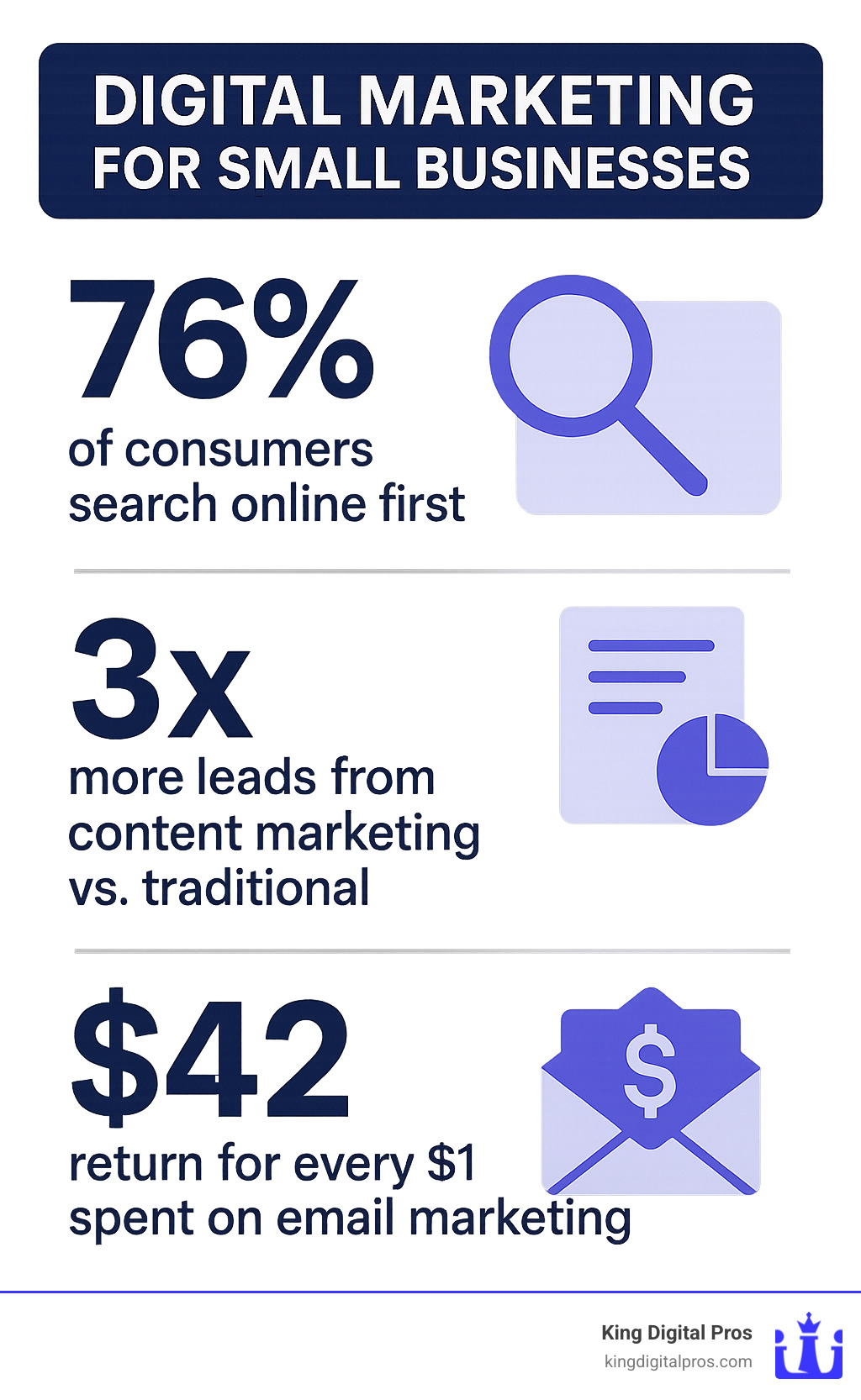
The numbers don’t lie. 76% of consumers look for a company online before visiting a store, and 45% are likely to visit after finding a strong online presence. Meanwhile, 20% of businesses fail in their first year, and 50% don’t make it past year five.
But here’s the thing—most small business owners feel completely lost when it comes to digital marketing. You’re juggling a million things already, and now you’re supposed to become an expert in SEO, social media, and Google Ads too?
You don’t need to become an expert overnight. You just need to understand the basics and focus on what actually moves the needle for your business.
I’m Bernadette King, and I’ve spent years helping small businesses cut through the digital marketing noise to find strategies that actually work. Through my agency King Digital Marketing Agency, I’ve seen how the right digital marketing for small businesses approach can transform a struggling local shop into a thriving operation.
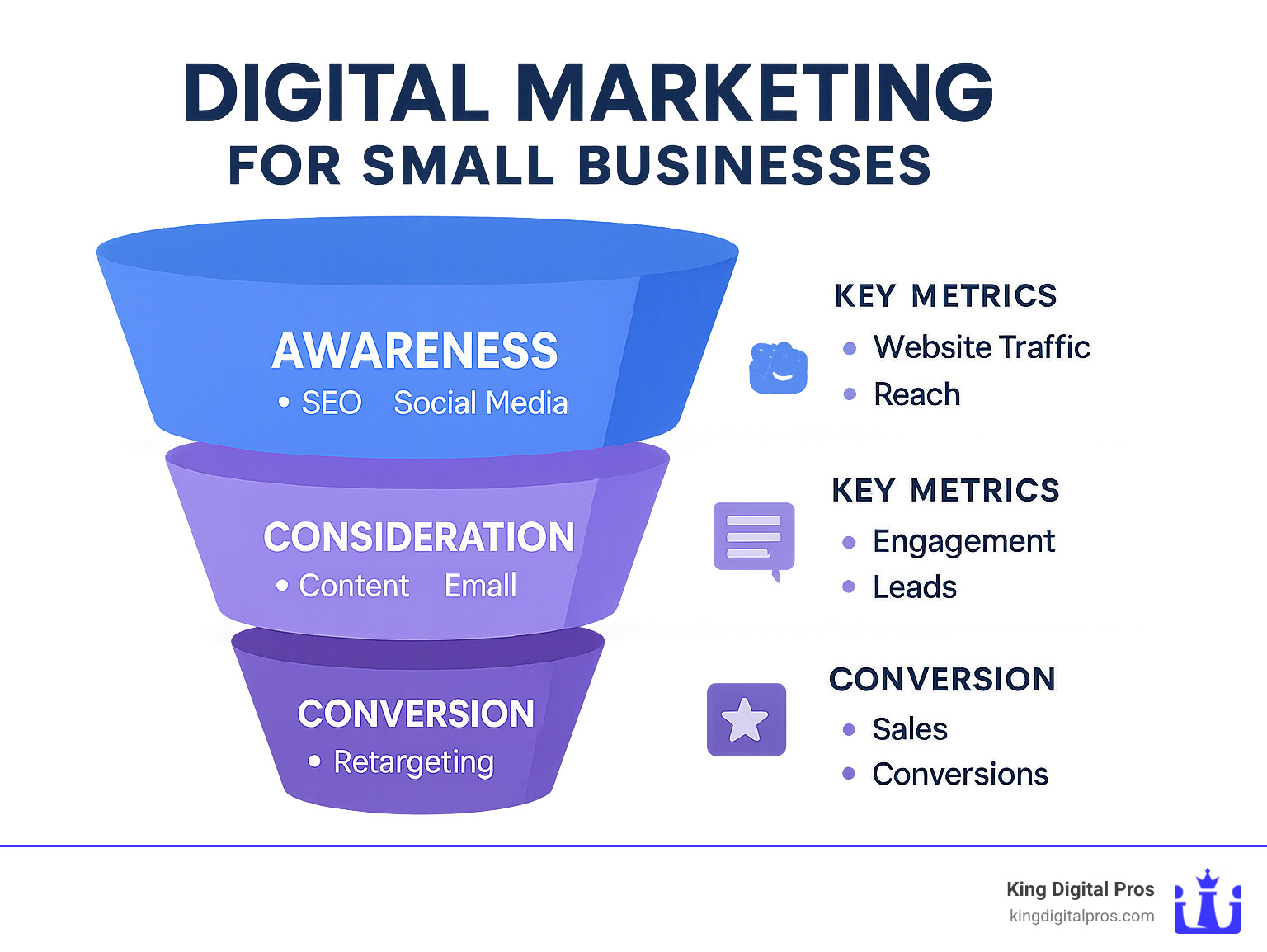
Digital Marketing for Small Businesses: Core Concepts
Think of digital marketing for small businesses as your modern-day storefront that never closes. It’s using online channels—your website, search engines, social media, and email—to connect with customers where they’re already spending their time.
But here’s what makes it so much more powerful than the traditional marketing you might be used to.
Cost-effectiveness is probably the biggest game-changer. Remember when a single newspaper ad could cost you hundreds of dollars, and you’d have no idea if anyone even glanced at it? With digital marketing, you can run targeted Facebook ads for just $5 a day and reach exactly the people who are most likely to become your customers.
The real-time tracking capabilities will blow your mind once you start using them. Instead of wondering if your marketing dollars are working, you’ll know exactly how many people saw your ad, clicked on it, visited your website, and made a purchase. It’s like having a crystal ball for your business.
You also get to choose between global and local reach depending on what makes sense for your business. A local bakery can focus on attracting nearby customers while also shipping specialty cakes nationwide. The choice is yours, and you can adjust your strategy anytime.
Hyper-targeting means you’re not wasting money showing your ads to people who’ll never buy from you. You can create different messages for first-time visitors versus loyal customers, or target people based on their interests, location, and buying behavior.
| Traditional Marketing | Digital Marketing |
|---|---|
| High upfront costs | Start with $5/day |
| Limited targeting | Precise audience targeting |
| Hard to measure ROI | Real-time analytics |
| One-size-fits-all messaging | Personalized content |
| Local reach only | Local to global scale |
| Static campaigns | Easy to adjust and optimize |
Why Digital Marketing for Small Businesses Beats Traditional Ads
Your customers’ behavior has completely changed, and your marketing needs to change with it. Over 5 billion people now use social media, and they’re not just scrolling for entertainment—they’re researching products, reading reviews, and making purchasing decisions.
Here’s the reality: when someone needs a plumber or wants to try a new restaurant, they don’t flip through phone books anymore. They grab their phone and search “plumber near me” or check Google Maps for restaurants with great reviews.
The statistic that should make every business owner pay attention? 76% of consumers look for a company online before visiting a store. If you’re not online, you’re literally invisible to three-quarters of your potential customers.
Digital marketing’s hyper-targeting capabilities are like having a superpower compared to traditional advertising. Instead of paying to show your plumbing ad to everyone reading the local newspaper (including renters who can’t hire you), you can target homeowners in your service area who’ve recently searched for home improvement services.
The measurability factor eliminates all the guesswork. You’ll know exactly which Google search, Facebook post, or email campaign brought each customer to your business. No more asking “How did you hear about us?” and getting shrugs in response.
Common Pitfalls in Digital Marketing for Small Businesses
Before we get into the fun stuff, let’s talk about the mistakes that can sabotage your efforts—because I’ve seen too many good businesses make these errors.
Overstretching across too many channels is the biggest trap. I’ve watched businesses try to maintain a presence on Facebook, Instagram, TikTok, LinkedIn, Twitter, Pinterest, and YouTube all at once. They end up posting mediocre content everywhere instead of creating amazing content on the 2-3 platforms where their customers actually spend time.
Inconsistent branding confuses potential customers and hurts your credibility. When your website says you’re open until 9 PM, but your Google Business Profile says 6 PM, and your Facebook page hasn’t been updated in six months, people notice. They start wondering if you’re still in business or if you pay attention to details.
Ignoring analytics is like driving blindfolded. You might eventually reach a destination, but it probably won’t be where you wanted to go. Your digital marketing platforms are giving you incredibly valuable data about what’s working and what isn’t—use it.
Spammy tactics might seem like shortcuts, but they’re actually express lanes to damaging your reputation. Buying fake followers, stuffing your website with keywords that don’t make sense, or sending emails to people who never asked for them will get you penalized by search engines and social platforms. Plus, real customers can spot fake engagement from a mile away.
Budget-Friendly Channels & Action Plans
Here’s what I love about digital marketing for small businesses—you don’t need a Fortune 500 budget to see real results. According to the U.S. Small Business Administration, marketing budgets should be 9-12% of your gross revenue, but honestly? You can start seeing customers walk through your door with much less than that.
Think of it like learning to cook. You don’t start by making a five-course meal—you master scrambled eggs first, then work your way up. The same principle applies here.
Your Google Business Profile should be your first priority because it’s completely free and can dramatically increase your local visibility overnight. Next comes basic SEO work—mostly free but with huge long-term payoffs. Then email marketing delivers incredible ROI for just a few dollars a month. Social media gives you free organic reach, and you can boost the best posts with small paid budgets.
Online reviews cost nothing but time and systems, while content marketing requires mostly time investment but builds serious authority. Finally, paid advertising lets you test what works before scaling up.
Latest research on small-business online growth shows something fascinating: businesses that master online marketing and e-commerce earn twice as much per employee as those that don’t. That’s not just a small advantage—that’s changeal.
SEO Foundations That Pay Off Fast
Search Engine Optimization might sound intimidating, but it’s really just helping search engines understand what your business does and where you do it. The beautiful thing about SEO? Once you rank well, you get qualified traffic for months or years without paying for each click.
Keyword research is where everything starts. Don’t guess what your customers are searching for—use free tools like Google Keyword Planner to find out. I’ve seen restaurants assume people search for “fine dining” when they’re actually typing “best restaurants near me” or “family restaurants in Albuquerque.” Those small differences can make or break your visibility.
On-page optimization sounds technical, but it’s really just making sure your website clearly tells visitors and search engines what you do and where you’re located. If you’re a plumber in Los Alamos, your homepage title should say something like “Los Alamos Plumber | Emergency Plumbing Services | [Your Business Name].” Simple, clear, and exactly what people are searching for.
Here’s where most small businesses are missing out: Google Business Profile optimization. This is absolutely critical for local businesses, yet so many profiles are incomplete or outdated. Claim your profile, fill out every single section, add high-quality photos, post regular updates, and actively encourage reviews.
At King Digital Marketing Agency, we’ve seen businesses increase their local visibility by 300% just by properly optimizing their Google Business Profile. It sounds too good to be true, but the results speak for themselves. More info about SEO services
Local SEO becomes your secret weapon when you include your city and neighborhood naturally in your website content, get listed in local directories, create location-specific pages if you serve multiple areas, and use schema markup to help search engines understand exactly what your business offers.
Social Media & Content on a Shoestring
The biggest mistake I see small business owners make with social media? Trying to be everywhere at once. You don’t need a social media manager or expensive video equipment—you need strategy and consistency.
Pick your battles wisely. Choose 1-2 platforms where your actual customers spend their time. Facebook works beautifully for local businesses and tends to reach older demographics (35+). Instagram shines for visual businesses and younger audiences who love behind-the-scenes content. LinkedIn serves B2B services and professional networking perfectly. TikTok reaches very young demographics and works well for creative or entertainment-focused businesses.
Content that works without breaking the bank includes behind-the-scenes videos showing how you make your product or deliver your service, customer spotlights featuring happy clients (with their permission, of course), quick tips sharing valuable industry advice, and user-generated content where you encourage customers to post photos using your product or service.
Here’s the secret to social media success that most people miss: consistency beats perfection every single time. It’s better to post three quality pieces of content per week for months than to post ten times one week and then disappear for a month.
Free scheduling tools like Buffer or Facebook Creator Studio let you batch your content creation and schedule posts in advance, making consistency much easier to maintain.
Email, Reviews & Reputation Goldmine
Email marketing delivers an average ROI of $42 for every $1 spent, making it one of the highest-return activities in digital marketing for small businesses. Yet so many business owners either ignore it completely or do it poorly.
Building your email list starts with offering value. Give people a compelling reason to share their email address—a discount, free guide, exclusive tips, or early access to sales. Add signup forms to your website, social media profiles, and even use QR codes in your physical location.
Never, ever buy email lists. They’re ineffective, often illegal, and can get your business blacklisted from email platforms.
Smart segmentation makes your emails more effective. Don’t send the same message to everyone. Create different segments for new customers versus returning customers, different product or service interests, various locations (especially if you serve multiple areas), and purchase history.
Review management can transform your business reputation. Here’s a sobering fact: 96% of consumers read reviews, and 60% require a 4+ star rating before they’ll even consider your business.
Building a review generation system means asking every satisfied customer for a review through in-person requests, follow-up emails, or QR codes that link directly to your review pages. Make it as easy as possible by providing direct links to your Google, Yelp, or Facebook review pages.
Respond to every review—positive and negative—within 48 hours. Use negative reviews as opportunities to demonstrate excellent customer service publicly.
We help businesses throughout New Mexico build systematic review generation processes that consistently attract positive reviews and properly manage their online reputation. More info about Reputation services

Paid Ads & Influencers Without Breaking the Bank
Paid advertising can deliver immediate results, but you need to approach it strategically rather than throwing money at every platform and hoping something sticks.
Start small with daily budgets of just $5-10 per day on one platform. Test different audiences, ad copy, and images to see what actually converts before scaling up your investment.
Geo-targeting becomes your best friend for local businesses. Don’t waste money showing ads to people in other states or countries. Target within a specific radius of your location—maybe 15 miles for a restaurant, 50 miles for a specialized service that people will travel for.
Nano-influencers with 1,000-10,000 followers often deliver better results than mega-influencers for small businesses. They typically have higher engagement rates, more authentic connections with their audience, and charge significantly less. A local fitness trainer with 5,000 engaged followers might charge $100 to promote your gym while delivering better results than a celebrity with millions of disengaged followers.
Creative testing helps you avoid expensive mistakes. Create 3-4 different ad versions with different images, headlines, or calls-to-action. Let them run for a week, analyze the results, then put more budget behind the clear winners while pausing the underperformers.
Optimize, Measure, and Iterate
Here’s the truth about digital marketing for small businesses: the magic doesn’t happen when you launch your first campaign or post your first social media update. It happens when you start paying attention to what’s working and doubling down on those wins.
Think of your digital marketing like tending a garden. You plant seeds (launch campaigns), water them (invest time and money), but then you need to watch what grows and what doesn’t. The businesses that thrive are the ones constantly tweaking, testing, and improving based on real data—not gut feelings.
Turn Your Site into a 24/7 Salesperson
Your website needs to work harder than your best employee—because it never takes a lunch break or calls in sick. When someone lands on your site at 2 AM looking for your services, that website better be ready to convert them into a customer.
Mobile speed is absolutely critical. We live in an impatient world where 53% of mobile users will abandon your site if it takes longer than 3 seconds to load. That’s faster than it takes to tie your shoes. Use Google’s PageSpeed Insights tool to check how fast your site loads and get specific recommendations for improvement.
Every page on your website should have clear calls-to-action that tell visitors exactly what to do next. Don’t make people guess whether they should call, email, or fill out a form. Use big, bright buttons with action words like “Call Now,” “Schedule Appointment,” “Get Your Free Quote,” or “Order Online.” Make it so obvious that even someone browsing on their phone while walking their dog knows what to do.
Trust signals are what separate legitimate businesses from sketchy ones in your customers’ minds. Include customer testimonials with real names and photos, display any security badges or certifications, make your contact information easy to find, and use professional photos of your team and location. People need to trust you before they’ll hand over their credit card or invite you into their home.
Schema markup might sound technical, but it’s basically a way to help search engines understand your business better. When implemented correctly, it can make your search listings show star ratings, business hours, and other helpful details that make people more likely to click on your result.
At King Digital Marketing Agency, we’ve seen businesses increase their website conversion rates by 40% just by fixing these fundamental issues. More info about Conversion Optimization
Metrics & Tools Every Owner Should Track
You don’t need to become a spreadsheet wizard, but you absolutely need to track a few key numbers that tell you whether your digital marketing for small businesses efforts are paying off.
Traffic sources tell you where your visitors are coming from—Google search, Facebook, email campaigns, or people typing your website directly into their browser. This information is gold because it shows you which marketing activities are actually working. If you’re spending hours on Instagram but getting zero traffic from it, maybe it’s time to focus on the channels that are delivering.
Cost per lead is simple math that can save you thousands of dollars. If it costs you $50 in advertising to get one potential customer to contact you, and your average customer is worth $500, that’s a fantastic return. But if it’s costing you $200 to get a lead for a $100 service, you need to fix something fast.
Return on ad spend should be at least 3:1—meaning for every dollar you spend on advertising, you should generate at least three dollars in revenue. Anything less than that and you’re probably better off putting that money in a savings account.
You can track all of this with free tools that are probably already available to you. Google Analytics shows you website traffic and visitor behavior, Google Search Console reveals how you’re performing in search results, and your social media platforms have built-in insights showing which posts are getting engagement.
UTM tags sound fancy but they’re just special codes you add to links that help you track exactly which campaigns are driving traffic and sales. When you share a link on Facebook or in an email newsletter, adding UTM parameters lets you see its performance in Google Analytics. It’s like putting a tracking device on each of your marketing efforts.
Stop These Mistakes Before They Drain Your Budget
Some mistakes in digital marketing are expensive lessons you don’t need to learn the hard way. Keyword stuffing—cramming your target keywords into every sentence—makes your content sound like it was written by a robot having a bad day. Write naturally for humans first, and search engines will reward you for it.
Buying followers is like buying a fancy sports car with no engine. Those fake followers look impressive on paper, but they’ll never buy anything from you. It’s much better to have 500 engaged followers who actually care about your business than 5,000 fake accounts from halfway around the world.
Set-and-forget advertising is a budget killer. Your ads need attention at least once a week. Check which ones are performing well and increase their budgets, then pause the ones that are eating money without delivering results. Think of it like tending a campfire—you need to keep feeding the flames that are burning bright and stop wasting wood on the ones that won’t catch.
Finally, ignoring mobile users in 2024 is like opening a store but keeping the front door locked. Over 60% of searches happen on mobile devices, so if your website looks terrible on a phone or tablet, you’re literally turning away more than half of your potential customers.
The beauty of digital marketing is that everything is measurable and adjustable. Unlike traditional advertising where you’re mostly guessing, you can see exactly what’s working and make smart decisions based on real data. That’s the power that levels the playing field between small businesses and big corporations.
Future-Proofing: Trends Small Businesses Must Watch
The digital landscape changes fast, but some trends are worth paying attention to:
AI & Automation for Digital Marketing for Small Businesses
AI tools are making sophisticated marketing accessible to small businesses:
Chatbots: Handle basic customer questions 24/7, schedule appointments, and qualify leads while you sleep.
Content Generators: Tools like ChatGPT can help you brainstorm blog topics, write social media captions, and create email subject lines.
Predictive Analytics: Some platforms can predict which customers are most likely to buy or churn, helping you focus your efforts.
The key is starting simple. Don’t try to automate everything at once—pick one area where automation can save you time or improve customer experience.
Local Search, QR, and “Near Me” Dominance
“Near me” searches have grown over 200% in recent years. People want immediate, local solutions.
Google Business Profile Updates: Google keeps adding features like appointment booking, product catalogs, and messaging. Stay current with these features to maintain your competitive edge.
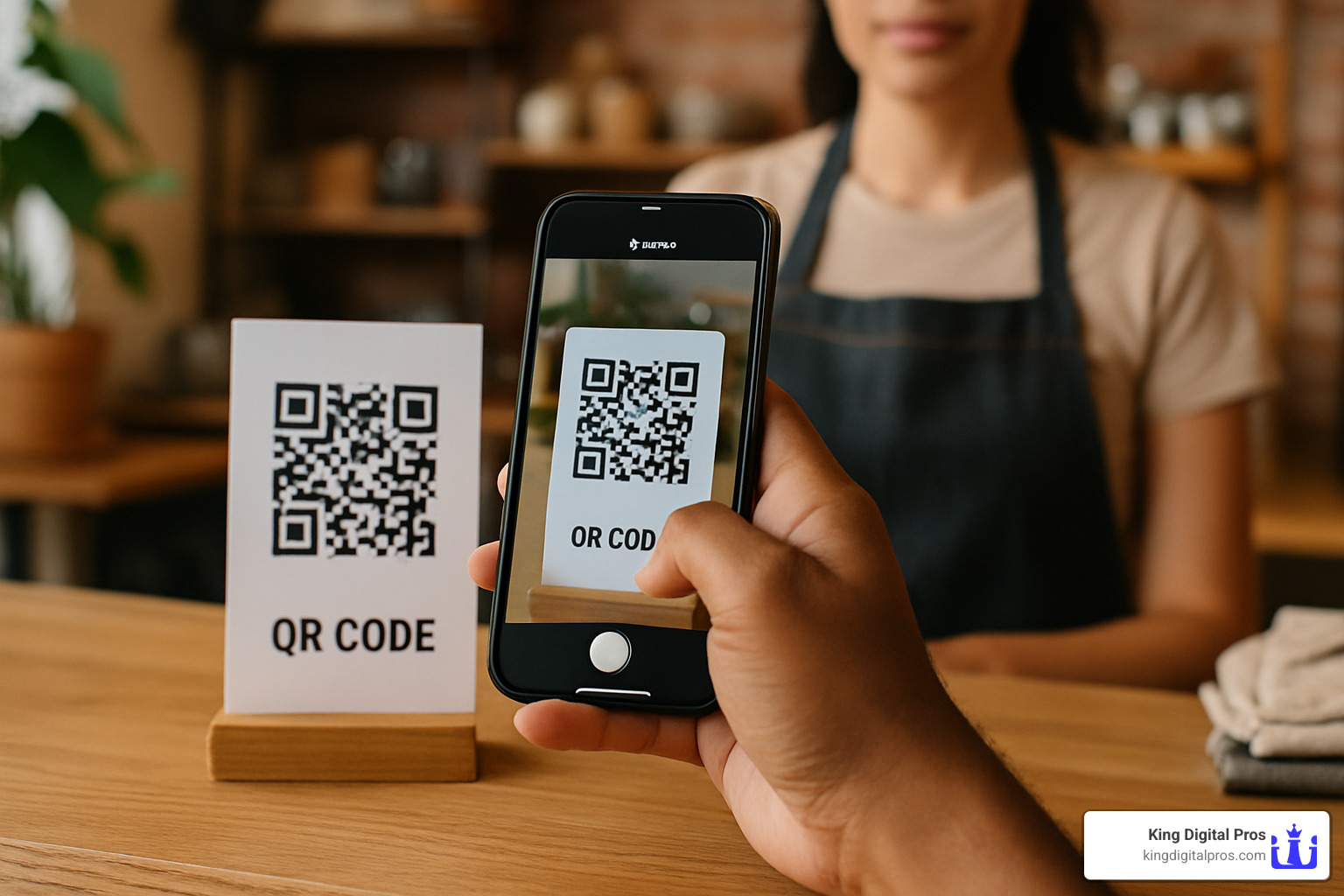
Dynamic QR Campaigns: QR codes aren’t just for menus anymore. Use them to collect customer emails, drive social media follows, or share special offers. Scientific research on AI productivity shows QR codes can significantly boost engagement when used strategically.
Hyper-Local Keywords: Optimize for neighborhood-level searches. Instead of just “Albuquerque restaurant,” target “Nob Hill restaurant” or “Old Town dining.”
Frequently Asked Questions about Digital Marketing for Small Businesses
Let’s tackle the questions I hear most often from small business owners who are ready to dive into digital marketing for small businesses but aren’t sure where to start.
How much should I budget for digital marketing?
Here’s the honest answer: you don’t need to break the bank to get started. The U.S. Small Business Administration suggests 9-12% of gross revenue for marketing, but that includes all marketing—not just digital.
For digital marketing specifically, here’s what actually works in the real world:
If you’re just starting out, $200-500 per month can make a real difference. That might sound like a lot, but remember—you’re probably already spending money on marketing that isn’t working as well as it could be.
When your business is growing and you’re seeing results, $500-2,000 monthly lets you scale up what’s working and test new strategies.
Established businesses typically invest 7-10% of revenue back into digital marketing because they’ve seen the returns it generates.
But here’s the thing—you can start seeing results before you spend a dime. Begin with the free stuff: optimize your Google Business Profile, clean up your website’s basic SEO, and post consistently on one social media platform. Then gradually add paid advertising as you start seeing results and have more confidence in what works.
Which channel gives the quickest ROI?
This is where a lot of business owners get frustrated because they want immediate results. The good news? Some digital marketing for small businesses strategies really can deliver fast wins.
Google Business Profile optimization is your fastest path to results if you’re a local business. I’ve seen businesses start getting more calls within days of properly setting up their profile. It’s free, it takes a few hours to do right, and when someone searches for your type of business “near me,” you’ll actually show up.
Email marketing to your existing customers is another quick winner. These people already know and trust you—they just need a gentle reminder about your services or a heads-up about a special offer. You can set up a simple email campaign this week and see results by next week.
Paid ads deliver immediate traffic, but here’s the catch: they only work as long as you keep paying for them. Think of paid ads as the gas pedal—great for acceleration, but you need the other strategies as your engine.
The smartest approach? Start with the quick wins to build momentum, then layer in the longer-term strategies that compound over time.
How do I know if my campaigns are working?
This question keeps a lot of business owners up at night. You’re putting time and money into marketing, but how do you know if it’s actually working?
The most important metric is simple: are you getting more customers? Everything else is just supporting data to help you understand how you’re getting those customers.
Here’s what to watch for in your first few months. Website traffic should be increasing, especially from the sources you’re focusing on. If you’re working on SEO, you should see more visitors from Google search. If you’re active on social media, you should see more visitors from those platforms.
Phone calls and contact form submissions should tick upward. This is where the rubber meets the road—people who are ready to become customers.
Your search rankings for important keywords should gradually improve. Don’t expect to rank #1 overnight, but you should see steady progress over 3-6 months.
Your email list and social media followers should grow consistently. These aren’t vanity metrics—they represent people who want to hear from you.
Set up Google Analytics (it’s free) and check your numbers once a month. Don’t obsess over daily fluctuations, but if you’re not seeing improvement after three months, it’s time to adjust your strategy.
The bottom line: If you’re not getting more customers and revenue after 90 days of consistent effort, something needs to change. That might mean adjusting your approach, trying different platforms, or getting help from experts who can spot what you’re missing.
Conclusion
Digital marketing for small businesses doesn’t have to feel like learning a foreign language while juggling flaming torches. The truth is, you already have everything you need to get started—you just need to take that first step.
Here’s what I want you to remember: Start with your Google Business Profile. Seriously, this one action alone can transform how many local customers find you. Get that optimized first, then build an email list so you can stay connected with the customers you already have. Once those are humming along, pick just one or two social media platforms where your customers actually spend time and commit to showing up consistently.
The magic happens when you track what’s working and do more of it. Don’t get caught up in vanity metrics like follower counts. Focus on what actually matters—more phone calls, more appointments, more sales walking through your door.
I’ve seen too many small business owners try to tackle everything at once and burn out within a month. The businesses that actually succeed? They start simple, get good at one thing, then gradually expand. You don’t need to become a digital marketing expert overnight. You just need to be better online than you were yesterday.
At King Digital Marketing Agency, we’ve walked alongside hundreds of small businesses across New Mexico—from the art galleries in Santa Fe to the auto shops in Roswell, from the cafes in Silver City to the service companies in Farmington. We’ve seen what works because we’ve tested it, tweaked it, and celebrated the wins with our clients.
The most important thing? Start today. Not next Monday when you have more time. Not after you finish that big project. Today. Every single day you wait is another day your competitors are building relationships with customers who should be finding you instead.
Your customers are out there right now, phones in hand, searching for exactly what you offer. They’re typing “near me” into Google and scrolling through social media. The only question is whether they’ll find your business or keep scrolling to find someone else.
Ready to stop feeling overwhelmed by digital marketing and start seeing real results? More info about our services
Because here’s the thing—your customers are already online. Isn’t it time you met them there?