
Advertising ROI Calculator 2025: Ultimate Guide
Are Your Ads Actually Making You Money?
An advertising roi calculator helps you determine if your marketing dollars are turning a profit. Here’s what you need to know:
Quick Answer: How to Use an Advertising ROI Calculator
- Add up all costs – Include ad spend, creative production, software, and staff time
- Track revenue generated – Attribute sales directly to your campaigns
- Apply the formula – ROI = (Revenue – Cost) / Cost x 100
- Analyze the result – A positive percentage means profit; negative means loss
Example: Spend $1,000 on ads, generate $3,000 in revenue = 200% ROI (you earned $2 for every $1 spent)
Ever wondered if your Facebook or Google ads are actually worth it? You’re not alone. Marketing Week found that 53% of large business owners and 43% of small business owners consider ROI the most important metric. Yet many keep spending on ads without knowing if they’re making or losing money.
The challenge isn’t just measuring success-it’s understanding what it looks like. A campaign might bring in customers, but did it generate more profit than you spent acquiring them?
An advertising ROI calculator cuts through the noise, changing confusing data into a clear answer: are your ads profitable?
But there’s a catch: 61% of marketing leaders struggle with calculating ROI due to unreliable data. Attribution is messy, costs can be hidden, and revenue doesn’t always trace cleanly back to a single ad.
I’m Bernadette King, founder of King Digital, and I’ve helped dozens of franchise owners and small businesses cut through the confusion to understand their true advertising ROI. Using an advertising roi calculator correctly has helped my clients redirect thousands of dollars from losing campaigns into winning ones.
The Foundation: ROI vs. ROAS and Key Metrics
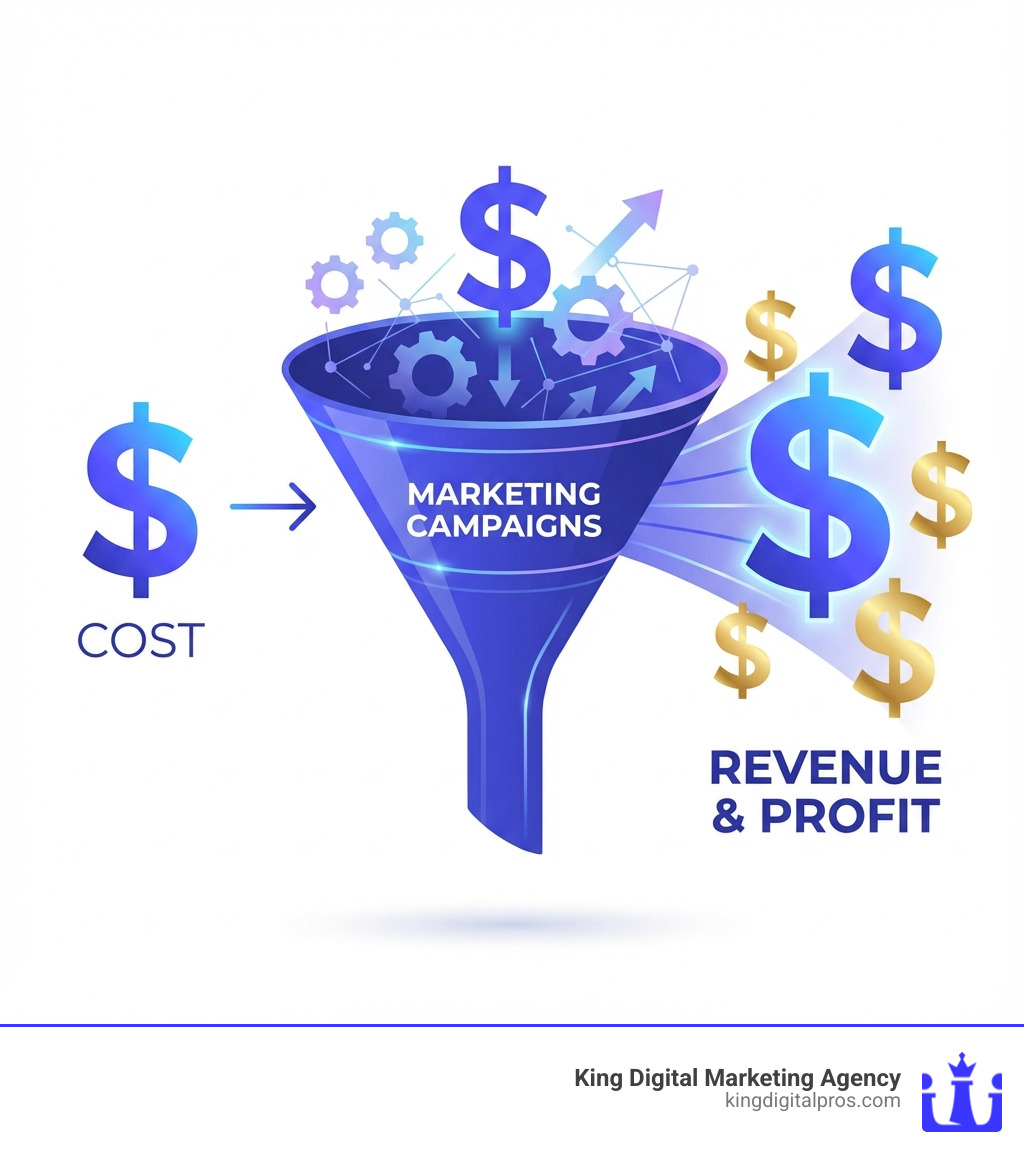
When discussing advertising success, ROI and ROAS are two key acronyms. While similar, they tell different stories. Understanding this distinction is crucial for any business, from a local shop in Santa Fe to a service provider in Albuquerque.
Why is ROI so important? It puts real numbers behind your strategy, proving campaign value and driving business growth. It helps justify investments, prioritize what works, and spot underperformance. As a survey by Marketing Week confirms, 53% of large business owners and 43% of small business owners consider ROI the most important metric. It’s about making sound financial decisions.
Let’s break down the difference between ROI and ROAS:
| Feature | Return on Investment (ROI) | Return on Ad Spend (ROAS) |
|---|---|---|
| What it measures | Overall profitability of an investment after all costs. | Gross revenue generated for every dollar spent on ads. |
| Formula | (Net Profit – Total Investment) / Total Investment x 100% | Revenue / Ad Spend |
| Focus | Holistic view of financial health, net profit. | Specific to ad campaign effectiveness, gross revenue. |
| Costs included | All costs associated with the investment (ad spend, product costs, salaries, software, etc.). | Only direct ad spend. |
| Goal | Maximize net profit and long-term business growth. | Maximize ad campaign revenue, often a short-term view. |
ROAS offers a quick snapshot of revenue generation from ads (e.g., a 2x ROAS is $2 earned for every $1 spent). ROI provides a holistic view by considering all costs, making it the true measure of profitability. For local businesses, focusing on ROI ensures every marketing dollar contributes to the bottom line.
Key Metrics for Your Advertising ROI Calculator
To use an advertising roi calculator effectively, you need the right data. These key metrics are the building blocks for an accurate picture of marketing profitability.
- Total Revenue: The total money generated from sales. For a specific campaign, focus on the revenue directly attributable to it.
- Gross Profit: Revenue minus the cost of goods sold (COGS). This is the money left to cover operating expenses.
- Net Profit: The bottom line: what remains after deducting all expenses (COGS, operating costs, taxes) from revenue. This is the “gain” in your ROI calculation.
- Marketing Investment: Includes all marketing costs: ad spend, creative production, software, agency fees, and staff time.
- Customer Acquisition Cost (CAC): The cost to acquire one new customer, showing the efficiency of your marketing and sales. We have more info about lead generation to help you dive deeper.
- Customer Lifetime Value (LTV): The total revenue expected from a customer over their entire relationship with your business. LTV is critical for local businesses in places like Rio Rancho or Grants, as a customer’s long-term value can justify the initial ad spend.
The Simple ROI Formula Explained
At its core, the ROI formula is simple yet powerful, answering the question: “For every dollar I put in, how many dollars do I get back in profit?”
The basic formula is:
ROI = (Net Profit / Total Investment) x 100%
Let’s break down the components:
- Net Profit (Amount Gained): The financial benefit from your campaign. It’s revenue minus the cost of goods sold and other operational costs tied to that revenue.
- Total Investment (Amount Spent): This encompasses all campaign costs, including ad spend, creative development, software, and staff time.
For example, a business in Edgewood invests $1,000 in a Google Ads campaign. It generates $4,000 in revenue. The cost of goods sold (COGS) is $1,500, and operational costs are $500.
- Net Profit = $4,000 (Revenue) – $1,500 (COGS) – $500 (Operational Costs) = $2,000
- Total Investment = $1,000 (Ad Campaign Cost)
So, ROI = ($2,000 / $1,000) x 100% = 200%.
This means for every dollar invested, the campaign returned two dollars in net profit.

This percentage provides a clear measure of success. A positive ROI means profit, while a negative ROI signals a loss and the need for a strategy change.
How to Use an Advertising ROI Calculator to Boost Profitability
An advertising roi calculator is a practical guide for optimizing ad spend and making smarter business decisions. By applying its principles, you can transform marketing from a guessing game into a profit-driven engine. This is especially true for local businesses in communities like Los Alamos or Taos, where every dollar counts.
Step 1: Tallying Your Total Advertising Costs
To calculate your return, you need a clear picture of your investment. This means going beyond just the ad platform bill. Think of it like baking a cake: you count the flour, sugar, eggs, and butter!
Here’s what to include in total advertising costs:
- Ad Spend: Money paid directly to platforms like Google, Facebook, or Instagram.
- Creative Production Costs: Expenses for photography, design, or copywriting.
- Software Costs: Subscriptions for analytics tools, CRMs, or email platforms.
- Agency Fees: Fees paid to a digital marketing agency for their services.
- Staff Time: The monetary value of your team’s hours spent on marketing.
- Cost-Per-Click (CPC): The total cost for campaigns where you pay per click.
- Cost-Per-Impression (CPI): The cost for campaigns where you pay per thousand views (CPM).
A comprehensive view of these figures ensures your “Total Investment” is accurate, setting the stage for a reliable ROI calculation.
Step 2: Attributing Revenue to Your Campaigns
This is often the trickiest part. Customer journeys are rarely linear. Someone in Cedar Crest might see a Facebook ad, then Google your business, and finally call to make a purchase. Which touchpoint gets the credit?
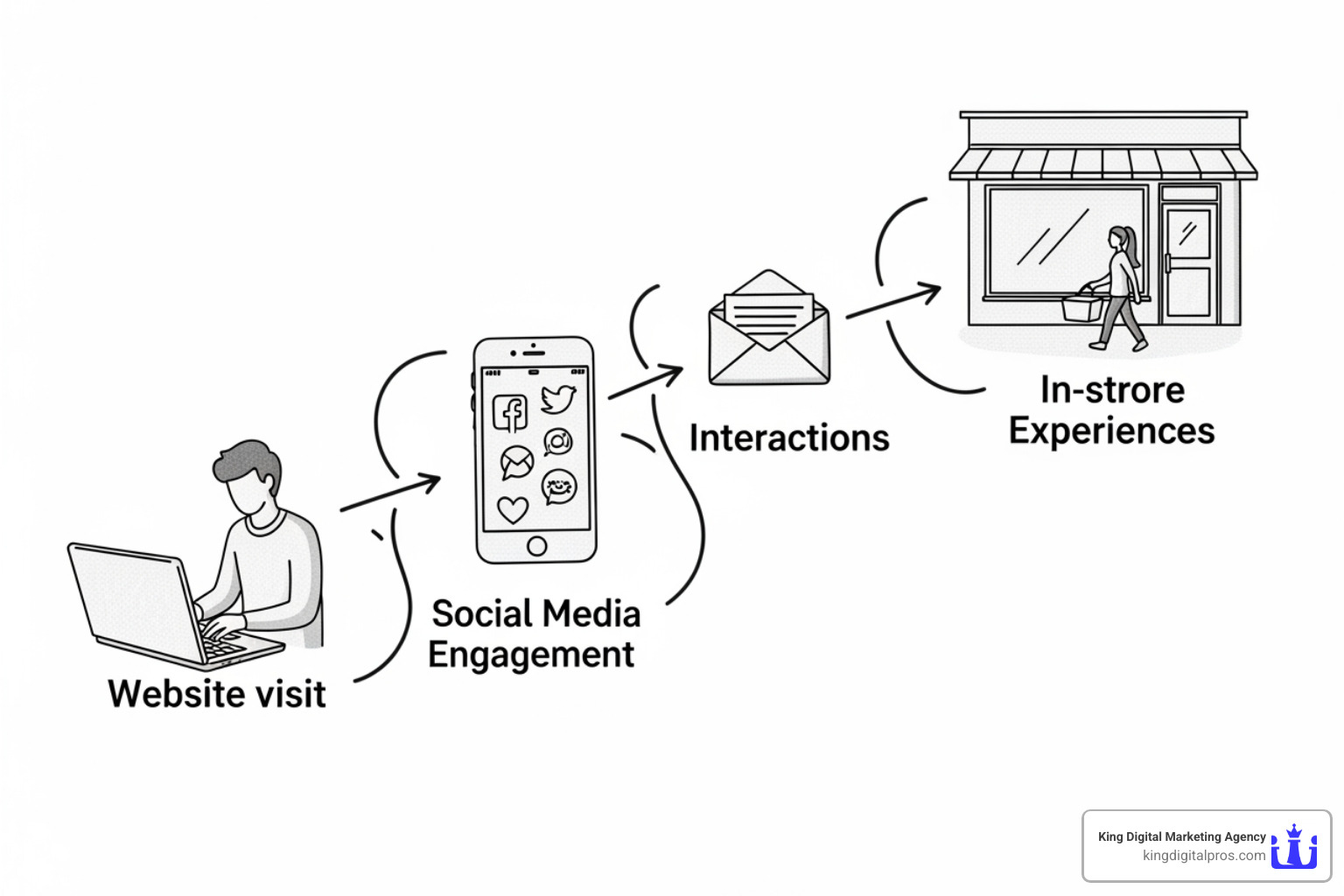
Here’s how to approach attributing revenue:
- Direct Revenue: Easiest to track. A customer clicks an ad and immediately makes a purchase.
- Assisted Conversions: Google Analytics can show which campaigns “assisted” a conversion, even if they weren’t the final click.
- Attribution Models: These assign credit strategically across the customer journey:
- Last-Click: Credits the last touchpoint before conversion. Simple but incomplete.
- First-Click: Credits the first touchpoint. Good for tracking initial awareness.
- Linear: Spreads credit equally across all touchpoints.
- Time Decay: Credits touchpoints closer to the conversion more heavily.
- Position-Based: Credits the first and last touchpoints most.
- Tracking Sales: This requires robust analytics, CRM integration, and sometimes asking customers how they heard about you. For local businesses, tracking phone calls and walk-ins from online ads is paramount.
Be consistent with your chosen attribution model and understand its limits. For more guidance, our guide on How to Measure Marketing ROI offers deeper insights.
Step 3: Calculating and Analyzing the Results
With your costs and revenue, you’re ready to use the advertising roi calculator.
- Input Data: Plug your Net Profit and Total Investment into the formula:
ROI = (Net Profit / Total Investment) x 100%. - Interpret the Percentage:
- Positive ROI: You’re making a profit. A 100% ROI means you doubled your money ($2 earned for every $1 spent).
- Negative ROI: You’re losing money. A -50% ROI means you lost half your investment and need to make adjustments.
- Make Data-Driven Adjustments: Use the results to guide your strategy. Increase the budget for high-ROI campaigns. For low or negative ROI, investigate the cause-is it the targeting, creative, or landing page? Make changes and re-test.
- Leverage A/B Testing: The calculator is perfect for A/B testing. Test different ad creatives or landing pages and use ROI to determine the winner. This cycle of testing, measuring, and optimizing maximizes your budget.
What’s a Good ROI? Benchmarks and Channel-Specific Goals
“What’s a good ROI?” is a common question, but the answer depends on your industry, profit margins, and business goals. However, some general benchmarks can help you set realistic expectations when using an advertising roi calculator.
General Marketing ROI Benchmarks
Here’s a widely accepted framework for evaluating marketing ROI:
- Acceptable ROI (2:1 or 100%): For every $1 spent, you get $2 back in profit. This is a common minimum benchmark.
- Good ROI (5:1 or 400%): Earning $5 for every $1 spent. This indicates a strong, effective campaign.
- Excellent ROI (10:1 or 900%+): Earning $10+ for every $1 invested. This is an exceptional return for highly optimized campaigns.
These are general guidelines. A new business in Grants might be happy with a 1:1 ROI, while an established company in Tijeras might aim for a much higher return. The ultimate goal is always a positive ROI that contributes to overall profitability.
How Different Channels Impact Your Advertising ROI Calculator
The marketing channel you choose significantly impacts potential ROI. Different channels have varied costs, reach, and conversion rates.
- Email Marketing ROI: Often hailed as the king of ROI, email marketing can reach a whopping 3,600% ROMI. Its low cost and direct line to an engaged audience create incredible returns. For local businesses, an email list is a goldmine. Learn more with our Email Marketing ROI Calculator Guide.
- SEO ROI: SEO is a long-term play with powerful results, averaging an 825% ROMI over 3 years. While it can take 6-24 months to see full effects, the sustained organic traffic is incredibly cost-effective. For businesses dependent on local searches, like those in Santa Fe or Taos, a strong local SEO strategy is non-negotiable.
- Google Ads ROI: Google Ads offers immediate visibility and targeted traffic, with an average ROMI of 200% ($2 back for every $1 spent). It’s excellent for generating quick leads and sales for local service providers.
Understanding these channel-specific benchmarks helps you set realistic goals and allocate your budget wisely. For a comprehensive look at local marketing efforts, explore our Local Marketing ROI Complete Guide.
Common Challenges and Best Practices for Improving ROI
Even with an advertising roi calculator, improving ROI has its challenges. In fact, according to a survey by Uptempo, 61% of marketing leaders struggle with calculating ROI because they’re not confident about the data. This often boils down to a few key areas:
- Attribution Complexity: The customer journey isn’t linear, making it hard to assign credit to a single touchpoint. Choosing and applying a consistent attribution model is a common challenge.
- Long-Term Value: Channels like SEO and content marketing build value over months or years. Measuring the long-term ROI of these “marathon” efforts with “sprint”-focused tools can be misleading.
- Brand Awareness Campaigns: It’s hard to put a dollar value on brand recognition. Campaigns aimed at awareness don’t always lead to direct sales, making their immediate ROI difficult to quantify with traditional methods.
Best Practices for Maximizing Your Advertising Return
Despite the challenges, you can implement several best practices to improve advertising ROI:
- Refine Audience Targeting: Precisely targeting ads reduces wasted spend and increases conversions.
- Optimize Landing Pages: Ensure landing pages are relevant, clear, compelling, and mobile-friendly with a strong call to action.
- Improve Ad Creative: Regularly test headlines, images, and copy to see what resonates with your audience.
- Focus on High-LTV Customers: Target customer segments with the highest Customer Lifetime Value to justify acquisition costs with long-term profitability.
- Test New Channels Strategically: Start with small, controlled experiments on new channels and use an advertising roi calculator to evaluate their effectiveness before scaling.
- Integrate Data: Centralize data from ad networks, analytics, and your CRM for a unified view of the customer journey.
Overcoming the Challenge of Attribution
Attribution is complex, but not impossible. Here’s how to tackle it:
- Multi-Touch Attribution Models: Use models that distribute credit across multiple touchpoints (not just first or last click) for a more accurate picture.
- Consistency is Key: Choose an attribution model and stick with it. This allows for accurate comparison of campaign performance over time.
- Use Analytics Tools: Leverage the attribution reporting in tools like Google Analytics. Integrating with your CRM provides an even richer dataset.
- Track Offline Conversions: For local businesses in places like Grants or Edgewood, track offline sales from online efforts. Use unique phone numbers, dedicated forms, or simply ask customers how they found you.
- Consider Proxies for Brand Awareness: For brand campaigns, measure proxy metrics like increased website traffic, direct brand searches, and social media engagement to show impact.
Frequently Asked Questions about Advertising ROI
Here are answers to common questions about advertising ROI.
How often should I calculate my advertising ROI?
Calculate ROI regularly (monthly or quarterly) to monitor performance. For dynamic campaigns on Google Ads or social media, weekly checks may be necessary. This allows you to catch underperforming campaigns early and pivot your strategy.
Can I calculate ROI for campaigns that don’t directly generate sales, like brand awareness?
Yes, but it’s more complex. Use proxy metrics like increased brand searches, social media engagement, and direct website traffic. You can assign a monetary value to this increased visibility based on typical conversion rates to estimate an indicative ROI. While not as precise as direct sales ROI, it provides a valuable estimation.
What’s the difference between ROI and ROAS?
ROAS (Return on Ad Spend) measures gross revenue per dollar of ad spend (e.g., a 4:1 ROAS means $4 revenue for $1 ad spend). It’s a top-line metric for campaign efficiency. ROI (Return on Investment) measures total profit after all costs (ad spend, COGS, etc.). ROI is the true measure of profitability.
Take Control of Your Marketing Success
Calculating advertising ROI is not just about numbers; it’s about gaining clarity and control over our marketing strategy. By using an advertising roi calculator, we transform vague metrics into actionable insights, ensuring every dollar we spend works harder for our business. For local businesses across Albuquerque, Rio Rancho, Santa Fe, and beyond, understanding and optimizing advertising ROI is the key to sustainable growth and outcompeting larger players.
We believe that every business deserves to know exactly how their marketing efforts are contributing to their bottom line. By embracing the principles of ROI, we can move from guesswork to informed decisions, confidently investing in what works and intelligently refining what doesn’t.
For expert help in optimizing your digital marketing efforts and maximizing your return, the team at King Digital is ready to guide you. We specialize in helping local businesses like yours cut through the noise and open up their full potential. Explore our marketing tools and calculators to get started.