The Hidden Impact of Weak Copywriting on AUM Growth
When financial advisory practices evaluate their marketing, they often look at search traffic, website design, and ad spend first. However, the copy on the screen is the real engine that converts visitors into Assets Under Management (AUM). Weak website copy acts as a persistent bottleneck in your lead generation pipeline.
According to Kitces Research, 73% of prospective clients visit a financial advisor’s website before agreeing to a first meeting. If your messaging feels generic or confusing, a significant portion of those prospective clients will leave without taking action.
Organic search drives 53% of all website traffic across industries, while paid channels account for only 27%. Capturing that organic demand requires high-performing content that engages readers immediately. By addressing audience pain points directly, 75% of businesses using targeted messaging rate their approach as highly effective. Improving your copy transforms passive traffic into active inquiries while supporting long-term organic growth. For practical ideas on evaluating technical factors alongside messaging, read our guide on Website Performance Improvement Tips for SMB Success.
Why Most Advisory Messaging Fails
Most financial advisor copywriting fails not because advisors lack expertise, but due to three distinct structural friction points:
- Compliance Fear: Many advisors default to broad corporate language out of fear of non-compliance. By stripping out specifics to avoid regulatory scrutiny, they end up with bland text that says very little.
- Audience Spread: Trying to appeal to everyone – from young tech workers to business owners nearing retirement – dilutes the message. When you speak to everyone, you resonate deeply with no one.
- The Positioning Gap: Advisories frequently rely on overused cliches such as “comprehensive financial planning,” “holistic approach,” or “trusted fiduciary.” Because almost every competitor uses these exact terms, prospective clients see no real difference between choices.
When messaging fails to highlight clear differentiators, readers struggle to evaluate value, leaving your firm to compete purely on brand awareness or price.
The Cost of Abstract Language
Abstract language creates cognitive friction for prospective clients. Research indicates that users spend an average of just 54 seconds reviewing a financial advisor’s homepage. Furthermore, key decisions about staying on a page are made in as few as eight seconds.
If your headline reads, “We deliver personalized wealth management solutions for life’s transitions,” the prospect’s brain has to work hard to figure out what you actually do. Contrast that with: “We help tech leaders with equity compensation minimize taxes and retire five years early.”
When you state clear, actionable outcomes, readers grasp your core value right away. Eliminating abstract jargon reduces cognitive load and keeps qualified prospects moving smoothly through your site. To learn more about assessing user engagement, see our diagnostic breakdown: Is Your Website Converting?.
Essential Strategies for Copywriting for Financial Advisors
Effective copywriting for financial advisors combines strategic positioning, audience empathy, and structured direct-response frameworks. Moving from a broad, brochure-style website to a high-converting growth asset requires an intentional communication approach.

Core Frameworks for Effective Copywriting for Financial Advisors
Proven copywriting frameworks provide structure for financial messaging, keeping it clear and compelling without crossing regulatory lines. Two of the most effective structures for financial advisors are the AIDA (Attention, Interest, Desire, Action) model and the PAS (Problem, Agitation, Solution) formula.
| Framework Component | AIDA (Attention, Interest, Desire, Action) | PAS (Problem, Agitation, Solution) |
|---|---|---|
| Stage 1 | Attention: “Nearing retirement with over $2M in corporate stock options?” | Problem: “Worried a market downturn could derail your retirement timeline?” |
| Stage 2 | Interest: “Unlocking tax-efficient decumulation strategies designed for corporate executives.” | Agitation: “Watching years of hard-earned gains get eaten away by unnecessary taxes feels overwhelming.” |
| Stage 3 | Desire: “Imagine stepping away from your desk at 60 with full confidence in your lifelong cash flow.” | Solution: “Our custom risk-mitigation framework protects your wealth while keeping retirement on track.” |
| Stage 4 | Action: “Schedule a 15-minute introductory call to review your portfolio.” | Action: “Download our free pre-retirement stress test checklist today.” |

Applying direct-response principles within copywriting for financial advisors also involves understanding reader awareness levels, as described by marketing pioneer Eugene Schwartz. Most prospective clients land on your site in a “Problem-Aware” state (knowing they have financial stress) or a “Solution-Aware” state (knowing they need financial advice). Structuring your headlines to match their awareness level creates immediate trust.
Audience Research and Storytelling for Target Niches
To write copy that converts, you must speak the precise language of your target niche. Conducting 10 to 15 client interviews yields real phrases, fears, and priorities directly from your ideal prospects.
For example, an advisor specializing in medical professionals should highlight terms like attending salaries, student loan consolidation, and malpractice asset protection. Conversely, an advisor targeting business owners should focus on equity events, succession planning, and tax-efficient exit strategies.
Using concrete language builds trust fast. For instance, according to OJay Media’s advisor copywriting guide, specific claims convert prospective clients at substantially higher rates than general statements. Replacing passive phrasing like “We strive for solid returns” with specific positioning like “We help pre-retirees in the Pacific Northwest navigate sequence-of-returns risk” creates immediate relevance.
Key Website Pages That Turn Visitors into High-Value Clients
A financial advisory website needs distinct pages designed to achieve clear, specific business goals.
Homepage, About Page, and Bio Distinction
Many advisory websites blur the lines between their Homepage, About Page, and Team Bios. Keeping these pages distinct improves user experience and conversation flow:
- The Homepage: Serves as your digital front door. The hero section must clearly state who you serve, the core problem you solve, and the main call to action above the fold. Applying the “Mom Test” – ensuring anyone can understand what you offer without using financial jargon – helps guarantee your headline passes the 50-millisecond test.
- The About Page: Should focus primarily on the client, not just your company history. It tells the story of why your firm exists, your underlying philosophy, and how your team solves prospective client problems.
- Biography Pages: Keep individual credentials, designations (CFP, CPA, CFA), and career histories on dedicated team bio pages. This separates professional credentials from your core brand narrative while boosting local search optimization.
To see how clear positioning fits into a broader digital strategy, check out our guide on What is Online Visibility and Why It Matters.
Services, Pricing, and the Start Here Page
Transparency builds trust early in the prospective client journey. Fee structures and service descriptions should be clear, detailed, and completely free of technical jargon:
- Services & Fee Page: Clearly laying out service tiers or account minimums acts as a helpful self-qualification filter. Stating fee schedules upfront respects the visitor’s time, weeds out unqualified leads, and establishes immediate transparency.
- “Start Here” Page: This page offers a low-friction entry point for visitors who aren’t quite ready to schedule a discovery meeting. It can host lead magnets, high-value video overviews, or simple self-assessment quizzes.
- AI Brand Page: A modern addition to advisor sites, this structured overview outlines your firm’s mission, audience, and key services. It helps AI search tools (like ChatGPT, Perplexity, and Google AI Overviews) index your brand accurately for Answer Engine Optimization (AEO).
Regulatory Compliance and Storytelling in Financial Messaging
Overcoming Compliance Barriers in Copywriting for Financial Advisors
Strict oversight from regulators like the SEC and FINRA makes compliance a top priority for advisory copy. Under SEC Rule 206(4)-1 (the Marketing Rule), RIAs can use testimonials and reviews, provided they include explicit disclosures, note compensation, and avoid misleading claims. Broker-dealers governed by FINRA Rule 2210 must ensure all communications remain fair, balanced, and free of unapproved performance projections.
To write engaging, compliant copy, create a Pre-Approved Messaging Library. Develop core brand claims, value statements, and disclaimers, then review them with your compliance team before writing campaign copy.
As highlighted in Rob Palmer’s compliance insights, building a library of pre-approved messaging components lets you launch campaigns quickly without risking regulatory issues or costly rewrites.
Using Metaphors and Plain Language to Explain Complex Financial Concepts
Complex concepts like Monte Carlo simulations, sequence-of-returns risk, and tax-loss harvesting can feel overwhelming to readers. Using clear analogies translates complex ideas into practical, relatable benefits.
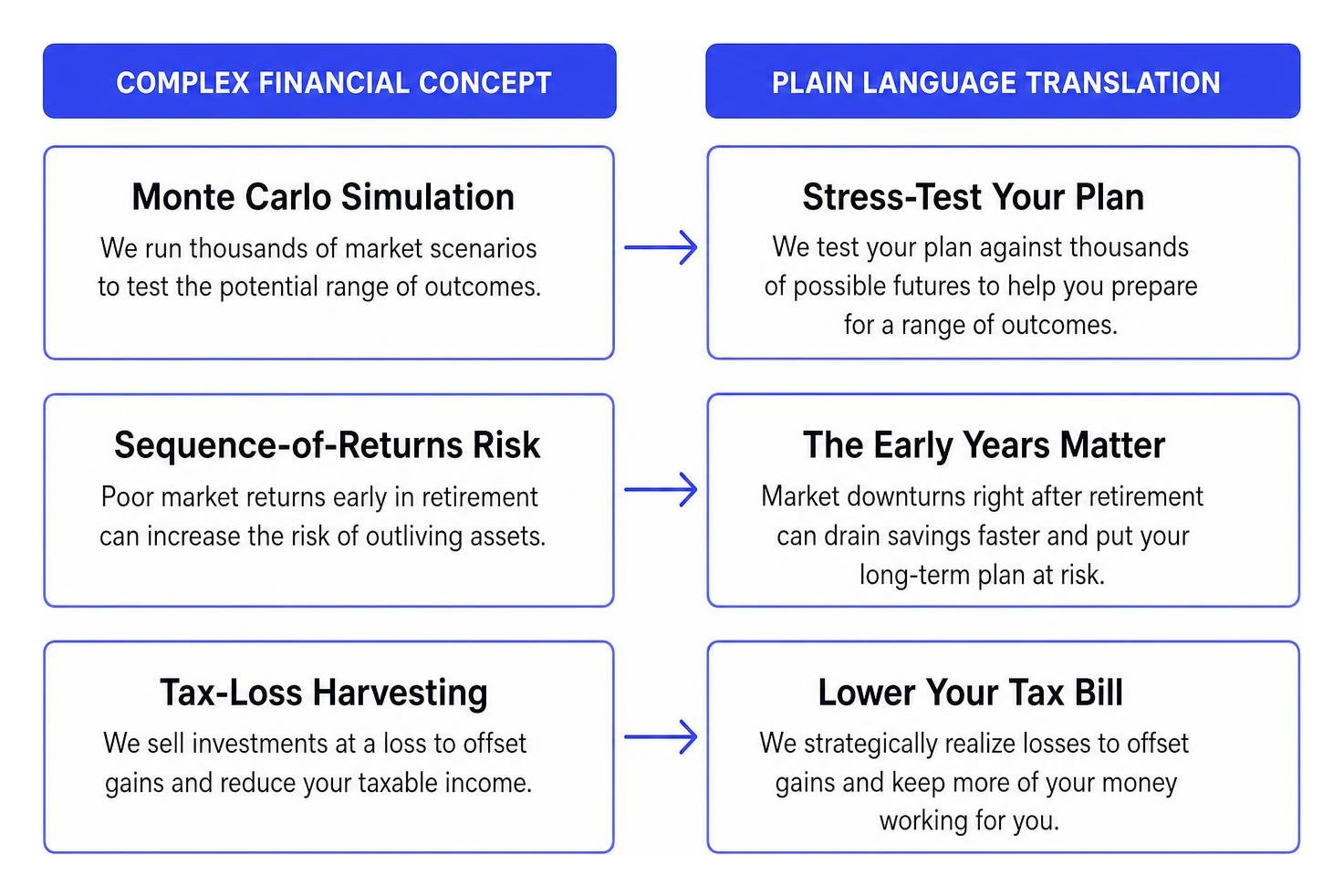
Instead of saying:
“We utilize dynamic asset allocation algorithms to mitigate sequence-of-returns volatility during the early decumulation phase.”
Try stating:
“We build a financial buffer for your early retirement years so market swings won’t impact your daily living expenses.”
Removing jargon respects the reader’s time and makes complex financial advice easy to understand.
Frequently Asked Questions About Financial Advisor Copywriting
Why does generic financial copy fail to generate organic leads?
Generic financial copy fails because it relies on overused industry phrases like “holistic wealth management” or “client-centric solutions.” These broad terms fail to highlight unique value or address specific client pain points. When messaging sounds identical to competitors, prospective clients see no compelling reason to book a call.
How can financial advisors write persuasive copy without violating SEC rules?
Advisors can write persuasive, compliant copy by focusing on client pain points, processes, and service outcomes rather than guaranteeing returns or making promissory claims. Establishing a pre-approved messaging framework and involving compliance officers early allows you to craft engaging messaging anchored in verifiable facts and balanced disclosures.
What essential pages drive the highest conversions on an advisor website?
The Homepage, Fee/Pricing Page, About Page, and “Start Here” Page drive the highest conversions. A hero section with a clear value proposition captures immediate attention, transparent pricing pre-qualifies prospective clients, and a dedicated About page builds trust through relatable storytelling.
Conclusion
Mastering copywriting for financial advisors is one of the most effective levers for driving organic lead growth and expanding AUM. By replacing abstract industry jargon with clear language, clear service options, and compliant frameworks, your practice can turn passive website visitors into long-term clients.
At King Digital Marketing Agency, we help advisory practices craft clear, compliance-ready messaging that builds trust and drives measurable business growth. To upgrade your firm’s messaging and turn your website into a powerful asset, explore how our team can help by reading about our professional copywriting services.
