Why Website Design Matters for Your Business
Website design is the planning, visual layout, content structure, and user experience that shape how people interact with your business online. It matters because your website often acts as your digital storefront: it should quickly explain what you do, build trust, work well on mobile devices, and guide visitors to call, request a quote, or visit your location.
A strong website is not just attractive. It is easy to navigate, fast to load, readable on every screen, and built around what potential customers need to know. For local businesses, thoughtful design can also support clearer search visibility by organizing services, locations, contact details, and helpful content in ways that people and search engines can understand.
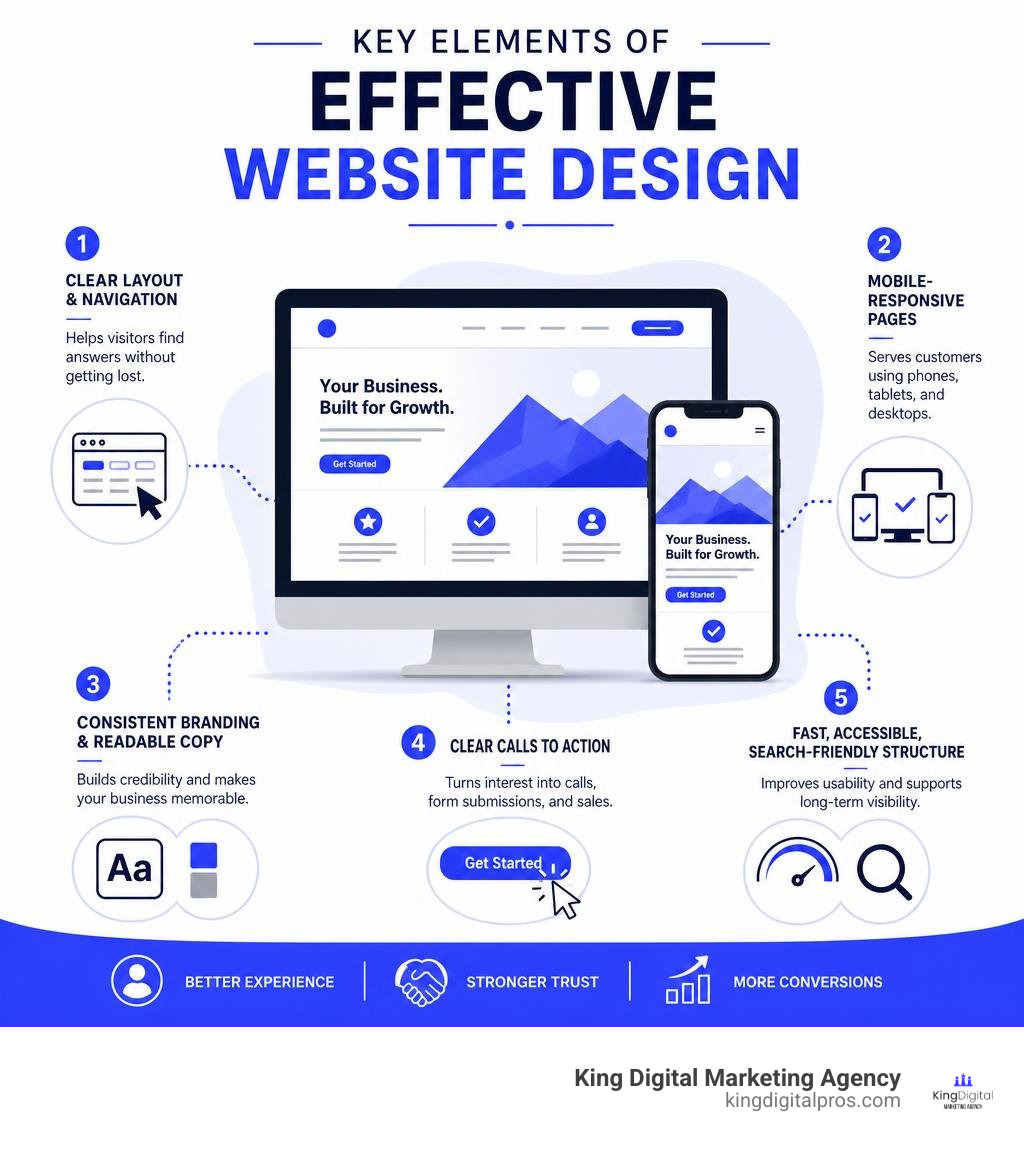
| Effective website design includes | Why it matters |
|---|---|
| Clear layout and navigation | Helps visitors find answers without getting lost |
| Mobile-responsive pages | Serves customers using phones, tablets, and desktops |
| Consistent branding and readable copy | Builds credibility and makes your business memorable |
| Clear calls to action | Turns interest into calls, form submissions, and sales |
| Fast, accessible, search-friendly structure | Improves usability and supports long-term visibility |
Modern tools make it possible to launch simple sites quickly without code, but the best choice still depends on your goals. A portfolio, local service website, online store, and content-heavy company site each need different features, levels of flexibility, and ongoing support.
I am Bernadette King, a digital marketing strategist and founder of King Digital Marketing Agency, with experience building growth strategies that combine persuasive content, SEO, and Website design for small businesses and franchise owners. This guide will help you understand what makes a business website effective and what to consider before building or redesigning yours.
Fundamentals of Strategic Website Design for Modern Businesses
Every successful website starts with a strategic foundation. When someone lands on your site, you have only a few seconds to communicate who you are and why they should stay. If your visual structure is chaotic or confusing, visitors will bounce back to search results before reading a single word. Strategic website design aligns your digital presence with real-world business goals, converting casual browsers into loyal customers.
We look at web architecture as digital real estate. Just as a physical storefront requires an inviting entrance, clear signage, and intuitive aisles, your website needs logical organization and polished visual appeal. Understanding Why Web Design is Important helps business owners prioritize elements that actually build brand equity rather than focusing solely on flashy graphics.
Key Principles of User-Centric Website Design
User-centric design focuses on the experience of the real person navigating your site. To keep users engaged, expert designers rely on core foundational principles:
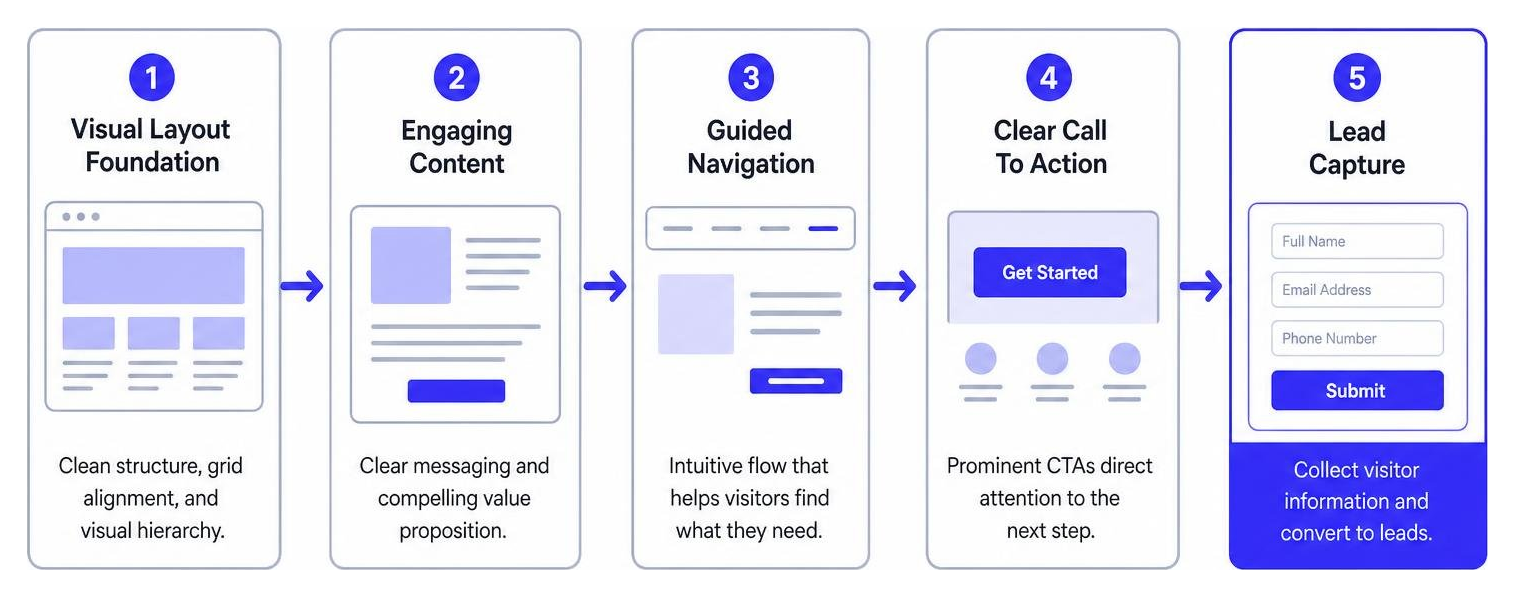
- Grid Layouts and Alignment: Utilizing clean grid structures keeps content balanced and predictable, allowing eyes to scan naturally across the page.
- Visual Hierarchy: Arranging headings, subheadings, images, and buttons in order of importance directs user attention where it matters most.
- Negative Space: Leaving breathing room around text blocks and visual elements prevents cognitive overload and keeps pages feeling modern and approachable.
- Typography Standards: Restricting font selections to two or three readable web-safe typefaces ensures high readability across screens.
- Color Theory: Selecting purposeful color palettes enhances brand recognition while creating comfortable visual contrast.
- Progressive Enhancement: Delivering core content in plain, reliable HTML first ensures accessibility for all users before layering on styling or animation.
Usability experts often note that homepage carousels and auto-rotating banners can actually harm usability and search performance. Instead of distracting moving elements, static layouts with clear value propositions deliver higher engagement.
How Modern Website Design Drives Conversion and Local Visibility
A great website doesn’t just look pretty – it acts as an automated lead generation machine. By pairing intuitive layout decisions with user search intent, your design active guides visitors toward action. Whether someone wants to schedule a service call, book a consultation, or buy a product, your layout must make that next step obvious.
For local companies in markets like Albuquerque, Rio Rancho, or Santa Fe, connecting your layout to local search intent is essential. Clear location pages, embedded maps, and localized service offerings build trust with neighbors searching online. To dive deeper into creating conversion-driven sites, explore how to Build a Local Business Website That Wins Leads.
Evolution and Core Platforms of Digital Development
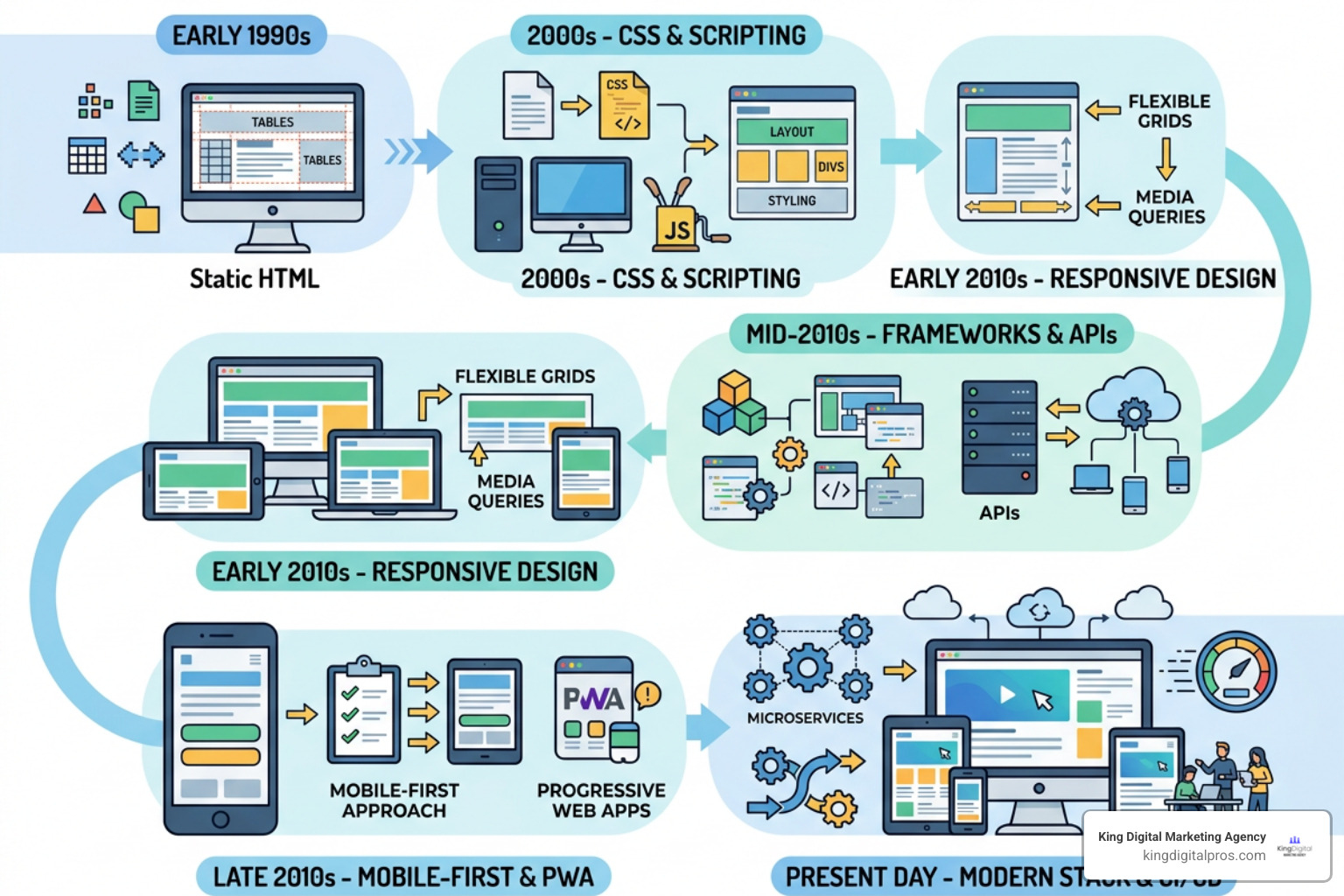
The world of web creation has changed drastically over the past three decades. What once required tedious, line-by-line coding in basic text files can now be accomplished visually in modern browser environments.
Historical Shift from HTML Tables to Fluid Grids
In the late 1990s, web design was rigid and fragile. Webmasters built site structures using nested HTML tables, using transparent spacer GIF images inside empty cells to prevent layouts from collapsing. By 2001, single desktop browsers dominated over 96% of global web usage, leading many creators to build exclusively for static desktop screens.
The mobile revolution shattered those static assumptions. The introduction of CSS media queries allowed developers to apply conditional styling based on screen width, giving rise to responsive design. By March 2018, search engines officially implemented mobile-first indexing, prioritizing sites that render smoothly on mobile devices. Today, adhering to W3C web standards ensures code validates properly across all modern browsers.
No-Code vs Custom Development Solutions
Modern visual platforms have made web design accessible to non-technical creators while giving professional developers powerful tools to launch rapidly.
| Feature / Metric | No-Code Builders (e.g., Squarespace) | Visual Developer Engines (e.g., Webflow) | Custom Code Development |
|---|---|---|---|
| Ease of Use | Beginner-friendly visual tools | Intermediate to advanced | Requires specialized dev skills |
| Typical Project Timeline | Days to a few weeks | 2 to 4 weeks | 6 to 10+ weeks |
| Design Flexibility | Template-driven grid systems | Total visual CSS control | Unlimited freedom |
| Maintenance Needs | Platform-managed security | Minimal technical upkeep | Ongoing server & plugin care |
| Best Used For | SMBs, portfolios, standard sites | High-growth marketing sites | Custom enterprise software |
While basic builders offer fast setup, larger organizations often require custom development setups. Enterprise teams adopting modern visual platforms often report dramatic efficiency gains – some reporting up to 67% fewer internal developer tickets and annual infrastructure savings reaching into millions of dollars.
Technical Architectures: Static vs Dynamic Websites
Choosing the right technical foundation for your website depends on your content updates, security requirements, and functional complexity.
Static Websites for Speed and Security
Static websites consist of pre-rendered HTML, CSS, and asset files delivered straight to the visitor’s browser. Because there is no database querying or server-side processing occurring on each page visit, static websites offer exceptional benefits:
- Unmatched Page Speeds: Files load almost instantaneously over global Content Delivery Networks (CDNs).
- Enhanced Security: Without a central database or dynamic scripting environment, static sites have a vastly smaller attack surface.
- Low Overhead: Web hosting costs for static pages are minimal, making them perfect for event landing pages, individual portfolios, or basic service brochures.
Dynamic Platforms for Complex Ecosystems
Dynamic websites construct web pages on the fly by fetching stored content from a database whenever a user visits a URL. Content Management Systems (CMS) use dynamic architectures to power complex interactions:
- User Authentication: Securely logging into member portals, online forums, and account dashboards.
- E-Commerce Functionality: Handling real-time inventory management, shopping carts, and dynamic payment gateways.
- API Integrations: Pulling live data feeds, custom maps, or dynamic scheduling calendars seamlessly.
When dynamic websites are properly optimized, they combine interactive capabilities with robust search visibility.
Role of Artificial Intelligence and Modern Building Technologies
Artificial intelligence has rapidly evolved from a novel tech trend into an integral part of modern web production workflows.
Generative AI and Automated Canvas Workflows
AI design generators enable teams to turn simple text prompts into production-ready web section concepts in seconds. These tools generate tailored hero blocks, feature grids, pricing layouts, and footers automatically.
Rather than replacing human creativity, on-canvas AI design agents assist designers by creating rapid variations, drafting initial body copy, generating matching style kits, and maintaining consistent brand palettes across subpages. Combining these AI assistants with visual design canvases allows teams to test multiple visual directions in minutes.
Answer Engine Optimization and Next-Gen SEO
As search habits shift toward generative search tools and AI answer engines, web design must adapt. Answer Engine Optimization (AEO) focuses on structuring site data so artificial intelligence models can easily crawl, parse, and cite your site’s information.
Implementing clear schema markup, maintaining semantic HTML hierarchy, and presenting direct answers to common questions ensure your site ranks effectively in both traditional search engines and emerging AI interfaces. For an in-depth breakdown on structuring your site correctly, review The Complete Guide to SEO-Friendly Web Design.
Best Practices for Mobile-Responsive Layouts and Site Performance
A visually stunning website is useless if it takes ten seconds to load or breaks on a mobile screen. Technical performance and usability go hand in hand.
Technical SEO, Speed, and Safe Migration
Search engines track user experience metrics known as Core Web Vitals, including Largest Contentful Paint (LCP), Interaction to Next Paint (INP), and Cumulative Layout Shift (CLS). Optimizing images, leveraging browser caching, and removing redundant code can reduce page load times by 50% to 70%.
When redesigning an existing website, protecting established search traffic is critical. Mishandled site overhauls without proper technical migration planning risk losing 60% to 80% of organic traffic overnight due to broken URL paths.

A safe redesign migration plan includes:
- Conducting a comprehensive pre-launch URL and content audit.
- Building and testing the new site on a private staging server.
- Creating a 1-to-1 mapping of legacy URLs to new page structures using permanent 301 redirects.
- Submitting updated XML sitemaps to Google Search Console immediately after launching.
Web Accessibility and Navigation Standards
Web Content Accessibility Guidelines (WCAG) ensure your website is usable by everyone, including people relying on screen readers or assistive devices:
- Color Contrast: Ensuring strong contrast ratios between body text and background colors for effortless readability.
- Keyboard Navigation: Allowing users to navigate interactive menus, buttons, and forms using only keyboard inputs.
- Semantic HTML: Using standard tags (
,,) to give clear structure to assistive technology. - Alt Text: Providing descriptive alt tags for all informative visual assets.
Frequently Asked Questions About Web Development
How long does a professional web design project take from start to finish?
A typical custom website project generally takes between 6 to 10 weeks from initial discovery to live launch. Simple template builds can be created in a few days or weeks, while enterprise platforms with complex custom functionality or extensive e-commerce catalogs may take 2 to 3 months. Timelines depend heavily on project scope, custom design requirements, and content readiness.
What is the primary difference between web design and web development?
Web design focuses primarily on the visual layout, user experience (UX), graphic elements, color schemes, and interface structure (UI) of a site. Web development involves writing the underlying code – such as HTML, CSS, JavaScript, and database scripts – that brings those visual concepts to life and makes interactive features function smoothly behind the scenes.
How do I maintain Google search rankings during a site refresh?
To protect your organic search traffic during a site redesign, keep your overall content depth intact, perform a comprehensive SEO audit before making changes, and implement a meticulous 301 redirect map for every legacy URL that changes location. Developing the new site on a private staging environment ensures your live site remains accessible to customers and search engines until the exact moment of launch.
Conclusion
Your business website is the focal point of your online identity. Investing in strategic website design builds trust, elevates brand credibility, improves local search visibility, and turns casual traffic into ongoing revenue. Whether you operate in Albuquerque, East Mountains, Corrales, Taos, or Grants, having a responsive, high-performing website sets you apart from local competitors.
When updating your site, remember a helpful structural detail: WordPress automatically outputs the post title as the page H1, keeping your document hierarchy clean for search engines right out of the box. Maintaining active Google Search Console tracking and continually refining site performance ensures your digital storefront delivers results for years to come.
Ready to build a digital presence that grows your business? Explore our expert Website Design Albuquerque Services at King Digital Marketing Agency today, and let us help you build a website that delivers real results.
