TL;DR:
- Auto repair shops can improve local rankings by optimizing their Google Business Profile and generating consistent, detailed reviews. Building city-specific service pages and tracking monthly performance are essential for sustained success in local SEO. Ongoing review requests and profile updates enhance visibility and AI search recommendations, leading to more nearby customers.
Local SEO for auto repair shops is the set of systematic steps that auto repair shops use to rank higher in local search results and attract nearby customers who are ready to book. The auto repair local SEO steps covered here address Google Business Profile optimization, review generation, content strategy, and performance tracking. AI-powered search engines now pull shop recommendations directly from review text and profile data, making these steps more consequential than ever. King Digital Marketing Agency works with auto shops across the Albuquerque region to execute exactly this kind of local search engine optimization, and the results speak for themselves.
What are the essential elements needed before starting local SEO?
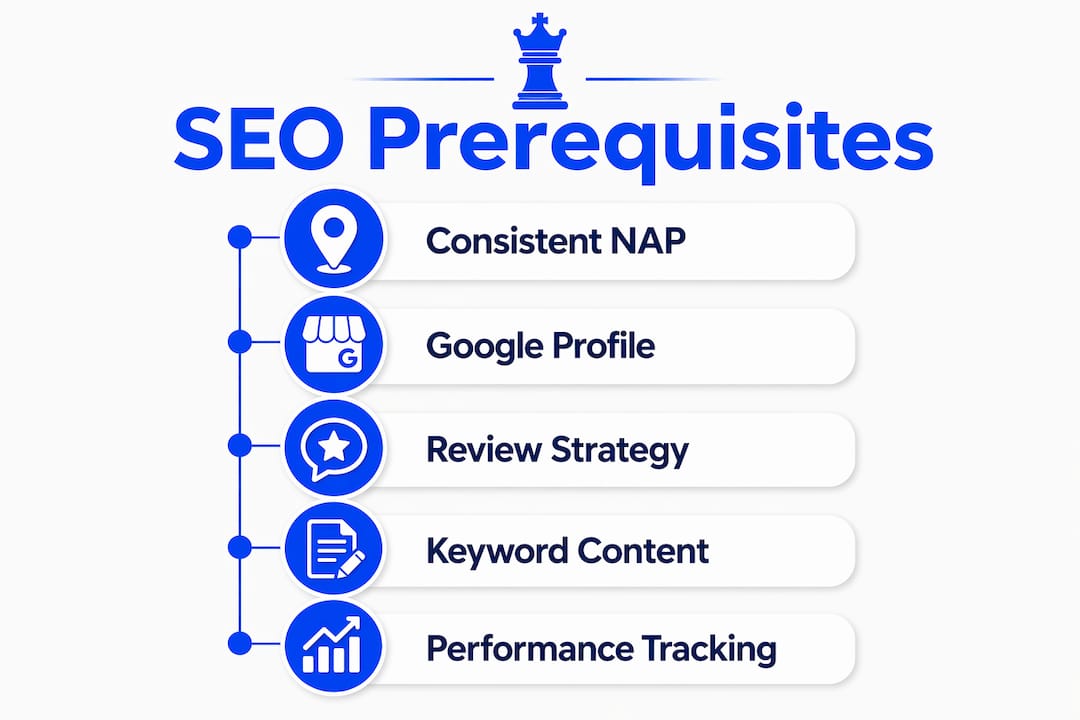
Before you touch a single keyword, your foundational data must be airtight. The three non-negotiables are consistent NAP data (Name, Address, Phone), a claimed and verified Google Business Profile, and a mobile-friendly website. 80% of businesses get basic profile information wrong. That single error costs you map pack rankings before the race even starts.
Core prerequisites for auto repair SEO
Work through this checklist before moving to any optimization step:
- NAP consistency: Your business name, address, and phone number must match exactly across Google, Yelp, your website, and every directory listing. Even a suite number abbreviation (“Ste” vs. “Suite”) can create a mismatch signal.
- Google Business Profile: Claim your profile at business.google.com and complete the verification process. An unverified profile is like a storefront with locked doors and the lights off.
- Mobile-friendly website: Google indexes the mobile version of your site first. If your site loads slowly or breaks on a phone, your rankings suffer regardless of everything else you do.
- Service category selection: Choose your primary category as “Auto Repair Shop” and add secondary categories like “Brake Shop,” “Oil Change Service,” or “Transmission Shop” to capture specific searches.
- Review management system: Set up a process to request, collect, and respond to reviews before you start driving traffic. A review management system turns every completed repair order into a ranking opportunity.
The table below shows which prerequisites have the highest impact on your local search rankings.
| Prerequisite | Impact on local rankings |
|---|---|
| Consistent NAP data | Prevents ranking penalties from conflicting signals |
| Verified Google Business Profile | Unlocks map pack eligibility and AI search visibility |
| Mobile-friendly website | Required for Google’s mobile-first indexing |
| Accurate service categories | Matches your profile to relevant local search queries |
| Active review collection | Drives recency and volume signals Google weights heavily |
How do you optimize your Google Business Profile for auto repair?
Your Google Business Profile is the single most powerful free tool in local SEO for auto shops. A fully optimized profile shows up in the map pack, in Google’s AI Overviews, and in voice search results. Attributes and frequent updates are the two factors most shops overlook in 2026.
Follow these steps in order:
- Claim and verify your profile. Use postcard verification if phone or video options are unavailable. Do not skip this step. An unverified profile cannot rank in the map pack.
- Complete every field. Add your exact business hours, holiday hours, a detailed business description (use phrases like “ASE-certified technicians” and “same-day oil changes”), and your service area.
- Select precise categories. Your primary category drives the most ranking weight. Secondary categories expand your reach to related searches.
- Upload photos consistently. Add photos of your shop exterior, service bays, team members, and completed work. Profiles with recent photos receive more clicks than those with outdated or missing images.
- Use attributes. Attributes like “wheelchair accessible,” “veteran-owned,” and “appointment required” feed directly into AI-driven search filters that customers use in 2026.
- Maintain the Q&A section. Seed it yourself with common questions: “Do you work on diesel trucks?” or “Do you offer free estimates?” Answer each one thoroughly.
- Post weekly updates. Use Google Posts to share promotions, seasonal service reminders, or new service offerings. Fresh posts signal an active, trustworthy business.
Pro Tip: Set a recurring calendar reminder every Monday to add one new Google Post and one new photo. This 10-minute habit compounds into a measurable ranking advantage over 90 days.
How to build a customer review strategy that boosts local SEO

Reviews are the most direct ranking signal you control. Shops with consistent review requests double their Google review count year over year, which produces a compounding lift in map pack rankings. The key word is “consistent.” A burst of reviews followed by months of silence actually hurts your recency score.
The review flywheel method
The review flywheel works by linking your review request to the emotional high point of the customer visit. The moment a customer gets their keys back and sees a fair final bill is the lowest-friction moment to ask. Automated review solicitation tied directly to service completion keeps that flywheel spinning without relying on your service advisors to remember.
Here is how to build the system:
- SMS requests: Send a review request via text 30–90 minutes after service completion. SMS open rates near 98% dwarf email’s 20–25% average. That gap translates directly into more reviews per month.
- QR codes: Place QR codes on invoices, key tags, and glovebox cards. Full-stack QR implementations consistently achieve 14–22% review conversion rates per visit.
- Review filtering: Route customers through a simple satisfaction check first. Happy customers go straight to your Google review page. Unhappy customers go to a private feedback form. This protects your public rating while giving you a chance to resolve issues before they go public.
- Respond to every review. Responding to negative reviews publicly shows accountability. Timely, professional responses reduce the ranking damage from low-star reviews and demonstrate trustworthiness to prospective customers reading your profile.
“AI-driven search now uses detailed customer review text to recommend shops based on service specifics and vehicle types. Reviews that mention the exact repair performed, the vehicle make and model, and the customer’s experience give AI search engines the specificity they need to recommend your shop over a competitor.”
The Impact of Customer Reviews on AI Visibility for Auto Repair Shops
Pro Tip: Train your service advisors to ask customers to mention the specific repair in their review. “If you have a moment, a Google review mentioning your brake job would really help us” produces far more useful review content than a generic ask.
The connection between customer feedback and revenue growth is well-documented. Shops that treat reviews as a revenue driver, not just a reputation tool, consistently outperform those that treat them as an afterthought.
What content and keyword strategies work for auto repair SEO?
Your website content is the second pillar of local search engine optimization. Google needs text on your site to understand what you do, where you do it, and who you serve. Generic pages that say “We fix cars” rank for nothing.
The most effective approach uses city-specific, long-tail keywords woven into dedicated service pages. Phrases like “brake repair in Albuquerque” and descriptions that include specific vehicle makes and service details increase organic visibility significantly. Each core service deserves its own page: oil changes, brake repair, transmission service, AC repair, and so on.
- Service pages: Write at least 400 words per service page. Include the service name, the city, common symptoms that bring customers in, and what your process looks like. This depth satisfies both Google’s quality signals and AI search engines that pull detailed answers.
- Location pages: If you serve multiple neighborhoods or cities, build a dedicated location page for each one. Generic “we serve the whole metro” copy does not rank.
- FAQ and blog content: Answer the questions your customers actually ask. “How often should I change my transmission fluid?” or “What does a check engine light mean?” These pages capture informational searches and build topical authority.
- AI-friendly descriptions: Write in plain, specific language. Describe the exact steps of a service, the tools used, and the outcome the customer can expect. AI search engines extract this detail to generate recommendations.
The impact of AI on local business visibility means that thin, generic content is a liability in 2026. Specificity is the new competitive advantage.
How do you track and troubleshoot auto repair local SEO performance?
Tracking your local SEO performance monthly is the only way to know whether your efforts are working. Google Business Profile’s built-in analytics dashboard shows discovery searches (customers who found you by searching a service category) versus direct searches (customers who already knew your name). A rising discovery search count means your local SEO is working.
Watch for these common mistakes that undo good work:
- Inconsistent NAP listings: A phone number change that you update on your website but not on Yelp, Apple Maps, or Bing Places creates conflicting signals. Audit all listings every quarter.
- Keyword stuffing in your business name: Adding “Best Auto Repair Albuquerque” to your Google Business Profile name violates Google’s guidelines and can trigger a suspension. Google penalizes spammy business names and inconsistent listings.
- Ignoring profile updates: Outdated hours, missing holiday schedules, and stale photos all reduce your profile’s authority score.
- No review cadence: Letting review requests lapse for even 60 days drops your recency score. Automate the process so it never depends on memory.
Tracking Google Business Profile analytics monthly aligns your efforts with actual local consumer behavior. The data tells you which services drive the most profile views and which neighborhoods generate the most calls.
| Common mistake | Fix |
|---|---|
| Inconsistent NAP data | Audit all directory listings quarterly and correct mismatches |
| Keyword stuffing in business name | Use your legal business name only; add keywords to description instead |
| Stale profile photos | Upload at least two new photos per month |
| No review request system | Automate SMS requests 30–90 minutes post-service |
| Ignoring analytics | Review Google Business Profile insights monthly for trend data |
For a complete local SEO mistake checklist, King Digital Marketing Agency has published a detailed fix-it guide that covers the most damaging errors shop owners make.
Key Takeaways
Consistent review generation, a fully optimized Google Business Profile, and city-specific service page content are the three pillars that determine whether your auto repair shop ranks in the local map pack.
| Point | Details |
|---|---|
| Google Business Profile is foundational | Verify it, complete every field, and post updates weekly to maintain ranking eligibility. |
| SMS review requests outperform email | Near-98% open rates make SMS the most reliable channel for generating consistent review volume. |
| Review content specificity matters | Reviews mentioning specific repairs and vehicle types improve AI search recommendations for your shop. |
| City-specific content wins local search | Service pages using phrases like “brake repair in [city]” rank for queries generic pages cannot reach. |
| Monthly analytics reviews are non-negotiable | Discovery search trends in your Google Business Profile dashboard show whether your SEO is gaining ground. |
What I’ve learned about local SEO for auto shops after years in the field
I’m Bernadette King, and I want to be direct with you: most auto repair shops are leaving serious money on the table because they treat local SEO as a one-time setup task rather than an ongoing system.
The shops I see dominating their local map packs share one trait. They treat review generation the way a good mechanic treats preventive maintenance. They do it on a schedule, every single time, without exception. The shops that struggle are the ones waiting for happy customers to leave reviews on their own. That almost never happens at the rate you need.
The other thing I see consistently underestimated is the shift toward AI-driven search. When a customer asks Perplexity or Google’s AI Overview “who does the best transmission repair near me,” the answer comes from review text, not just star ratings. A shop with 200 detailed reviews mentioning specific repairs will beat a shop with 500 generic five-star reviews in that AI recommendation. That is a real competitive gap you can close right now by coaching your service advisors on how to ask for reviews.
One more thing: do not let perfect be the enemy of good. I have watched shop owners delay their entire local SEO effort because they wanted a perfect website first. Start with your Google Business Profile and your review system. Those two steps alone will move your rankings faster than a website redesign.
— Bernadette
How King Digital Marketing Agency helps auto shops rank locally
Auto repair shops that want to move faster than the DIY pace have a clear option.
King Digital Marketing Agency builds and manages complete local SEO programs for auto repair shops, covering Google Business Profile optimization, review automation setup, service page content, and monthly performance reporting. The agency’s local SEO service is built specifically for small to medium-sized businesses that need real results without the overhead of a large agency. Every program is customized to your shop’s services, location, and competitive market. If you want a clear picture of where your shop stands right now, King Digital Marketing Agency offers a consultation to audit your current local search presence and identify the highest-impact fixes. You can also review the agency’s local search optimization guide to see the full methodology before you commit to anything.
FAQ
What are the most important auto repair local SEO steps?
The highest-impact steps are claiming and fully optimizing your Google Business Profile, building a consistent SMS-based review request system, and creating city-specific service pages on your website. These three actions address the core ranking signals Google uses for local map pack placement.
How do customer reviews affect local SEO for auto shops?
Reviews influence both ranking position and AI search recommendations. Shops with consistent review volume and detailed review text that mentions specific repairs rank higher in the map pack and appear more frequently in AI-generated local recommendations.
How often should I update my Google Business Profile?
Post at least one update and add at least two new photos per week. Google weights profile activity as a freshness signal, and regular updates keep your profile competitive against shops that post infrequently.
What keywords should auto repair shops target for local SEO?
Target service-plus-city combinations like “oil change in [city]” and “brake repair near [neighborhood].” Add vehicle-specific terms like “Honda transmission repair” or “diesel truck service” to capture high-intent searches with lower competition.
How long does it take to see results from local SEO for auto shops?
Most shops see measurable movement in Google Business Profile discovery searches within 60–90 days of consistent optimization. Map pack ranking improvements typically follow within three to six months, depending on your market’s competition level.
Recommended
- Optimize local search: Ultimate Guide 2025
- Understanding Local Search Ranking for Business Growth
- Local search marketing expert: Unlock Success 2025
- Top Mistakes in Local SEO: 2026 Fix-It Guide
