
TL;DR:
- A digital marketing roadmap is a structured plan that links activities directly to measurable business goals. It breaks down into three 30-day phases to enable agility, testing, and timely optimization. Focusing on 2-3 core channels and setting clear metrics ensures accountability and improved marketing results.
A digital marketing roadmap is a structured, time-bound plan that connects your marketing activities directly to measurable business goals. Think of it as the GPS for your online growth. Without it, you are running campaigns, posting on social media, and spending on ads without knowing whether any of it moves the needle. The concept is closely aligned with what practitioners call a digital marketing strategy, but a roadmap goes further. It assigns phases, timelines, and specific metrics to every initiative. Businesses that execute tactics before strategy consistently produce fragmented, costly results.
What is a digital marketing roadmap and what does it include?
A digital marketing roadmap is defined as a strategic document that aligns marketing tasks across timelines, linking campaigns to measurable business targets rather than isolated tactical activities. That alignment is what separates a roadmap from a simple to-do list. It creates coordination, accountability, and a clear line of sight from daily work to revenue.
Every effective roadmap contains five core components:
- Clear SMART objectives. Each goal must be Specific, Measurable, Achievable, Relevant, and Time-bound. “Get more website traffic” is not a goal. “Increase organic traffic by 30% in 90 days” is.
- Defined audience and customer journey. You need to know who you are reaching and at what stage of the buying process. A local Albuquerque restaurant owner and a national e-commerce brand require entirely different touchpoints.
- Channel selection. Roadmaps should focus on 3–5 high-priority initiatives, not every platform available. Spreading thin across eight channels produces weak results on all of them.
- A North Star metric. This is the single number that best reflects whether your marketing is working. Examples include qualified leads generated, revenue from organic search, or customer acquisition cost.
- Supporting operating metrics. These are the secondary numbers that explain why your North Star is moving up or down. Think click-through rates, email open rates, and cost per click.
The roadmap ties all five elements together into a plan your whole team can execute and measure. Without this structure, your digital marketing strategy becomes a collection of good intentions with no accountability attached.
How is a 90-day digital marketing roadmap structured?
Practitioners favor 90-day execution cycles over rigid annual plans because shorter cycles allow rapid testing, learning, and pivoting based on real market data. A full-year plan written in january is often obsolete by april. A 90-day roadmap stays relevant because you rebuild it every quarter with fresh data.
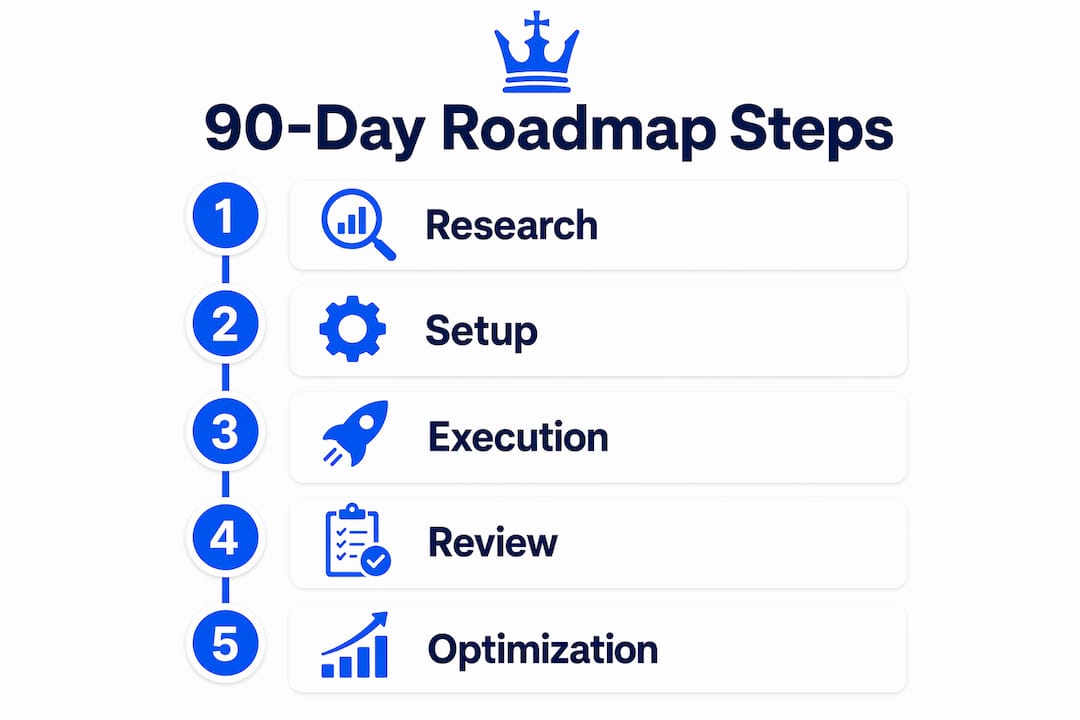
The standard structure breaks into three 30-day phases:
-
Days 1–30: Research and setup. This phase covers audits, audience research, competitor analysis, and channel configuration. You are not running campaigns yet. You are building the foundation. Activities include reviewing your current SEO performance, setting up tracking in Google Analytics 4, and confirming your North Star metric. Skipping this phase is the single most common reason campaigns underperform.
-
Days 31–60: Execution. Campaigns go live. Content gets published. Paid ads begin running. The 90-day roadmap format enables marketing teams to test hypotheses and reallocate resources promptly. This phase is where you gather real performance data, not assumptions. You track weekly, not monthly, so you catch problems early.
-
Days 61–90: Optimize and scale. You analyze what worked, cut what did not, and put more budget or effort behind your top performers. This is also when you begin planning the next 90-day cycle. The output of this phase feeds directly into your next roadmap.
Pro Tip: Set a weekly 30-minute review meeting during the execution phase. Teams that review data weekly catch budget waste and missed opportunities three to four weeks faster than those that review monthly.
The iterative nature of this structure is its greatest strength. Each cycle makes you smarter. By the end of three cycles, you have nine months of real performance data shaping your decisions.

What are the best measurement practices for a digital marketing roadmap?
Measurement is where most roadmaps fail. Teams track marketing metrics like impressions and follower counts but never connect them to business outcomes. Measuring marketing ROI is a top operational priority for marketing leaders, and it requires explicit linkage between roadmap items and revenue or market share. Tracking impressions without tying them to leads or sales tells you nothing useful.
A strong measurement plan includes:
- KPIs tied to business outcomes. Every initiative on your roadmap needs a metric that connects to revenue, leads, or customer retention. Use your marketing ROI calculator to assign a dollar value to each channel’s contribution.
- A reporting cadence. Weekly check-ins for active campaigns, monthly summaries for channel performance, and quarterly reviews for roadmap-level decisions. Each cadence serves a different decision-making need.
- A measurement plan with optimization steps. Roadmaps need a measurement plan that includes KPIs, reporting frequency, and defined actions to take when performance drops. Without the optimization step, reporting becomes a passive exercise.
- Attribution clarity. Know which channel gets credit for a conversion. Multi-touch attribution models give a more accurate picture than last-click alone, especially for businesses running both SEO and paid ads simultaneously.
Pro Tip: Build your measurement dashboard before you launch any campaign. If you cannot measure it from day one, you will not have the data you need when it matters most in the optimize phase.
Understanding how to measure marketing ROI accurately is the difference between knowing your roadmap is working and just hoping it is.
How do you maintain focus when developing a marketing roadmap?
Focus is the hardest discipline in digital marketing. Every platform promises results, and every new trend creates pressure to add another channel. The businesses that win are the ones that go deep on a few channels rather than shallow on many. Depth over breadth is a proven principle: mastering a few digital channels produces better results than spreading efforts thinly across many platforms.
The SES framework offers a practical way to maintain that focus. SES stands for Search, Email, and Social. Each represents a core channel category, and the framework recommends focusing on one strong tactic per channel for efficient resource allocation. For a small business in Albuquerque, that might mean local SEO for Search, a monthly newsletter for Email, and one social platform where your audience actually spends time.
The table below shows how channel focus affects outcomes:
| Approach | Channels active | Typical result |
|---|---|---|
| Scattered presence | 6–8 platforms | Thin content, low engagement, poor ROI |
| Focused depth (SES) | 2–3 core channels | Consistent content, stronger audience, measurable growth |
Limiting your roadmap to 3–5 high-priority initiatives also protects your team’s time. Every initiative you add competes for the same budget, attention, and creative capacity. A roadmap with twelve priorities has no priorities. Choose fewer, execute better, and measure the results before adding anything new.
Key Takeaways
A digital marketing roadmap works because it connects every marketing activity to a measurable business goal within a defined timeframe, preventing wasted spend and scattered effort.
| Point | Details |
|---|---|
| Define before you execute | Set SMART goals, audience, and channels before launching any campaign. |
| Use 90-day cycles | Break your roadmap into three 30-day phases for agility and faster learning. |
| Pick a North Star metric | Choose one primary metric that reflects business impact, then support it with operating metrics. |
| Focus on 3–5 initiatives | Limiting priorities keeps your team accountable and your budget effective. |
| Measure ROI, not just activity | Link every roadmap item to revenue or leads, not just impressions or clicks. |
Why the 90-day roadmap changed how I think about marketing strategy
I have worked with business owners who spent thousands of dollars on annual marketing plans that were outdated before the ink dried. The market shifted, a competitor changed tactics, or a new platform emerged, and suddenly the plan was irrelevant. The 90-day roadmap fixed that problem for me personally.
What I find most valuable is not just the shorter timeframe. It is the discipline the structure forces. When you know you have 90 days and three phases, you stop debating and start doing. The research phase keeps you from launching blind. The execution phase keeps you from overthinking. The optimize phase keeps you honest.
The SES framework also deserves more credit than it gets. Business owners constantly ask me which social platform they should be on, and my answer is always the same: pick one, master it, then expand. The businesses I have seen grow fastest are the ones that resisted the urge to be everywhere and instead became genuinely good at two or three channels.
My practical advice is this: write your first 90-day roadmap in a single afternoon. Set one North Star metric. Choose two channels. Define three initiatives. That is enough to start. Complexity can come later. Clarity comes first.
— Bernadette
How King Digital Marketing Agency helps you build a roadmap that delivers results
Building a roadmap sounds straightforward until you are staring at a blank page with a marketing budget on the line. King Digital Marketing Agency works with small and medium-sized businesses to create customized 90-day digital marketing roadmaps grounded in real data and local market insight.

The team at King Digital Marketing Agency handles everything from the initial audit through channel selection, KPI setup, and campaign execution. Every roadmap ties directly to your business goals, whether that means more qualified leads, stronger local visibility, or better ROI on your ad spend. If you are ready to replace guesswork with a plan that actually tracks, visit the digital marketing success guide to see how King Digital Marketing Agency builds roadmaps that produce results you can measure.
FAQ
What is a digital marketing roadmap in simple terms?
A digital marketing roadmap is a structured plan that maps out your marketing activities, timelines, and goals so every action connects to a measurable business outcome.
How long should a digital marketing roadmap be?
The recommended timeframe is 90 days, broken into three 30-day phases covering research and setup, execution, and optimization.
How many channels should a marketing roadmap include?
Roadmaps should focus on 2–3 core channels to start, using the SES framework of Search, Email, and Social as a practical guide for channel selection.
What is the difference between a digital marketing strategy and a roadmap?
A digital marketing strategy defines your goals and approach. A roadmap translates that strategy into specific phases, timelines, and metrics that your team executes and tracks.
How do you measure the success of a digital marketing roadmap?
Success is measured by linking each initiative to a North Star metric and supporting KPIs tied to business outcomes like revenue, qualified leads, or customer acquisition cost.
Recommended
- Questions to Ask a Digital Marketing Agency in 2026
- Your Guide to Effective Digital Marketing Solutions | King Digital Marketing Agency
- Why invest in digital marketing: grow your Albuquerque business in 2026
- Startup Success: Your Digital Marketing Launchpad | King Digital Marketing Agency
