TL;DR:
- Local SEO takes time because Google builds trust through a phased process involving reviews, citations, and profile activity. Visible results appear after several weeks or months, with high competition extending the timeline significantly. Consistent effort and maintaining trust signals accelerate progress and improve chances of ranking higher over time.
Local SEO is defined as the process of improving a business’s visibility in geographically targeted search results, and it takes time to work because Google must first verify your business’s trustworthiness before moving your rankings. This is not a flaw in the system. It is the system. Google evaluates dozens of trust signals, including review velocity, NAP consistency, and Google Business Profile activity, before committing to ranking your business higher. Understanding why local SEO takes time to work is the first step toward building a plan that actually delivers results. At King Digital Marketing Agency, we work with local business owners every day who expect fast results and need a clear picture of what the process actually looks like.
What are the key phases in the local SEO timeline?
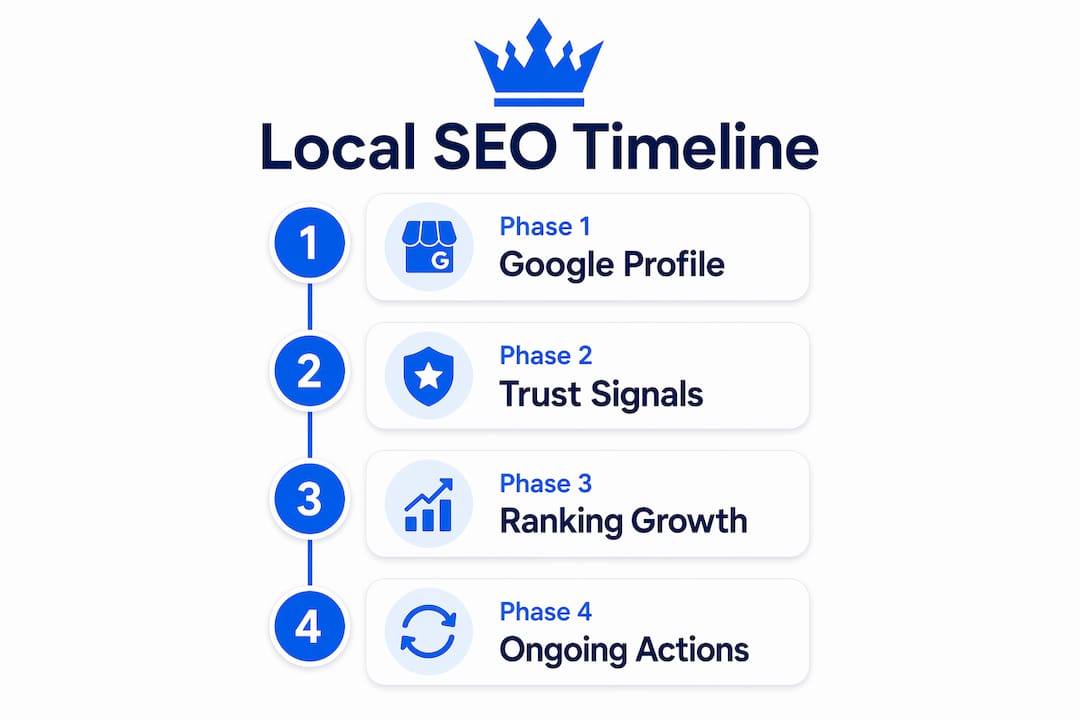
Local SEO results follow a predictable sequence of phases, and knowing each one helps you set realistic expectations from day one.
-
Crawling and indexing (weeks 1–2). Google takes 1–2 weeks to crawl and index changes you make to your website or Google Business Profile. No ranking movement happens during this window. Think of it as Google reading your file before deciding anything.
-
Google Business Profile lift (weeks 3–5). Profile activity, including photos, posts, and updated hours, registers with Google faster than website changes. GBP improvements show within 3–5 weeks for most small businesses. This is the earliest visible sign that your efforts are working.
-
Early ranking movement (weeks 8–16). Analysis of 200 small businesses found a median ranking movement at 10 weeks, with website rankings shifting after 10–14 weeks. This is when you start seeing real position changes in local pack results.
-
Meaningful, stable results (months 3–6). Significant ranking changes typically appear after 2–3 months of consistent effort. Stability, meaning rankings that hold rather than fluctuate, comes closer to the 6-month mark.
-
Sustained authority (months 6 and beyond). This is where compounding kicks in. Businesses that stay active past month 6 build authority that becomes increasingly difficult for competitors to displace.
One important distinction: local pack rankings (the map results) and organic website rankings follow different timelines. Your Google Business Profile can climb into the local pack weeks before your website ranks on page one. Treat them as two separate goals with overlapping strategies.
How do trust signals like review velocity and NAP consistency affect timing?
Trust signals are the load-bearing foundation of local SEO. Without them, your timeline extends indefinitely, regardless of how much other work you do.
Review velocity is the rate at which new reviews arrive, and it predicts ranking speed more accurately than total review count alone. Businesses with 2+ new reviews per month rank approximately 60% faster than those with stagnant review profiles. Google interprets fresh reviews as proof that a business is active, legitimate, and trusted by real customers.
NAP consistency refers to the accuracy of your Name, Address, and Phone number across every directory, citation, and platform where your business appears. Inconsistencies in this data are one of the most common reasons local SEO stalls. NAP inconsistencies delay local pack rankings by an average of 6 weeks. That delay compounds when multiple directories carry conflicting information.
Common pitfalls that hurt your trust signals include:
- Unclaimed or duplicate Google Business Profile listings
- Old addresses or phone numbers left on Yelp, Yellow Pages, or industry directories
- Business name variations (abbreviations, punctuation differences) across platforms
- No response strategy for incoming reviews, which signals low engagement
Consistent citations across major directories, including Google, Bing Places, Apple Maps, and Yelp, build the foundational trust Google needs to rank your business with confidence. A thorough Google Business Profile audit catches most of these issues before they cost you weeks of progress.
Pro Tip: Set a monthly reminder to check your top 10 directory listings for NAP accuracy. One outdated phone number on a high-authority directory can quietly stall your local pack progress for weeks.
Why does competition level affect how long local SEO takes?
Competition is the single biggest variable in the local SEO results timeframe. Two businesses in the same city can follow identical strategies and see results months apart, simply because of what they are competing against.

High-competition categories like legal or dental in major cities may require 9–11 months before meaningful local SEO results appear. These markets are saturated with established businesses that have years of reviews, authoritative backlinks, and optimized profiles. Breaking into the local pack requires outpacing all of them on every signal simultaneously.
Specialty trades in mid-size markets, such as a niche contractor or a specialty food shop in a smaller city, can reach page one within 8–12 weeks. The competition is thinner, the existing authority of top-ranked businesses is lower, and Google has fewer strong signals to compare against.
| Market type | Typical timeline | Key challenge |
|---|---|---|
| High-competition urban (legal, dental) | 9–11 months | Established authority and review volume |
| Mid-competition local service | 3–6 months | Consistent NAP and review velocity |
| Low-competition specialty niche | 8–12 weeks | Profile completeness and initial citations |
Your existing online authority also matters. A business with an aged domain, prior press mentions, or a history of local citations starts ahead of a brand-new listing. If your business is new, factor in an extra 4–8 weeks for Google to build baseline confidence in your profile. Understanding local search ranking factors helps you identify where your business sits on this spectrum before you set timeline expectations.
What ongoing actions accelerate local SEO results?
Consistent activity is what separates businesses that see results in 3 months from those still waiting at month 9. Local SEO is not a one-time setup. It is an ongoing process that rewards steady effort.
GBP activity signals register within 2–4 weeks, which means inconsistent posting resets your engagement signals and delays progress. Treat your Google Business Profile like a social channel that needs regular attention.
Actions that accelerate your local SEO timeline:
- Post to your Google Business Profile at least once per week (offers, updates, photos)
- Ask every satisfied customer for a review within 24 hours of service completion
- Respond to every review, positive or negative, within 48 hours
- Audit your NAP citations quarterly and correct any discrepancies immediately
- Publish locally relevant content on your website, such as neighborhood guides or local project spotlights
- Build relationships with local organizations, chambers of commerce, and complementary businesses for natural link opportunities
Avoid abandoning your campaign during months 2–4. This is the window where most businesses see only modest movement and lose confidence. That period is when Google is actively testing your signals against competitors. Stopping now means starting over later.
Pro Tip: Create a simple weekly checklist: one GBP post, one review request follow-up, and one citation check. That 20-minute routine compounds into measurable ranking gains over 90 days.
How do you measure progress during the local SEO timeline?
Measuring local SEO progress requires tracking the right signals at the right intervals. Early wins look different from stable rankings, and confusing the two leads to premature decisions.
Early visibility signals to track in the first 60 days:
- Google Business Profile views and search impressions (available in your GBP dashboard)
- “Discovered” searches, meaning how often your profile appears for non-branded queries
- Direction requests and phone call clicks from your profile
- Website sessions from local organic search in Google Search Console
After month 3, shift your focus to ranking position tracking for your target keywords and call volume trends. These are the metrics that reflect real business impact.
Ranking volatility is normal during months 2–4. Google runs what the industry calls “ranking tests,” temporarily moving businesses up or down to measure user behavior. A drop in week 8 does not mean your campaign is failing. It often means Google is actively evaluating you. 61% of businesses abandon local SEO before the 4-month mark, missing the compounded gains that follow. Staying the course through volatility is one of the highest-value decisions a local business owner can make. Pairing your local efforts with a solid local SEO keyword research strategy ensures you are tracking the terms that actually drive customers through your door.
Key Takeaways
Local SEO takes time to work because Google builds trust in your business through a phased evaluation of review velocity, NAP consistency, and ongoing profile activity before committing to stable rankings.
| Point | Details |
|---|---|
| Timeline phases are predictable | Expect GBP lifts in 3–5 weeks, ranking movement by weeks 8–16, and stable results by month 6. |
| NAP inconsistencies cost real time | Conflicting business data across directories adds an average of 6 weeks to your local pack timeline. |
| Review velocity beats review count | Earning 2+ new reviews per month accelerates ranking speed more than a large but stagnant review total. |
| Competition sets the ceiling | High-competition niches like legal or dental can require 9–11 months; low-competition niches may rank in 8–12 weeks. |
| Quitting early is the biggest mistake | 61% of businesses abandon local SEO before month 4, missing the compounded gains that follow sustained effort. |
The truth about patience and local SEO that most agencies won’t tell you
I have worked with local business owners long enough to know that the hardest part of local SEO is not the technical work. It is the waiting. And I understand why. You invest time, money, and energy, and then you watch a dashboard that barely moves for two months. That feels like failure. It is not.
What I have seen repeatedly is that the businesses that treat local SEO as a trust-building feedback loop, not a quick fix, are the ones that eventually dominate their local markets. The businesses that quit at month 3 hand their competitors a gift. Those competitors stay consistent, and by month 6, they are untouchable.
The other thing I tell every client: set your expectations before you start, not after you get frustrated. Know your competition level. Know your starting authority. Know that a dental practice in Albuquerque competing against 40 established listings needs a different mindset than a specialty florist in a smaller market. The timeline is not random. It is logical. And once you understand the logic, the patience becomes a lot easier to maintain.
— Bernadette
How King Digital Marketing Agency helps you build local SEO momentum
Local SEO requires consistent, coordinated effort across your Google Business Profile, citations, reviews, and content. That is a lot to manage while running a business.
King Digital Marketing Agency works with small and medium-sized businesses to handle every layer of local SEO, from NAP audits and citation cleanup to review management and GBP optimization. Our team monitors your progress, catches issues before they stall your timeline, and keeps your profile active so Google’s trust in your business keeps growing. If you are ready to build the kind of local authority that holds rankings for years, our local search optimization guide is a strong starting point. When you are ready for hands-on support, our team is here to build a plan around your market, your competition, and your goals.
FAQ
How long does local SEO take to show results?
Most small businesses see first ranking movement between 8–16 weeks, with Google Business Profile improvements appearing in 3–5 weeks. Stable, meaningful results typically arrive between months 3–6.
Why is my local SEO so slow compared to competitors?
NAP inconsistencies, low review velocity, and inactive Google Business Profiles are the most common causes of a delayed local SEO timeline. Fixing these three areas accelerates progress faster than any other action.
Does review count or review frequency matter more for local SEO?
Review frequency matters more. Businesses earning 2+ new reviews per month rank significantly faster than those with a large but stagnant review total, because Google treats fresh reviews as an active trust signal.
What happens if I stop my local SEO campaign early?
Stopping before month 4 resets much of the trust and authority you have built. Research shows 61% of businesses quit before this point, which is precisely when compounded ranking gains begin to accelerate.
How does competition affect my local SEO timeline?
High-competition categories like legal or dental in major cities can take 9–11 months for meaningful results. Low-competition specialty niches in mid-size markets can reach page one in as little as 8–12 weeks.
Recommended
- Top Mistakes in Local SEO: 2026 Fix-It Guide
- Local Marketing SEO: Unfair Advantage in 2025
- Local SEO best practices 2025: Dominate & Grow
- Understanding Local Search Ranking for Business Growth
