TL;DR:
- Content strategy involves planning, governing, and measuring content as a valuable business asset. It emphasizes clear goals, audience understanding, content audits, and ongoing performance tracking to ensure long-term growth. Building strong governance and system processes is essential for sustainable and measurable content success.
Content strategy is defined as the deliberate plan for creating, managing, governing, and measuring content as a business asset to achieve specific goals and engage your audience. It is not a content calendar. It is not a blog schedule. Think of it as the operating system that runs every piece of content your business produces, from your website copy to your social media posts. Harvard Business School Professor Sunil Gupta puts it plainly: content drives SEO and owned media, making a clear plan the difference between marketing that compounds and marketing that wastes budget.
What is content strategy and what does it actually include?
Content strategy is the planning, production, governance, and measurement of content treated as a business asset, not an afterthought. That distinction matters more than most business owners realize. When content is treated as an afterthought, you end up with disconnected blog posts, orphan web pages, and social content that goes nowhere. When it is treated as an asset, every piece has a purpose, an audience, and a measurable outcome.

The content strategy definition recognized by practitioners like Kristina Halvorson includes four core pillars: what content gets built, who it is for, how it is produced and governed, and how success is measured. Salesforce, the Interaction Design Foundation, and Columbia University all align on this framework. Content strategy guides planning, delivery, and maintenance across the full content lifecycle, not just the creation phase.
A strong content strategy also produces six operational artifacts: a positioning statement, a content model, a taxonomy, an editorial calendar, brief templates, and a governance RACI. These six artifacts make strategy operational, meaning your team can produce content consistently without making ad hoc decisions every week. Without them, even the best content ideas stay fragmented.
How do you create a content strategy step by step?
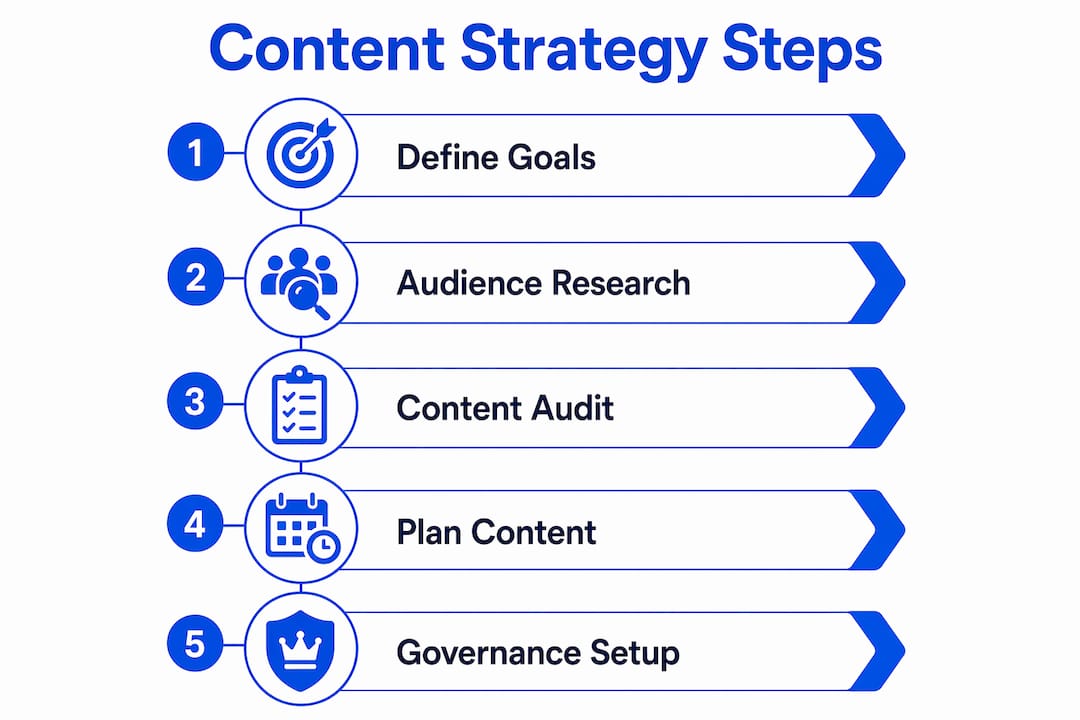
A standard content strategy framework follows seven core steps. Each step builds on the last, and skipping any one of them creates gaps that show up later as wasted effort or missed results.
- Define your goals. Decide what the content must accomplish. Examples include increasing organic search traffic, generating leads, or building brand authority in your local market.
- Identify your audience. Go beyond demographics. Map the questions your audience asks, the problems they face, and the channels they use. Tools like Google Search Console and Answer the Public reveal real search behavior.
- Audit existing content. Review what you already have. Identify what performs, what is outdated, and what has no clear purpose. This step prevents you from duplicating effort.
- Plan your topics and content types. Match topics to audience needs and business goals. Decide which formats serve each topic best: long-form articles, short videos, landing pages, or email sequences.
- Create and optimize content. Write, design, and produce content with SEO, clarity, and user intent in mind. Tools like Grammarly and Hemingway Editor improve readability before publication.
- Distribute through the right channels. Publish where your audience already spends time. A local Albuquerque business may prioritize Google Business Profile, local SEO, and Facebook over LinkedIn.
- Measure and refine. Track performance against your goals. Use data to cut what does not work and scale what does.
Pro Tip: Most teams skip the audit in step three because it feels slow. Skipping it means you will rebuild content you already have, miss quick wins from existing pages, and repeat the same topic gaps. The audit is where strategy pays off fastest.
How does content strategy differ from content marketing and content design?
These three terms get used interchangeably, and that confusion costs businesses real money. Each discipline has a distinct role, and understanding the difference helps you hire the right people and build the right processes.
Content marketing focuses on producing and distributing content to attract and retain customers. It is the execution layer: blog posts, email campaigns, social content, and video series. Content marketing without strategy is calendar-driven and unaccountable. You publish consistently but cannot explain why specific topics were chosen or what they produced.
Content design focuses on clarity, user experience, and formatting. Content designers ask how information should be structured so users can act on it. They work closely with UX teams and product teams to make content usable, not just readable.
Content strategy is the governing layer above both. It sets the rules, the goals, and the systems that content marketing and content design operate within.
| Discipline | Primary Focus | Key Output |
|---|---|---|
| Content strategy | Goals, governance, and measurement | Positioning statement, governance RACI, content model |
| Content marketing | Audience growth and customer acquisition | Blog posts, email campaigns, social content |
| Content design | Clarity, UX, and information structure | Structured copy, UX writing, formatted guides |
Why is content strategy important for business owners?
The importance of content strategy shows up most clearly in what happens without it. Teams produce volume without direction. Content pieces compete with each other in search results. Brand messaging drifts across channels. Budget gets spent on content that no one finds.
Harvard Business School’s Sunil Gupta states that content is the foundation of SEO and owned media. That means every dollar you spend on search optimization depends on the quality and structure of your content. A content strategy makes those SEO investments work harder by ensuring content is planned around real search intent, not guesswork.
“Content strategy treats content as a business asset rather than a marketing afterthought, emphasizing audit, governance, and measurement for sustainable growth.” — Kristina Halvorson
The benefits of content strategy extend well beyond search rankings. Here is what a working strategy delivers:
- Efficiency. Teams spend less time debating what to create because the strategy defines priorities.
- Consistent brand messaging. Every piece of content reflects the same voice, values, and positioning.
- Audience engagement. Content built around real audience needs earns more time on page, more shares, and more return visits.
- Discoverability. Structured, well-governed content ranks better and stays relevant longer.
- Measurable ROI. When goals are defined upfront, you can track whether content is actually earning its keep. Tools like a marketing ROI calculator make this concrete.
Organizations often undervalue content strategy because its benefits are second-order effects. Alignment, discoverability, and governance are not as visible as page views or follower counts. That invisibility is exactly why so many businesses skip the strategy layer and then wonder why their content never compounds.
What are the biggest challenges in implementing content strategy?
The most common failure point is not topic selection. Most teams struggle with governance, taxonomy, and decision rights. Without clear ownership, content gets created by whoever has time, reviewed inconsistently, and published without a clear purpose. The result is volume without compounding value.
Orphan pages are a concrete symptom of this problem. An orphan page is a piece of content with no internal links pointing to it, no clear audience, and no defined goal. It exists on your website but does nothing for your business. Governance structures and editorial processes prevent orphan content by defining who creates, reviews, and publishes each piece, and why.
Another common challenge is treating content strategy as a one-time document. A strategy written in january and filed away is not a strategy. It is a plan that has already expired. Content strategy requires regular review cycles, updated briefs, and a living editorial calendar.
Pro Tip: Build a one-page governance document before you write your first piece of content. List who owns creation, who approves it, and where it lives after publication. That single document eliminates 80% of the coordination problems that slow content teams down.
You can build a smarter content workflow by starting with governance, not topics. Define the system first. The content follows naturally.
How do you measure content strategy effectiveness?
Measurement is where most content strategies either prove their value or quietly fade out. Continuous measurement and optimization based on data are what separate a living strategy from a static document. The goal is not to track everything. The goal is to track the metrics that connect directly to your business goals.
Key performance indicators for content strategy fall into four categories:
- SEO performance: organic traffic, keyword rankings, and click-through rates from search results.
- Engagement: time on page, scroll depth, social shares, and return visitor rate.
- Conversion: form submissions, phone calls, email sign-ups, and purchases attributed to content.
- Content health: number of orphan pages, outdated articles, and duplicate topics.
| Metric category | What it tells you | How often to review |
|---|---|---|
| SEO performance | Whether content is being found | Monthly |
| Engagement | Whether content is resonating | Weekly |
| Conversion | Whether content drives business outcomes | Monthly |
| Content health | Whether your content library is well-governed | Quarterly |
Tracking online marketing metrics consistently gives you the data to cut underperforming content, update high-potential pieces, and double down on topics that drive real results. Without this review cycle, your strategy becomes a guess you never correct.
Key Takeaways
A content strategy that treats content as a governed business asset, not a publishing schedule, is the single most reliable path to compounding online growth.
| Point | Details |
|---|---|
| Content strategy definition | It is the plan for creating, governing, and measuring content as a business asset with clear goals. |
| Seven-step framework | Follow goals, audience, audit, planning, creation, distribution, and measurement in sequence. |
| Governance is the hard part | Most teams fail at decision rights and taxonomy, not topic selection. |
| Benefits are long-term | Alignment, discoverability, and ROI compound over time and are not visible in vanity metrics. |
| Measure what matters | Track SEO, engagement, conversion, and content health on a regular review cycle. |
What I have learned after years of watching content strategies succeed and fail
I have seen business owners invest thousands of dollars in blog content that never ranked, never converted, and never got updated. The content was well-written. The problem was always the same: no governance, no measurement, and no clear reason for each piece to exist.
The uncomfortable truth about content strategy is that most businesses skip the hard parts. They build an editorial calendar, hire a writer, and call it a strategy. That is content production. It is not content strategy. The difference shows up six months later when the content library is full and the leads have not moved.
What actually works is building the system before the content. Define your goals in writing. Map your audience’s real questions, not the questions you wish they were asking. Audit what you already have before creating anything new. Then govern the process so quality stays consistent as you scale.
The other thing I want you to understand is that content strategy is not a marketing department problem. It is a business decision. When your content reflects a clear positioning statement and targets real audience needs, it becomes one of the most cost-effective assets your business owns. It works while you sleep. It answers customer questions before they call. It builds trust before a prospect ever meets you.
Invest in the governance layer. Build the briefs. Define the decision rights. That is where the compounding starts.
— Bernadette
How King Digital Marketing Agency can help you build a content strategy that works
Content strategy is only as good as its execution. King Digital Marketing Agency works with small and medium-sized businesses across Albuquerque to build content plans grounded in real SEO data, clear audience research, and measurable goals.
The team at King Digital Marketing Agency combines SEO-friendly website design with content planning to make sure your content gets found and converts. Whether you are starting from scratch or fixing a fragmented content library, King Digital Marketing Agency provides the structure, the process, and the expertise to turn your content into a compounding business asset. Reach out to King Digital Marketing Agency to get a content strategy built around your specific goals, your audience, and your market.
FAQ
What is the simplest content strategy definition?
Content strategy is the plan for creating, governing, and measuring content to achieve specific business goals. It covers what gets built, who it is for, how it is managed, and how success is tracked.
What are content strategy goals?
Content strategy goals typically include improving organic search rankings, increasing audience engagement, generating qualified leads, and building consistent brand authority across channels.
How long does it take to create a content strategy?
A basic content strategy can be built in two to four weeks. A thorough strategy that includes a content audit, audience research, and governance documentation typically takes four to eight weeks.
What is the difference between content strategy and content marketing?
Content strategy is the governing system that defines goals, governance, and measurement. Content marketing is the execution layer that produces and distributes content. One without the other produces either unused plans or unaccountable publishing.
How do you measure content strategy success?
Track SEO performance, engagement metrics, conversion rates, and content health on a regular schedule. Measuring marketing ROI from content requires connecting specific pieces to business outcomes like leads and sales, not just page views.
Recommended
- Build a winning content strategy process for Albuquerque SMBs
- Social Media Strategy Step by Step for SMBs
- Types of Content for Local Businesses That Actually Work
- Why Update Website Content: SMB Guide for 2026
