What B2B Content Writing Really Means (And Why It Matters in 2026)
B2B content writing is the practice of creating written content – blog posts, white papers, case studies, emails, and more – that helps one business attract, educate, and convert other businesses as customers.
Quick answer:
- What it is: Writing content aimed at business buyers, not individual consumers
- Who reads it: Managers, executives, and buying committees making high-stakes decisions
- Why it works: It builds trust, drives organic traffic, and moves buyers through a long sales cycle
- Common formats: Blog posts, guides, case studies, white papers, email sequences, landing pages
- Key goal: Turn qualified readers into leads, and leads into customers
B2B content writing is not just a marketing tactic. It is the backbone of how modern businesses grow online. Unlike writing for everyday shoppers, B2B writing speaks to professionals who are solving real business problems – improving efficiency, reducing risk, scaling operations. These readers are skeptical, busy, and often part of a buying group that includes 10 or more stakeholders.
According to Content Marketing Institute, 91% of B2B organizations use content marketing – a higher adoption rate than B2C. And with 68% of all online experiences starting with a search engine, the businesses that invest in quality B2B content are the ones that show up first when buyers come looking.
The challenge? Most B2B content is forgettable. It is keyword-stuffed, jargon-heavy, and written for search bots rather than real people. That gap between what gets published and what actually converts is exactly where good B2B writing creates its biggest advantage.
I’m Bernadette King, founder of King Digital Marketing Agency, and I’ve spent my career turning complex products and services into clear, compelling content that drives measurable results – making B2B content writing a core pillar of every growth strategy I build. In this guide, I’ll walk you through everything you need to know to create B2B content that ranks, resonates, and converts.
B2b content writing vocab to learn:
What is B2B Content Writing?

At its heart, B2B content writing is about translating complex products, software, or services into clear, actionable, and trust-building narratives. When one business writes for another, it isn’t trying to spark an impulse buy. Instead, it is trying to establish authority, solve a specific pain point, and provide the logical proof required to justify a commercial investment.
To write effective B2B content, you must move beyond the superficial. You aren’t just selling a tool; you are selling a solution that helps a department head meet their quarterly targets, helps a CFO save money, or helps a CEO scale operations.
B2B vs. B2C: Key Differences in Audience and Intent
The differences between B2B and B2C writing come down to who is reading, why they are reading, and how they make decisions. While B2C content often pulls on emotional triggers, immediate desires, and personal identity, B2B content relies on logic, evidence, and long-term value.
In B2B, you are rarely writing for a single reader. Instead, you are writing for a buying committee. A single purchase decision might require approval from IT, finance, legal, and the end-users themselves. This means your content must address multiple pain points and answer technical, financial, and operational questions all at once.
| Feature | B2B Content Writing | B2C Content Writing |
|---|---|---|
| Primary Audience | Buying committees, executives, managers | Individual consumers, solo shoppers |
| Decision Drivers | ROI, efficiency, scalability, logic | Emotion, status, immediate gratification, price |
| Sales Cycle | Long (3 to 12+ months) | Short (minutes to days) |
| Content Tone | Professional, authoritative, educational | Casual, conversational, highly engaging |
| Key Metrics | Pipeline revenue, MQLs, organic leads | CTR, immediate sales, social engagement |
To understand how professional content writing services adapt to these differing needs, explore our comprehensive guide on A Comprehensive Guide to Content Writing Services.
The Economic Impact of Professional B2B Content Writing
Investing in high-quality B2B content writing is not just an administrative expense; it is a powerful driver of business growth. Consider the data:
- High-ROI Channels: Blogs have the highest return on investment (ROI) of any digital marketing channel, alongside social media shopping tools and influencer marketing.
- Compounding Value: Unlike paid advertising, which stops generating leads the moment you stop spending, SEO-optimized B2B content continues to attract organic traffic and generate leads for months or even years after publication.
- Email Performance: Email sequences and newsletters driven by strategic writing continue to deliver, with data showing that emails drive an average of $36 for every $1 spent.
- Direct Pipeline Impact: A single, well-researched blog post targeting a high-intent commercial keyword can yield massive returns. For example, B2B tech companies often see hundreds of thousands of dollars in pipeline revenue generated from a single top-ranking asset.
For small and medium-sized businesses (SMBs) in our local communities – from Albuquerque and Rio Rancho to Santa Fe and the East Mountains – content is the ultimate equalizer. It allows local service providers and tech firms to compete with national brands by dominating local search intent and establishing clear regional authority. To learn how to leverage this locally, read about Content Marketing Strategies That Grow Albuquerque SMB Leads.
Strategic Frameworks for the Modern Buyer Journey
To write content that actually converts, we must align our writing with a structured strategy. In 2026, successful B2B brands do not simply publish random articles; they build comprehensive topical authority maps based on their Ideal Customer Profile (ICP).
Building an ICP involves understanding the exact types of businesses that get the most value from your services. Once you have defined your target businesses, you must map out the individual buyer personas within those companies. In a typical B2B transaction, you will need to address several key roles:
- The Initiator: The person who first identifies the problem and starts looking for a solution.
- The Influencer: The team member who researches options and recommends specific vendors.
- The Decision-Maker: The executive who holds the final sign-off power.
- The Gatekeeper: The IT or legal professional who ensures the solution meets security and compliance standards.
To learn how to structure this process for your business, take a look at our guide on how to Build Winning Content Strategy Albuquerque SMBs.
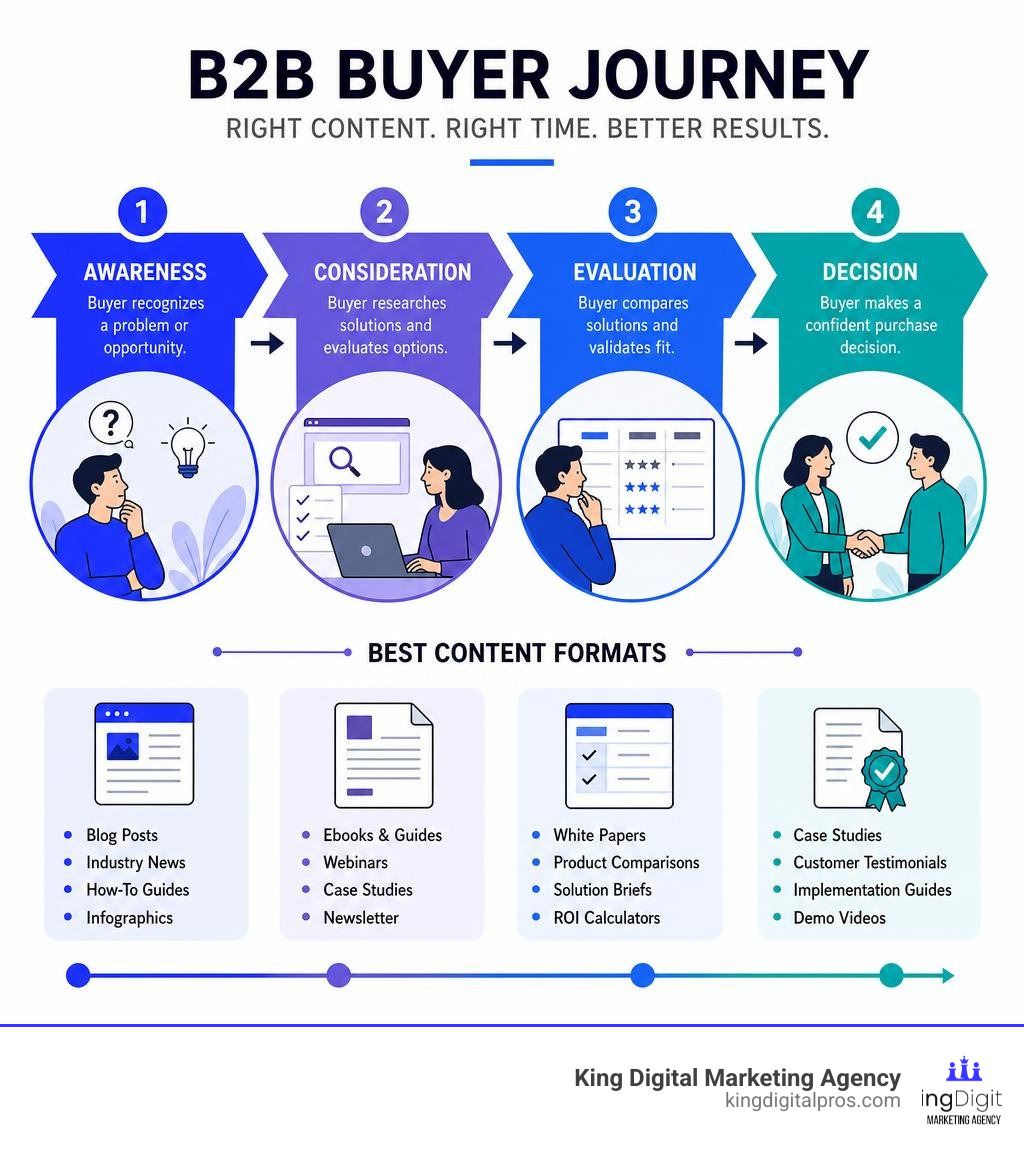
Mapping Content Formats to the Marketing Funnel
A successful B2B writing strategy matches specific content formats to the appropriate stages of the buyer journey:
- Top-of-the-Funnel (TOFU) – Awareness: At this stage, prospects are looking for answers to broad industry questions or trying to define a problem they are experiencing. The best formats here are educational blog posts, definitive guides, and infographics. The goal is to capture search traffic and build initial brand awareness. Discover more about this in our resource on Business Blog Writing.
- Middle-of-the-Funnel (MOFU) – Consideration: Prospects now understand their problem and are actively researching potential solutions. This is where you use gated e-books, white papers, webinars, and in-depth use cases to capture contact information and build trust.
- Bottom-of-the-Funnel (BOFU) – Decision: Buyers are comparing specific vendors and preparing to make a purchase. To help them make their final decision, write detailed case studies, competitor comparison pages, and ROI documentation.
To scale your production across all these stages, many businesses rely on professional content creation services that understand how to align copy with search intent.
Building Topical Authority and Answer Engine Optimization
Search engine optimization has changed. In 2026, search engines like Google and AI-driven Answer Engines (like ChatGPT and Google’s Gemini-powered AI Overviews) no longer look for isolated keywords. Instead, they reward topical authority – which means comprehensively covering a subject area through structured content clusters.
A content cluster consists of a broad, comprehensive “pillar page” (typically 3,000 to 6,000 words) that links to and from several shorter, highly specific “cluster articles.” This structure signals to search engines that your website is a highly credible, expert source on the topic.
Furthermore, with the rise of Answer Engine Optimization (AEO), we must structure our B2B content to provide direct, clear answers to common industry questions. If an executive asks an AI assistant to recommend a vendor or explain a complex process, your content must be structured in a way that allows the AI to easily parse, cite, and recommend your business. Learn how to design this modern architecture by studying Semrush’s Guide to B2B SEO Strategy.
Best Practices for Creating High-Impact Business Content

Writing for businesses does not mean your writing has to be dry or boring. In fact, because business buyers are constantly inundated with generic, AI-generated filler, clear and engaging human writing stands out more than ever.
Here are the core principles for writing high-impact B2B content:
- Prioritize Scannability: On average, web visitors only read 20% to 28% of the words on a page. Use clear headings, bulleted lists, and bold text to highlight key takeaways. Keep paragraphs short (under five lines on a desktop screen).
- Use Clear, Direct Language: Avoid unnecessary corporate jargon. If you can explain a concept using simple, everyday words, do so. Speak directly to your reader’s practical experience.
- Support Claims with Data: Business buyers are naturally skeptical. Every claim you make should be backed up by recent statistics, original research, or real-world examples.
- Focus on the Core Message Early: Do not bury your main point. State your primary solution or answer in the very first few paragraphs so busy readers know they are in the right place.
How to Balance SEO with Creative Storytelling
A challenge in B2B content writing is balancing search engine requirements with compelling storytelling. If you write purely for search bots, your content will feel robotic and fail to convert. If you write purely for creative expression, your content may never be found.
The secret is to use a human-first approach. Start by writing a compelling narrative that addresses a real human problem, and then optimize it for search engines using a natural keyword integration process. Weave customer stories, real-world case studies, and practical anecdotes into your guides to keep readers engaged.
For a deeper dive into balancing these elements, explore HubSpot’s Guide to Website Content Writing.
Overcoming Common Challenges in B2B Content Writing
B2B writers face unique hurdles, from managing technical complexity to aligning multiple stakeholders. Here is how to overcome them:
- Handling Technical Complexity: If you are writing about highly technical topics like cybersecurity or fintech, don’t try to fake expertise. Interview internal subject matter experts (SMEs), read technical documentation, and translate those complex ideas into clear business benefits.
- Maintaining Freshness: B2B industries evolve quickly. Set a quarterly schedule to audit and update your top-performing posts to ensure all statistics, links, and product details remain accurate.
- Sourcing Local Talent: If you are building a local presence in New Mexico, finding writers who understand both your industry and your local market is key. You can search for local professionals on platforms like Freelance Writing Jobs in Albuquerque, NM | Writers.Work , connect with local business hubs like East Mountains – FatPipe NM , or look into professional writing networks like the The Taos Writer’s Retreat Waitlist – Jennifer Louden .
For a step-by-step approach to local content optimization, read our SEO Content Creation Guide Albuquerque Local Leads.
Frequently Asked Questions about B2B Writing
What is the difference between B2B and B2C writing?
B2B (business-to-business) writing targets professional decision-makers and buying committees. It focuses on logic, return on investment (ROI), operational efficiency, and long-term value, typically supporting a long sales cycle. B2C (business-to-consumer) writing targets individual shoppers, focusing on personal emotions, immediate needs, lifestyle alignment, and quick purchasing decisions.
How long does it take to see results from B2B content?
While high-intent landing pages can drive immediate conversions, a comprehensive organic B2B content strategy typically takes 3 to 6 months to mature. Over this period, search engines index your content clusters, your topical authority grows, and you start seeing a steady, compounding stream of organic leads and pipeline revenue.
Should businesses use AI to write B2B content?
AI tools are highly effective for research, outlining, and improving writing efficiency. However, they should not be used to completely automate the writing process. B2B buyers and search engines demand original insights, real-world experience, and verified data – qualities that require human writers and editors to ensure accuracy, brand voice, and trust.
Conclusion
Mastering B2B content writing is one of the most effective ways to build trust, establish authority, and drive sustainable, organic lead generation for your business. By understanding your audience’s pain points, structuring your content for modern search and answer engines, and balancing technical accuracy with engaging storytelling, you can turn your website into a powerful revenue-generating asset.
At King Digital Marketing Agency, we specialize in helping businesses grow their online presence and attract more customers. Beyond content strategy, we are experts in optimizing Google Business Profiles and managing local map listings to ensure your business stands out exactly when local buyers are searching for your services. Whether you are operating in Albuquerque, Rio Rancho, Santa Fe, Taos, or the East Mountains, we are here to help you build a winning digital presence.
Ready to take your business growth to the next level? Explore our professional Content Creation Services and let’s start building your custom strategy today.
