TL;DR:
- Regularly updating website content maintains accuracy, strengthens SEO, and keeps your business competitive in AI and traditional search results. Fresh pages with ongoing revisions outperform new content by 106% on average and help preserve existing backlinks and authority. Implementing a structured refresh plan ensures faster search visibility, improved user trust, and sustained traffic growth for SMBs.
Updating website content is the process of revising and optimizing existing pages to keep information accurate, relevant, and competitive in search results. For small and medium-sized business owners, this practice is not optional maintenance. It is one of the highest-return activities in your entire marketing program. Updated content can grow organic search views by 106% on average, outperforming brand-new pages. That number reflects a core truth: your existing pages already carry authority, backlinks, and indexed history. Refreshing them is faster, cheaper, and more effective than starting from scratch. Google Search Console, HubSpot, and Semrush all confirm that content freshness directly influences rankings, AI citations, and user trust.
Why update website content: the SEO case you cannot ignore
Google rewards pages that stay current, and the evidence from 2026 is hard to argue with. Google’s May 2026 Core Update explicitly targets surfacing relevant, satisfying, and recently updated content from all site types. That means a page you published two years ago and never touched is actively losing ground to competitors who refresh theirs regularly.
The impact extends beyond traditional search. AI-powered answer engines like ChatGPT, Perplexity, and Google’s AI Overviews now drive a significant share of discovery traffic. AI search engines prefer content updated within the last six months, with Semrush reporting citation rates of 73% to 81% across top AI platforms for fresh content. That preference means your update cadence now directly determines whether your business appears in AI-generated answers.
The mechanics behind this are straightforward. When you refresh an existing page, that page keeps its backlinks and its indexed authority. Ten Speed’s research shows that refreshed pages move rankings from position nine to position five within four weeks after a meaningful update. A brand-new page starts at zero and takes months to build the same trust signals. For an SMB with limited time and budget, the refresh-first approach delivers faster results.
Pro Tip: Connect your pages to Google Search Console and filter by “impressions” with low click-through rates. Those are your highest-priority refresh candidates. A page ranking on page two with strong impressions is one good update away from page one.
What are the key reasons SMBs should refresh their site regularly?
The reasons to update website content go well beyond SEO rankings. Here is what stale content actually costs your business, and why a regular refresh schedule protects your investment.
- Accuracy and trust. Outdated pricing, discontinued services, or old staff bios signal to visitors that your business is not paying attention. Stale content is linked to higher bounce rates and reduced user trust, both of which hurt conversions directly.
- Brand alignment. Your business evolves. New services, rebranded messaging, and updated value propositions need to be reflected on every page. A website that contradicts your current pitch confuses prospects at the worst possible moment.
- Competitive positioning. When a competitor refreshes their content and yours stays static, they gain ground in rankings and in perceived authority. Staying current is how you hold your position.
- Technical health. Broken links, outdated calls-to-action, and expired offers create friction. Regular content reviews catch these issues before they quietly drain your conversion rate.
- User experience. Visitors who find current, well-organized information stay longer and engage more. Pages with updated FAQs, clear CTAs, and recent examples reduce the cognitive load on your reader and move them toward a decision faster.
- Traffic protection. Content decay causes an average traffic loss of 37% within 12 months for pages left untouched. Systematic refresh programs can recover up to 78% of that lost traffic, according to Ahrefs 2026 data.
Each of these reasons compounds the others. A page with outdated information, broken links, and declining rankings is not just underperforming. It is actively working against your business.
How often should SMBs update their website content?
Update frequency depends on content type, industry pace, and the signals your analytics are sending. There is no single answer, but there are clear patterns that work for most SMBs.

AI search engines surface fresher content faster than traditional search, which makes update cadence more critical in 2026 than it was even two years ago. A blog post that was accurate in 2024 may now cite outdated statistics, reference deprecated tools, or miss entirely new search intent patterns. The general guidance from content research points to a three-to-six-month review cycle for most business content.
The table below gives you a practical framework based on content type.
| Content type | Recommended update frequency | Key trigger for immediate update |
|---|---|---|
| Blog posts and articles | Every 3 to 6 months | Traffic drop, outdated stats, or competitor refresh |
| Service and product pages | Every 6 months | Pricing change, new offering, or ranking decline |
| Homepage and about page | Annually or after rebrand | Brand messaging shift or leadership change |
| FAQ pages | Every 3 months | New customer questions or AI citation gaps |
| Landing pages | After each campaign cycle | Low conversion rate or outdated offer |
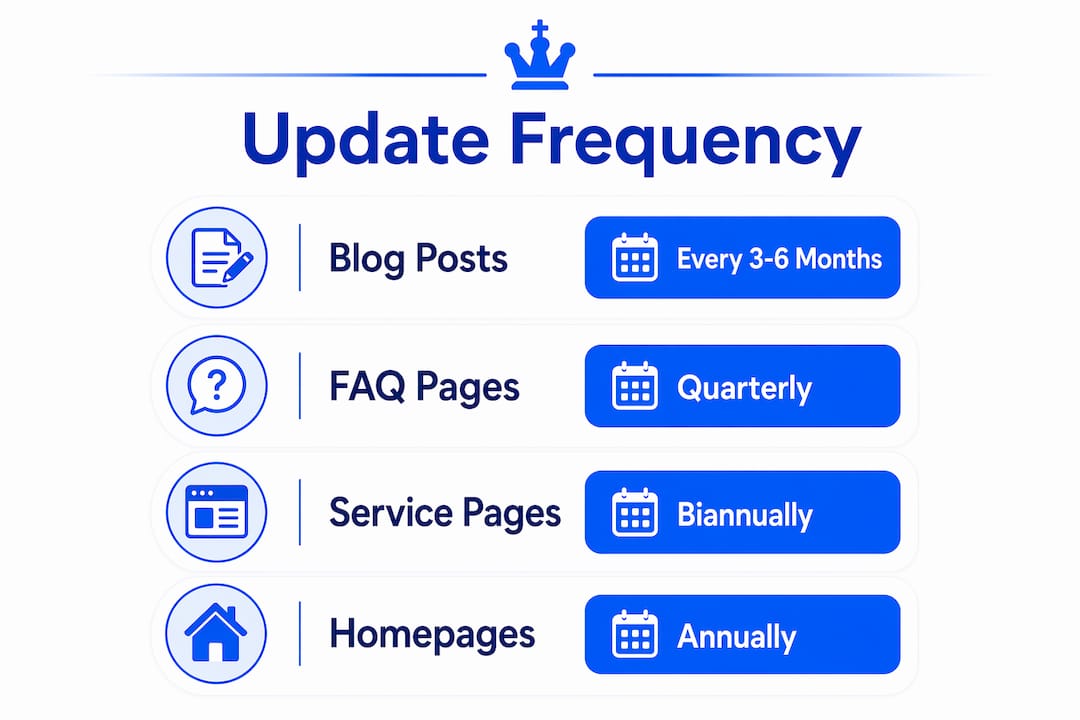
The most reliable trigger for an immediate update is a traffic drop of 15% or more over 60 days in Google Search Console. That pattern almost always points to content decay, a competitor refresh, or a shift in search intent that your page no longer matches. Catching it early means recovery is faster and less expensive.
What are the best practices for effective content updates?
Knowing you need to update is one thing. Knowing how to update so that Google and your readers both reward you is another. The following workflow is what King Digital Marketing Agency recommends to SMB clients who want measurable results from their refresh efforts.
- Audit your existing content. Pull your pages into a spreadsheet and sort by organic traffic, bounce rate, and time on page using Google Search Console and Google Analytics. Pages with declining traffic and high impressions are your first targets.
- Match current search intent. Search your target keyword and study the top five results. If the format, depth, or angle of your page no longer matches what Google is surfacing, rewrite to align. Intent shifts are one of the most common causes of ranking drops.
- Update statistics, examples, and references. Replace any data point older than 18 months. Swap out case studies that reference outdated tools or platforms. Readers and AI engines both notice when your evidence is stale.
- Revise headlines and metadata. Your title tag and meta description are the first things a searcher sees. If they were written years ago, they likely miss current keyword patterns and click-through opportunities. Tools like HubSpot’s AEO grader can flag gaps in AI visibility.
- Strengthen internal linking. Add links to newer related content on your site. This distributes authority, keeps visitors engaged longer, and signals to Google that your site is actively maintained. For a deeper look at how site structure affects this, the SEO-friendly design guide from King Digital Marketing Agency walks through the architecture side.
- Add or expand FAQs. Answer Engine Optimization requires well-structured, clearly formatted content to be surfaced by AI-powered answer engines. FAQ sections are one of the highest-value additions you can make to any page.
- Measure and iterate. Set a 30-day and 60-day checkpoint after each refresh. Track ranking position, organic clicks, and bounce rate. Use those numbers to decide whether the page needs another pass or is ready to hold.
Pro Tip: Never update just the publish date without making substantive changes to the content itself. Superficial date changes are penalized by search engines and flagged by Google’s March 2025 update as a trust signal violation. Every refresh must include real improvements to earn the ranking benefit.
For SMBs in competitive local markets, the content optimization steps for Albuquerque SMBs published by King Digital Marketing Agency offers a region-specific framework that pairs well with this workflow.
Key takeaways
Refreshing existing pages delivers faster SEO gains than creating new content because updated pages retain backlinks, indexed authority, and ranking history while satisfying Google’s and AI engines’ preference for fresh information.
| Point | Details |
|---|---|
| Refresh beats new content | Updated pages grow organic views by 106% on average, faster than brand-new pages. |
| AI engines favor freshness | Semrush data shows 73% to 81% of AI citations go to content updated within six months. |
| Content decay is costly | Pages left untouched lose an average of 37% of traffic within 12 months. |
| Update frequency by type | Blogs need review every 3 to 6 months; service pages every 6 months; FAQs every 3 months. |
| Substance over cosmetics | Date-only updates are penalized. Every refresh must include real content improvements. |
Why I treat content updates as the highest-ROI task in SMB marketing
I have worked with dozens of small businesses over the years, and the pattern I see most often is this: a business owner invests in a well-built website, gets solid initial traction, and then shifts focus to running the business. The website sits untouched for 18 months. Traffic quietly erodes. By the time they notice, they are looking at a recovery project instead of a maintenance task.
The uncomfortable truth is that most SMBs do not need more content. They need better content from what they already have. Refreshing underperforming pages across a site often yields faster ROI than any new content campaign, because the authority is already there. You are not building from zero. You are restoring something that already has momentum.
What I recommend to every client is treating content updates as a scheduled business activity, not a reaction to a traffic drop. Build a quarterly review into your calendar. Assign ownership. Measure the results the same way you measure any other marketing spend. The businesses that do this consistently are the ones that hold their rankings through algorithm updates and outpace competitors who are still publishing new posts and ignoring their existing library.
The content freshness research backs this up clearly. Fresh content is not a nice-to-have in 2026. It is the baseline requirement for staying visible.
— Bernadette
How King Digital Marketing Agency helps SMBs keep their content competitive
Your website is your hardest-working sales tool, and it only performs when the content inside it is current, accurate, and optimized for how people search today.
King Digital Marketing Agency works with small and medium-sized businesses to audit, refresh, and maintain website content that ranks and converts. From technical SEO to page-level rewrites, the team handles the work so you can stay focused on your business. If your site has not been updated in the last six months, it is likely losing ground right now. Explore the website update service to see exactly how King Digital Marketing Agency approaches content refreshes for SMBs, or review the SEO-friendly design framework to understand how structure and content work together for maximum search visibility.
FAQ
Why does updating website content improve SEO rankings?
Search engines like Google prioritize pages that are accurate, current, and aligned with what users are searching for today. Refreshed pages also retain their existing backlinks and authority, which means ranking improvements happen faster than they would for a new page.
How often should a small business update its website?
Blog posts and FAQ pages benefit from a review every three to six months, while service pages and homepages can be reviewed every six to twelve months. Any page showing a traffic drop of 15% or more over 60 days should be reviewed immediately.
Does refreshing old content work better than writing new content?
For most SMBs, yes. Refreshed pages outperform new pages because they inherit existing SEO authority, and the average post-refresh growth in organic views is 106%. New pages start with no authority and take significantly longer to rank.
What counts as a meaningful content update?
A meaningful update includes revising outdated statistics, rewriting sections to match current search intent, improving headlines and metadata, adding FAQs, and strengthening internal links. Changing only the publish date without editing the content is penalized by search engines and does not qualify as a real refresh.
What is Answer Engine Optimization and why does it matter for SMBs?
Answer Engine Optimization, or AEO, is the practice of structuring content so AI-powered search tools like Perplexity and Google’s AI Overviews can cite it directly. Well-structured pages with clear FAQs and updated information are far more likely to appear in AI-generated answers, which now represent a growing share of how customers find local businesses.
Recommended
- Web Design for SMBs: What You Need to Know
- Website Performance Improvement Tips for SMB Success
- Build a Smarter Content Marketing Workflow in 2026
- Build a winning content strategy process for Albuquerque SMBs
