Website update service: Vital for 2025 Growth
Why Your Website Needs More Than Just a Pretty Design
Website update service is the ongoing professional maintenance that keeps your business website secure, fast, functional, and visible in search results. It includes content updates, security patches, performance optimization, design improvements, and technical fixes – ensuring your digital storefront works as hard as you do.
What a Website Update Service Typically Includes:
- Security Updates – Plugin patches, malware scans, SSL certificate management
- Content Changes – Text updates, new pages, pricing changes, contact information
- Technical Maintenance – Broken link fixes, database optimization, backup management
- Performance Improvements – Speed optimization, mobile responsiveness, bug fixes
- Design Improvements – Visual refreshes, new features like galleries or forms
Your website is often the first interaction a potential customer has with your business. But here’s the reality: 38% of people will stop engaging with a website if the content or layout is unattractive, and 48% cite a website’s design as the number one factor in deciding the credibility of a business. A website that worked perfectly six months ago can become slow, outdated, or even vulnerable to security threats without regular attention.
Think of your website like your physical storefront. You wouldn’t let dust pile up on the windows or leave a broken door hanging for weeks. The same principle applies online. Outdated information, broken forms, expired security certificates, or slow loading times send a clear message to customers: this business might not be active anymore.
The good news? Professional website update services handle all of this for you – from the simple stuff like changing your business hours to the complex technical work like security patches and code updates that keep everything running smoothly behind the scenes.
I’m Bernadette King, founder of King Digital, and I’ve spent years helping local businesses transform their online presence through strategic website update service solutions. After building multiple successful businesses and working with franchise owners and small business operators, I’ve seen how regular website maintenance directly impacts visibility, trust, and revenue.
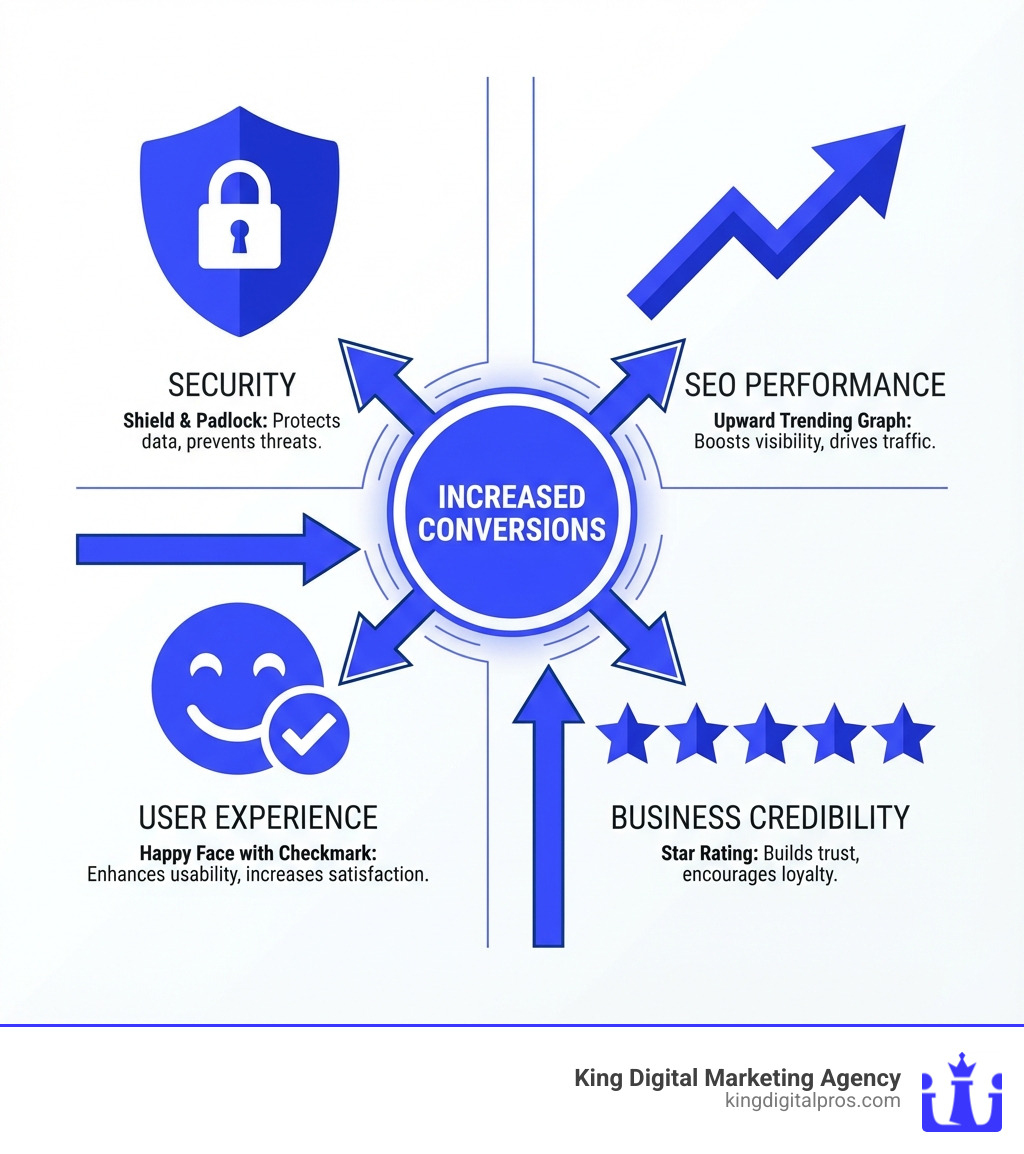
Why Regular Website Updates are Non-Negotiable
In today’s digital world, your website isn’t just an online brochure; it’s a dynamic tool that represents your business 24/7. Neglecting it is like leaving your physical store unattended – eventually, customers will stop coming. Regular website update service ensures your online presence remains vibrant, engaging, and trustworthy, especially for businesses in our local New Mexico communities like Albuquerque, Santa Fe, and Rio Rancho.
Consider these critical points:
- User Engagement: As the statistic highlights, nearly four out of ten people will abandon a website if its content or layout is unappealing. We want visitors to stay, explore, and convert, not click away in frustration.
- Business Relevance: An outdated website can make your business appear inactive or unprofessional. When customers see current information, fresh content, and a modern design, it signals that you are active, attentive, and ready for business. It confirms you’re still serving clients in places like Los Alamos and Taos.
- Competitive Edge: Your competitors are likely investing in their online presence. Regular updates help you keep pace, or even surpass them, ensuring your website stands out. This is particularly crucial in competitive markets like Edgewood and Grants.
- Building Customer Trust: A well-maintained website builds credibility. When 48% of people judge a business’s credibility by its website design, you know it’s a make-or-break factor. Trust is the foundation of any successful business relationship, and your website is often the first place it’s earned.
Investing in a consistent website update service is an investment in your business’s future. It keeps your digital storefront welcoming and efficient, ready to convert curious clicks into loyal customers. For more insights into how design impacts visibility, explore our guide on SEO Friendly Website Design.
The Impact on SEO and User Experience (UX)
Think of your website as a digital magnet. To attract the right customers in places like Corrales and Sandia Park, it needs to be powerful, polished, and perfectly positioned. This is where the synergy between SEO (Search Engine Optimization) and UX (User Experience) comes into play, heavily influenced by your website update service.
- Search Engine Rankings: Search engines like Google favor websites that are regularly updated, fast, secure, and mobile-friendly. An active website update service ensures your site meets these criteria, leading to higher rankings in search results. Broken links, for example, are a red flag to search engines and can negatively impact your SEO.
- User-Friendly Navigation: A website that is easy to steer keeps users engaged longer. If visitors can’t find what they’re looking for within a few seconds, they’ll leave. Updates often include refining navigation paths and improving site structure.
- Mobile Responsiveness: With a majority of internet traffic now coming from mobile devices, a responsive design isn’t optional; it’s essential. Your website update service ensures your site looks and functions flawlessly on any screen size, from smartphones in Tijeras to tablets in Cedar Crest.
- Page Speed: We’ve all been there – waiting for a slow page to load. It’s frustrating, and often, we just give up. Research shows that a one-second delay in page load time can lead to a 7% reduction in conversions. Regular technical updates optimize images, code, and server responses to keep your site lightning-fast.
- Unattractive Layout & Credibility: As we mentioned, 38% of people will disengage from an unattractive site, and 48% judge your business’s credibility on its design. A modern, clean, and intuitive design reinforces your professional image and builds trust.
By prioritizing these elements through a dedicated website update service, we ensure your website isn’t just found, but loved by both search engines and your potential customers. Dig deeper into optimizing your site’s structure for search engines with our article on How to Create an SEO Friendly Website Design Structure.
Bolstering Your Website’s Security
Imagine leaving your business’s front door open uped in a busy city. That’s essentially what an unmaintained website is – an open invitation for trouble. For businesses across New Mexico, from Albuquerque to Taos, safeguarding your online assets is paramount. Our website update service includes robust security measures to protect your digital property.

- Malware Protection & Hacking Prevention: The internet can be a wild west. Malicious software (malware) and hackers are constantly looking for vulnerabilities. Outdated software, plugins, and themes are common entry points. Regular security updates patch these holes, making it much harder for cybercriminals to gain access.
- Software & Plugin Updates: Just like your computer or smartphone, your website’s underlying software (like WordPress) and its various plugins need constant updating. These updates often contain critical security fixes. Neglecting them leaves your site exposed.
- Security Certificates (SSL): An SSL certificate encrypts data passed between your website and its visitors, protecting sensitive information like passwords and credit card details. This is why you see “HTTPS” in your browser’s address bar. Without an up-to-date SSL certificate, browsers will warn visitors that your site is “not secure,” driving them away and hurting your SEO.
- Data Protection: Beyond protecting your customers’ data, strong website security protects your own business data, intellectual property, and reputation. A security breach can be devastating, leading to financial losses, legal issues, and a significant blow to customer trust.
We take security seriously, implementing regular scans, firewalls, and updates to keep your website safe from evolving threats. Think of us as your digital security guard, working tirelessly behind the scenes. And to ensure your website is always online and accessible, we also recommend tools that monitor website uptime for free, providing an extra layer of vigilance.
How Often Should You Update Your Website?
The question of “how often” is a popular one, and the answer, like a good New Mexico green chile dish, has layers! There’s no one-size-fits-all schedule, as the ideal frequency for your website update service largely depends on your business type, industry, and goals. However, we can provide some general guidelines:
- Content Updates (Weekly to Monthly): This includes new blog posts, news articles, case studies, or changes to product descriptions. Fresh content keeps your audience engaged and signals to search engines that your site is active and relevant. For businesses in fast-moving sectors, weekly updates might be ideal, while others might thrive on a monthly cadence.
- Technical Maintenance (Monthly to Quarterly): This covers the essential but often unseen tasks. Think of it as your website’s regular oil change and tire rotation. We’re talking about updating your CMS (like WordPress) core files, themes, and plugins. These updates are crucial for security, performance, and compatibility. Monthly checks are ideal for active sites, while quarterly might suffice for simpler, less dynamic ones.
- Security Scans & Backups (Daily to Weekly): Security should be an ongoing, almost constant process. Automated daily security scans and weekly backups are non-negotiable. If anything goes wrong, a recent backup is your lifeline.
- Design & Functionality Reviews (Annually to Biannually): Technology and design trends evolve rapidly. A full review of your website’s design, user experience, and functionality should happen at least once a year, or every two years. This ensures your site remains modern, intuitive, and competitive.
- Business Type Dependency: An e-commerce site with hundreds of products will require more frequent and intensive updates than a static informational site for a local service provider in Grants or Edgewood. The more dynamic your business and its online offerings, the more frequent your updates should be.
A proactive approach to your website update service is always best. Don’t wait until something breaks or becomes outdated. For a deeper dive into custom maintenance schedules, read our guide on Small Business Website Maintenance.
What’s Included in a Comprehensive Website Update Service?
When we talk about a comprehensive website update service, we’re not just referring to a quick fix here and there. We’re talking about a holistic approach to keeping your website in peak condition, much like maintaining a classic car – it needs regular care, not just when it breaks down.
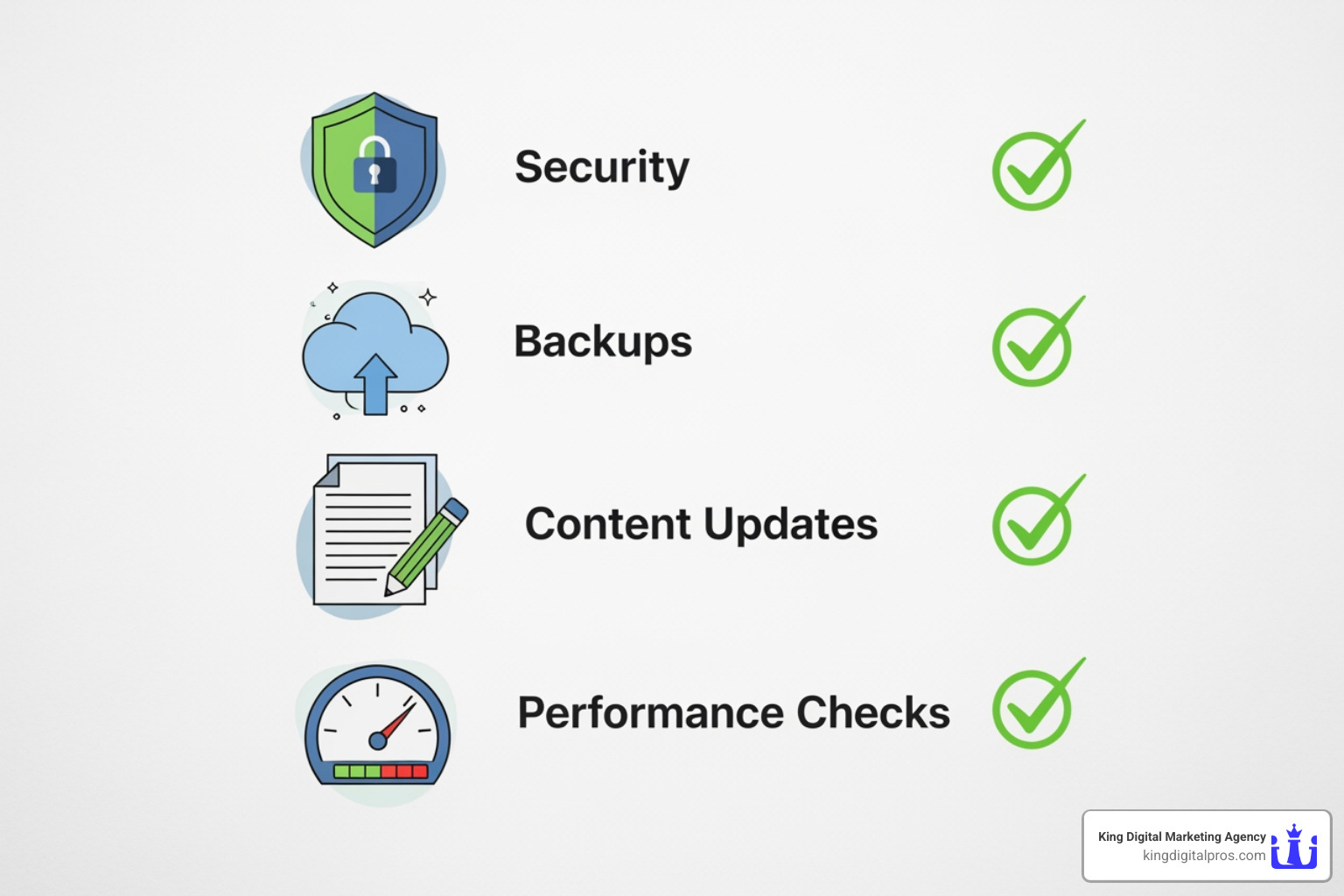
Many businesses initially opt for one-time updates when they need a specific change, like updating business hours or adding a new service. While these ad-hoc requests are certainly part of what we offer, the true power lies in ongoing website maintenance. This proactive service ensures continuous security, performance, and relevance, saving you from costly emergencies down the line. It’s about keeping your website robust and ready for anything, so you don’t have to stress about it.
The scope of services can be incredibly broad, custom to your specific needs. From tiny tweaks to significant overhauls, our goal is to handle the technical heavy lifting so you can focus on running your business in places like Albuquerque, Santa Fe, or Rio Rancho. To understand the depth of tasks involved, check out our article on What Does a Website Manager Change for a Maintenance?.
Content and Information Updates
This is often the most visible aspect of any website update service, and it’s where your business communicates directly with your audience. Outdated or incorrect information can be incredibly detrimental to your credibility and customer experience. We ensure your website always reflects the most current and accurate representation of your business.
Here’s a list of common content updates we handle:
- Adding New Blog Posts/Articles: Regularly publishing fresh content is vital for SEO and engaging your audience with valuable information.
- Updating Contact Information: Phone numbers, addresses (especially for multi-location businesses in New Mexico), email addresses, and contact forms must always be accurate.
- Adjusting Pricing and Services: If your offerings or prices change, your website should be updated immediately to avoid customer confusion.
- Staff Changes: Updating team bios, adding new employees, or removing former ones ensures your “About Us” page is current.
- Company News and Announcements: Sharing milestones, new initiatives, or important updates keeps your audience informed.
- Event Calendars: For businesses hosting events in areas like Taos or Los Alamos, keeping event listings current is crucial.
- Removing Outdated Promotions: Expired offers can lead to disappointment and frustration for your visitors.
Ensuring this information is always current helps maintain your professional image and builds trust with your customer base.
Technical Maintenance and Performance
While content updates are the face of your website, technical maintenance is the heart and lungs. It’s the essential work happening behind the scenes that keeps everything running smoothly, securely, and efficiently. Our website update service dives deep into the technical elements to ensure optimal performance.
Key technical tasks we perform include:
- WordPress Core Updates: Keeping the foundational software of your WordPress site up-to-date is critical for security and accessing new features.
- Theme & Plugin Management: We ensure your website’s theme and all plugins are compatible and regularly updated. Outdated plugins are a common cause of security vulnerabilities and site malfunctions.
- Website Backups: Regular, reliable backups are your ultimate safety net. In the event of a catastrophic failure, a recent backup means your site can be restored quickly.
- Database Optimization: Over time, your website’s database can become cluttered, slowing down your site. Optimization cleans it up, improving speed and efficiency.
- Fixing Web Forms: Non-functioning contact forms or lead generation forms are lost opportunities. We test and fix these crucial elements.
- Error Resolution: From broken links to 404 errors and beyond, we identify and resolve technical issues that can harm user experience and SEO.
- Performance Monitoring: We continuously monitor your site’s speed and uptime, proactively addressing any slowdowns or outages.
These technical tasks are vital for maintaining a healthy, fast, and secure website. Without them, even the most beautifully designed site can crumble. Find the full range of how we can support your online presence through our comprehensive services.
Design and Functionality Improvements
Your website’s design isn’t just about aesthetics; it’s about functionality, usability, and reflecting your brand’s evolution. A dynamic website update service helps you keep your digital storefront fresh, engaging, and equipped with the latest features.
Here’s how we improve design and functionality:
- Visual Refresh: Design trends change, and so do user expectations. A visual refresh can modernize your site’s look, improve its appeal, and reinforce your brand’s image. This can involve updating color schemes, fonts, imagery, and overall layout.
- Adding New Pages: As your business grows and your offerings expand, you’ll need new pages for new services, products, or information. We seamlessly integrate these into your existing site structure.
- Feature Additions: Want to showcase your products with a stunning photo gallery? Need to embed a video to explain a complex service? Or maybe add a new booking system for your Corrales business? We can integrate these features to improve user engagement.
- UI/UX Improvements: User Interface (UI) and User Experience (UX) are paramount. We analyze how users interact with your site and make improvements to navigation, layout, and calls-to-action to make their journey smoother and more intuitive.
- Custom Coding: For unique functionalities or specific design elements that off-the-shelf solutions can’t provide, our expertise in custom coding ensures your website can do exactly what you need it to do.
- Theme Customization: If you’re using a pre-built theme, we can customize it to better match your brand identity and provide unique features without compromising its core functionality.
Staying ahead of the curve in terms of design and functionality can significantly impact how users perceive your brand and interact with your content. It also helps you stand out from competitors. To keep an eye on what your rivals are doing, consider tools that monitor competitor website changes.
Finding Your Ideal Website Update Partner
Deciding whether to handle your website updates yourself or hire a professional is a common dilemma for business owners. While a DIY approach might seem appealing for minor tweaks, we have found that for anything beyond the simplest content changes, a professional website update service is almost always the smarter choice.
Why? Because what might take us a few minutes to resolve could take a business owner hours of frustrated searching, potentially leading to errors that are even more time-consuming (and costly) to fix. We are talking about saving you valuable time and money that you can re-invest into your core business operations in areas like Albuquerque or Santa Fe.
A professional partner brings expertise and experience to the table, handling complex tasks like security patches, code updates, and performance optimizations with precision. They understand the nuances of various platforms and can preemptively address issues before they become critical. Moreover, good communication is key. We pride ourselves on clear, concise communication, ensuring you are always in the loop without being bogged down by technical jargon. For comprehensive digital support, learn more about our digital marketing agency.
For broader context on why ongoing maintenance matters, major platforms like WordPress.org and security experts at Sucuri also emphasize regular updates and monitoring as essential to website health and security.
What to Look For in a Provider
Choosing the right partner for your website update service is like picking the right mechanic for your car – you want someone knowledgeable, trustworthy, and efficient.
Here is what we believe you should look for:
- Proven Expertise: Do not just take their word for it. Look for a track record of successful projects and positive client testimonials. A good provider will have a portfolio that demonstrates their capability across various types of websites.
- Coding Knowledge: While many platforms are user-friendly, advanced customizations, bug fixes, or unique integrations often require deep knowledge of coding languages like HTML, CSS, JavaScript, PHP, or Python. This expertise ensures they can handle any challenge.
- Platform Experience: Does your website run on WordPress, Shopify, Squarespace, or something else? Ensure your prospective provider has extensive experience with your specific platform. Each CMS has its quirks, and familiarity means faster, more effective updates. We specialize in platforms commonly used by small businesses in New Mexico.
- Clear Communication: This is paramount. You need a partner who can explain technical issues in plain English, provide regular updates, and respond promptly to your queries. A lack of communication can lead to misunderstandings and delays.
- Turnaround Time: Discuss expected turnaround times for different types of updates. While emergencies happen, a good provider will have a clear process for handling requests efficiently.
- Client Reviews and Testimonials: What do other businesses say about working with them? Reviews on platforms like Google or independent review sites can offer valuable insights into a provider’s reliability and service quality. For example, some monitoring services such as UptimeRobot have strong reviews on G2.com and Trustpilot, indicating reliability.
By carefully vetting potential providers against these criteria, you can ensure you find a partner who will truly lift your online presence.
The Financials: Understanding Website Update Service Costs
When considering a website update service, understanding the associated costs is crucial. Pricing models can vary widely, reflecting the scope of work, frequency of updates, and the provider’s expertise. It is not just about the cheapest option, but about the best value for your business in places like East Mountains or Tijeras.
Here is a breakdown of common pricing models:
| Pricing Model | Description |
|---|---|
| Retainer (for example, Monthly or Quarterly Plans) | This is the most common model for ongoing website update service. You pay a recurring fee (for example, monthly or quarterly) for a defined set of services. These plans often include security monitoring, regular backups, software updates (WordPress core, themes, plugins), performance checks, and a certain number of content updates or minor design tweaks. Some plans might offer tiers such as “Essentials” for basic maintenance, “Professional” for more frequent updates and faster delivery, and “Enterprise” for priority support and fully managed services. |
| Hourly Rates | For ad-hoc or irregular updates, some providers charge an hourly rate. This is suitable for businesses with infrequent, specific needs rather than ongoing maintenance. The cost here will depend on the complexity of the task and the developer’s experience. It is important to get an estimate of hours before work begins to avoid surprises. Guidance from industry resources such as Clutch.co shows how hourly rates can vary by region and expertise. |
| Fixed-Fee One-Time Updates | In this model, a fixed price is agreed for a specific task, such as creating a new page, adding a gallery, or resolving a particular error. This approach is transparent and predictable, but it does not cover ongoing needs or unexpected issues that might arise later. |
| Per-Project Pricing | Here, a fixed price is agreed for a clearly defined project, such as redesigning the entire website or implementing a new booking system. This model offers clear cost visibility for larger initiatives and is often used alongside a retainer for future maintenance. |
Industry guides like Nielsen Norman Group highlight that long-term maintenance is typically more cost-effective than periodic large overhauls, reinforcing the value of structured maintenance plans.
The Process of a Professional Website Update Service
Understanding the typical workflow of a professional website update service can make the experience smoother and more predictable:
- Requesting an Estimate: You outline what you need updated or fixed. The provider reviews your request, may ask clarifying questions, and then supplies an estimate or recommends the appropriate maintenance plan.
- Providing Clear Instructions: To ensure accuracy and speed, you share precise directions, including links to the pages that need changes, exact text or image assets, and any design preferences.
- Sharing Login Credentials Securely: Access credentials for your CMS, hosting, or third-party tools are shared through secure methods (for example, password managers or encrypted links), never via plain text email when it can be avoided.
- Creating a Staging Environment: For larger or riskier updates, professionals often clone your site to a staging environment. This allows them to test changes without affecting your live site, reducing the risk of downtime or errors.
- Implementing Updates: The provider performs the agreed changes, whether content, design, or technical work, following best practices for security and performance.
- Testing and Quality Assurance: Before anything goes live, key functions are tested. This can include contact forms, navigation, mobile responsiveness, page load speed, and browser compatibility.
- Review and Approval: You are invited to review the changes. Any necessary revisions are made to ensure everything aligns with your expectations and branding.
- Deployment to Live Site: Once approved, updates from staging are pushed to the live environment, usually during low-traffic periods to minimize disruption.
- Monitoring and Follow-Up: After deployment, the provider monitors for issues such as errors, broken links, or performance drops, and addresses anything that appears.
- Invoicing and Payment: Finally, you receive an invoice aligned with the agreed pricing model (retainer, hourly, or project-based), along with a summary of work completed.
This structured process helps ensure your website remains secure, stable, and aligned with your business goals while minimizing risk and downtime.
