TL;DR:
- Organic lead generation relies on non-paid channels like SEO and local search to attract qualified visitors. Building detailed buyer personas, targeting long-tail keywords, optimizing your website, and tracking actual conversions are essential for sustained growth. Consistently nurturing leads with targeted content and precise measurement transforms traffic into high-quality customers.
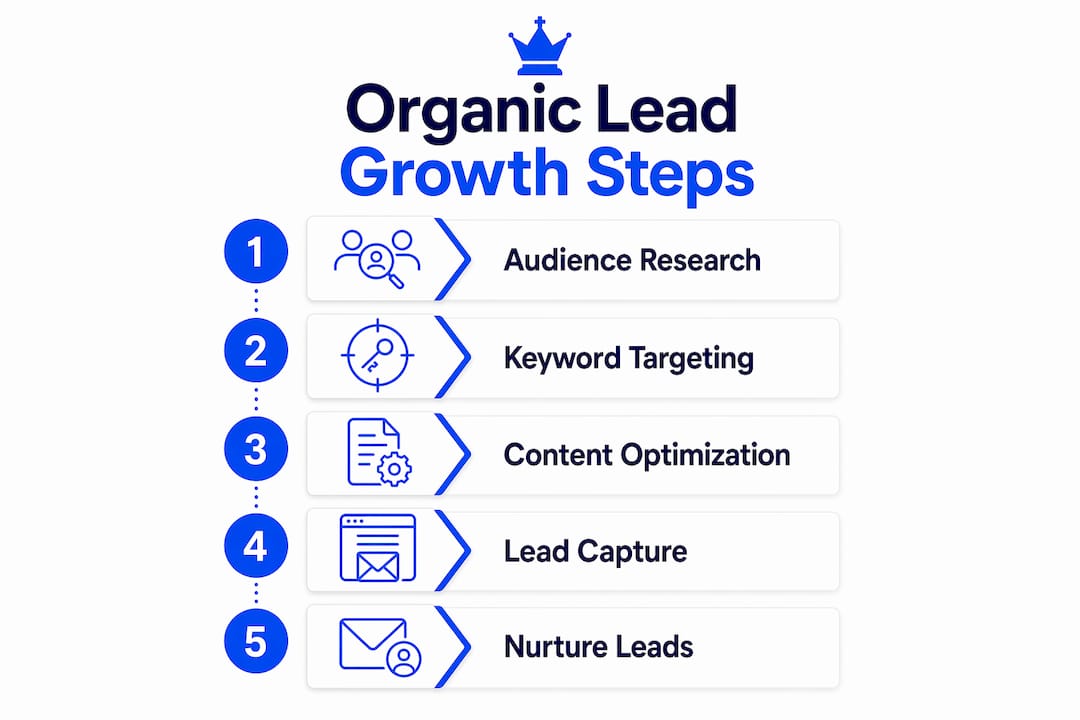
Organic lead generation is the practice of attracting potential customers through non-paid channels like SEO, content marketing, and local search visibility. When you boost organic leads through these methods, you build a self-reinforcing system where better rankings produce more qualified visitors, and more qualified visitors convert into paying customers. For small and medium-sized businesses, this approach delivers compounding returns that paid ads simply cannot match. The strategies in this guide cover audience targeting, keyword selection, website optimization, lead capture, and measurement — everything you need to generate organic leads consistently in 2026.
How to boost organic leads by knowing your audience first
You cannot attract the right visitors if you do not know who you are trying to reach. Organic lead generation starts with building buyer personas grounded in real data, not assumptions.

Pull purchasing data from your CRM, run social listening through tools like Sprout Social or Brandwatch, and review the search queries already bringing visitors to your site in Google Analytics. These three sources together reveal what your audience actually wants, not what you think they want. The gap between those two things is where most SMB lead generation strategies fail.
Once you have a clear picture of your audience, segment them by behavior and intent:
- First-time researchers who are comparing options and need educational content
- Comparison shoppers who are evaluating specific solutions and respond to case studies or reviews
- Ready-to-buy visitors who need a clear, low-friction path to contact or purchase
Each segment requires different content and a different call to action. Sending a ready-to-buy visitor to a 2,000-word educational blog post is like handing someone a menu when they have already decided what they want. Match the content to the stage.
Pro Tip: Segment your email list and landing pages by persona type. A CTA that says “Download our free guide” converts researchers. One that says “Get a free quote today” converts buyers. The same page rarely serves both well.
Why long-tail keywords are the fastest path to organic lead growth
Most SMBs chase broad, high-volume keywords and wonder why their traffic does not convert. The answer is intent. A visitor searching “marketing agency” is browsing. A visitor searching “affordable SEO agency for small business in Albuquerque” is ready to hire someone.
Long-tail keywords carry lower competition and higher conversion rates because they match the exact language buyers use when they are close to a decision. Similarweb confirms that intent-rich long-tail targeting improves lead quality far more reliably than chasing broad ranking positions. This is a fundamental shift in how you should think about SEO for lead generation.
Here is a practical process for finding and using these keywords:
- Start with your service pages. List every service you offer and write down three to five questions a customer might ask before hiring you for each one.
- Use Semrush or Ahrefs to expand those questions into keyword clusters. Filter for keywords with clear commercial or transactional intent.
- Map each keyword to a buyer journey stage. Informational keywords belong on blog posts. Transactional keywords belong on service and landing pages.
- Check search intent alignment. Look at the top three results for each keyword. If they are all blog posts, Google sees that keyword as informational. If they are service pages, it is commercial.
- Review and update your keyword list monthly. Search behavior shifts, and a keyword that underperforms in January may surge in March.
Understanding search intent is not optional for this process. It is the filter that separates keywords worth targeting from keywords that waste your time.
Pro Tip: Build a simple spreadsheet that tracks each keyword, its intent classification, the page it maps to, and its monthly conversion rate. Review it every 30 days. You will spot patterns that no tool surfaces automatically.
Optimizing your website and content to capture more organic leads
Improving SEO rankings earns more clicks from researchers actively looking for what you offer. But ranking is only half the equation. Your site also has to convert those visitors once they arrive.
On-page SEO fundamentals that still matter in 2026
Every page targeting a lead-generating keyword needs a focused title tag, a meta description that matches search intent, a clean URL structure, and schema markup where relevant. Schema markup, specifically LocalBusiness and FAQ schema, helps Google surface your content in rich results, which increases click-through rates without requiring a higher ranking position.
Content formats that generate leads
Pillar pages, detailed service pages, and comparison content consistently outperform generic blog posts for lead generation. A pillar page on “SEO for small businesses” that links to supporting posts on keyword research, local SEO, and conversion tracking builds topical authority and keeps visitors on your site longer. Answer-first content structure also improves visibility in AI-powered search engines, which increasingly surface direct answers rather than lists of links.
Here is a quick comparison of content types and their lead generation strengths:
| Content type | Best for | Lead generation strength |
|---|---|---|
| Pillar pages | Topical authority and internal linking | High |
| Service/landing pages | Transactional keywords | Very high |
| Blog posts | Informational keywords, top of funnel | Medium |
| Comparison pages | Buyer-stage visitors evaluating options | High |
| Video content | Engagement and brand trust | Medium |
Lead capture on your website
Forms, demos, and newsletter sign-ups are the primary tools for converting organic visitors into leads. Place lead capture forms above the fold on high-traffic pages. Keep form fields to a minimum — name and email is enough for a first touch. Add a specific, intent-matched CTA rather than a generic “Submit” button.
Site speed directly affects both rankings and conversions. A page that loads in under two seconds retains significantly more visitors than one that takes four seconds. Use Google PageSpeed Insights to identify and fix performance issues before they cost you leads.
Pro Tip: Add an exit-intent popup on your highest-traffic blog posts offering a relevant lead magnet. A visitor who is about to leave is still a warm prospect. A well-timed offer converts a meaningful percentage of those exits into email subscribers.
How to capture and nurture organic leads once they arrive
Getting a visitor to your site is step one. Getting them to raise their hand and say “I’m interested” is step two. Most SMBs invest heavily in step one and almost nothing in step two.
The micro-yes strategy works by asking for small commitments before asking for a big one. Instead of leading with “Book a consultation,” you first offer a free resource, a quiz, or a short email course. Each small yes builds trust and moves the visitor closer to a buying decision. This approach consistently outperforms aggressive CTAs because it respects where the visitor is in their journey.
Effective lead magnets for SMBs include:
- Ebooks or guides that solve a specific problem your ideal customer faces
- Free audits or assessments that demonstrate your expertise while delivering immediate value
- Webinars or recorded workshops that let prospects experience your knowledge before committing
- Free samples or trials for product-based businesses that remove purchase risk
- Email courses that deliver value over five to seven days and keep your brand top of mind
Once a lead opts in, segment them immediately based on what they downloaded or which page they came from. A visitor who downloaded a guide on local SEO has different needs than one who requested a pricing page. Send each segment content that matches their specific interest. Tools like Mailchimp, ActiveCampaign, or ConvertKit make this segmentation straightforward even for small teams.
Matching CTAs to buyer intent rather than using generic buttons is one of the highest-leverage changes you can make to your lead capture process. HubSpot’s research confirms that intent-aligned CTAs convert organic visitors at a measurably higher rate than generic alternatives.
Pro Tip: Never ask for a phone number in a first-touch lead magnet form. It signals a sales call is coming and dramatically reduces opt-in rates. Collect the phone number in a follow-up sequence once you have established trust.
Measuring organic lead generation for continuous improvement
SEO without conversion tracking is guesswork. You need to know which pages, keywords, and CTAs are actually producing leads, not just traffic. GA4 and GTM event-based tracking is the current standard for connecting organic search activity to real business outcomes.
The most common mistake SMBs make is tracking pageviews as a proxy for success. Pageviews are a vanity metric. A page can receive thousands of visits and generate zero leads. Custom event setup in GA4 lets you track the actions that actually matter: form submissions, phone call clicks, demo requests, and file downloads.
Here is a practical tracking framework by page type:
| Page type | Conversion event to track | Why it matters |
|---|---|---|
| Service pages | Form submission, phone click | Direct lead intent |
| Blog posts | Email opt-in, content download | Top-of-funnel capture |
| Pricing pages | Demo request, contact form | High-intent buyer signal |
| Landing pages | Form submission, CTA click | Campaign performance |
Connect Google Search Console data to GA4 to see which organic search queries are driving conversions, not just clicks. This connection reveals which keywords are producing actual leads versus which ones are producing traffic with no commercial value. Understanding how to calculate lead value from this data gives you a clear picture of your SEO ROI and helps you prioritize where to invest next.
Pro Tip: Set up a GA4 exploration report that filters organic traffic and shows conversion events by landing page. Review it weekly. Pages with high traffic and low conversions are your highest-priority optimization targets.
Key takeaways
Organic lead generation succeeds when you combine precise audience targeting, intent-matched keywords, conversion-optimized content, and event-based tracking into one connected system.
| Point | Details |
|---|---|
| Audience segmentation drives results | Build buyer personas from real data and tailor content and CTAs to each segment. |
| Long-tail keywords convert better | Target intent-rich phrases that match buyer-ready language, not broad ranking terms. |
| Content must capture, not just inform | Use forms, lead magnets, and intent-aligned CTAs to turn organic visitors into leads. |
| Track events, not pageviews | Set up GA4 custom events to measure real lead actions and connect them to organic search. |
| Nurture before you sell | Use micro-yes strategies and segmented email sequences to build trust before asking for a commitment. |
What I have learned about organic leads after years of working with SMBs
Working with small and medium-sized businesses across Albuquerque and beyond, I have seen the same pattern repeat itself more times than I can count. A business owner invests months into SEO, watches their traffic climb, and then asks why the phone is not ringing. The traffic was real. The problem was that nothing on the site was designed to capture it.
The uncomfortable truth is that most SMBs treat their website like a digital brochure rather than a lead generation system. A brochure informs. A lead generation system qualifies, captures, and nurtures. Those are fundamentally different jobs, and they require different design decisions.
I have also seen businesses obsess over ranking for broad, competitive keywords while ignoring the long-tail phrases their actual buyers use. One client of mine ranked on page one for a generic industry term and generated almost no leads from it. We shifted focus to three specific long-tail phrases with clear buyer intent, and their qualified inquiries doubled within 90 days. The traffic volume was lower. The lead quality was dramatically higher.
Patience matters here, too. Organic lead growth is not a campaign. It is a compounding asset. The content you publish today, the backlinks you earn this quarter, and the technical fixes you make this month all stack on top of each other. Businesses that stay consistent for 12 to 18 months build a lead generation engine that runs whether or not they are actively spending on ads.
My honest advice: start with your audience, get specific with your keywords, fix your lead capture, and measure what actually matters. The businesses that do all four consistently are the ones that win.
— Bernadette
Ready to build a website that generates organic leads?
Your website is the foundation of every organic lead generation strategy. If the structure is not built for SEO and conversion from the ground up, even the best content and keyword targeting will underperform. At King Digital Marketing Agency, we specialize in building and optimizing websites for small and medium-sized businesses that need to compete and win in local search.
Our team designs SEO-friendly website structures that support organic lead growth from day one, combining technical SEO, conversion-focused design, and local search strategy into one cohesive system. We also offer a full suite of services including Google My Business optimization, content marketing, and web design for SMBs tailored to your market and goals. If you are ready to turn your website into your best-performing sales asset, let’s talk.
FAQ
What are organic leads in digital marketing?
Organic leads are potential customers who find your business through non-paid channels like Google search, content marketing, or local SEO. They arrive with existing intent, which makes them more likely to convert than cold paid traffic.
How long does it take to increase organic leads through SEO?
Most SMBs see measurable organic lead growth within three to six months of consistent SEO effort, with significant compounding results appearing at the 12-month mark. The timeline depends on your starting authority, competition level, and how consistently you publish and optimize content.
What is the best tool for tracking organic lead conversions?
GA4 combined with Google Tag Manager is the current standard for SEO conversion tracking. Set up custom events for form submissions, phone clicks, and demo requests to measure actual lead actions rather than pageviews.
How do long-tail keywords help attract organic leads?
Long-tail keywords match the specific language buyers use when they are close to a decision, which means they attract visitors with higher purchase intent. Targeting these phrases consistently produces better lead quality than competing for broad, high-volume terms.
What lead magnets work best for SMB organic lead generation?
Free audits, downloadable guides, and short email courses are the highest-converting lead magnets for SMBs because they deliver immediate, specific value. Match the lead magnet to the page topic and the visitor’s stage in the buying journey for the best opt-in rates.
Recommended
- Digital marketing for Albuquerque SMBs: grow local leads
- Lead generation explained: How SMBs in Albuquerque drive growth
- Top Online Marketing Metrics for SMBs in 2026
- Social media marketing tips to boost Albuquerque SMBs
