Your Online Reputation Is Either Working For You or Against You
Reputation management platforms are software tools that help businesses monitor, respond to, and grow their online reviews and brand mentions across multiple sites – all from one place.
Here’s a quick look at the top options to compare:
| Platform | Best For | Key Strength | Starting Price |
|---|---|---|---|
| Birdeye | Multi-location businesses | AI-powered review automation | Custom quote |
| Podium | Local businesses | SMS-based review requests | Custom quote |
| Reputation.com | Enterprise brands | Rep Score + AI insights | Custom quote |
| BrightLocal | Agencies & local SEO | 80+ sites monitored | ~$44/month |
| Yext | Listings + reviews | Local search accuracy | Custom quote |
| Hootsuite + Talkwalker | Enterprise listening | Crisis detection + AI | Custom quote |
| Whitespark | Local businesses | Google review focus | From $79/month |
Think about the last time you tried a new restaurant, hired a contractor, or booked a service. Chances are, you checked the reviews first.
Your customers do the same thing.
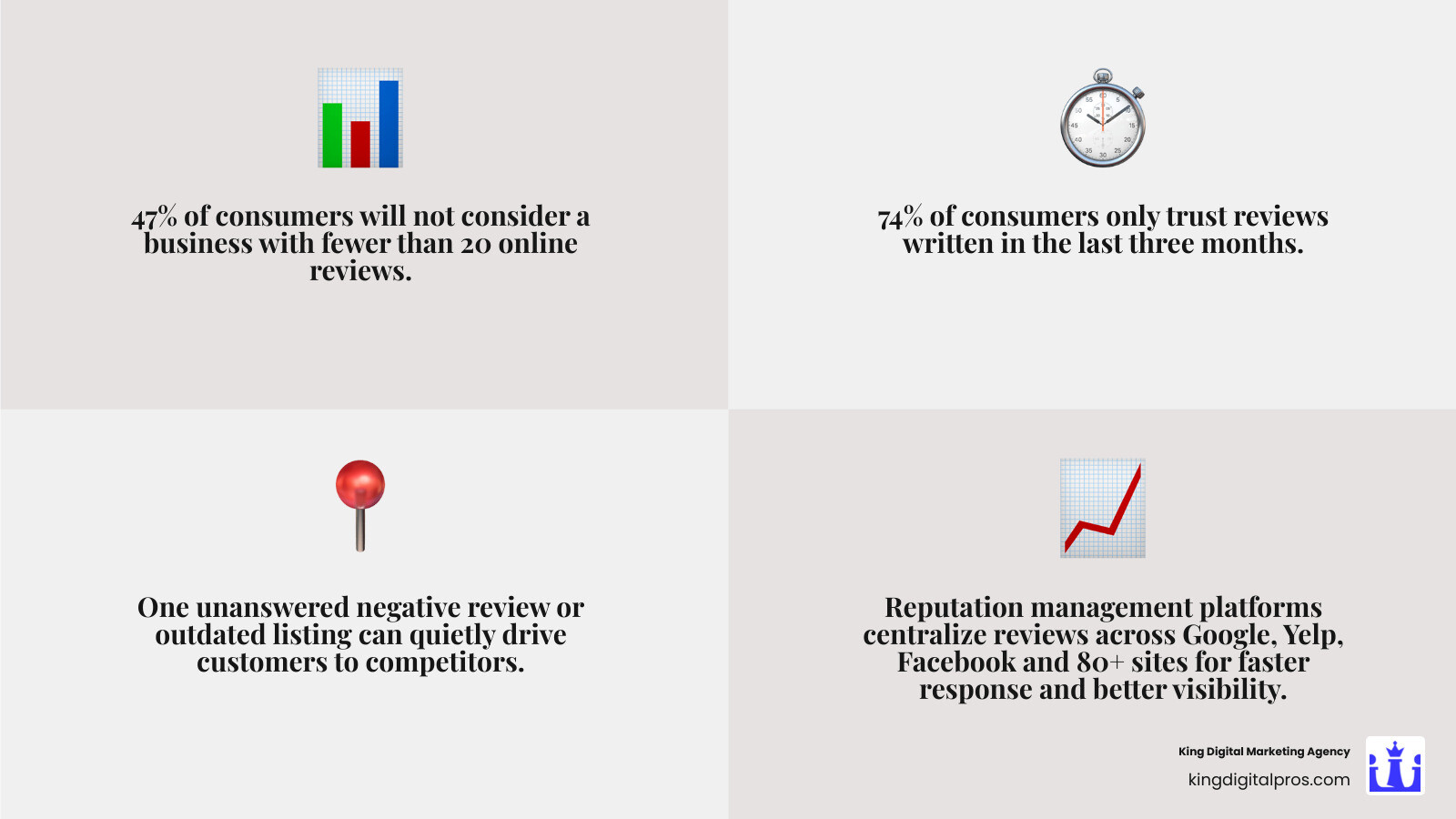
And the numbers back this up. Research shows that 47% of consumers won’t even consider a business with fewer than 20 reviews – and 74% only trust reviews written in the last three months. That’s a short window to make a strong impression.
One bad review left unanswered. A spike in negative mentions. Outdated info on Google. Any of these can quietly push customers toward your competitors.
Managing all of this manually – across Google, Yelp, Facebook, and dozens of other platforms – is nearly impossible for a busy business owner.
That’s exactly what reputation management platforms are built to solve.
I’m Bernadette King, founder of King Digital Marketing Agency, where I’ve helped franchise owners and local businesses use reputation management platforms to turn their online reviews into a steady stream of new customers. In the sections below, I’ll break down the top platforms, what they actually do, and how to pick the right one for your business.
Discover more about reputation management platforms:
What Are Reputation Management Platforms and How Do They Work?
At its core, online reputation management software acts as a centralized command center for your brand’s digital presence. Instead of manually logging into Google Business Profile, Facebook, Yelp, and specialized industry directories every morning, these platforms aggregate all of your customer feedback into a single, unified inbox.
But how do they actually work under the hood?
First, they continuously scan the web. Using API integrations and advanced web-scraping technology, they track mentions of your business name, reviews, and social media comments in real-time. Whenever a customer leaves a review on Google or mentions your business on a local forum, the platform pulls that data into your dashboard and sends you an instant alert.
Second, they automate the collection of new feedback. We know that businesses using automated review campaigns collect up to 4x more reviews compared to those using manual, sporadic collection methods. By integrating with your existing Customer Relationship Management (CRM) system or Point of Sale (POS) software, these platforms can automatically send branded review requests via SMS or email immediately after a transaction.
Third, they help you analyze customer sentiment. It’s not just about counting stars anymore; it’s about understanding the “why” behind customer opinions. Reputation tools analyze the text of your reviews to identify common themes – such as “long wait times” or “friendly staff” – giving you actionable insights to improve your operations.
To dive deeper into how these systems function and how to set one up for your business, check out our Reputation Management Systems Complete Guide. For a broader look at the strategic side of protecting your brand online, HubSpot’s Ultimate Guide to Online Reputation Management provides an excellent framework for building a proactive brand strategy.
Key Features to Look For in Reputation Management Software
Choosing the right platform can feel overwhelming with so many options on the market. To make sure you get a tool that actually saves you time and drives revenue, you need to know which features are essential and which are just flashy extras.

Core Capabilities of Modern Reputation Management Platforms
If you are evaluating different tools, these are the non-negotiable features your software must have:
- A Centralized Review Inbox: You should be able to read and reply to reviews across dozens of platforms (Google, Facebook, Yelp, etc.) without ever leaving your dashboard.
- Automated Review Generation: Look for customizable SMS and email templates that allow you to request feedback automatically. SMS is particularly powerful, as text messages boast incredibly high open and response rates.
- First-Party vs. Third-Party Routing: Excellent platforms allow you to set up smart routing. You can guide happy customers directly to third-party public sites like Google, while routing unhappy customers to a private first-party feedback form. This gives you a chance to resolve the issue privately before it hurts your public rating.
- Real-Time Alerts: You need to know the moment a negative review lands so you can respond quickly and mitigate any damage.
- Customizable Website Widgets: Once you collect those beautiful 5-star reviews, you want to show them off. Look for platforms that offer easy-to-embed widgets to display live reviews on your website, building instant trust with new visitors.
If you want to streamline this process without spending hours managing it yourself, take a look at The Lazy Person’s Guide to Automated Review Management to learn how to put your review acquisition on autopilot.
AI-Powered Features in Reputation Management Platforms
By May 2026, AI is no longer just a buzzword tacked onto software; it is the engine driving the most efficient reputation management platforms. Platforms like Reputation.com are designed with AI built directly into their core architecture, rather than added as an afterthought.
AI-powered reputation tools enhance your capabilities in several key ways:
- Natural Language Processing (NLP) & Sentiment Analysis: AI can scan thousands of reviews across multiple locations to instantly identify patterns. If customers in your Santa Fe location are praising your customer service, but customers in Rio Rancho are complaining about billing errors, the AI highlights these trends automatically.
- AI-Powered Reply Assistants: Drafting unique, professional responses to every single review is exhausting. AI reply generators can analyze the sentiment of a review and draft a tailored, professional response in seconds. This ensures you maintain a high response rate while saving hours of manual writing.
- Trend Forecasting and Predictive Analytics: Advanced tools can monitor sentiment shifts over time and alert you to emerging risks before they spiral into a full-blown PR crisis.
- AI Search Visibility Optimization: As search engines increasingly rely on AI-driven search experiences, maintaining structured, accurate, and highly rated business data across the web is crucial. AI-native platforms help ensure your business listings are optimized for these conversational search models.
To learn more about how AI is shaping local search and customer perception, read Search Engine Land: How to Use AI for Local SEO and Reputation Management.
Comparing the Top Types of Reputation Management Solutions
Not all reputation management tools are created equal. Depending on the size of your business and your primary goals, you will likely find yourself choosing between two main categories of software: Local Review Management Software and Enterprise Brand Listening Tools.
| Feature / Capability | Local Review Software (e.g., BrightLocal, Whitespark) | Enterprise Listening Tools (e.g., Hootsuite + Talkwalker, Reputation.com) |
|---|---|---|
| Primary Focus | Local SEO, Google Map Pack, and review generation. | Brand sentiment, crisis detection, and competitive benchmarking. |
| Data Sources | Google Business Profile, Yelp, Facebook, local directories. | Social media platforms, news blogs, forums, video platforms, and review sites. |
| Best For | Local businesses, medical practices, home service providers, and regional franchises. | Global brands, multi-location enterprises, and public corporations. |
| Key Benefit | Directly boosts local search rankings and review volume. | Protects brand health across millions of sources and predicts emerging risks. |
If you are running a business with a physical footprint or a defined local service area – such as in Albuquerque, Rio Rancho, or Santa Fe – your focus should be on local search visibility. Managing local reviews directly impacts your rankings in the Google Map Pack. For strategies on managing reviews across multiple physical locations, refer to our guide on Mastering Franchise Review Management for Multi-Location Success.
On the other hand, if you manage a larger brand where public relations, media mentions, and social media sentiment are critical, enterprise listening tools are indispensable. For instance, platforms powered by Hootsuite enable organizations to track brand health across millions of online sources, helping teams detect sentiment shifts in three key phases: Pre-Viral, Critical Mass, and Reaction.
For a comprehensive breakdown of how to structure your overall digital presence, check out the Search Engine Journal: Guide to Online Reputation Management.
The Business Benefits and ROI of Active Reputation Monitoring
Investing in one of the leading reputation management platforms isn’t just about making your business look good online – it has a direct, measurable impact on your bottom line.

Consider these powerful benefits and ROI metrics:
- Massive Conversion Boost: Displaying reviews on your website can lead to a 270% increase in conversions. When prospective customers see real, verified feedback from other locals, their purchasing anxiety melts away.
- Direct Revenue Growth: Businesses that actively use review platforms experience an average of 82% revenue growth. More reviews lead to better visibility, which leads to more leads and sales.
- Improved Search Visibility: Google has made it clear that review volume, frequency, and diversity are major ranking factors for local search. A steady stream of fresh reviews helps secure your spot in the coveted Google Map Pack.
- Stronger Customer Retention: Responding to reviews – especially negative ones – shows that you care about your customers. Turning a bad experience into a positive resolution can convert a frustrated customer into a loyal advocate.
- Invaluable Operational Insights: Reviews are a goldmine of free feedback. If multiple customers mention that your dispatchers in Tijeras are incredibly helpful, or that a technician in Los Alamos was late, you know exactly where to focus your training efforts.
To understand the deeper psychological reasons behind how reviews influence modern buyers, read Beyond the Stars: Understanding Review Management for Business Growth. For academic and behavioral insights into this phenomenon, the Spiegel Research Center: How Online Reviews Influence Sales offers outstanding data-backed proof of why reviews matter.
Frequently Asked Questions About Brand Reputation Tools
How much do reputation management platforms typically cost?
The cost of reputation management software varies widely based on your business size, the number of locations you have, and the features you need.
- Entry-Level / Local SEO Tools: Platforms like BrightLocal start around $44 per month, making them incredibly affordable for single-location local businesses. Whitespark’s Reputation Builder plans start at $79 per month. These tools are excellent for tracking reviews, managing local citations, and automating basic review requests.
- Mid-Market / Growth Platforms: Tools like Podium and Birdeye generally operate on custom pricing, but typically range from $150 to $500+ per month per location. These platforms offer deeper CRM integrations, advanced SMS webchat tools, and robust automated campaigns.
- Enterprise / AI-Native Solutions: Comprehensive platforms like Reputation.com or enterprise setups using Hootsuite and Talkwalker are priced on a custom contract basis. These plans can range from $1,000 to over $5,000 per month, depending on the scale of media monitoring, sentiment analysis, and managed services required.
Which industries benefit the most from reputation software?
While every business with an online presence needs to monitor their reputation, certain industries are highly sensitive to customer feedback:
- Healthcare and Dental: Patients rely heavily on reviews when choosing a provider. Maintaining a stellar online presence is critical for doctors, dentists, and clinics. For a specialized look at this industry, check out our guide on Online Reputation Management for Doctors.
- Home Services: Plumbers, electricians, HVAC technicians, and roofers live and die by their local reputation. Customers want to know they can trust who they are letting into their homes.
- Hospitality and Retail: Restaurants, hotels, and boutiques are highly dependent on review recency and star ratings to attract travelers and locals alike.
- Professional Services: Law firms, real estate agencies, and financial advisors need to project high levels of trust and authority online to win high-value clients.
How do these tools help with Google Business Profile optimization?
Your Google Business Profile (GBP) is the cornerstone of your local SEO strategy. Reputation management platforms help optimize your GBP in several distinct ways:
- Review Velocity: They help you maintain a steady, consistent flow of new reviews, which signals to Google’s algorithm that your business is active and popular.
- Keyword Enrichment: When customers write detailed reviews, they naturally include local keywords (e.g., “best plumber in Albuquerque” or “emergency AC repair in Rio Rancho”). Google crawls this user-generated content, boosting your relevance for those search terms.
- Owner Response Rate: Google rewards active businesses. By using a centralized platform to reply to 100% of your reviews quickly, you show Google – and potential customers – that you are highly responsive.
Conclusion
In May 2026, your online reputation is your most valuable digital asset. Leaving it to chance is no longer an option. Whether you are running a medical practice in Santa Fe, a home service business in Rio Rancho, or a retail store in Albuquerque, utilizing the right reputation management platforms is the key to keeping your brand squeaky clean and highly visible.
While these software platforms provide incredible tools, managing them, optimizing your local listings, and consistently winning the Google Map Pack battle takes time and expert strategy.
That is where we come in. At King Digital Marketing Agency, we specialize in helping local businesses optimize their Google Business Profiles, manage their map listings, and build powerful review acquisition systems that drive real, measurable growth.
Ready to turn your online reputation into your most powerful marketing tool? Explore our Review Management Services today, and let us help you dominate your local market.
