TL;DR:
- Choosing the right digital marketing agency requires understanding their experience, customization, and accountability.
- Ask specific questions about industry expertise, management, reporting, ROI, AI use, and contract terms to evaluate their capabilities thoroughly.
Hiring a digital marketing agency is one of the most consequential decisions you’ll make for your business. The wrong partner burns your budget and your time. The right one compounds every dollar you invest. But most business owners walk into agency conversations without a clear framework, getting dazzled by polished decks and impressive client logos. The real questions to ask a digital marketing agency go deeper than “What services do you offer?” They expose how an agency thinks, operates, measures, and adapts. This guide gives you exactly those questions.
Table of Contents
- Key takeaways
- Questions to ask a digital marketing agency: know yourself first
- 1. What experience do you have in my industry?
- 2. How do you customize strategy rather than reuse templates?
- 3. Who will actually manage my account day to day?
- 4. How do you report results and how often?
- 5. How do you define and track ROI?
- 6. What does your communication process look like?
- 7. What analytics tools and technology do you use?
- 8. How do you approach AI and emerging technology?
- 9. What does the contract actually say?
- My take on what most business owners miss
- How King Digital Marketing Agency helps you skip the guesswork
- FAQ
Key takeaways
| Point | Details |
|---|---|
| Define success before you ask | Know your own ROI targets and growth goals before evaluating any agency’s answers. |
| Verify who actually runs your account | The person selling you the contract is rarely the one executing your campaigns. |
| Demand measurable definitions upfront | Agencies that avoid specific metrics in early conversations will avoid accountability later. |
| AI readiness separates good from great | Only 30% of organizations report mature AI capabilities, so probe this area hard. |
| Operational transparency is non-negotiable | Reporting frequency, dashboard access, and escalation paths reveal an agency’s true culture. |
Questions to ask a digital marketing agency: know yourself first
Before you fire off a list of digital marketing agency inquiries, you need clarity on your own situation. Agencies are only as useful as the brief you give them. If you walk in without knowing your goals, your budget range, or what success looks like, you will accept whatever answers they offer.
Start by asking yourself a few foundational questions:
- What is the specific business problem I am trying to solve? Lead volume, brand visibility, local search dominance, or conversion rate improvement all require different strategies. Strong marketing strategies start by defining the exact business problem before discussing tactics.
- What does success look like in 12 months? Revenue targets, number of qualified leads, cost per acquisition, or organic traffic growth. Pick the numbers that actually move your business.
- What is my realistic monthly budget? Marketing budgets remain flat at 7.8% of company revenue in 2026, so tying your budget to a percentage of revenue is a reasonable benchmark.
- How marketing-mature is my business? A business with no existing digital presence needs different help than one trying to scale an already-performing paid search program.
These parameters shape every question you ask next. They also reveal quickly whether an agency is listening to your actual situation or just pitching their standard package.
Pro Tip: Write down your three most important business outcomes before the first agency call. If an agency never asks you about them, that tells you everything.
1. What experience do you have in my industry?
This is not about collecting impressive logos. It is about understanding whether the agency has earned real insight into your customer’s behavior and your competitive environment. An agency that has run campaigns for home services businesses in a regional market understands local intent, seasonal demand, and review velocity in ways a generalist shop simply does not.
Ask for specific examples. Case studies with real numbers. References you can actually call. Agencies that demonstrate deep understanding of user psychology and connect their efforts to business outcomes are the ones worth your time.
2. How do you customize strategy rather than reuse templates?
This is one of the most effective marketing agency questions you can ask, and most business owners skip it entirely. A cookie-cutter agency plugs you into their existing playbook. A real partner builds from your goals outward.
Ask them to walk you through how they would approach your specific situation. If they pivot immediately to a service menu or a pricing tier before asking you more questions, take note. Commercially grounded agencies prioritize your margin, customer lifetime value, and competitive position before recommending channels or creative.
Pro Tip: Ask the agency: “What would you NOT recommend for a business like mine right now?” A confident, client-focused agency will have a real answer. A sales-focused one will dodge it.
3. Who will actually manage my account day to day?
This is one of the most overlooked key questions for any agency evaluation. The person presenting to you during the sales process is often not the day-to-day account manager. You could be sold by a senior strategist and then handed off to a junior coordinator with six months of experience.
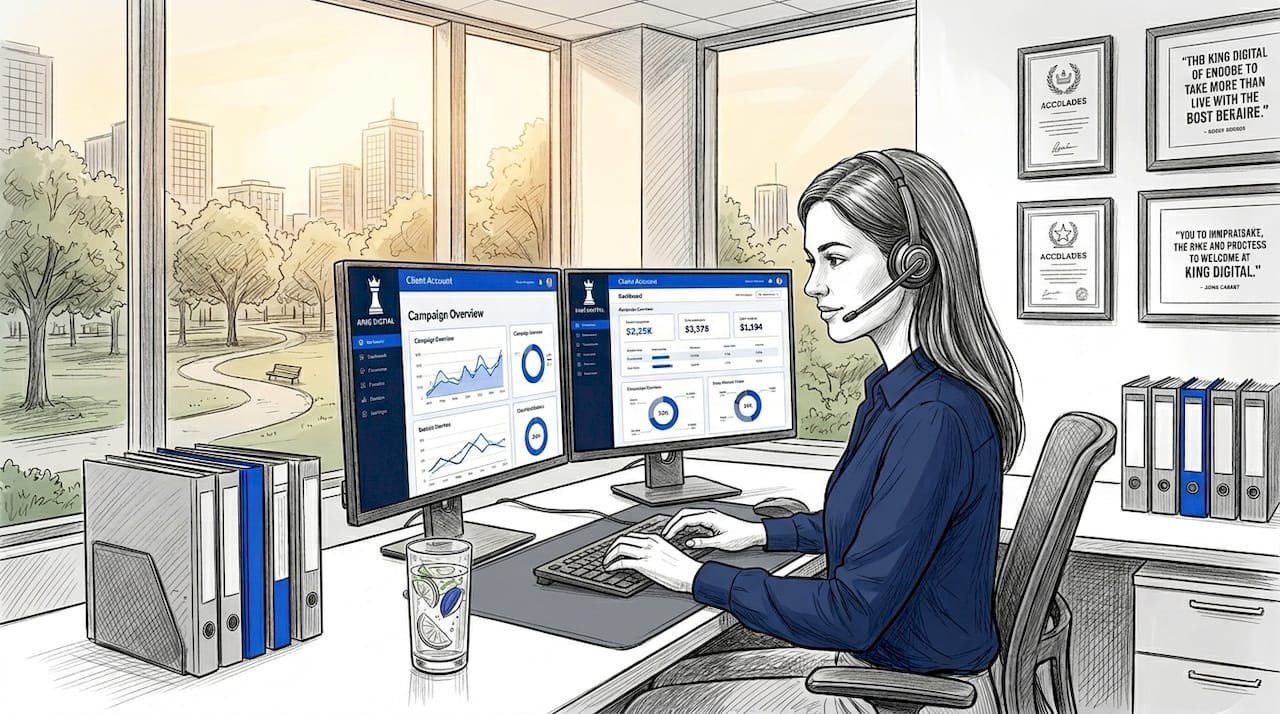
Ask for the name and role of every person who will touch your account. Request their LinkedIn profiles and any relevant credentials. Ask specifically how much of their time will be allocated to your account and whether that allocation is contractually defined.
This question makes uncomfortable agencies very visible, very fast.
4. How do you report results and how often?
Reporting is where agency accountability either lives or dies. Vague monthly PDFs with traffic charts that go up and to the right are not reporting. They are theater. What you need is access to the data behind the performance.
Ask about:
- Reporting frequency: Weekly, biweekly, or monthly? What triggers an unscheduled update?
- Metrics included: Are they reporting vanity metrics like impressions, or business metrics like cost per lead and revenue influenced?
- Dashboard access: Do you get live access to a reporting dashboard, or do you wait for their summary?
- Insight delivery: Do they tell you what the numbers mean, or just hand you a spreadsheet?
Understanding how to measure marketing ROI is something you should be able to do independently, not just take on faith from your agency.
5. How do you define and track ROI?
This deserves its own conversation, separate from general reporting. ROI means different things to different agencies, and vague definitions are how budgets disappear without accountability.
Here is a numbered framework for vetting this area:
- Ask how they define a conversion for your specific business.
- Ask what attribution model they use, last-click, first-click, or multi-touch, and why.
- Ask how they handle offline conversions such as phone calls and in-store visits.
- Ask what timeline is realistic before you should expect measurable returns.
- Ask what happens when campaigns underperform. Do they adjust, or do they explain?
Marketing leaders should ask if agencies define success with measurable terms upfront. If an agency gives you ranges and approximations instead of actual frameworks, that is a red flag. Tools like a marketing ROI calculator can help you cross-check their numbers independently.
Pro Tip: Ask them: “Can you show me a campaign where results came in below expectations, and what you did about it?” The answer reveals far more than any success story they volunteer.
6. What does your communication process look like?
Agency relationships fail more often over communication breakdowns than strategy failures. You need to know, before you sign anything, how responsive this agency will be when something goes wrong or when you have an urgent question.
Ask about their primary communication channels. Do they use email only, or do they offer Slack, a client portal, or project management software? Ask what their response time commitment is. Ask who you escalate to if your primary contact is unavailable or if you disagree with a strategic decision.
These questions surface whether the agency has a real client service infrastructure or just a good pitch deck.
7. What analytics tools and technology do you use?
The tools an agency uses reflect how seriously they take data. Google Analytics 4, Google Search Console, a CRM integration, call tracking software, and heat mapping tools are table stakes at this point. An agency that cannot name specific tools or explain why they chose them is operating on instinct, not data.
Also ask how they handle data privacy and compliance, especially if your business operates in a regulated industry or serves customers in states with active privacy laws. Understanding your digital marketing conversion rate and how it is tracked is a right, not a privilege.
8. How do you approach AI and emerging technology?
This is no longer a bonus question. It is a baseline one. Only 30% of organizations report mature AI readiness despite 70% of CMOs identifying AI leadership as critical for 2026. The gap between what agencies claim and what they actually do with AI is enormous right now.
Here is a quick comparison to guide your evaluation:
| What to ask | A strong answer looks like | A weak answer looks like |
|---|---|---|
| How do you use AI in campaigns? | Specific tools for targeting, content, or bid optimization | “We use AI across everything” with no specifics |
| How does your team stay current? | Structured training, certifications, experimentation | “We keep up with industry news” |
| How do you handle AI ethics? | Clear policy on transparency and data use | Confusion or dismissal of the question |
AI-driven marketing raises the bar for what agencies need to deliver. Agencies that treat AI as a buzzword rather than an operational priority will fall behind, and so will your campaigns. Look for teams that see AI as a way to add efficiency to real workflows, not just something to mention on their website.
9. What does the contract actually say?
Nobody likes talking about contracts, which is exactly why you must. Before signing, ask specifically about contract length, cancellation terms, and who owns the assets created during the engagement. Your website, ad accounts, content, and creative materials should be yours the moment you leave.
Ask what happens to your ad account access, your SEO data, and any ongoing campaigns if the relationship ends. An agency that retains ownership of assets you paid for is one that is building dependency, not partnership.
My take on what most business owners miss
I have watched business owners get burned by agencies that looked great on paper. What I have learned is that the most revealing questions are not about credentials. They are about character.
The surface questions, “What services do you offer?” or “How much does it cost?”, are things any agency can answer convincingly. The questions that expose real capability are the uncomfortable ones. Asking about a campaign that failed. Asking who specifically will run your account. Asking how they handle disagreements.
What I have found is that agencies with genuine confidence welcome these questions. They answer without deflection because they have real experience to draw from. Agencies that get defensive or vague are telling you something important.
I also think business owners underestimate how much their own preparation matters. If you walk in without clarity on your goals or your success metrics, you are handing the agency permission to define both for you. Asking the right questions about commercial alignment before campaigns begin surfaces the gaps that would have cost you dearly six months in.
Be proactive. Be skeptical. And be specific. The right agency will respect you more for it.
— Bernadette
How King Digital Marketing Agency helps you skip the guesswork
If you have read this far, you already know what good agency behavior looks like. At King Digital Marketing Agency, we operate exactly the way this article describes. We lead with your goals, assign real account managers with verified experience, and report in metrics that connect directly to your revenue.
Our team specializes in local paid advertising built for Albuquerque SMBs who need results they can see in their pipeline, not just their dashboard. We also run social media programs designed to generate real engagement from real local customers. Every strategy we build starts with your specific business problem, not our standard service menu. If you want a partner who can answer every question in this article without hesitation, we would like to talk.
FAQ
What are the most important questions to ask a digital marketing agency?
Ask who will manage your account day to day, how they define and measure ROI, and what their reporting process looks like. These three areas separate accountable agencies from those that overpromise.
How do I know if an agency is a good fit for my business?
A strong fit shows up when the agency asks you more questions than you ask them, customizes their approach to your specific goals, and provides verifiable case studies from relevant industries.
Should I ask about AI capabilities when choosing a digital agency?
Yes. With 70% of CMOs identifying AI leadership as critical for 2026, any agency that cannot explain how they use AI in real campaign execution is already behind.
What should I watch out for in agency contracts?
Confirm that you retain ownership of all assets, including ad accounts, website files, and content created during the engagement. Ask about cancellation terms and data access after the relationship ends.
How long before I should expect measurable results from a digital marketing agency?
Paid advertising campaigns can show measurable signals within 30 to 60 days. SEO and content programs typically take 90 to 180 days to show meaningful movement. Any agency promising faster organic results without a clear explanation deserves scrutiny.
Recommended
- Digital Marketing Agency for Small Businesses: 1 Win
- Why invest in digital marketing: grow your Albuquerque business in 2026
- Startup Success: Your Digital Marketing Launchpad | King Digital Marketing Agency
- Your Guide to Effective Digital Marketing Solutions | King Digital Marketing Agency
