TL;DR:
- Technical SEO ensures search engines can crawl, read, and rank your website effectively.
- Core elements include site speed, mobile-friendliness, HTTPS security, and proper structured data.
- Fixing technical issues can significantly improve local search visibility for Albuquerque SMBs.
You publish great blog posts, you’ve researched your keywords, and your Google Business Profile looks polished. Yet your competitors keep outranking you. The frustrating truth is that your content may never reach the top of search results if your website’s technical foundation is broken. Technical SEO is the invisible engine that determines whether Google can even find, read, and rank your pages. For small and medium-sized businesses in Albuquerque, understanding this layer of SEO is not optional. It is the difference between showing up and being invisible.
Table of Contents
- What is technical SEO? A clear definition
- Core technical SEO elements every SMB must address
- How technical SEO impacts local search in Albuquerque
- Common technical SEO mistakes (and how to avoid them)
- Why most Albuquerque SMBs underestimate technical SEO
- Level up your Albuquerque SEO with technical expertise
- Frequently asked questions
Key Takeaways
| Point | Details |
|---|---|
| Technical SEO defined | Technical SEO makes your site accessible for search engines so you can actually rank. |
| Core elements matter | Crawlability, site architecture, speed, security, and mobile-friendliness are non-negotiable for visibility. |
| Local SEO link | Albuquerque businesses gain visibility when technical SEO is aligned with local search requirements. |
| Common pitfalls | Mistakes like blocking crawlers or misusing canonical tags can quietly tank rankings. |
| Action leads to growth | Fixing technical SEO issues often yields faster improvements than new content alone. |
What is technical SEO? A clear definition
Now that you know technical SEO might be missing from your strategy, let’s define what it actually means.
Most business owners think SEO is about writing content with the right keywords. That belief is understandable, but it only tells half the story. Content is what you say. Technical SEO is how well Google can hear you.
“Technical SEO is the process of optimizing a website’s infrastructure so search engines can crawl, render, index, and serve your content correctly and efficiently.”
Think of your website like a physical store. Your content is the merchandise on the shelves. Technical SEO is the building itself: the lighting, the clear aisles, the working front door. If the door is locked, it does not matter how beautiful your products are. Nobody gets in.
Google’s process works in four steps. First, it discovers your site. Then it crawls your pages by following links. Next, it renders the page to understand what users see. Finally, it indexes those pages so they can appear in search results. Technical SEO ensures each of those steps runs without a hitch. When any step breaks, pages disappear from rankings, often without you knowing.
The connection between SEO success and website structure is tighter than most SMB owners realize. A well-structured site sends clear signals to Google’s crawlers, which means faster indexing and stronger rankings. A poorly structured one creates dead ends, confusion, and missed opportunities.
Here is why this matters urgently for Albuquerque businesses. Local search is intensely competitive. When someone types “plumber near me” or “Albuquerque HVAC repair,” Google evaluates dozens of signals in milliseconds. Technical health is one of those signals. A site with crawl errors, slow load times, or missing HTTPS security is at a measurable disadvantage before a single keyword even enters the picture.
The good news is that most technical SEO issues are fixable. You do not need to rebuild your website from scratch. You need a clear picture of what is broken and a plan to address it systematically.
Core technical SEO elements every SMB must address
With the concept clear, it’s time to break down what technical SEO actually covers in practice.
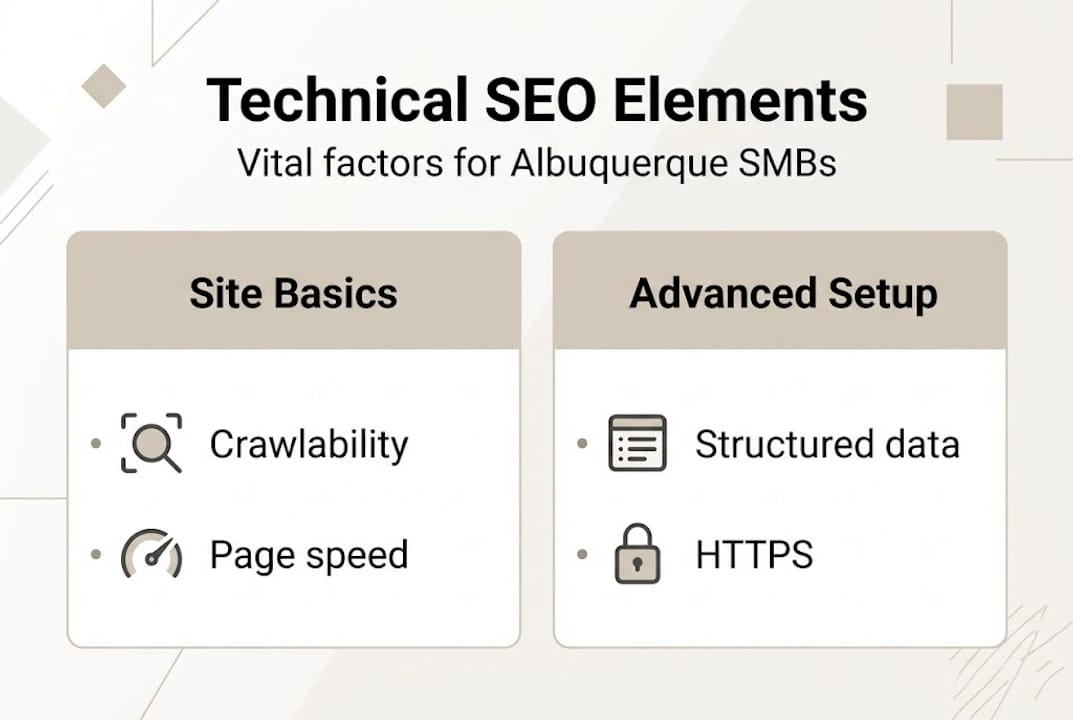
A practical technical SEO scope includes crawlability and indexability, site architecture, page speed and Core Web Vitals, mobile optimization, HTTPS security, structured data, and canonicalization. Each element plays a distinct role in how Google evaluates and ranks your site.
Here is a quick reference table to show what each element does and why it matters for your business:
| Technical SEO element | What it controls | Business impact |
|---|---|---|
| Crawlability and indexability | Whether Google can access your pages | Pages not crawled cannot rank |
| Site architecture | Internal links and navigation structure | Helps Google understand your site’s hierarchy |
| Page speed and Core Web Vitals | Load time and user experience scores | Slow sites rank lower and lose visitors |
| Mobile-friendliness | How your site displays on phones | Google uses mobile-first indexing |
| HTTPS security | Encrypted connection for users | Builds trust and is a confirmed ranking signal |
| Structured data | Rich result markup like review stars | Improves click-through rates in search |
| Canonicalization | Prevents duplicate content confusion | Consolidates ranking signals to the right page |
Let’s look at each of these more closely.
Crawlability and indexability are the foundation. If your robots.txt file accidentally blocks Google from accessing key pages, those pages simply will not appear in search results. This is a surprisingly common error, especially after website redesigns.
Site architecture refers to how your pages connect to each other. Logical menus, clear categories, and strategic internal linking help Google understand which pages are most important. A well-designed SEO friendly site design ensures crawlers follow a clear path through your content rather than getting lost.

Page speed and Core Web Vitals are Google’s official user experience metrics. They measure how fast your page loads, how stable the layout is while loading, and how quickly users can interact with it. A page that takes five seconds to load loses a significant portion of visitors before they even see your offer.
Mobile-friendliness is non-negotiable. Google now indexes the mobile version of your site first. If your site looks broken on a phone, your rankings will reflect that.
HTTPS is the security layer that encrypts data between your site and visitors. Google confirmed it as a ranking signal years ago, and browsers now flag non-HTTPS sites as “Not Secure,” which destroys user trust instantly.
Structured data is code you add to your pages to help Google display richer results, like star ratings, business hours, or FAQ answers, directly in search. For local businesses, this can dramatically increase click-through rates.
Canonicalization tells Google which version of a page is the “official” one when multiple URLs show similar content. Without it, your ranking power gets split across duplicate pages.
Pro Tip: Open Google Search Console right now and check the Coverage and Core Web Vitals reports. These two reports alone will surface the most critical technical errors affecting your site’s visibility, and they are completely free.
For a deeper look at building a technically sound site from the ground up, the complete SEO design guide walks through each of these elements in detail.
How technical SEO impacts local search in Albuquerque
After outlining the essentials, let’s see how technical SEO directly affects Albuquerque-local results and what businesses often miss.
Local search is its own competitive arena. When Albuquerque residents search for a service near them, Google pulls results from a combination of your Google Business Profile, your website’s authority, and yes, your technical SEO health. Technical SEO focuses on making Google’s discovery, crawling, rendering, and indexing steps work for your site, and in local search, every one of those steps has a direct effect on whether you appear in the map pack.
Here is a comparison of what optimized versus unoptimized local business websites typically experience:
| Factor | Optimized local website | Unoptimized local website |
|---|---|---|
| Map pack visibility | Frequently appears in top 3 | Rarely or never appears |
| Mobile load time | Under 3 seconds | 5 to 8 seconds or more |
| NAP consistency | Matches across all pages and citations | Varies across pages and directories |
| Local schema markup | Present and validated | Missing or broken |
| Crawl errors | Zero or minimal | Multiple blocked or broken pages |
| HTTPS status | Secure on all pages | Mixed or fully unsecured |
The differences above are not theoretical. They translate directly to phone calls, form submissions, and foot traffic for Albuquerque businesses.
Here are the technical SEO moves that most directly influence local search rankings:
- Local schema markup: Adding LocalBusiness schema to your site tells Google your business name, address, phone number, hours, and service area in a language search engines understand perfectly.
- Consistent NAP data: Your Name, Address, and Phone number must match exactly across your website, Google Business Profile, Yelp, and every other directory. Even small discrepancies, like “St.” versus “Street,” can dilute your local authority.
- Fast mobile experience: Most local searches happen on phones. A slow mobile site is a direct ranking disadvantage in local results.
- Crawlable location pages: If you serve multiple Albuquerque neighborhoods or have more than one location, each location needs its own crawlable, indexed page with unique content.
For businesses ready to go deeper, our guide to local search optimization covers the full picture of how technical and content signals combine to drive map pack rankings.
One more insight worth emphasizing: minor technical fixes often produce outsized results in local search. Fixing a single crawl error on your homepage or adding local schema can move you from page two into the map pack. The barrier to improvement is lower than most business owners assume. Pairing technical fixes with strong content optimization for Albuquerque creates a compounding effect that competitors without both layers simply cannot match.
Common technical SEO mistakes (and how to avoid them)
As you see the importance for local outcomes, understanding and avoiding these common technical setbacks is your next step.
Even well-intentioned website updates can introduce serious technical problems. Here are the most frequent mistakes we see Albuquerque SMBs make, and what to do about each one:
-
Blocking pages with robots.txt. A single misplaced line in your robots.txt file can prevent Google from crawling your most important pages. This happens most often after a site migration or redesign. Always verify your robots.txt after any major site change.
-
Missing or expired HTTPS certificate. If your SSL certificate lapses, browsers display a security warning to every visitor. Google also treats this as a negative signal. Set a calendar reminder to renew your certificate before it expires.
-
Slow page load times. Large uncompressed images are the most common culprit. Compress all images before uploading, use a content delivery network if possible, and minimize unnecessary scripts on your pages.
-
Incorrect or conflicting canonical tags. This is where many SMBs get tripped up. A canonical tag is supposed to tell Google which version of a page is the primary one. But as research confirms, canonical tags are hints, and Google can choose a different canonical URL when signals conflict. If your internal links point to one URL but your canonical tag points to another, Google may ignore your tag entirely.
-
Missing XML sitemap or outdated sitemap. Your sitemap is a roadmap for Google’s crawlers. If it is missing, outdated, or contains broken URLs, Google may miss important pages entirely.
-
No structured data on key pages. Skipping schema markup means missing out on rich results like star ratings and FAQ answers in search, features that increase click-through rates significantly.
“Canonical tags are hints, and Google can choose a different canonical URL when signals conflict, so ‘it’s set’ does not guarantee ‘it’s used.’”
The canonical tag issue deserves extra attention because it is so widely misunderstood. Many business owners assume that once a canonical tag is placed, the problem is solved. In reality, if your sitemap, internal links, and canonical tags all point to different versions of the same page, Google weighs all of those signals together and makes its own decision. The tag is a vote, not a command.
Pro Tip: Run a free audit using Google Search Console, Screaming Frog’s free tier, or PageSpeed Insights at least twice a year. These tools surface crawl errors, slow pages, and missing tags without requiring any technical background to interpret.
When you do find an issue, the process is straightforward: document what you found, fix it or hand it to your developer, then monitor Google Search Console over the following weeks to confirm the fix registered. Staying current with on-page SEO best practices alongside technical fixes creates a well-rounded SEO strategy that is hard to beat locally.
Why most Albuquerque SMBs underestimate technical SEO
With technical pitfalls in mind, let’s zoom out for a fresh perspective on why so many local businesses still lag behind despite their best efforts.
Here is the uncomfortable truth I share with every Albuquerque business owner we work with: you have probably been sold a content-first story that is incomplete. Social media posts, blog articles, and keyword research get all the attention because they are visible and feel productive. Technical SEO is invisible, which makes it easy to ignore.
But in my experience, when a business already has decent content in place, fixing technical issues moves the needle faster than publishing ten new blog posts. A single crawl fix or a schema addition can unlock map pack visibility that content alone never could.
What makes technical SEO especially valuable for SMBs is that most fixes are one-time efforts with lasting benefits. You fix your canonical tags once. You add local schema once. You compress your images once. Those improvements keep working for you every day without additional effort.
It is not about coding or becoming a developer. It is about removing the hidden roadblocks that prevent Google from promoting your business. Think of it this way: your content optimization strategy is the fuel, and technical SEO is the engine. Without the engine running cleanly, the fuel goes nowhere.
Level up your Albuquerque SEO with technical expertise
If you’re ready to take the next step and turn technical SEO insights into business growth, here’s how King Digital Marketing Agency can help Albuquerque companies.
At King Digital Marketing Agency, we specialize in exactly this kind of work for local Albuquerque businesses. We audit your site’s technical health, identify the specific issues holding back your rankings, and implement fixes with measurable results.

Start with our SEO checklist for small businesses to see where your site stands right now. If you want to go deeper, explore how SEO friendly website structure directly impacts your local rankings. And when you are ready to partner with a team that treats your business like a priority, learn how website design for SEO success can transform your online visibility from the ground up.
Frequently asked questions
What is the main difference between technical SEO and on-page SEO?
Technical SEO focuses on site infrastructure and crawlability, while on-page SEO targets keywords, content, and page-level optimization. Both are necessary, but technical SEO must work correctly before on-page efforts can deliver results.
Does technical SEO need coding skills?
No, many issues like page speed, mobile optimization, and sitemaps can be improved using free tools without writing a single line of code. Coding is rarely required for the basics that most SMBs need to address.
Why does Google sometimes ignore my canonical tag?
Google treats canonical tags as suggestions rather than commands, so it can choose a different canonical URL when signals like internal links or sitemaps conflict with your tag. Keeping all signals consistent is the only reliable fix.
What is the most common technical SEO mistake for SMBs?
Accidentally blocking search engines from crawling key pages through a misconfigured robots.txt file is one of the most frequent and harmful errors, especially after a website redesign.
How often should a small business audit technical SEO?
At least twice per year or immediately after any major site update to catch new errors before they damage your search visibility.
Recommended
- Boost leads in Albuquerque: on-page SEO best practices
- SEO ranking factors: Local Albuquerque guide for SMBs
- Website content optimization steps for Albuquerque SMBs
- Web Design Essentials for Albuquerque SMBs: Boost Leads & SEO
