What is B2B Lead Management and Why Does It Matter?
B2B lead management is the process of capturing, tracking, qualifying, and nurturing business leads until they are ready to buy.
Quick answer — what is B2B lead management?
| Stage | What Happens |
|---|---|
| Capture | Collect leads from web, ads, events, or outbound outreach |
| Enrich | Add firmographic and behavioral data to each lead record |
| Qualify | Score and categorize leads as MQL, SAL, or SQL |
| Distribute | Route leads to the right sales rep at the right time |
| Nurture | Engage leads with relevant content until they’re sales-ready |
| Convert | Hand off to sales and close the deal |
Here’s the reality most sales teams already know but rarely talk about: a full pipeline doesn’t mean a healthy pipeline.
According to HubSpot research, 61% of marketers say generating traffic and leads is their top challenge. But the real problem often isn’t getting leads into the funnel. It’s knowing what to do with them once they’re in.
Without a structured system, leads fall through the cracks. Sales reps chase the wrong prospects. Marketing burns budget on people who will never buy. And revenue suffers.
That’s what B2B lead management is designed to fix.
It’s not just a process. It’s the backbone of predictable revenue growth — connecting every touchpoint from the first hello to the final sale.
I’m Bernadette King, founder of King Digital Marketing Agency, and I’ve spent years helping business owners build smarter, leaner B2B lead management systems that turn online visibility into real revenue. In this guide, I’ll walk you through exactly how to do the same — step by step.
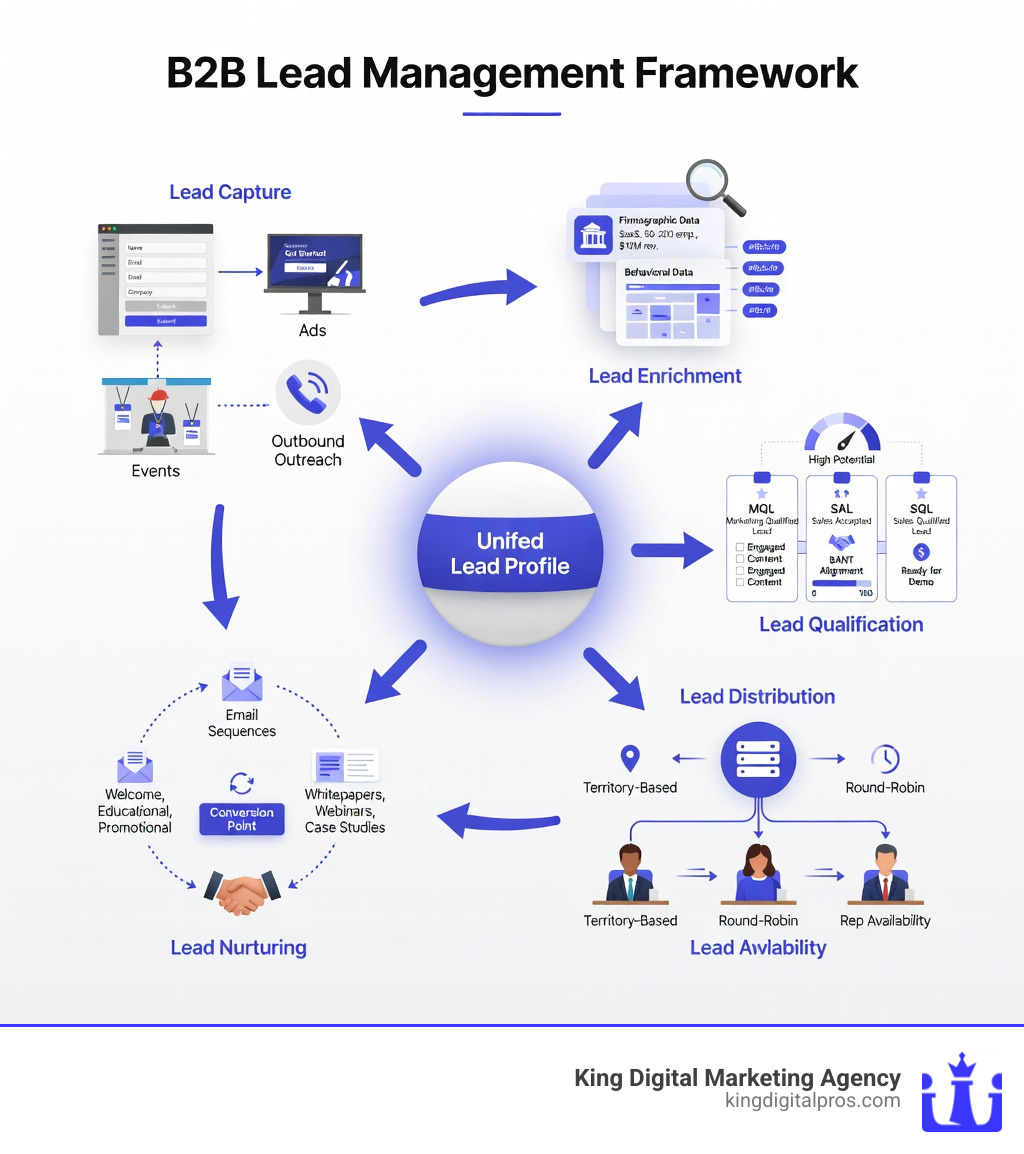
Basic b2b lead management terms:
At its core, b2b lead management is the architectural framework that keeps your sales engine running without sputtering. It is the bridge between a stranger clicking on your website and a happy client signing a contract. Without it, your sales funnel isn’t a funnel—it’s a sieve.
In the B2B world, the stakes are higher than in B2C. We aren’t talking about impulse-buying a pair of socks; we are talking about multi-stakeholder decisions, long procurement cycles, and high-ticket investments. Because of this complexity, managing how a lead moves through your system is the difference between scaling your business and just staying busy.
Effective b2b lead management directly impacts three critical areas:
- Pipeline Health: Ensuring your pipeline is filled with actual opportunities, not just “tire kickers.”
- Sales Velocity: Reducing the time it takes for a lead to move from “Hello” to “Closed-Won.”
- Conversion Rates: Making sure that when marketing hands off a lead, sales is ready to catch it and run.
If you are feeling overwhelmed, you aren’t alone. As mentioned, 61% of marketers struggle with lead generation. However, the real “secret sauce” isn’t just getting more leads; it’s managing them better. For a deeper dive into the mechanics, check out our Online Sales Lead Management Ultimate Guide.
The Impact on Revenue Growth
We’ve all seen a pipeline that looks “fat” but produces nothing. Research from Gleanster indicates that only 25% of leads in a typical sales pipeline are legitimate prospects. That means 75% of your team’s time could be wasted on leads that will never close.
When you don’t have a solid b2b lead management strategy, you face “lead leakage.” This is where warm prospects get ignored because the sales team is bogged down with unqualified data, or because a follow-up happened three days too late. Oracle reports that effective management prevents this waste, ensuring that every dollar spent on marketing actually contributes to the bottom line.
Building Trust Through Social Proof
In B2B, trust is the primary currency. Before a business owner in Albuquerque or Santa Fe signs a contract with you, they are going to look for proof that you can deliver.
Statistics show that a staggering 95% of consumers read reviews before buying anything. Furthermore, 92% of buyers trust word-of-mouth recommendations from their peers. This is why incorporating social proof—like case studies, testimonials, and high-quality reviews—into your lead management process is vital. It’s not just about tracking the lead; it’s about providing the evidence they need to move to the next stage.
The 5 Essential Stages of the B2B Lead Management Process
To manage leads effectively, we break the journey down into five distinct phases. This structure prevents the “guessing game” and ensures everyone on your team knows exactly where a prospect stands. If you need help setting this up, our Sales Lead Management services can provide the roadmap you need.
Effective Lead Capture and Enrichment
The journey begins with Lead Capture. This is where you gather information through landing pages, webinars, or even interactive content like ROI calculators. Interestingly, 81% of marketers agree that interactive content is more effective at grabbing attention than static pages.
Once you have the name and email, you move to Lead Enrichment. This is the process of layering on “firmographic” data. Does the lead work at a company with 10 employees or 500? What is their actual job title? Using tools like Hunter.io or LinkedIn can help you fill in these blanks so your sales reps don’t have to go in blind. For more on the digital side of this, see our Internet Lead Management Complete Guide.
Strategic Lead Distribution and Routing
Once a lead is qualified, it needs to get to the right person—fast. This is Lead Distribution. You might use “Round-robin” (giving leads to reps in a set order) or territory-based routing (ensuring a lead from Rio Rancho goes to your New Mexico specialist).
Speed is everything here. McKinsey research shows that when companies automate follow-ups with personalization and rapid response, conversion rates can climb by about 25%. If you wait a day to respond, your lead has already moved on to your competitor.
Mastering Qualification in B2B Lead Management
Not all leads are created equal. To avoid wasting your sales team’s time, we use a qualification hierarchy. This ensures that only the most “ready” leads get the most attention.
| Lead Type | Definition | Action Required |
|---|---|---|
| MQL (Marketing Qualified Lead) | Shows interest (downloaded an ebook, signed up for a newsletter). | Nurture with more educational content. |
| SAL (Sales Accepted Lead) | Marketing has passed it over, and Sales has agreed it meets the basic criteria. | Move to discovery or initial outreach. |
| SQL (Sales Qualified Lead) | High buying intent (requested a demo, asked for pricing). | Immediate sales engagement and closing efforts. |
To get this right, many businesses utilize professional Lead Scoring Services to automate the heavy lifting.
How Lead Scoring Works in B2B Lead Management
Lead scoring is a mathematical way of ranking prospects. You assign points based on:
- Behavioral triggers: Did they visit your pricing page? (+10 points). Did they unsubscribe? (-50 points).
- Demographic fit: Are they a decision-maker (CEO/VP)? (+20 points). Are they a student doing research? (-100 points).
Once a lead hits a specific point threshold, they are automatically flagged for sales. This prevents reps from calling people who aren’t ready to talk. Learn more about setting up these triggers in our guide on Inbound Lead Scoring.
Aligning Sales and Marketing via SLAs
The biggest point of failure in b2b lead management is the “blame game.” Marketing says Sales isn’t following up; Sales says Marketing is sending “garbage” leads.
The solution is a Service Level Agreement (SLA). This is a formal agreement between the two teams that defines what a “qualified lead” actually looks like and how fast Sales must follow up. Gartner reports that 47% of companies say their lead generation suffers because of misalignment. By setting shared definitions and feedback loops, you close the gap and create a unified front.
Leveraging Technology and AI for Scalable Growth
In the modern B2B landscape, you cannot manage leads effectively using just a spreadsheet. You need a tech stack that works while you sleep. From Lead Manager Software to advanced CRM systems, technology is the force multiplier that allows a small team to act like a giant corporation.
Scaling Nurturing with Automation
Remember: Marketo’s research says that just 4% of website visitors are ready to buy right now. What happens to the other 96%? If you don’t have automated lead nurturing, they disappear.
Automated email sequences and personalized journeys keep your brand top-of-mind. 74% of top-performing companies use automated lead nurturing to stay connected. By delivering the right content at the right time—whether it’s a blog post on SEO or a case study on local visibility—you build the authority needed to close the deal later. Check out our insights on Lead Scoring Email Marketing to see how to combine these two powerful tactics.
The Role of AI in Modern B2B Lead Management
AI is no longer a futuristic concept; it’s a daily tool for B2B success. AI can analyze “buying groups” (the committee of people involved in a B2B purchase) and even perform sentiment analysis on emails to tell you if a prospect is getting frustrated or becoming more interested.
Chatbots can qualify leads in real-time on your site, and predictive analytics can tell you which leads in your CRM Leads database are most likely to close this month. This allows your team to focus their human energy where it matters most: building relationships.
Frequently Asked Questions about Lead Management
How do you measure the success of a lead management system?
Success is measured by looking at your conversion rates (from lead to customer), your Cost Per Lead (CPL), and your overall pipeline contribution. If your sales cycle is getting shorter and your “Closed-Won” rate is going up, your system is working. We recommend using Lead Conversion Tracking to get a clear picture of these numbers.
What is the difference between an MQL and an SQL?
An MQL (Marketing Qualified Lead) is someone who has engaged with your content but isn’t necessarily ready for a sales call. An SQL (Sales Qualified Lead) has been vetted by your team and has shown direct intent to purchase, such as requesting a quote or a demo. Understanding this helps you calculate lead value more accurately.
Why is lead nurturing important if a lead isn’t ready to buy?
Because B2B sales cycles are long. If you ignore a lead just because they aren’t ready today, they will go to a competitor when they are ready tomorrow. Nurturing builds brand authority and ensures you are the first person they call when the budget is approved. Marketo research says only 4% of visitors are ready to buy immediately—nurturing captures the other 96%.
Conclusion
Mastering b2b lead management is the single best way to ensure predictable revenue for your business. By moving from a “spray and pray” approach to a structured process of capturing, qualifying, and nurturing, you stop wasting resources and start closing more deals.
At King Digital Marketing Agency, we specialize in helping businesses in Albuquerque, Santa Fe, and across New Mexico optimize their local visibility and lead flow. Whether you are looking to fix a “leaky” funnel or implement AI-driven tracking, we are here to help you scale.

Ready to take control of your pipeline? Explore our Lead Tracking Services and let’s turn those “hellos” into final sales.
