Lead Scoring Services: Transform Sales 2025
Why Your Business Needs to Prioritize Leads
Lead Scoring Services help businesses rank potential customers based on their likelihood to buy. For most companies, the challenge isn’t a lack of leads, but identifying the few who are ready to purchase. Without a system, sales teams waste time on dead ends while hot prospects slip away.
What Lead Scoring Services Do:
- Assign point values to leads based on demographics, behavior, and engagement.
- Separate hot leads from cold ones so sales teams focus on the right people.
- Automate lead qualification using rules or AI-powered predictive models.
- Integrate with your CRM to trigger follow-ups and nurture campaigns.
- Measure lead quality over lead quantity.
Why It Matters:
- Sales reps spend 17% of their time researching and prioritizing leads.
- Businesses with structured lead scoring achieve faster sales cycles and higher close rates.
- AI-based lead scoring has been shown to increase sales by 27%.
- Properly scored leads can have a lead-to-customer conversion rate as high as 50%.
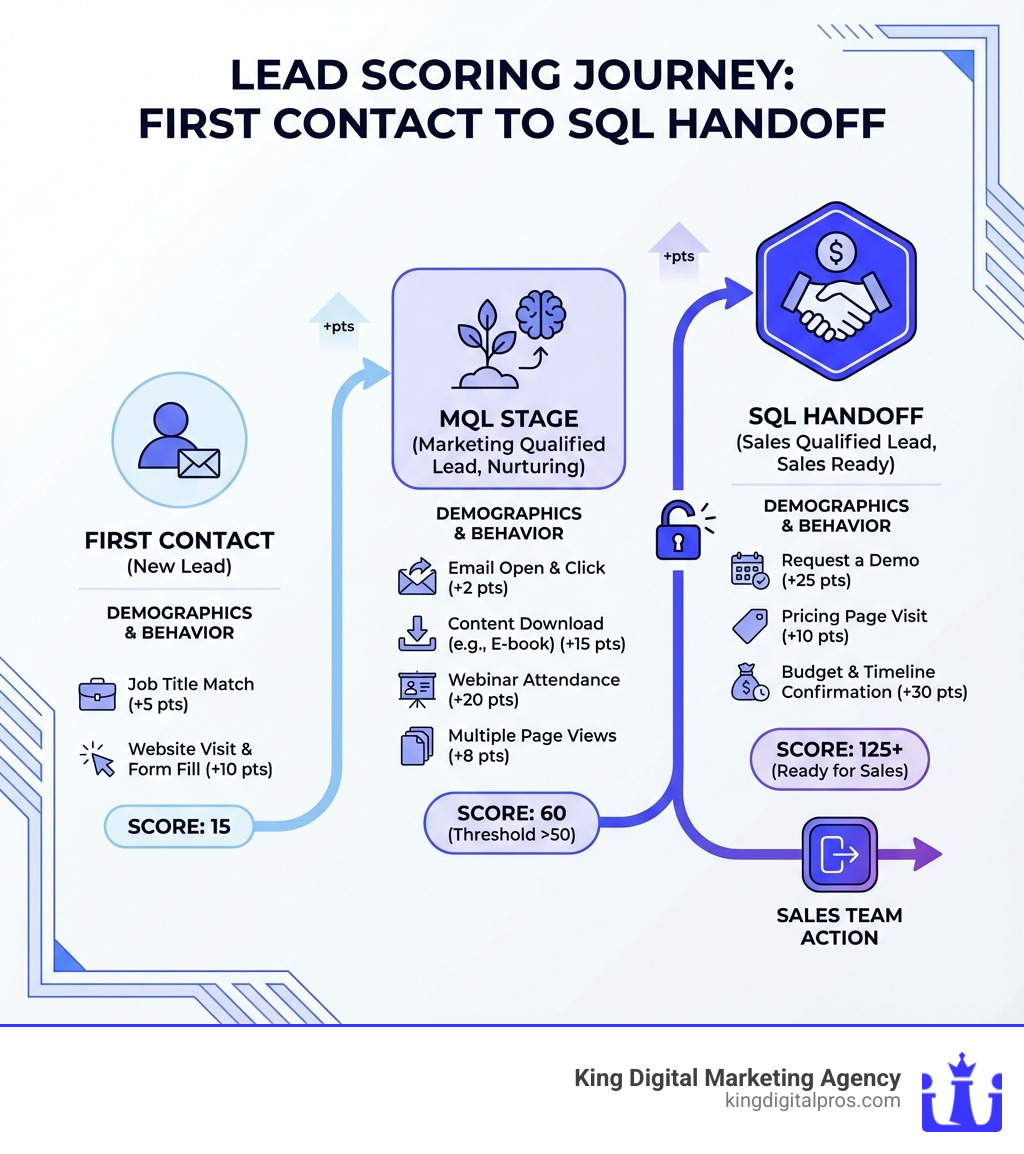
Lead scoring provides an objective ranking to identify where each prospect is in the buying process. It clarifies the difference between a Marketing Qualified Lead (MQL), who needs nurturing, and a Sales Qualified Lead (SQL), who is ready for a sales conversation.
I’m Bernadette King, founder of King Digital, and I’ve spent years helping local businesses optimize their marketing funnels with Lead Scoring Services to turn more leads into paying customers. My background in conversion-driven content has shown me how the right scoring system transforms sales efficiency.
Foundations of Lead Scoring: From MQL to SQL
Lead scoring is a strategic imperative that brings clarity and efficiency to the sales process. Businesses that implement structured lead scoring consistently report faster sales cycles and higher close rates, with many seeing significant increases in revenue. It transforms lead prioritization from a subjective guessing game into an analytical approach, making teams more productive.
At its heart, lead scoring fosters critical alignment between sales and marketing. By establishing a shared, objective definition of a “quality lead,” marketing knows which prospects to deliver, and sales knows what to expect. This synergy ensures that only leads showing strong buying signals are passed to sales, improving conversion rates and reducing friction. This precision helps Boost Conversion Rates and reduces the number of promising leads lost in the shuffle.
Understanding the Lead Funnel: MQL vs. SQL
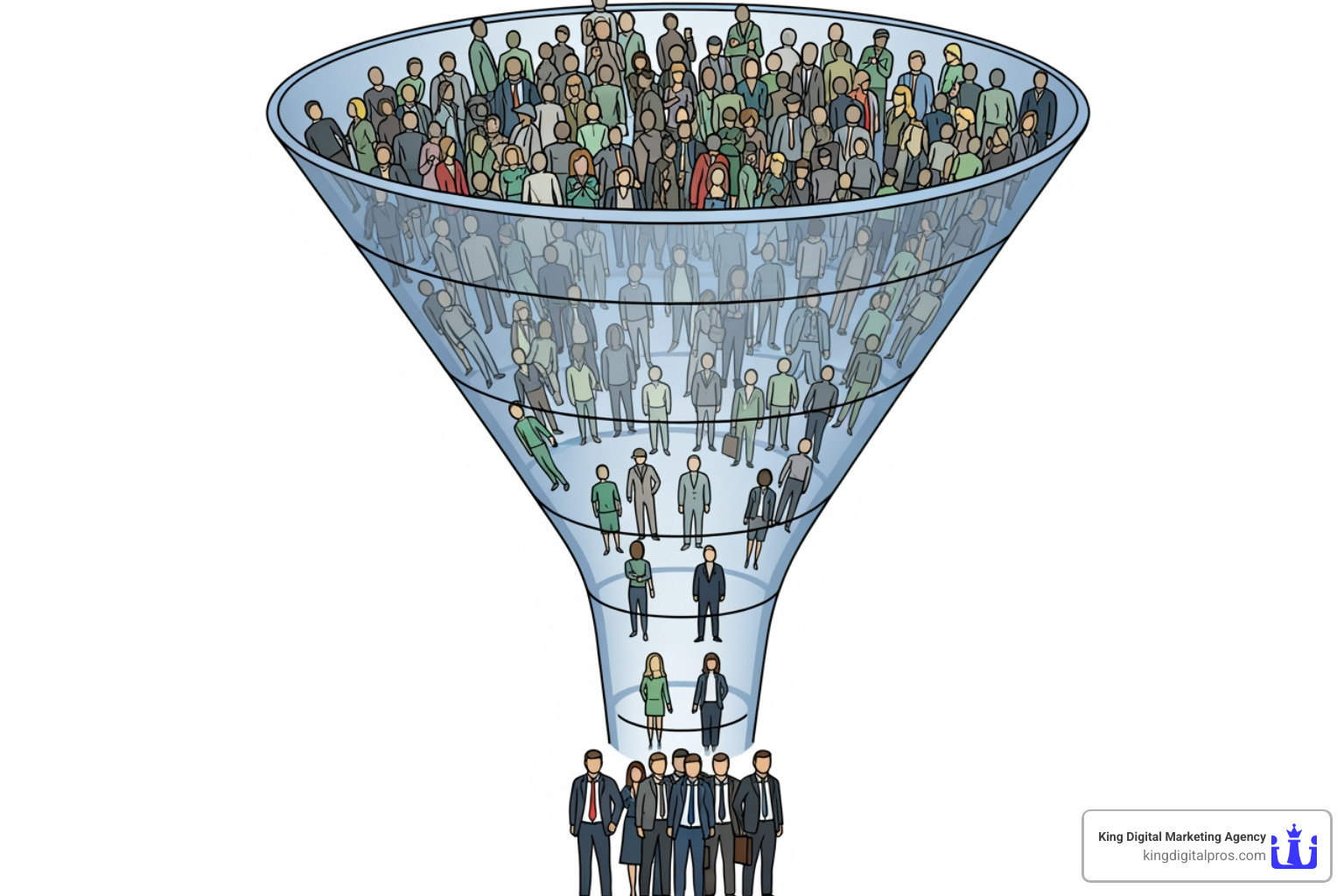
To grasp the power of lead scoring, you must understand the distinctions within the sales funnel: the Marketing Qualified Lead (MQL) and the Sales Qualified Lead (SQL).
An MQL is a lead that has shown initial engagement (e.g., downloaded an e-book, attended a webinar) but isn’t ready to buy. They are still in the research phase and require further nurturing from marketing.
An SQL, on the other hand, has progressed further and is ready to engage with the sales team, indicating a clear intent to purchase. They might have requested a demo or filled out a contact form. An SQL has an imminent purchase in mind and is handed off from marketing to sales.
The biggest difference between an MQL and an SQL is their purchase intent. Lead scoring acts as the bridge between these two stages, identifying the precise moment an MQL transitions into an SQL.
The Core Benefits of Lead Scoring
Implementing a robust lead scoring system offers several benefits that directly impact your bottom line.
-
Improved Sales Productivity: Lead scoring frees sales reps from researching and prioritizing leads, which can consume up to 17% of their time. This allows them to focus on high-intent prospects and dedicate more time to selling.
-
Shorter Sales Cycles: When sales teams focus on leads who are genuinely ready to buy, the time it takes to close a deal naturally shrinks, leading to faster revenue generation.
-
Higher Close Rates: By prioritizing high-scoring leads who fit your ideal customer profile, you provide sales with prospects who are more likely to convert, directly increasing close rates.
-
Better Forecasting: With a clear understanding of lead quality, sales forecasting becomes more accurate, allowing for better resource allocation and strategic planning.
-
Data-Driven Decision Making: Lead scoring replaces subjective guesswork with an analytical process. This data-driven approach allows for continuous refinement of your strategies and optimization of your Online Sales Lead Management Ultimate Guide.
How an Effective Lead Scoring System Works
At King Digital, we see lead scoring as the brain of the sales and marketing engine. It’s a data-driven process that assigns numerical “point values” to leads based on various criteria. Once a lead crosses a predetermined score threshold, they are deemed ready for sales engagement, ensuring the sales team always engages with the most promising prospects. This process is often managed with Lead Manager Software that automates calculations and integrations.
Key Components of Effective Lead Scoring Services
A comprehensive lead scoring model incorporates two main data categories:
-
Explicit Data: Information directly provided by the lead that tells you about their fit as a customer.
- Demographic Information: Details like job title, seniority, and geographic location (e.g., whether they are in Albuquerque, Santa Fe, or Rio Rancho).
- Company Information (Firmographics): For B2B, this includes industry, annual revenue, and company size.
-
Implicit Data: Information gathered from a lead’s behavior, indicating their interest level and intent.
- Behavioral Data (Digital Body Language): This includes tracking how leads interact with your website, emails, and other digital assets.
- High-Value Actions: Visiting a pricing page, requesting a demo, opening emails, and downloading case studies are all strong indicators of interest.
Types of Lead Scoring Models
Lead scoring models range from simple rule-based systems to sophisticated predictive ones.
| Feature | Manual Scoring (Rule-Based) | Automated Scoring (Predictive/AI) |
|---|---|---|
| Setup Time | Moderate (defining rules) | Initial setup can be complex, but then self-optimizing |
| Complexity | Simpler, human-defined rules | Highly complex, uses algorithms and machine learning |
| Data Reliance | Explicit and implicit data, defined by human logic | Vast amounts of historical data, identifies hidden patterns |
| Flexibility | Easy to adjust rules manually | Learns and adapts continuously, requires less manual intervention |
| Bias | Can be influenced by human assumptions | Reduces human bias, but can pick up biases from historical data |
| Accuracy | Good, if rules are well-defined and updated | Generally higher and improves over time |
| Maintenance | Requires regular manual review and adjustment | Self-optimizing, but needs monitoring and data quality assurance |
| Cost | Potentially lower initial software cost, higher labor cost | Higher software cost, lower labor cost for optimization |
| Example | “If job title = CEO, add 10 points” | “Predicts a 75% likelihood of conversion based on 100+ data points” |
Manual scoring uses a defined set of rules (e.g., +10 points for visiting the pricing page). In contrast, automated scoring leverages AI to analyze historical data and predict conversion likelihood, identifying complex patterns humans might miss. A software company, for example, increased sales by 27% using an AI-based tool.
It’s also crucial to implement negative scoring (deducting points for disinterest, like unsubscribing) and consider lead decay (decreasing a score over time due to inactivity) to keep scores relevant.
The Role of Social and Behavioral Data
Social engagement and website behavior provide invaluable insights. With 72% of U.S. adults on social media, as noted by the Pew Research Center, monitoring brand interactions on these platforms is essential. Likes, shares, and comments can indicate strong interest.
Scoring website behavior, or “digital body language,” offers a deep understanding of intent. Using Lead Tracking Services, you can assign higher scores for high-value actions like visiting service or pricing pages, consuming detailed content, or submitting a “Request a Quote” form. These actions build an accurate picture of a lead’s readiness for sales.
Implementing Your Lead Scoring System: A Step-by-Step Guide
Setting up a lead scoring system is an actionable process that begins with strong alignment between sales and marketing. This collaboration ensures the scoring model reflects a shared understanding of the ideal customer. Next, define your Ideal Customer Profile (ICP) by identifying the shared characteristics of your best customers. For us, this might be local businesses in New Mexico (Albuquerque, Santa Fe, etc.) with specific digital marketing needs. Once you know your ICP, you can build your scoring model.
Step 1: Calculate Baselines and Define Attributes
Start by analyzing historical data to set a performance benchmark.
-
Calculate Baseline Conversion Rate: Use the formula (Number of Converted Customers / Total Number of Leads) x 100 to establish your current lead-to-customer conversion rate.
-
Identify Key Customer Attributes: Research your successful customers to find common demographic, firmographic, and behavioral traits. Consult with your sales team for their invaluable frontline knowledge. This process helps you understand How to Calculate Lead Value and align scoring with business goals.
-
Analyze Past Leads: Examine both successful and unsuccessful leads to learn which signals predict conversion and which do not. This helps refine which attributes to score.
Step 2: Assign Point Values and Set Thresholds
With your attributes defined, it’s time to assign points.
-
Assign Points to Each Attribute: Give points based on how strongly an attribute correlates with conversion. For example, if leads who request a demo convert at a much higher rate than average, that action should receive a high point value.
-
Implement Negative Scoring: Deduct points for disqualifying factors, such as a lead being a student, a competitor, or providing fake information. This filters out low-quality leads early.
-
Define the SQL Threshold: Establish the specific score at which a lead is considered an SQL and is ready for sales. This threshold balances lead quality with providing the sales team enough opportunities.
Step 3: Integrate with CRM and Marketing Tools
A lead scoring system is only as powerful as its integration with your tech stack.
-
Sync Scores with CRM: Integration with your Customer Relationship Management (CRM) system is paramount. Lead scores must be visible within each lead’s profile, giving sales reps instant context for prioritization.
-
Automate Workflows: Integration allows you to automate actions based on a lead’s score. For example, when a lead reaches the SQL threshold, a task can be automatically created for a sales rep. Alerts can notify reps in real-time when a lead takes a critical action.
-
Trigger Nurture Campaigns: For MQLs who are not yet sales-ready, automated nurture campaigns can keep them engaged with valuable content until their score increases. Our Sales Lead Management services can provide further guidance on structuring these processes.
Advanced Strategies and the Future of Lead Scoring Services
The landscape of lead scoring is constantly evolving, with advanced Lead Scoring Services offering dynamic, real-time intelligence. These systems use automated improvements and sophisticated analytics to continuously refine scoring models. Scores update in real-time as a lead interacts with your brand, and data enrichment from third-party sources builds richer, more accurate lead profiles. This significantly reduces human bias in lead qualification by relying on objective evidence.
The Power of Automated and Data-Driven Lead Scoring
Automated lead scoring models are game-changers, using artificial intelligence (AI) and machine learning (ML) to analyze historical lead data.
This allows them to:
- Identify Non-Obvious Buying Signals: AI can spot subtle patterns and correlations in behavior that human analysts might miss.
- Continuously Learn and Refine: Unlike static models, AI-powered systems learn from new data as it comes in. As the Harvard Business Review notes, this continuous improvement is key to maximizing sales force productivity.
- Increase Accuracy Over Time: The more data these systems process, the smarter they become, leading to more precise predictions and efficient resource allocation.
Choosing the Right Lead Scoring Software
Selecting the right software is critical. It must integrate with your existing tools and meet your business needs. Key features to consider include:
- CRM Integration: The software must sync seamlessly with your CRM (e.g., Salesforce, HubSpot) so scores are visible to sales teams.
- Customization: The ability to customize scoring rules, attributes, and thresholds is essential to align with your unique ICP.
- Reporting and Analytics: Robust dashboards are crucial for tracking performance, identifying areas for improvement, and demonstrating ROI.
- Ease of Use: The platform should be intuitive for both marketing and sales teams.
- Scalability: The software should handle increasing lead volumes and adapt to more complex models as your business grows.
Future Trends in Lead Scoring Technology
The future of lead scoring promises even greater precision and automation:
- Account-Level Scoring (ABM): Instead of scoring individuals, ABM scores entire companies by evaluating engagement from multiple contacts, which is ideal for B2B sales.
- Opportunity Scoring: This goes a step further by scoring active sales opportunities in the pipeline to predict the likelihood of a deal closing.
- Conversation Intelligence Integration: Tools that analyze sales calls for sentiment and buying signals will feed directly into lead scores.
- Increased Use of Third-Party Data: Systems will increasingly leverage external intent and technographic data to enrich lead profiles.
- Adherence to Standards: As the field grows, adherence to ethical standards, such as those promoted by the Lead Quality Alliance, will be paramount for ensuring data integrity.
Measuring Success and Avoiding Common Pitfalls
Implementing a lead scoring system is an investment that requires measuring its impact. Tracking key metrics allows you to understand if your efforts are yielding results and provides insights for continuous improvement.
Key metrics to monitor include:
- Sales Acceptance Rate: The percentage of MQLs that sales accepts, indicating alignment.
- Conversion Rates of Scored Leads: Compare the conversion rates of scored leads versus unscored leads.
- Length of Sales Cycle: Track whether the time to close a deal is decreasing for scored leads.
- Revenue from Scored Leads: The ultimate metric – is lead scoring contributing to increased revenue? This helps you How to Measure Marketing ROI.
How to Measure the ROI of Your Lead Scoring Efforts
Calculating the Return on Investment (ROI) compares the tangible benefits against the costs.
-
Calculate ROI: Compare the additional revenue generated from scored leads against the costs of the software, setup, and management. A 27% sales increase from an AI tool is a clear example of positive ROI.
-
Analyze Impact on CAC: By focusing sales efforts on better leads, you reduce wasted resources, which can lower your Customer Acquisition Cost (CAC). Our Tools Marketing ROI Calculator can assist with these calculations.
-
Long-Term Value (CLTV): Analyze if customers acquired through lead scoring are more loyal or have a higher Customer Lifetime Value.
Common Mistakes to Avoid
Avoiding these common pitfalls will save time and frustration:
-
Using Poor-Quality Data: A scoring model is only as good as its data. Stale or inaccurate information leads to flawed scores. Continuously update and clean your CRM data.
-
Not Involving the Sales Team: Sales reps are on the front lines; their input in defining a “qualified lead” is crucial for the system’s adoption and success.
-
Setting and Forgetting the Model: Buyer behavior and market conditions change. Your model needs continuous review and refinement based on performance data.
-
Overly Complex Rules: Starting too complex makes the model difficult to manage and optimize. It’s better to start simple and add complexity as needed.
-
Ignoring Negative Scoring: Focusing only on positive actions can waste time on unqualified leads. Negative scoring is just as important for filtering out poor fits. If you’re wondering Is Your Website Converting?, a lack of negative scoring could be a factor.
Conclusion: Transform Your Sales Process with Smart Lead Prioritization
Prioritizing leads is a necessity. Lead Scoring Services transform sales and marketing by replacing guesswork with an analytical, data-driven approach. By understanding the MQL-to-SQL journey and leveraging automated models, you can ensure your teams focus on the most promising opportunities.
The benefits are clear: improved sales productivity, shorter sales cycles, higher close rates, and more predictable revenue.
At King Digital, we specialize in helping local businesses in Albuquerque, Santa Fe, and across New Mexico steer these complexities. Our expertise in optimizing marketing funnels means we can design and implement a lead scoring system that fits your unique business.
Don’t let valuable leads slip through the cracks. Take the next step to Boost Conversion Rates and drive revenue with expert Lead Scoring Services. Let us help you build a smarter, more efficient sales process.
