Why YouTube SEO Is the Smartest Growth Strategy You’re Not Using
YouTube SEO is the process of optimizing your videos and channel so they rank higher in YouTube search results — and get recommended more often to the right viewers.
Here’s a quick breakdown of what it involves:
| YouTube SEO Element | What It Means |
|---|---|
| Keyword research | Finding the exact words your audience types into YouTube search |
| Title optimization | Placing your target keyword early in a compelling, clear title |
| Description & tags | Giving YouTube’s algorithm context about your video content |
| Thumbnails | Creating custom images that earn clicks in search results |
| Watch time & retention | Keeping viewers watching so YouTube promotes your video further |
| Channel optimization | Building a consistent, keyword-rich channel presence |
Now, why does this matter for a local business owner?
YouTube has 2.5 billion monthly users, and they spend an average of 48 minutes per day on the platform. That’s not a niche audience — that’s your audience, searching for answers right now.
Here’s the thing most people miss: YouTube is not just a video platform. It’s the world’s second-largest search engine, processing over 3 billion searches every month. When someone types “best roofer in my city” or “how to fix a leaky faucet,” YouTube serves video results just like Google does.
And unlike a social media post that disappears in 48 hours, a well-optimized YouTube video can drive consistent traffic for years.
I’m Bernadette King, founder of King Digital Marketing Agency, and I’ve spent years helping small businesses turn their digital presence into a real growth engine — including using YouTube SEO to drive organic visibility without relying entirely on paid ads. In this guide, I’ll walk you through exactly what works in 2026, step by step.
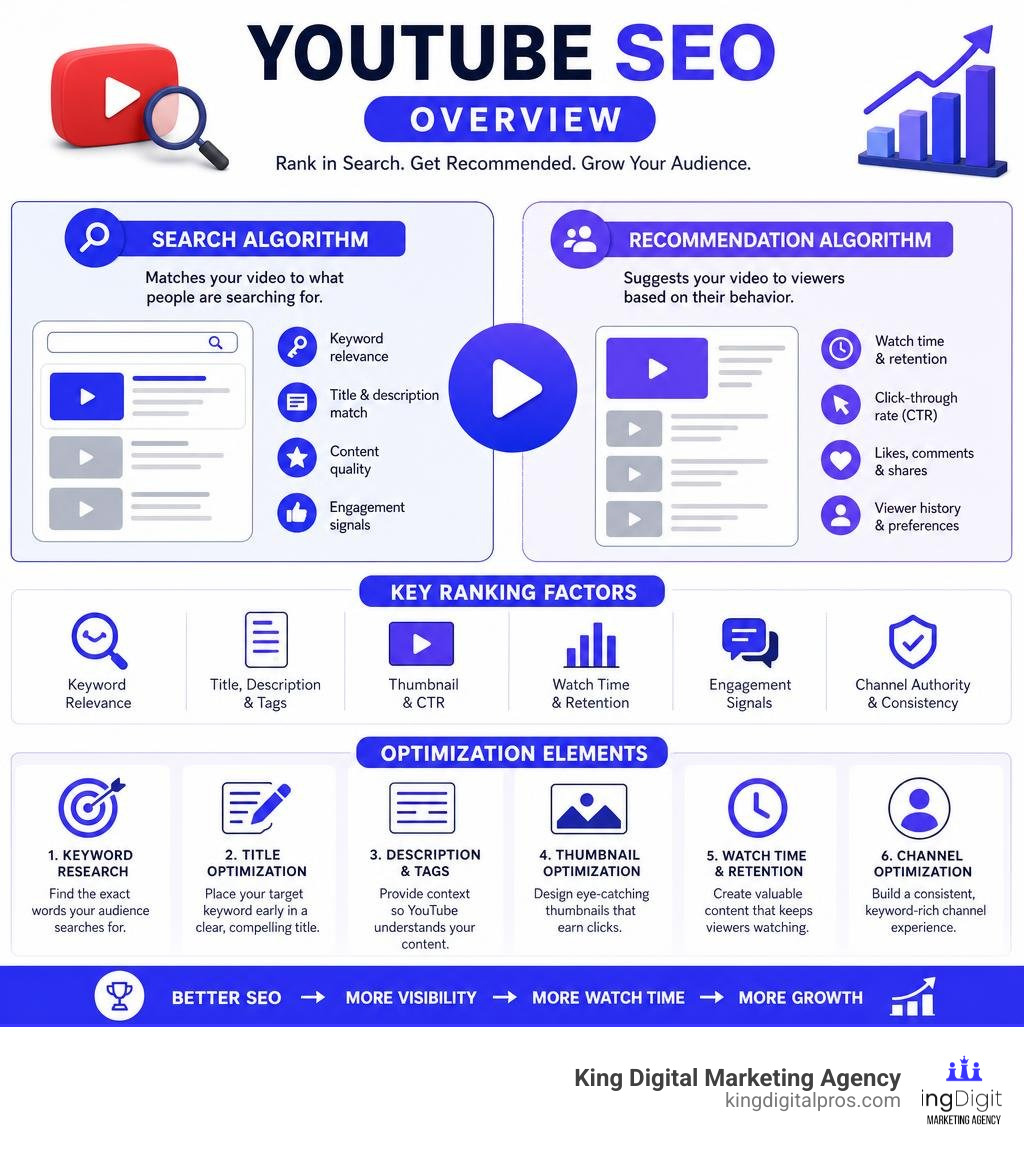
Youtube seo terms explained:
Understanding the Core Mechanics of YouTube SEO
To win at youtube seo, you must first understand how the platform actually decides which videos to show. Many creators believe that ranking is a mystery or a matter of pure luck. In reality, YouTube’s system operates on a highly logical, two-phase process designed to maximize viewer happiness.
The two primary phases of the YouTube algorithm are:
- The Click Prediction Phase: This is where YouTube’s system evaluates your title, thumbnail, and topic to predict how likely a user is to click on your video.
- The Satisfaction Prediction Phase: Once a user clicks, the system closely monitors how long they stay (watch time and retention) and how they interact with the video (engagement signals and feedback).
If your video has a high click-through rate (CTR) but terrible viewer retention, the algorithm will quickly stop showing it. Conversely, a video with solid retention and steady engagement will be pushed to more search results and recommended feeds because it keeps users on the platform.
To build a sustainable strategy, we must focus on optimizing for both search and recommendation systems. If you want to dive deeper into how these concepts align with search engine marketing, you can Learn what SEO in YouTube means to build a solid foundation.
How the YouTube Algorithm Evaluates YouTube SEO
The algorithm in 2026 is smarter than ever. Gone are the days when you could rank a video simply by stuffing keywords into your tags and description. Today, the system prioritizes viewer satisfaction signals over technical metadata.
The key ranking factors evaluated by the algorithm include:
- Average View Duration (AVD) & Retention Curve: This is the absolute king of ranking signals. YouTube looks at the percentage of the video that viewers actually watch. If you can maintain a 40% retention rate on a 10-minute video, you are outperforming the vast majority of creators.
- Click-Through Rate (CTR): The percentage of people who click your video after seeing it on their screen. This must be compared against your own channel’s baseline rather than generic industry benchmarks.
- Topical Relevance: YouTube parses your title, description, and automated transcript to understand exactly what your video is about.
- Engagement Signals: Comments, likes, shares, and new subscriptions generated directly from the video signal high value to the algorithm.
- User Feedback: Post-watch surveys and satisfaction signals help refine future recommendations.
To understand how these search and discovery mechanics function from the source, you can review YouTube’s official guide on search and discovery.
Why YouTube SEO is Critical for Channel Growth
For local businesses and independent creators alike, youtube seo acts as a long-term organic traffic engine. Unlike social media platforms where content life expectancy is measured in hours, optimized YouTube videos experience a powerful compounding effect.
Consider a local home service business in Rio Rancho or Albuquerque. If you publish an optimized video answering a common customer question—such as “how to prepare your home swamp cooler for New Mexico winters”—that video can rank at the top of local search results for years. Every month, new homeowners searching for that exact solution will find your video, build trust in your expertise, and contact your business.
This creates a highly efficient lead-generation channel with compounding returns:
- Permanent Organic Real Estate: Your rankings remain steady until a significantly better video replaces them.
- High-Intent Audiences: Viewers searching for specific tutorials or guides already have a problem they need to solve, making them highly qualified leads.
- Brand Authority: High-ranking videos position your business as the leading local expert in your industry.
To explore how these pieces fit into a broader marketing framework, you can Discover the YouTube SEO Complete Guide.
Step-by-Step Video Optimization Strategy
Optimizing your video content does not require complex technical tricks. Instead, it requires a systematic, step-by-step workflow that aligns your video’s metadata with actual user search intent.

Keyword Research and Finding Search Volume
Every successful video starts with thorough keyword research before you ever turn on your camera. If you do not know what terms your target audience is typing into the search bar, you are essentially flying blind.
Here are the most effective ways to find high-value search terms:
- YouTube Search Autocomplete: Start typing your primary topic into the YouTube search bar. The suggestions that drop down are actual, high-volume search queries that real users have typed recently.
- Competitor Video Mining: Look at other successful channels in your niche (including local channels across New Mexico, such as those highlighting travel in Taos or historical guides in Corrales). Identify their top-performing videos and analyze the exact keywords they use in their titles.
- Google Trends (with the YouTube filter): Compare different keyword variations to see which topics are rising in popularity over time.
- Specialized SEO Tools: Platforms like TubeBuddy and vidIQ can help you analyze search volume and competition scores.
For a detailed walkthrough on evaluating search metrics and finding the right keywords for your channel, read our guide on How to Find YouTube Keyword Competition Score and SEO.
Crafting Click-Worthy Titles and Descriptions
Your title and description do the heavy lifting when it comes to indexing your video. They must be written for human readers first while still containing clear keyword signals for the algorithm.
Video Titles
Your title should be kept under 70 characters so it does not get cut off in search results. Place your primary keyword naturally within the first 5 words of the title. For example, instead of naming your video “Our Team Working in Santa Fe,” use a structured, search-friendly title: “How to Restore Historic Adobe Walls in Santa Fe, NM.”
Video Descriptions
YouTube provides up to 5,000 characters for your description, yet many creators leave this space almost empty. To optimize this area:
- Treat the first 150 characters as a search preview snippet. Put your primary keyword in the very first sentence.
- Write a detailed summary of at least 250 to 300 words, weaving in secondary keyword variations naturally.
- Add clear calls-to-action (CTAs) and links to your website or related videos.
To understand how search engines index and display video content in general search results, check out Google’s official explanation of video indexing.

Thumbnails, Chapters, and Closed Captions
To maximize both your Click-Through Rate and your retention curve, you must focus on the finer details of your video presentation.
Custom Thumbnails
Ninety percent of the best-performing videos on YouTube use custom thumbnails rather than auto-generated frames. Design your thumbnails with high-contrast, clean backgrounds, and limit text overlays to 1–3 readable words. Ensure the design is highly legible on mobile devices, where over 70% of YouTube watch time occurs.
Video Chapters
Adding timestamped chapters to your description makes your video much easier to navigate. It also creates separate indexed entry points, allowing a single video to rank for multiple specific queries. Start your timestamps at 00:00 and include at least three chapters that are at least 10 seconds in length.
Closed Captions
While YouTube automatically transcribes your video, these auto-generated captions often contain spelling errors—especially with local New Mexico place names like Tijeras, Los Alamos, Cedar Crest, or Sandia Park. Uploading a manually corrected SRT file significantly improves accessibility and provides clean, indexable text for search engines.
| Caption Type | Accuracy | SEO Indexing Value | Accessibility Rating |
|---|---|---|---|
| Auto-Generated Captions | Moderate (often misses local names/jargon) | Low (errors dilute keyword signals) | Basic |
| Manually Uploaded Captions | 100% | High (exact keyword indexing) | Excellent |
Channel-Level Optimization and Authority Building
Youtube seo is not limited to individual video uploads. To build long-term search rankings, you must establish topical authority across your entire channel.
Playlists, Channel Trailers, and Branding
A cohesive, professional channel layout signals trust to both your viewers and the algorithm.
- Thematic Playlists: Group your videos into highly focused playlists using descriptive, keyword-rich titles. For instance, a local agency in Albuquerque might group videos into “Local SEO Tips,” “Google Business Profile Optimizations,” and “Video Marketing Guides.” This encourages binge-watching, which increases your overall channel watch time.
- Channel Bio & Keywords: Optimize your channel’s “About” section by incorporating your primary business keywords in the first 150 characters, as this snippet often appears in search results. Add relevant channel keywords in your YouTube Studio settings.
- Channel Trailer: Create a short, 30-to-60-second trailer that clearly explains what your channel is about and why viewers should subscribe.
- Upload Consistency: Publishing videos on a predictable schedule (whether weekly or bi-weekly) signals reliability to the algorithm and helps maintain early engagement momentum.
If you want to master the art of ranking your channel assets systematically, you can Learn how to Rank Your Videos on YouTube.
Building Backlinks and Off-Platform Promotion
To accelerate your channel’s growth, you should look beyond the YouTube platform itself. External signals can help search engines discover and trust your content faster.
- Social Sharing: Share your newly published videos across your social media channels to drive early traffic and engagement signals.
- Video Embedding: Embed your YouTube videos on highly relevant pages of your website. For example, if you have a service page targeting Grants, NM, embedding an educational video about your services in that area can keep visitors on your site longer while boosting your video’s views.
- High-Quality Backlinks: Building links to your video URLs and channel page increases their overall authority.
To learn how to build these external signals effectively without spending a fortune, explore our guides on how to Create YouTube Backlinks Like a Pro Without Spending a Dime and how to acquire high-authority Backlinks for YouTube Channel pages.
How to Rank YouTube Videos on Google Search
One of the greatest advantages of youtube seo is the dual-platform benefit. Because Google owns YouTube, well-optimized videos frequently rank directly on Google search results pages, appearing in standard organic listings, video carousels, featured snippets, and AI Overviews.
To optimize your videos to rank on Google search:
- Target “Video-Intent” Keywords: Search Google for your target terms to see if video results already appear. Queries starting with “how to,” “tutorial,” “review,” or “comparison” are highly likely to trigger video carousels.
- Use Schema Markup: When embedding your YouTube video on your website, implement
VideoObjectschema markup. This helps search engine crawlers understand the structure, duration, and thumbnail of your video content. - Structure Content for Key Moments: Use descriptive chapter titles in your video description. Google uses these timestamps to display “Key Moments” directly in search results, letting users jump straight to the answer they need.
To ensure your structured data complies with search engine standards, read Google’s Video Schema Markup Guidelines. If you want a complete, step-by-step roadmap for bridging the gap between YouTube and Google search, refer to our detailed guide: YouTube SEO Explained: A Step-by-Step Guide to Google Rankings.
Measuring Performance and Avoiding Common Mistakes
To turn your video optimizations into a predictable growth engine, you must bring a data-driven approach to your channel management.
Key Metrics to Track in YouTube Studio
Do not get distracted by vanity metrics like total view counts. Instead, focus on the core metrics in YouTube Studio that reflect genuine viewer satisfaction and search health:
- Audience Retention Curve: Look for sharp drops in your retention graphs. A sudden drop indicates where viewers lost interest or felt misled, helping you improve your future video scripts.
- Traffic Sources: Verify that “YouTube Search” is a growing traffic source for your channel, indicating that your keyword targeting is working.
- Impressions Click-Through Rate (CTR): If your CTR is below 2-4% on search terms, test new thumbnail designs or adjust your title to make it more compelling.
- Viewer Comments and Shares: High engagement rates signal to the algorithm that your content is valuable enough to be recommended to a broader audience.
Pitfalls to Avoid: Keyword Stuffing and Clickbait
When optimizing your channel, avoid these common mistakes that can damage your rankings and channel authority:
- Keyword Stuffing: Do not write descriptions that are simply long lists of keywords. This looks spammy to viewers and can lead to search penalties from the algorithm.
- Misleading Thumbnails (Clickbait): If your thumbnail promises something your video does not deliver, viewers will click away within the first 10 seconds. This ruins your average view duration and signals to YouTube that your content is low quality.
- Tag Spam: Do not use hundreds of irrelevant tags. Focus on 5 to 10 highly specific tags that directly match your video topic.
- Ignoring Analytics: Failing to review your retention curves means you will continue making the same scripting and editing mistakes in future uploads.
Frequently Asked Questions about Video Ranking
How long does it take for video optimization to show results?
For most videos, YouTube search indexing happens within 24 to 48 hours. However, establishing stable rankings for competitive terms can take anywhere from 2 to 8 weeks for smaller channels, and up to several months for highly competitive keywords as the algorithm gathers enough watch-time data to verify viewer satisfaction.
Do video tags still matter for ranking in 2026?
Tags have a much smaller impact on ranking than they did in the past. Today, they are primarily used as a legacy confirmatory signal for misspellings, local regional names, and topic disambiguation. Spend no more than two minutes adding 5 to 10 highly relevant tags to your upload.
Can a small channel outrank a large channel?
Yes! YouTube’s algorithm is highly merit-based. If a channel with 500 subscribers produces a video with exceptional click-through rates and strong viewer retention, it can easily outrank a channel with 500,000 subscribers that has weak viewer engagement on the same topic.
Conclusion
Mastering youtube seo is a marathon, not a sprint. By focusing on high-quality keyword research, structuring your metadata for both search engines and human viewers, and prioritizing audience retention, you can build a sustainable, compounding source of organic traffic that grows your brand’s authority over time.
At King Digital Marketing Agency, we specialize in helping businesses across New Mexico—from Albuquerque and Rio Rancho to Santa Fe and Taos—build highly effective digital marketing strategies that attract more local customers. If you are ready to turn your video content into a powerful lead-generation engine, let our team of experts handle the technical details for you.
Get professional YouTube SEO services today and start ranking higher where it matters most!
