Website Content Updates: Your Quick-Start Guide
Website content updates are one of the highest-leverage activities a small business owner can do to improve search rankings, keep visitors engaged, and turn more buyers into buyers.
If you need a fast answer, here is what regular content updates involve:
| What to Update | Why It Matters |
|---|---|
| Outdated text, stats, and dates | Keeps information accurate and trustworthy |
| Images, videos, and visuals | Improves engagement and reduces bounce rates |
| Broken links and technical errors | Protects SEO rankings and user experience |
| Keywords and headings | Aligns pages with how people search today |
| Author attribution and sources | Meets Google’s 2026 E-E-A-T standards |
Most experts recommend reviewing and refreshing your key pages every 3 to 6 months. Pages that are actively losing traffic should jump to the top of your list immediately.
Here is why this matters right now: Google’s July and August 2026 algorithm updates have made content freshness and demonstrated expertise more important than ever. Sites with stale, unreviewed content are seeing significant ranking drops. Sites that maintain updated, expert-led content are gaining ground.
This guide walks you through the entire process – from identifying which pages need attention first, to technical fixes, to measuring whether your updates are actually working.
I’m Bernadette King, founder of King Digital, and over my career building and scaling businesses online, I’ve helped franchise owners and local businesses use strategic website content updates to turn underperforming pages into consistent lead generators. I’ll share exactly what works in 2026 so you can do the same – even without a full marketing team behind you.
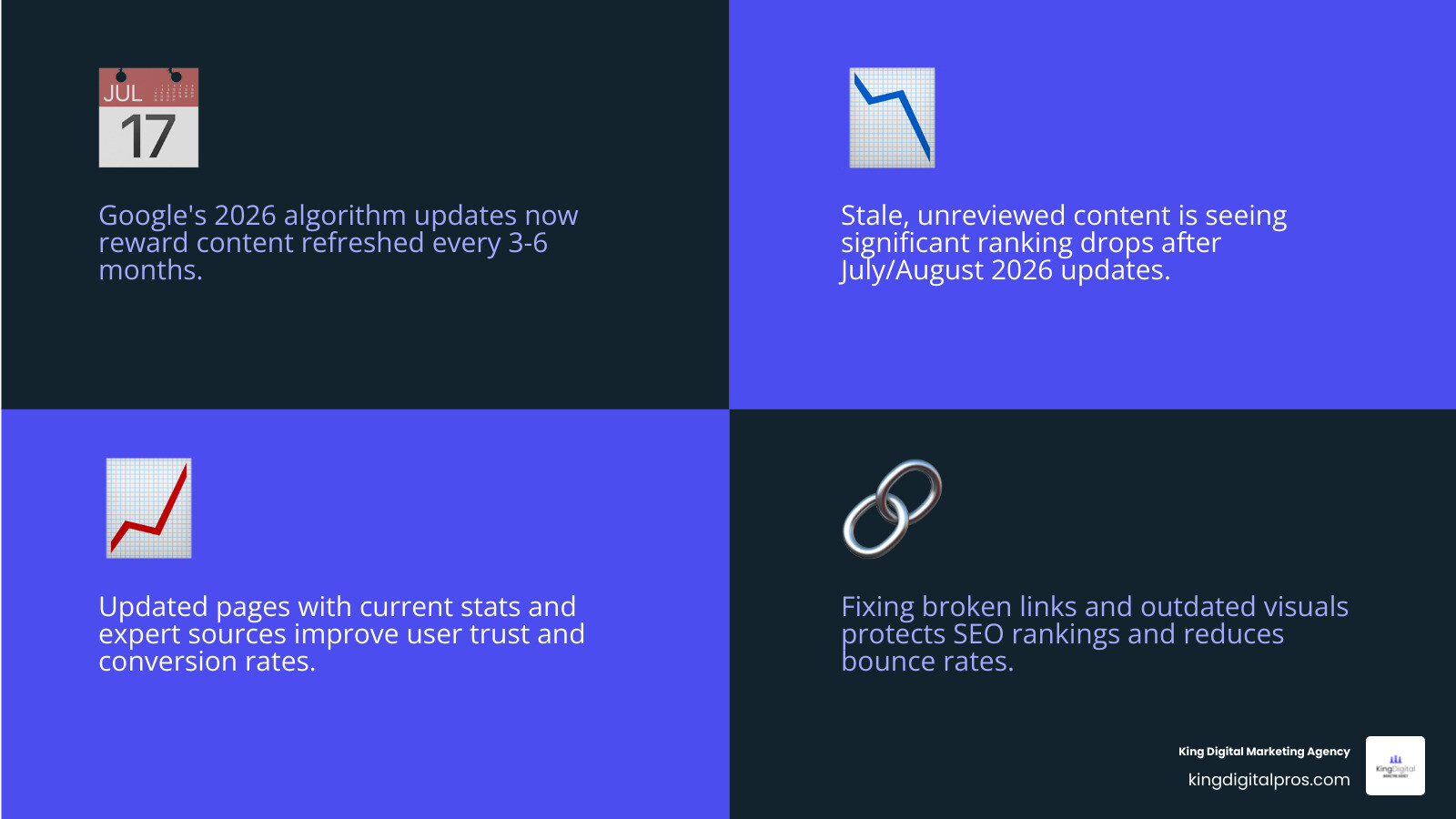
Quick look at Website content updates:
Why Regular Website Content Updates Are Crucial in 2026
Publishing a webpage is never a “set-it-and-forget-it” task. In July 2026, a static website is a decaying website. Regular website content updates are essential for maintaining your search visibility, keeping your bounce rates low, and maximizing your conversion rates.
When search engine crawlers return to your site and find updated statistics, clarified concepts, and fresh resources, they categorize your content as active and relevant. Conversely, if your content sits untouched for years, search engines assume the information is obsolete.
This directly impacts your bottom line. If a page’s content is outdated, users will quickly bounce to find a more current source. A high bounce rate signals to search engines that your page is not meeting user expectations, resulting in lower rankings. Furthermore, keeping your content updated is a direct way to improve your conversion rates. As your business evolves, your core service pages must accurately reflect your current offerings, pricing, and customer testimonials.
The search landscape has shifted dramatically. Zero-click searches now account for approximately 29% of all queries. Users are getting immediate answers on the search results page through AI-driven summaries. Furthermore, informational queries with AI Overviews are now delivering 40-65% lower organic click-through rates (CTR) than those same queries did before AI Overviews were introduced.
To win traffic in this environment, your site must be cited as a primary source by these AI models. According to a recent Study: Content Recency’s Impact on AI Visibility in 2026, 75% of the pages cited by LLMs (Large Language Models) like ChatGPT, Gemini, and Perplexity were updated within the last year. If you are not actively refreshing your site, you are rendering your business invisible to modern AI search tools. For a deeper look at why keeping your digital presence fresh is so vital for small businesses, check out our Why Update Website Content: SMB Guide for 2026.
How Often to Perform Website Content Updates
While there is no single industry-wide standard, reviewing and refreshing your high-value website content every 3 to 6 months (or at least twice a year) is a highly effective best practice.
The frequency of your updates should depend on the type of content you host. Your core brand pages, contact information, and local services require immediate updates whenever your business changes operational policies or launches new features. On the other hand, informational blog posts and guides can be scheduled for systematic reviews on a quarterly or bi-annual basis to ensure they remain evergreen.
For local businesses in New Mexico, keeping your geographic and contact details perfectly aligned across your website and map listings is critical. If you want to dive deeper into local-specific timing and strategies, read our Why Update Your Website Regularly: Albuquerque SMB Guide.
Prioritizing Your Website Content Updates by Type
When managing your update cycle, categorize your efforts into three main buckets:
- Text and Copy Updates: This involves revitalizing outdated statistics, correcting obsolete facts, adding new subheadings to address emerging user questions, and rewriting weak paragraphs. Breaking up large walls of text into short, scannable paragraphs of 2 to 3 sentences makes your content much easier for both human readers and AI crawlers to digest.
- Visual Refreshes: Aligning your visual elements with modern design trends is essential for user engagement. This includes swapping out old stock photos for original, high-quality images, updating seasonal banners, and integrating video. Video content is in massive demand – 91% of consumers express a desire for more video content from brands. Adding short video explanations or product demos can dramatically increase the time visitors spend on your pages.
- Technical Fixes: A content refresh should always go hand-in-hand with technical maintenance. If a page takes longer than 3 seconds to load, over half of mobile users will abandon it. You must compress your images, configure caching, and eliminate broken links (404 errors) to keep your page experience flawless.
How to Identify and Prioritize Pages for Refreshing
You do not have to update all your pages at once. The smartest approach is to target pages that will yield the fastest and most significant returns on your time and effort.
We recommend dividing your content audit into three distinct, manageable buckets:
- Pages Actively Losing Traffic: Use Google Search Console and Google Analytics to identify high-value pages that show a downward trend in visitor numbers over the last 3 to 6 months. These are your highest priority because they represent lost revenue and slipping search authority.
- Quick-Win Pages: Look for pages that rank on the second page of Google (positions 11 through 20) or at the bottom of the first page. With a few targeted keyword optimizations, updated statistics, and stronger headings, these pages can easily jump into top-ranking positions.
- New Pages to Fill Competitive Gaps: Analyze your competitors’ top-performing pages. If they are ranking for highly relevant industry terms that your site doesn’t cover, prioritize creating or expanding content to fill those structural gaps.
For businesses operating in Albuquerque, Rio Rancho, Santa Fe, and the surrounding areas, local search intent is your secret weapon. Tailoring your update priorities to local landmarks, regional services, and local customer reviews is an excellent way to capture high-intent traffic. For a step-by-step optimization workflow tailored to our region, see our guide on Website Content Optimization Steps for Albuquerque SMBs.
Resolving Team Disagreements on Priority
It is common for internal teams to disagree on which website updates should come first. Designers might lobby for visual overhauls, writers may want to focus on blog posts, and business owners might prioritize sales pages.
To resolve these conflicts objectively, apply the Impact-Effort Matrix from product management:
- Quick Wins (High Impact, Low Effort): These should always come first. Examples include fixing broken links on your top five traffic-generating pages, updating outdated pricing, or adding a clear Call-to-Action (CTA) to a popular blog post.
- Major Projects (High Impact, High Effort): Schedule these systematically. This includes complete rewrites of your core service pages or building out comprehensive, multi-page topic clusters.
- Fill-Ins (Low Impact, Low Effort): Do these during quiet periods. This involves minor cosmetic tweaks or updating older, low-traffic blog posts.
- Time Wasters (Low Impact, High Effort): Avoid these entirely. Do not spend days redesigning a complex page layout that only receives a handful of visits a month.
Always ground your decisions in objective user feedback and performance metrics. Consult your customer support logs to see what questions customers ask most frequently, and prioritize updating your content to answer those exact pain points.
Navigating E-E-A-T and AI Content in the Post-2026 Algorithm Era
Google’s major core algorithm updates in July and August of 2026 have completely rewritten the rules for content quality. Specifically, Google’s July 2026 “E-E-A-T Update” introduced a heavy emphasis on first-hand authority and real-world experience, aiming to filter out generic, mass-produced web content. For a detailed breakdown of these algorithmic changes, read Google’s July 2026 ‘E-E-A-T Update’ Rewards First-Hand Authority: What AI Content Creators Must Do – Shine Magazine.
Google is now utilizing an “Experience Density” signal. This signal is designed to detect language patterns and media assets that prove direct, lived experience (e.g., “when we tested this in our lab,” “in our 10 years of serving Rio Rancho customers”).
Early data from test deployments of these updates showed a staggering 40-60% traffic drop for websites relying heavily on outsourced, non-expert, or unreviewed content. Conversely, niche sites with clear, demonstrated author authority experienced organic traffic gains of 25% or more.
Additionally, Google’s core updates now perform entity-level content quality scoring. This means Google evaluates the specific credentials of the authors and organizations tied to your content. If you are using AI tools to assist in your writing, you must establish a rigorous editorial review process.
According to data from July 2026 Core Update: How Google Now Scores AI Content – WhatsMyGeoScore, sites that maintained transparent editorial oversight and human review saw an average ranking improvement of 8.3 positions for informational queries. Meanwhile, sites publishing unreviewed, raw AI content suffered an average drop of 12.7 positions.
To align your website content updates with these strict 2026 standards, follow these best practices:
- Add Real Proof of Experience: Include original photos of your team working in local areas like Corrales, Los Alamos, or Taos. Add custom screenshots, unique data charts, and direct quotes from your specialists.
- Implement Author Schema: Use structured data markup (such as Yoast SEO or Rank Math) to link your articles to detailed author bio pages. Show your real credentials, certifications, and links to your active social profiles.
- Publish Editorial Guidelines: Make your editorial and fact-checking processes transparent. Let both your users and search engines know exactly who reviews your content before it goes live.
- Avoid Cosmetic-Only Updates: Google actively penalizes sites that simply change the “Last Updated” date on a page without making substantive improvements to the text. Make sure your updates add real, original value.
Technical Enhancements, Automation, and Measuring Success
A successful content refresh is never just about the words on the page; it must be supported by a healthy technical foundation. When you update your text, you should simultaneously check and improve your page’s technical performance.
Make sure your pages pass the 2026 Core Web Vitals thresholds:
- Largest Contentful Paint (LCP): Under 2.5 seconds (measures loading speed).
- Interaction to Next Paint (INP): Under 200 milliseconds (measures page responsiveness).
- Cumulative Layout Shift (CLS): Under 0.1 (measures visual stability).
Additionally, keep your site secure. Over 30,000 websites are hacked daily, and the vast majority of these security breaches stem from unpatched core software, themes, or plugins. Just as software developers release regular updates to fix vulnerabilities – such as the recent release of LibreOffice 26.2.5 is available for download – TDF Community Blog to ensure system stability – you must keep your website’s plugins and platform updated to protect your search rankings and user data. For a complete checklist on how to keep your site running smoothly, explore our guide on Small Business Website Maintenance.
To keep your workflow efficient, use this comparison table to decide which technical checks to handle manually and which to automate:
| Technical Check | Manual Method | Automated Alternative |
|---|---|---|
| Broken Links (404s) | Clicking through internal links on your pages. | Using a site crawler tool (like Screaming Frog or online broken link checkers). |
| Page Speed & Core Web Vitals | Testing pages individually on mobile devices. | Running bulk reports via Google PageSpeed Insights or GTmetrix. |
| Image Optimization | Resizing and converting images before upload. | Using WordPress plugins (like Smush or Imagify) to compress images on upload. |
| Plugin & Core Updates | Manually checking the updates dashboard weekly. | Enabling managed updates through a trusted hosting provider. |
Measuring Success Metrics Post-Update
Once you have completed your website content updates, you must measure their impact to see what is working.
Do not expect immediate ranking jumps overnight; search engines typically take 2 to 4 weeks to recrawl and reevaluate updated pages. Track these three key metrics to measure your success:
- Organic Traffic and Impressions: Monitor Google Search Console to see if your updated pages are gaining impressions and clicks for your target terms.
- Engagement and Conversion Rates: Check if your bounce rates have decreased and if visitors are spending more time on your refreshed pages. Most importantly, track whether your updated CTAs are driving more form submissions and phone calls.
- AI Citation Rate: In 2026, ranking in traditional search is only half the battle. You must check if your pages are being cited inside AI Overviews and conversational search tools. You can track this by running your top 20 target queries through ChatGPT, Claude, and Gemini monthly to see if your site is cited in the answers. For more advanced tracking tips, see 32 SEO Page Content Best Practices for 2026.
Automating the Process with Content Opportunity Tools
Analyzing your website content manually can be incredibly time-consuming. Fortunately, modern SEO tools can automate the heavy lifting:
- Frase and Content Optimizers: These tools analyze the top-ranking search results for your target keywords and show you exactly what topics, subheadings, and questions your content needs to cover to match search intent.
- Content Decay Trackers: Software integrated with your Google Search Console can automatically alert you the moment a high-performing page begins to lose impressions or rankings, allowing you to refresh it before your traffic drops significantly.
- Automated Schema Generators: These tools ensure your FAQ, HowTo, and Author schema are perfectly formatted and easily extractable by search engines and AI crawlers alike.
Frequently Asked Questions About Content Refreshes
Does Google penalize AI-generated content?
No, Google does not penalize content solely because it was created using AI. However, Google heavily penalizes low-quality, “commodity” content that fails to add unique value, whether written by a human or generated by a machine. The key to ranking AI-assisted content is incorporating rigorous human editorial review, unique local insights, and verifiable first-hand experience.
How do core updates affect affiliate and informational sites?
Google’s core updates have introduced massive volatility for sites that rely on thin, aggregated informational content. With AI Overviews answering simple questions directly on the search results page, informational sites must pivot toward deep, expert-led content and Answer Engine Optimization (AEO) to maintain their visibility. For a detailed analysis of how these shifts are impacting online search real estate, read Google’s August 2026 Core Update Is Reshaping Affiliate SERP Real Estate – Affiliate Times.
What is the difference between a content update and a cosmetic refresh?
A content update focuses on improving the actual information on a webpage – such as updating statistics, rewriting outdated paragraphs, and optimizing keywords for SEO. A cosmetic refresh, on the other hand, focuses purely on visual design and brand identity, such as changing your logo, updating your brand colors, or altering your site’s layout without changing the underlying text. Both are important, but content updates have a much more direct impact on your search engine rankings.
Conclusion
Regular website content updates are the single most effective way to keep your business visible, credible, and competitive online. By systematically auditing your pages, prioritizing quick wins, integrating real-world experience, and maintaining your site’s technical health, you can ensure your digital presence continues to generate valuable leads for years to come.
At King Digital Marketing Agency, we specialize in helping local businesses across New Mexico – including Albuquerque, Rio Rancho, Santa Fe, Los Alamos, Taos, and the East Mountains – maximize their local visibility. From expert management of your Google Business Profile and local map listings to professional website maintenance, we make sure your business stands out where it matters most.
If you don’t have the time or technical team to manage your updates consistently, let us handle the hard work for you. Explore our professional Website Update Service or learn more about our comprehensive Website Hosting and Maintenance Plans to keep your online presence fresh, secure, and optimized for growth.
