Technical SEO services fix the behind-the-scenes problems that stop Google from finding, reading and showing your website. If your pages load slowly, hide content from search engines or confuse Google about which URL is the real one, great content and good reviews will not get you far. A technical SEO agency finds those problems, ranks them by impact and gets them fixed. At King Digital, we do this for Albuquerque businesses as part of our SEO services, so the work ties directly to calls, form fills and booked jobs.
TL;DR
- Technical SEO is the work of making your site easy for search engines to crawl, render, index and serve. It is the foundation under content, links and local listings.
- A good engagement starts with your own Search Console data, ranks fixes by business impact and measures results after the fixes ship.
- Common fixes include removing accidental noindex tags, correcting canonical tags, speeding up slow pages and making key content visible without JavaScript.
- For a local service business, the payoff is more visibility for “near me” and city searches, which means more qualified leads.
- The right agency tells you who makes each change, gives you full account access and does not lock you into a long contract.
Table of Contents
- What technical SEO services actually are
- What a technical SEO audit and service plan include
- Problems that come up most often, and how they get fixed
- Why technical SEO matters for local businesses
- What technical SEO costs
- How to judge a technical SEO agency before you hire
- Technical SEO or a new website?
- Getting started with King Digital
- Our perspective
- FAQ
- Sources
What technical SEO services actually are
Think of your website as a storefront. Content is the window display and reviews are the word of mouth. Technical SEO is the lock on the door, the lights and the address on the building. If any of those fail, customers never get inside, however good the shop is.
More precisely, technical SEO is the process of optimizing your website’s infrastructure so search engines can crawl, render, index and serve your content correctly and efficiently. Four terms are worth knowing:
- Crawling: Google’s software follows links to discover your pages.
- Rendering: Google processes the page, including any JavaScript, to see what a visitor would see.
- Indexing: Google stores the page so it can appear in results.
- Serving: Google picks the page to show for a search.
Technical SEO services are paid work that keeps every one of those steps running. You are not buying keywords or blog posts. You are buying a site that search engines can fully understand.
What a technical SEO audit and service plan include
An audit is the diagnosis. The service plan is the treatment. Agencies package them differently, but the work falls into five areas.
1. Crawlability
The audit checks whether Google can reach every page that matters. Typical crawl failures include orphaned pages (pages with no internal links pointing to them), a robots.txt file that blocks critical resources, navigation that only appears through JavaScript, and crawl traps that generate endless URL variations. A plumber with a service page nobody links to has a page Google may never find.
2. Indexing
A page can be crawled and still not appear in Google. The usual causes are noindex tags left on from a site build, canonical tags pointing to the wrong URL, thin or duplicate content, and pages returning something other than a normal 200 status code. The fixes are plain: remove the noindex, correct the canonical, merge thin pages into stronger ones.
Google Search Console, Google’s free reporting tool for site owners, shows which pages are indexed and why others are not. A solid audit starts there rather than with a generic crawl report. If you want to see how one Search Console check works, this Search Console sitemap audit walks through reviewing your sitemap, the file that lists the pages you want Google to find.
3. Site speed and Core Web Vitals
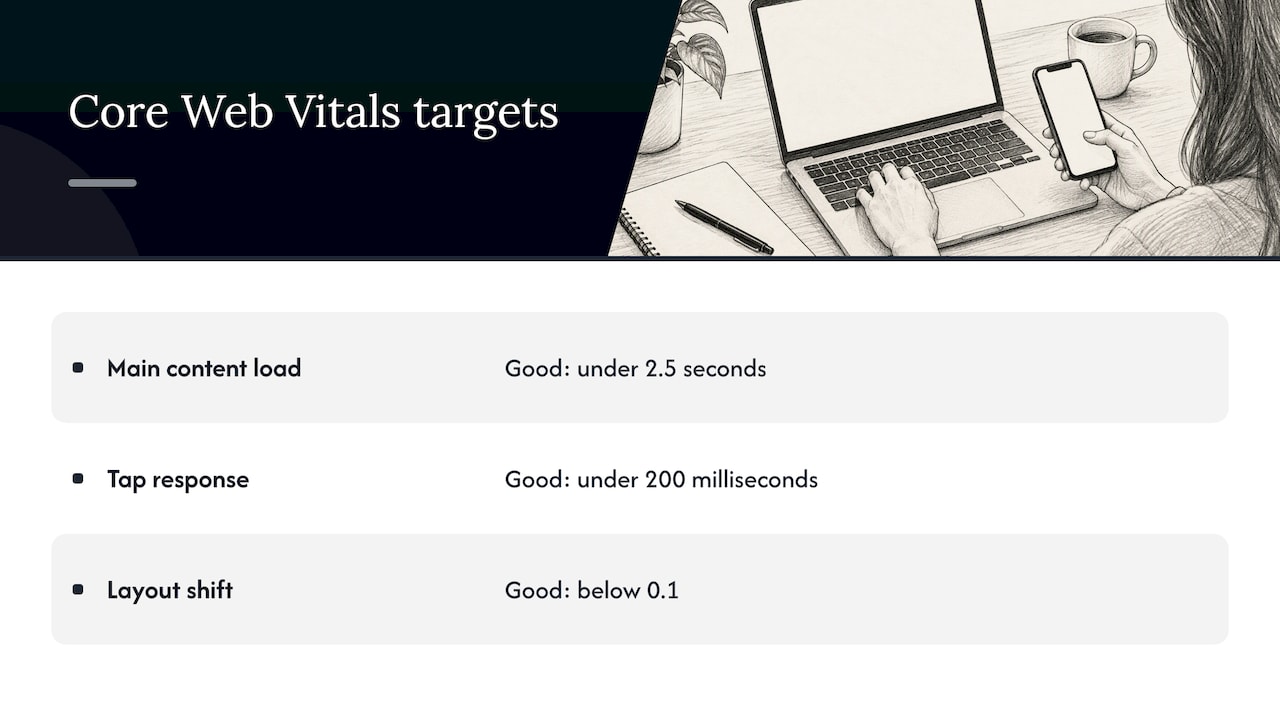
Core Web Vitals are Google’s measures of real-world page experience. The published “good” targets are Largest Contentful Paint (how fast the main content loads) under 2.5 seconds, Interaction to Next Paint (how fast the page responds to taps and clicks) under 200 milliseconds, and Cumulative Layout Shift (how much the page jumps around) below 0.1. Typical fixes are resizing and lazy-loading images, trimming unused JavaScript and setting up caching. Our own Core Web Vitals playbook for small businesses goes deeper on this, and it matters most on mobile, where most local searches happen. See also our mobile SEO tips.
4. Site architecture and structured data
Architecture is how your pages connect. A clean structure gives important pages multiple crawl paths so Google and visitors can reach them in a few clicks. Structured data is code that labels your content, such as your business name, address, hours and services, so search engines read it without guessing. Our guide to SEO-friendly website structure shows how this looks on a small business site.
5. Measurement
The last piece is proof. Before work starts, you should know the baseline: indexed pages, speed scores, calls and leads from search. After each fix ships, the same numbers get checked again. Without this step you have a list of changes and no idea whether they paid off. We pair technical work with analytics and lead tracking so results are tied to real inquiries.
Problems that come up most often, and how they get fixed
Most small business sites share a short list of problems. Here is how they typically look and what resolves them.
| Problem | What it looks like | Typical fix |
|---|---|---|
| Pages not indexed | Search Console reports pages as discovered or crawled but not indexed | Merge or improve thin pages and add internal links to them |
| Duplicate URLs | The same page reachable at several addresses, such as with and without tracking parameters | Canonical tags, or noindex on parameter URLs |
| Slow pages | Heavy images and unused scripts | Resize and lazy-load images, cut unused JavaScript, add caching |
| Content invisible to Google | Key text only appears after JavaScript runs | Server-side rendering or pre-rendering |
| Broken links | Old URLs return errors after a redesign | A redirect map pointing old pages to the right new ones |
These fixes follow the problem-and-solution pairs Outrank describes in its 2026 guide, and several of them, such as removing accidental noindex tags and making critical content available without JavaScript, also appear in Search Engine Land’s definitive guide.
One caution on structured data: FAQ-style markup used to win expanded listings for many sites, but since Google’s August 2023 change those rich results have mostly been limited to well-known government and health sites. A good technical plan does not promise them.
Why technical SEO matters for local businesses
Local results are a competition among nearby businesses. Google weighs relevance, distance and popularity, and a Google Business Profile is the free listing where you manage much of that. Your website is the other half. If Google cannot crawl your service pages, cannot tell which city you serve or loads a page so slowly that mobile visitors leave, the strongest profile in Albuquerque still sends people to a weak destination.
Here is how the technical side supports leads:
- Service and location pages get indexed, so you appear for “roof repair Albuquerque” and not just your brand name.
- Fast mobile pages keep visitors, which matters when someone is searching on a phone with a leaking pipe.
- Clean structure and markup make your name, address, phone and services consistent everywhere Google looks.
- Tracking shows which pages produce calls, so you spend your next dollar where it works.
For local service businesses, the numbers to watch are phone calls, Google Business Profile actions such as calls and direction requests, and visibility for location searches. Early on, index health and the number of technical fixes shipped show progress before revenue catches up. Our guides on local marketing SEO and local SEO location pages show how the technical and local pieces fit together.
What technical SEO costs
Technical SEO pricing depends mostly on how big and complicated your site is. A 20-page contractor site is a very different job from an online store with thousands of products or a site built heavily on JavaScript. Agencies price in three ways:
- One-time audits, where cost scales with page count.
- Projects, such as a migration, a speed overhaul or a cleanup after a redesign.
- Monthly retainers, for ongoing monitoring, fixes and reporting.
We do not publish a fixed price, because a scoped quote is more honest than a number that ignores your site. What we can tell you is that a small local site is usually the easiest kind to scope. For a view of the wider market, read our breakdown of what U.S. small businesses pay for local SEO and our guide to website maintenance pricing. Both give you ranges to compare against any quote you receive.
How to judge a technical SEO agency before you hire
You do not need to be technical to evaluate an agency. You need to know what good looks like. Use these questions.
- Where does the audit start? It should begin with your Search Console page indexing data and Core Web Vitals field data (measurements from real visitors), not just a generic automated crawl.
- Does every issue come with detail? For each problem you should see the evidence, the impact, the fix, who owns it and how much effort it takes.
- Who makes the changes? An audit that lists 200 issues you cannot implement is the most common way these engagements fail. Confirm whether the agency implements fixes, whether your developer does, or whether it is shared, and whether your website platform allows the changes at all.
- What access is needed? Read-only Search Console access is enough for an audit. Be wary of any request for more than that at the audit stage.
- Are the promises realistic? Technical fixes remove barriers. They do not guarantee rankings on their own, and a fixed-price “200-point audit” with no Search Console review is a red flag. These are the same warning signs Outrank’s guide lists.
- What does reporting show? Look for work completed, calls and leads by source and clear next steps, in plain English.
- What are the contract terms? You should keep access to your own accounts, and you should not be tied to a long lock-in.
Those last two are where we put our own emphasis. We are a boutique agency with in-house staff, our team came up as business owners frustrated with big agencies, and we do not lock clients into long-term contracts or withhold account access. You deal directly with the people doing the work.
Technical SEO or a new website?
Sometimes the cheapest fix is on the existing site: a cleanup of redirects, speed and indexing. Other times the platform itself is the obstacle, for example a theme that bloats every page or a builder that hides content from Google. In that case, rebuilding with search in mind costs less over time than patching. Our SEO-friendly web design work builds these foundations in from the start, and our guide to SEO-friendly website design explains what that involves. After launch, website hosting and maintenance keeps the site fast, updated and free of the slow decay that creates new technical problems.
Getting started with King Digital
If you run a service business in Albuquerque and suspect your website is holding back your search visibility, we start with a conversation about your site, your goals and who will make the changes. Our SEO work covers technical fixes alongside local SEO, so the site and your Google Business Profile pull in the same direction, and our consulting is available if you want your existing marketing plan reviewed. Reach us through our SEO and digital marketing services page or the local SEO page.

You will work with experienced marketers directly, with clear reporting and full access to your accounts.
Our perspective
Most business owners who come to us have already been burned once. An agency handed over a long report full of jargon, charged for it and left them wondering what, if anything, changed on the site.
We think technical SEO should be the opposite. It should be explained in plain language, ranked by what will actually bring in calls and customers, and carried out by people you can reach by phone. A fix that never ships is worth nothing, so we talk about who does the work from the first conversation.
We also believe technical SEO belongs with local SEO, web design and tracking, not in a silo. A fast, crawlable site with a verified, active Google Business Profile and honest reviews is what lets a local business win its own market. That is the combination we build for Albuquerque companies, month by month, with no long-term lock-in and no hidden accounts.
Bernadette
FAQ
What are technical SEO services?
They are services that improve how search engines crawl, render, index and serve your website. Typical work includes fixing indexing errors, duplicate URLs, redirects, page speed, JavaScript rendering, structured data and site architecture. The goal is to remove obstacles so your content can compete.
How much does technical SEO cost?
It depends on the size and complexity of your site and whether you buy a one-time audit, a project or a monthly retainer. Small local sites are generally the simplest to scope. We quote after looking at your site, and our local SEO pricing guide gives market ranges to compare against.
What is an example of technical SEO?
A common one is finding a noindex tag, left over from when the site was being built, on an important service page. Removing it lets Google add the page to its index. Compressing oversized images so pages load within Google’s 2.5-second target for the main content is another.
Do I need a technical SEO agency or just a local SEO agency?
Most local businesses are best served by one team that handles both, since local rankings depend on your Google Business Profile and on a website Google can fully read. Our SEO service covers technical and local work together, so nothing falls between two providers.
Sources
- What Is Technical SEO? The Definitive Guide, Search Engine Land
- Technical SEO Services: What’s Included and What It Costs, Outrank
- Search Console sitemap audit, AdPlug
Recommended
- Technical SEO explained: boost Albuquerque SMB visibility
- How website design drives SEO success for your business
- Mobile SEO Tips 2026: Boost Your Rankings Now
- Custom SEO Strategy Development for SMBs in 2026
