
Reputation management systems 2025: Master Guide
Why Your Digital Reputation Can Make or Break Your Business
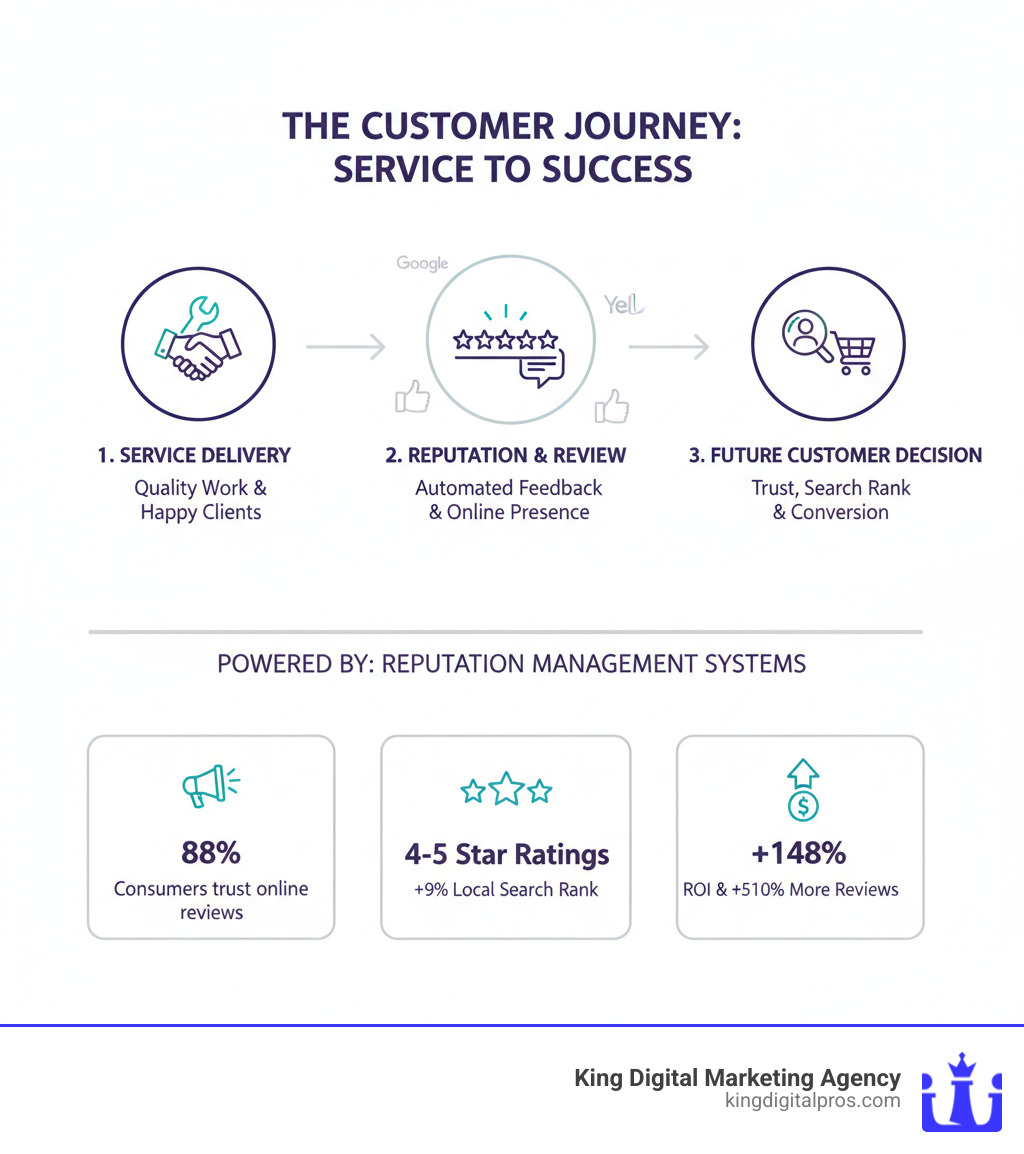
Reputation management systems are platforms that help businesses monitor, manage, and improve their online reputation. They automatically track customer reviews and feedback across channels like Google, Facebook, and Yelp, providing tools to respond quickly and analyze sentiment. These systems are crucial because 88% of consumers say online reviews influence their purchasing decisions.
A strong online reputation isn’t just about feeling good; it’s about showing up in search results, earning customer trust, and turning your digital presence into a lead-generating machine. Every review and star rating shapes whether a potential customer calls you or scrolls to a competitor.
The problem is that most business owners lack the time to chase reviews, respond to feedback on multiple platforms, or correct inaccurate business listings. Reputation management systems automate these tasks, giving you control over your brand’s story. Today’s customers trust peer reviews more than marketing claims, making split-second decisions based on what they find online.
I’m Bernadette King, and I’ve spent years helping local businesses transform their digital presence with these systems. I’ve seen how the right platform can turn visibility into sustainable growth, while neglecting your online reputation can cost thousands in lost business.
What Are Reputation Management Systems and Why Do They Matter?
A reputation management system acts as a digital guardian for your brand, centralizing the task of monitoring and managing online discussions. It automatically tracks comments, mentions, and reviews across platforms like Google, Facebook, and Yelp, ensuring you’re notified of all customer feedback. This allows for strategic responses that maintain a positive narrative and a high star rating.
In today’s market, your online reputation is fundamental to success. Customers actively “crowdsource” feedback and trust peer reviews far more than traditional advertising. To win their business, you must actively shape what they find online.
The Impact of Your Digital Reputation
Your digital reputation directly impacts customer acquisition, brand credibility, and your bottom line. A staggering 93% of consumers report that online reviews influence their purchasing decisions. For local businesses in New Mexico communities like Albuquerque or Santa Fe, every online comment plays a crucial role in attracting customers. Actively managing your online presence builds trust and can significantly increase leads and revenue. As noted by the Harvard Business Review, a business’s online reputation is a key factor in consumer purchasing decisions and directly affects revenue.
How a Negative Reputation Hurts Your Business
A negative reputation can lead to lost sales and damaged trust. Customers who find negative reviews or inaccurate business information are likely to choose a competitor. Businesses with lower star ratings often rank 9% lower in local search results, reducing visibility for services in areas like Corrales or Grants.
An unaddressed negative review can deter countless potential customers. However, a bad review is also an opportunity. Responding thoughtfully provides valuable insights for improvement and can even turn an unhappy customer into a loyal advocate. The goal is to resolve issues and transform potential crises into opportunities for growth.
The Core Mechanics: How Reputation Software Works

Reputation management systems automate, centralize, and streamline the management of your online presence. By gathering all online mentions into one intuitive dashboard, they save time and provide control over your brand’s story. The process involves four key steps: tracking, responding, generating, and analyzing.
Step 1: Monitoring and Aggregation
The first step is gathering information. The software automatically tracks comments, mentions, and reviews from review sites, social media, and blogs. Real-time alerts notify you whenever your brand is mentioned, and multi-channel monitoring with keyword tracking ensures you have a complete view of your online presence. To learn more, see our page on how to Monitor Comments.
Step 2: Response and Engagement
Once feedback is gathered, the next step is engagement. A unified inbox centralizes all customer communications, saving time and preventing missed messages. Response templates and AI-assisted replies help craft personalized, genuine messages to quickly address grievances. Acknowledging concerns, offering private discussion, and correcting false information are key tactics for handling negative feedback effectively.
Step 3: Generation and Promotion
Effective systems also help you generate more positive feedback. Automated review requests via email or SMS make it easy for happy customers to share their experiences. These campaigns turn satisfied clients into brand advocates. Many platforms also allow you to showcase positive reviews directly on your website, building transparency and trust with potential customers.
Step 4: Analytics and Reporting
Finally, these systems turn raw data into actionable insights. Performance dashboards provide an overview of your online standing, while sentiment analysis reveals the emotional tone behind feedback. Competitive benchmarking lets you compare your ratings against local competitors to identify opportunities. These easy-to-understand reports on metrics like review volume, sentiment trends, and response times empower you to make data-driven decisions.
Essential Features to Look for in a Reputation Management Platform

Choosing the right reputation management system means finding a platform that solves your specific problems. Focus on scalability, seamless integrations, user-friendliness, and security to ensure the system grows with your business and protects customer data.
Core Functionality for Every Business
A solid platform must master the basics:
- Review Monitoring: Track reviews across Google, Yelp, and Facebook with real-time alerts for new feedback.
- Review Generation: Automate review requests via email or SMS to make it easy for happy customers to share their experiences. For more strategies, see our guide to Manage Customer Feedback.
- Response Management: Use a centralized dashboard to manage all feedback, ensuring faster, more consistent responses.
- Business Listings Management: Keep your business information (address, hours, phone number) accurate across all online directories to prevent customer frustration.
Advanced Features in Modern Reputation Management Systems
Advanced features can make a system indispensable:
- Sentiment Analysis: AI-powered analysis reads the emotional tone of feedback to identify patterns and areas for improvement.
- Competitive Intelligence: Compare your reputation against local competitors to find market gaps and opportunities to stand out.
- Social Media Listening: Track brand mentions on social platforms to catch informal feedback. Research from Sprout Social shows that active listening builds stronger customer relationships.
- Survey Tools: Proactively gather specific feedback to shape service offerings and marketing messages.
- Analytics and Custom Reporting: Focus on key performance indicators (KPIs) with dashboards that track review volume, sentiment shifts, and response times.
- AI Visibility Tracking: A cutting-edge feature that monitors how your brand appears in AI-generated search results and chatbot responses.
The Tangible Benefits: Boosting Your Presence and Your Bottom Line
Reputation management systems deliver tangible results, translating into more leads, higher revenue, and long-term growth. These tools change how customers find, trust, and choose your business, with some companies reporting a 148% increase in ROI and a 510% boost in review volume. This leads to genuine customer loyalty, stronger brand equity, and a significant competitive advantage.
Improve Your Online Presence and SEO
Your online reputation and search rankings are deeply connected. A good reputation makes you more visible to customers. For local businesses in Albuquerque or Santa Fe, high visibility in Google’s Local Pack is critical. Businesses with 4- or 5-star ratings are positioned 9% higher in local search results.
According to research from BrightLocal, review signals account for about 16% of local ranking factors. Consistently gathering and responding to reviews signals trustworthiness to Google, improving your rankings. Reputation systems automate this process, increasing visibility and attracting more customers. Learn more about Leveraging Your Reputation.
Drive Business Growth and Customer Trust
Trust is the cornerstone of business growth. Today, 93% of consumers trust online reviews as much as personal recommendations. A strong collection of positive reviews acts as powerful social proof, building instant credibility and increasing conversion rates. The actionable insights from feedback also provide a roadmap for business improvement, leading to greater customer satisfaction and loyalty.
Specific Advantages for Small Businesses
For small business owners, these systems are game-changers. They offer significant time and resource savings by automating the tedious work of managing an online presence. This allows you to focus on serving customers and growing your business. These platforms also help you compete with larger brands by building a strong Local Business Reputation that levels the playing field. For businesses in communities like Corrales or Los Alamos, this competitive edge can be the difference between surviving and thriving.
The Future of Reputation: AI and Emerging Industry Trends
The online reputation landscape is rapidly evolving, shaped by innovation, predictive analytics, and automation. Artificial Intelligence (AI) is at the forefront, allowing businesses to predict consumer expectations rather than just react to them.
The Transformative Role of AI in Reputation Management
AI is revolutionizing online reputation by enabling more than basic automation. Modern reputation management systems now use AI for:
- AI-powered Review Responses: Crafting personalized, timely, and authentic responses to customer reviews.
- Predictive Sentiment Analysis: Analyzing customer data to predict emerging trends and identify potential issues proactively.
- Identifying Emerging Trends: Sifting through customer conversations to pinpoint new themes, preferences, or concerns.
- Tracking Brand Visibility in AI-Generated Search Results: Monitoring how a brand is represented in AI-driven search and large language models (LLMs).
As detailed in Forbes, AI is changing reputation management by enabling these advanced capabilities.
Key Trends to Watch
Several key trends are shaping the industry:
- Voice of the Customer (VoC) Programs: Integrating feedback from all channels (surveys, social media, calls) for a holistic view of customer sentiment.
- Hyper-Localized Management: Managing reviews and listings with precision for businesses with multiple locations, from Grants to Sandia Park.
- Improved Privacy and Data Controls: Evolving with stricter security to ensure compliance and build trust.
- Deeper Integration: Seamlessly connecting with CRM, marketing, and customer support platforms for a 360-degree customer view.
- Video and Multilingual Reviews: Collecting more engaging video testimonials and managing feedback in multiple languages.
- Reputation Risk Alerts: Flagging unusual activity or potential crises in real-time for rapid response.
How to Choose the Right Reputation Management Software
Choosing the right reputation management system is a critical decision that shapes your online visibility and trust. The ideal system should fit your unique needs, budget, and long-term goals, as what works for a large enterprise may not suit a local shop in Edgewood.
When evaluating platforms, ask key questions:
- Monitoring: What review sites and social platforms do you monitor?
- Local SEO: How does the platform improve local search rankings and manage business listings?
- Analytics: What kind of analytics and reporting do you offer? Can it track sentiment and response times?
- Integrations: Does the platform integrate with our existing CRM and marketing software?
- Scalability: Is the system scalable to handle business growth, new locations, and more users?
- Support: What level of customer support and onboarding is provided?
Key considerations for your reputation management systems
Beyond those questions, keep these factors in mind:
- Scalability for Growth: Ensure the system can grow with your business, offering flexible permissions and multi-location support.
- Industry-Specific Features: Look for platforms with features custom to your sector, such as hospitality, healthcare, or retail.
- Integration Capabilities: Double-check that the system connects smoothly with your existing tech stack to avoid manual work and centralize data.
- Customer Support: Quality onboarding and ongoing support are vital to maximizing the tool’s value.
- Budget and Value: Find a system that offers the best return on investment, considering its features, scalability, and overall impact.
Conclusion: Take Control of Your Online Narrative
Your brand’s story is being written online every day, whether you’re shaping it or not. For local businesses across New Mexico, from Santa Fe to Los Alamos, reputation management systems provide the tools to become the author of that story. These platforms empower you to monitor conversations, respond with authenticity, encourage positive feedback, and turn insights into business growth.
The benefits are tangible: improved local search rankings, higher conversion rates, significant time savings, and stronger customer loyalty. By taking a proactive approach, you can ensure your online presence reflects the quality of your work. As AI continues to reshape how consumers find businesses, leveraging these tools is more critical than ever.
At King Digital, we specialize in helping local businesses implement sophisticated reputation management systems that deliver results. We understand the unique challenges of New Mexico communities and combine cutting-edge technology with personalized strategy to build a powerful online reputation.
Don’t leave your online narrative to chance. To start driving more business through strategic reputation management, explore our professional Review Management Services. Let’s ensure your potential customers find a story of excellence and trust.