
Navigating the Digital Landscape: A Guide to the Online Reputation Management Market
Why the Online Reputation Management Market Matters for Your Business
The online reputation management market is experiencing explosive growth as businesses recognize that their digital reputation directly impacts revenue. Here’s what you need to know:
Key Market Insights:
- Current Market Value: USD 6.88 billion (2025)
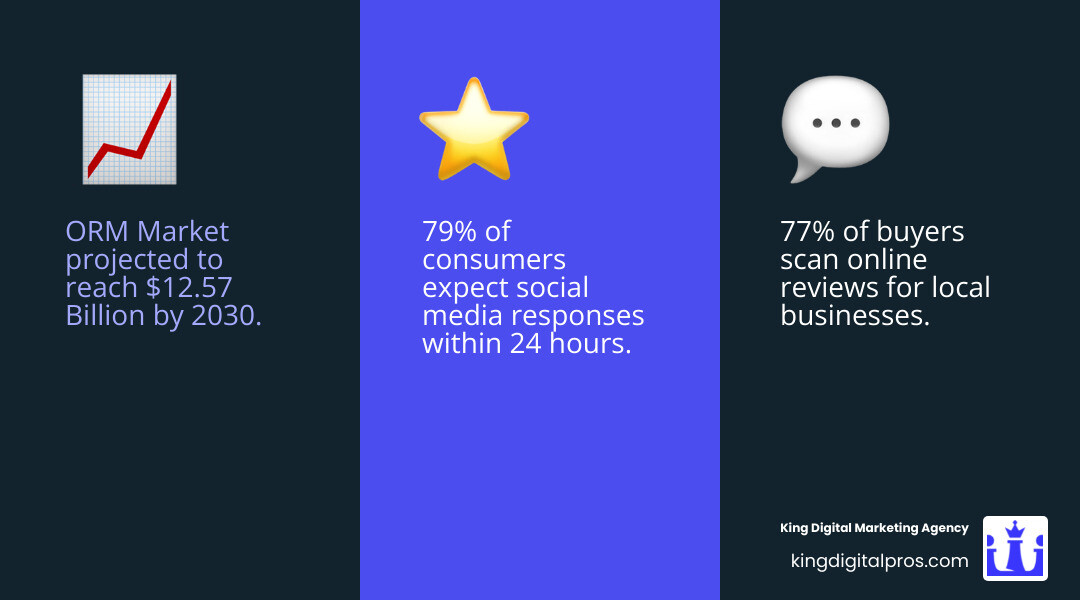
- Projected Value: USD 12.57 billion by 2030
- Growth Rate: 12.80% CAGR (2025-2030)
- Consumer Behavior: 89% of UK shoppers consult ratings before purchasing
- Review Impact: 77% of buyers scan reviews when selecting local businesses
- Response Expectations: 79% expect a social media response within 24 hours
The digital landscape has fundamentally changed how customers find and choose businesses. When 76% of consumers read online reviews before assessing local businesses, your reputation isn’t just about customer service anymore—it’s a competitive resource that directly affects your bottom line. A single negative review can cost you customers, while a strong star rating opens doors.
This shift has created a massive industry dedicated to helping businesses monitor, manage, and improve their online presence across review sites, social media, and search results. The online reputation management market now includes sophisticated AI-powered tools that can parse sentiment, track competitor performance, and alert you to reputation threats in real-time.
I’m Bernadette King, founder of King Digital Marketing Agency, and I’ve helped countless local businesses navigate the complexities of the online reputation management market through targeted SEO, Google Business Profile optimization, and strategic review management. Understanding this market’s dynamics helps you make smarter decisions about protecting and growing your digital presence.
Basic online reputation management market glossary:
- Clean Up Internet Reputation
- Medical Online Reputation Management
- Online Reputation Management for Financial Advisors
Current State of the Online Reputation Management Market
The online reputation management market is no longer a niche service for high-profile celebrities or Fortune 500 companies. Today, it is a critical infrastructure for any business that appears in a Google search. As of 2025, the market is valued at a staggering USD 6.88 billion. Industry analysts project this figure will climb to USD 12.57 billion by 2030, maintaining a steady compound annual growth rate (CAGR) of 12.80%.
This growth isn’t just about numbers; it reflects a fundamental shift in how trust is built. In our local communities—from Albuquerque and Rio Rancho to Santa Fe and Taos—customers are making split-second decisions based on what they see on their screens. Research shows that approximately 84% of consumers trust online reviews as much as personal recommendations. This “digital word-of-mouth” has turned reputation into a tangible financial asset.
For businesses in the New Mexico regions we serve, such as Los Alamos, Grants, and the East Mountains, staying ahead of these trends is vital. Whether you are a local contractor in Edgewood or a boutique owner in Corrales, your digital footprint is often the first (and sometimes only) impression you make. To dive deeper into the tools making this possible, check out our comprehensive guide on reputation management systems.
According to MarkNtel Advisors, the market is being propelled by the rapid expansion of end-user industries like healthcare and retail, where public perception is directly linked to patient or customer volume.
Primary Drivers and AI Transformation
Several powerful forces are fueling the expansion of the online reputation management market. The most prominent is the “E-commerce Effect.” As more transactions move online, the vulnerability to negative feedback increases. A single viral social media post can reach thousands of potential customers in minutes, making proactive monitoring essential.
Social media influence has also reached a tipping point. Nearly 70% of consumers admit they have changed their mind about a purchase based on negative social media feedback. Furthermore, the rise of review aggregation platforms has centralized consumer power. Sites like Google, Yelp, and TripAdvisor now act as the “front door” for most businesses. If that door looks uninviting due to low ratings, customers simply won’t walk through it.
We see this every day when helping our clients with local business reputation strategies. It isn’t just about deleting bad comments; it’s about building a fortress of positive, authentic content that reflects the true quality of your work.
AI Integration in the Online Reputation Management Market
The most exciting development in the online reputation management market is the integration of Artificial Intelligence (AI). AI is moving from a “bolt-on” feature to the core of reputation platforms.
- Sentiment Analysis: Modern AI can now parse sarcasm, emojis, and regional slang. This allows businesses to understand the tone of customer feedback, not just the keywords.
- Reputation IQ: Sophisticated platforms use “Reputation IQ” metrics to aggregate signals from across the web into a single, actionable score.
- Predictive Analytics: AI can now forecast potential reputation crises before they explode, allowing for “preventative” PR rather than just “reactive” cleanup.
- Automated Triage: For businesses with multiple locations in places like Sandia Park, Tijeras, or Cedar Crest, AI can automatically categorize reviews and route them to the right department for a response.
This technological leap enables real-time monitoring that humans simply couldn’t handle alone. AI-driven sentiment analytics have helped early adopters see up to a 30% jump in customer satisfaction ratings by allowing them to address issues faster than ever before.
Market Segmentation by Service and Vertical
The online reputation management market is diverse, serving everyone from individual professionals to global enterprises. In 2024, services held the lion’s share of the market at 65.6%, as businesses often require human expertise to manage complex crises or strategy.
- Business Solutions: These focus on review management, crisis handling, and branding. This segment dominates the market because businesses have the most to lose from a tarnished image.
- Individual Solutions: Often used by executives or public figures, these services focus on personal branding and content suppression.
- Media Channels: Interestingly, “Earned Media” (press releases, forum mentions, and third-party listings) captured 49.6% of revenue in 2024. This highlights that consumers still value third-party validation over paid advertisements.
Retail and e-commerce currently represent the largest vertical at 24.7% of the market share. However, we are seeing a massive surge in other areas. For instance, medical reputation management has become a top priority for practitioners in Santa Fe and Albuquerque as patients increasingly choose doctors based on online ratings.

Deployment Models and Industry Momentum
How businesses access these tools is also changing. Cloud deployment controlled 73.35% of the market in 2024. Why? Because cloud-based software is scalable and allows small businesses in places like Taos or Grants to access the same high-level monitoring tools as giant corporations without massive upfront costs.
| Feature | Cloud Deployment | On-Premise Solutions |
|---|---|---|
| Market Share | 73.35% (Dominant) | 26.65% |
| Scalability | High/Instant | Limited/Manual |
| Cost Structure | Subscription (SME Friendly) | High Upfront Investment |
| Updates | Automatic/Real-time | Manual/Periodic |
Healthcare is currently the fastest-growing vertical, accelerating at a 19.6% CAGR. This is driven by the need for HIPAA-compliant feedback loops and the transparency of the “patient experience.” The automotive sector and financial services are also seeing high adoption rates as they look to build trust in high-ticket transactions.
Challenges and Regulatory Landscape
While the online reputation management market offers incredible opportunities, it isn’t without its hurdles. Data privacy is at the top of the list. With regulations like the GDPR in Europe and the CCPA in California, businesses must be extremely careful about how they collect and use customer data. In fact, privacy regulations are estimated to subtract nearly 1.8 percentage points from the market’s potential growth rate.
Another challenge is the “cost of entry” for smaller businesses. While subscription models help, full-service reputation retainers can still be pricey. There is also the delicate balance of free speech; businesses must navigate how to handle “unfair” reviews without infringing on consumer rights or violating platform terms of service. According to Moz, reviews play an instrumental role in search engine algorithms, meaning any attempt to manipulate them can lead to severe penalties from Google.
Regulatory Compliance in the Online Reputation Management Market
The “Wild West” era of online reviews is ending. Regulatory bodies are stepping in to ensure authenticity. In October 2024, the Federal Trade Commission (FTC) introduced a landmark rule targeting fake reviews.
The stakes are now incredibly high:
- Fines: The FTC can fine businesses up to USD 51,744 per instance of a fake review or testimonial.
- Audit Trails: Platforms are now being built with “compliance-first” mentalities, keeping detailed records of how reviews are collected.
- Transparency: There is a growing demand for “transparency protocols,” where businesses must prove that their reviews come from real, verified customers.
For our clients in New Mexico, this means that “cutting corners” by buying reviews is not just unethical—it’s a massive financial risk. We focus on building reputation the right way: through excellent service and legitimate customer feedback management.
Regional Analysis and Future Trends
North America remains the powerhouse of the online reputation management market, accounting for 38.7% of global revenue in 2024. This leadership is due to the high concentration of tech companies and a consumer base that is highly sensitive to online ratings. However, the Asia-Pacific region is the fastest climber, with an 18.5% CAGR, fueled by rapid digitalization in countries like India and China.
Looking ahead, several trends will define the next five years:
- SME Adoption: Small and Medium Enterprises are expected to grow their adoption of ORM tools at a 17.2% CAGR as software becomes more affordable.
- ESG Perception Scores: Environmental, Social, and Governance (ESG) scores are starting to influence reputation. Banks are even beginning to charge higher interest rates to firms with poor social sentiment.
- Subscription Dominance: The “Software as a Service” (SaaS) model will continue to replace one-time service fees, making reputation management an ongoing operational expense rather than a one-time project.
Frequently Asked Questions about the ORM Market
What is the projected growth of the online reputation management market?
The market is expected to grow from its 2025 valuation of USD 6.88 billion to USD 12.57 billion by 2030. This represents a compound annual growth rate (CAGR) of 12.80%. This growth is driven by the increasing reliance on digital trust signals for consumer purchasing decisions.
Which industry vertical is growing the fastest in the ORM space?
While retail and e-commerce currently hold the largest share, healthcare is the fastest-growing vertical. It is accelerating at a CAGR of 19.6%. This is due to the increasing transparency of patient reviews and the strict requirement for HIPAA-compliant reputation management tools.
How do new FTC regulations affect reputation management strategies?
The new FTC rules make it illegal to create, buy, or sell fake reviews. Businesses can face fines of over USD 51,000 per violation. This has forced the online reputation management market to pivot toward “authenticity-first” strategies, focusing on verified customer feedback and transparent collection methods rather than “quick-fix” suppression or review-padding techniques.
Conclusion
The online reputation management market has evolved from a luxury service into a strategic necessity. When 90% of customers read reviews before visiting a business, your digital reputation is your reputation. It requires cross-functional governance—meaning your marketing, legal, and customer service teams must all be on the same page.
At King Digital Marketing Agency, we specialize in helping local businesses in Albuquerque, Rio Rancho, Santa Fe, and across New Mexico master this landscape. Our focus on Google Business Profile optimization and map listing expertise ensures that when local customers search for your services, they see a business they can trust.
Don’t leave your digital footprint to chance. Whether you’re in the East Mountains or Taos, we’re here to help you turn your online reputation into your greatest competitive advantage. For more information on how we can protect your brand, explore our reputation management services today.