Key Place-Based Ad Features for Multi-Loc Businesses 2025
Why Place-Based Advertising is the Key to Multi-Location Success
The key features of place-based advertising for multi-location businesses enable precise targeting, localized messaging, and performance tracking across different markets. These features include:
- Geofencing and geotargeting to create virtual boundaries around specific locations.
- Dynamic creative optimization (DCO) to automatically tailor ad content.
- Location extensions to display store addresses in search ads.
- Radius targeting to define custom geographic areas for hyper-local reach.
- Local inventory ads to show real-time product availability at nearby stores.
- Localized landing pages to direct customers to location-specific web pages.
- Performance tracking by location to monitor ROI and engagement for each branch.
For a multi-location business, a national ad campaign builds brand awareness but won’t drive customers to individual stores. This is where place-based advertising is essential. Consider that 46% of all searches on Google are made to find a local business. Consumers want what’s close and relevant, searching for “pizza near me,” not just “pizza.”
Traditional advertising fails to account for local differences. Customers in Phoenix have different needs than those in Seattle. Place-based advertising allows you to run highly targeted campaigns for each market while maintaining brand identity. This strategy is critical, as 94% of high-performing brands have a dedicated local marketing strategy.
I’m Bernadette King, founder of King Digital Marketing Agency. I’ve helped countless multi-location businesses use these features to drive measurable growth. This guide will show you how to implement them to maximize your local reach and ROI.
What is Place-Based Advertising and Why is it Crucial for Multi-Location Businesses?
Place-based advertising delivers marketing messages to customers based on their physical location. For businesses with multiple branches, this approach is essential. Consumer behavior has shifted dramatically; when someone in Albuquerque wants coffee, they search “coffee shop near me.” This local intent is powerful, as around 46% of all searches on Google are made to find a local business.
Ignoring this local focus means missing customers who are actively searching for your services nearby. Place-based advertising helps each of your locations stand out in its own neighborhood, cutting through digital noise and driving foot traffic. Furthermore, a recent disruption in brand loyalty, noted by McKinsey, shows consumers often prioritize convenience over familiar brands. This makes precise, location-based targeting more vital than ever to improve Google Local Ranking and capture these customers.
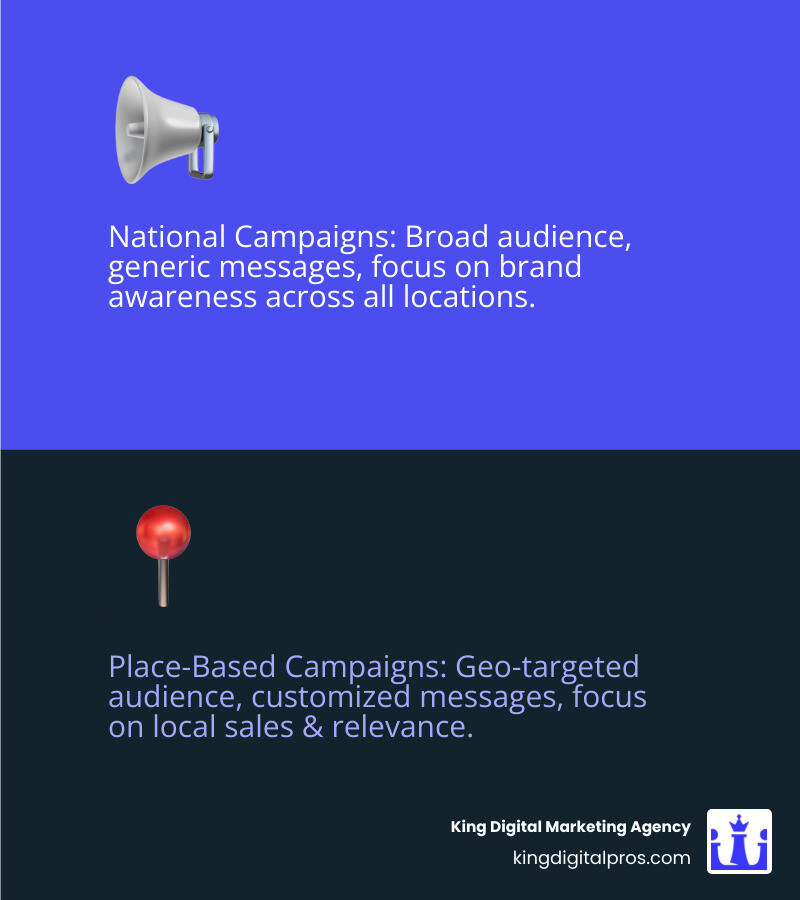
The Core Difference: National vs. Localized Campaigns
A national campaign builds broad brand awareness with a generic message, like a national TV commercial. It’s great for brand building but doesn’t drive immediate traffic to a specific store.
Localized advertising is surgical, focusing on driving sales by tailoring messages to a specific geographic area. For example, a KFC in San Antonio might promote a market-specific item while maintaining its singular brand voice, a strategy they’ve perfected for decades according to Global Franchise. This blend of brand consistency and local flavor is key. Our Local Marketing Strategy Complete Guide explores this balance in more detail.
The Bottom-Line Benefits for Your Branches
Adopting a place-based strategy offers tangible benefits for each location:
- Increased Foot Traffic: Reaching people when they are nearby or searching for local services boosts in-store visits.
- Higher Engagement: Personal, relevant ads lead to more interest and better interaction with your brand.
- Improved Cost-Efficiency: Avoids wasted ad spend by focusing your budget on high-intent local customers.
- Better Data Insights: Provides invaluable data on local customer behavior and branch performance to refine strategies.
- Competitive Edge: A localized approach helps you stand out from competitors using generic ads.
These benefits contribute directly to the growth of each location. For more ideas, explore our Attract Local Customers Ultimate Guide.
Core Principles and Key Features of Place-Based Advertising for Multi-Location Businesses
The key features of place-based advertising for multi-location businesses provide the precision tools to reach the right people in the right places. This approach combines geographic targeting with localized messaging, performance monitoring, and smart budget allocation, all while maintaining brand consistency.

Foundational Principles for Local Success
Effective place-based advertising is built on a few core principles:
- Audience Segmentation: Recognizing that customers in different areas have unique needs.
- Geo-targeting Precision: Focusing on specific neighborhoods or zip codes instead of entire cities to avoid wasted ad spend.
- Ad Personalization: Customizing ads with local references, events, or weather-specific offers.
- Localized Offers: Creating promotions that resonate with a specific market’s needs and timing.
- Maintaining a Singular Brand Voice: Ensuring your core brand identity remains consistent across all local variations, just as KFC has done for over six decades.
Finding the right local keywords is crucial. Our Local SEO Keyword Research guide shows how to identify terms that drive customers to your door.
Essential Digital Key Features of Place-Based Advertising for Multi-Location Businesses
These are the tools that turn strategy into results:
Geofencing and Geotargeting: Geofencing creates virtual boundaries around specific locations (like your store) to trigger ads when customers enter. Geotargeting serves ads to broader areas like cities or zip codes. Our Geofencing Marketing Complete Guide details this strategy.
Radius Targeting: Defines a circular area around each business location, allowing you to target customers within a specific distance, such as a 2-mile radius for lunch specials.
Dynamic Creative Optimization (DCO): Automatically adjusts ad content in real-time based on location, weather, time of day, or local events. Research from the Interactive Advertising Bureau confirms that personalized ads like these significantly outperform generic ones.
Location Extensions: Display your address, phone number, and a map marker directly in search ads, making it easy for customers to find you.
Local Inventory Ads: Show online searchers that a specific product is in stock at a nearby store, bridging the gap between online research and in-store purchases.
Effective Platforms and Strategies for Localized Campaigns
To make the key features of place-based advertising for multi-location businesses work, you must choose the right platforms, such as Google Ads and social media. Our Services: PPC Management can help you steer these platforms to maximize your budget for each location.
Leveraging Google Ads for Hyper-Local Targeting
Google Ads is essential for capturing customers actively searching for your offerings.
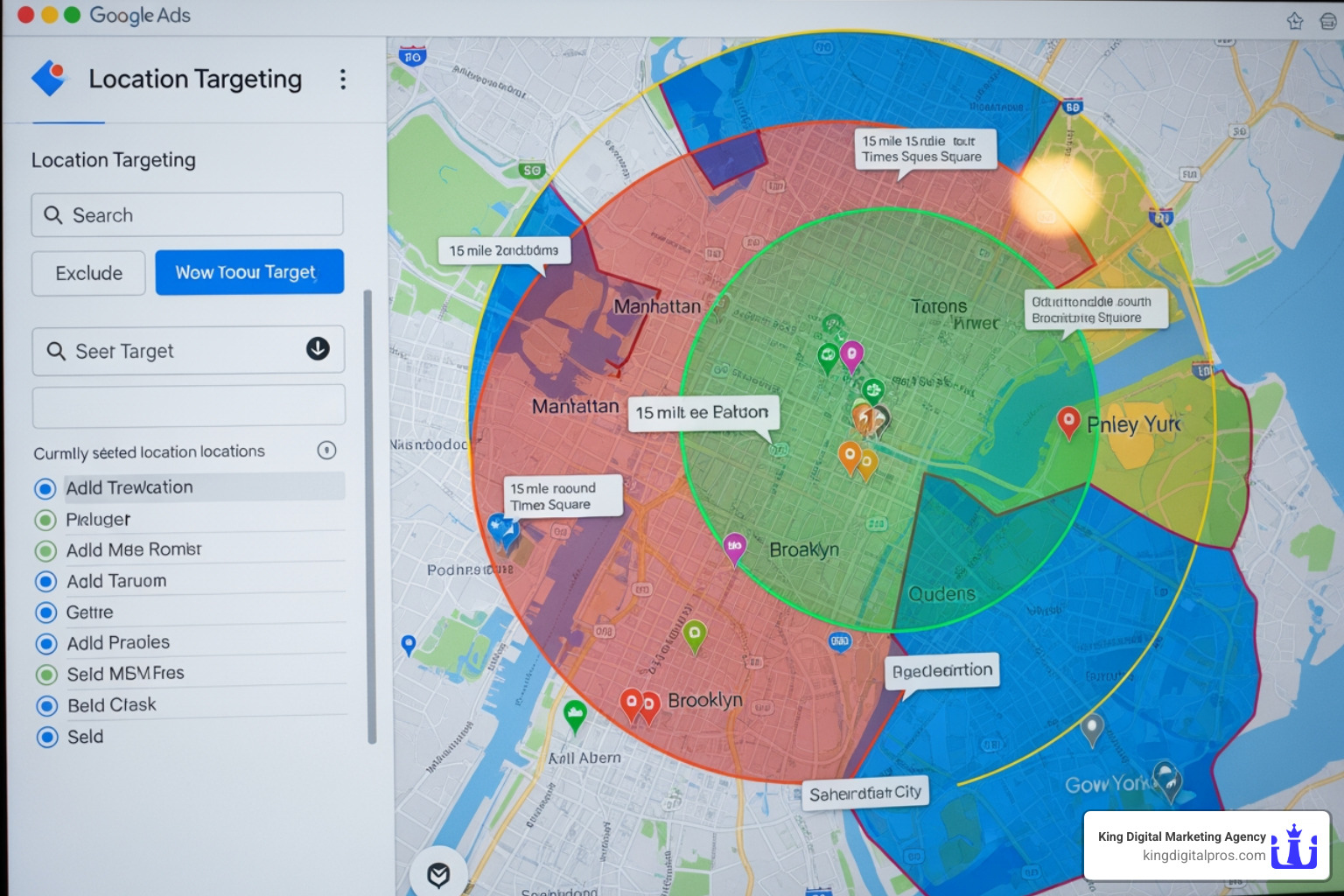
- Location Extensions: These display your address, phone number, and a map pin in search ads, pulling data from your optimized Google Business Profile.
- Local Keyword Strategy: Focus on location-specific phrases like “emergency plumber downtown” instead of broad terms. These keywords often cost less and deliver higher-quality traffic. Our Local PPC Advertising Complete Guide shows how to build these lists.
- Radius Targeting: Serve ads only to people within a defined circle around each location, which is highly effective for businesses where proximity is key.
- Bulk Location Management: Google Ads offers tools to upload and manage location data in bulk, allowing you to scale campaigns efficiently across hundreds of branches.
Using Social Media for Community-Level Engagement
Social media platforms like Facebook and Instagram allow you to reach people before they start searching, building community relationships.
- Local Awareness Ads: Use Facebook and Instagram to define a radius around each branch and promote location-specific offers or events to drive foot traffic.
- Geofencing Competitors: A clever tactic is to serve a timely ad to someone’s social feed after they visit a competitor’s location.
- Location-Specific Content: Share content that resonates locally, such as photos from a branch-sponsored event in Albuquerque or posts about art walks in Santa Fe.
- Community Hashtags: Use and follow local tags like #SantaFeLocal to connect with residents organically. Our Services: Social Media Advertising can help develop these strategies.
Using Location-Based Data for Ultimate Personalization
Combining location with deeper customer insights creates highly relevant messages. By layering demographic (age, income), psychographic (interests, lifestyle), and behavioral data (places visited, apps used), we can perform advanced audience segmentation. This allows for the creation of local customer personas, like “Sarah the Downtown Professional,” who receives lunchtime specials, or “Mike the Weekend Warrior,” who sees ads for outdoor gear. This level of personalization separates effective campaigns from generic ones that waste budget, a concept further explored in our Local SEO for Service Businesses guide.
Managing and Measuring Your Multi-Location Advertising Efforts
Effectively managing and measuring your campaigns across all locations is critical for success. This involves overcoming challenges in budget allocation, ROI tracking, and creative management. Our Services: Lead Tracking Services are designed to provide clarity and control over these processes.
Budget Allocation and ROI Tracking Across Regions
A one-size-fits-all budget doesn’t work for multi-location businesses. A strategy that works in Albuquerque may not be right for Grants. Your budget must reflect each market’s unique characteristics.
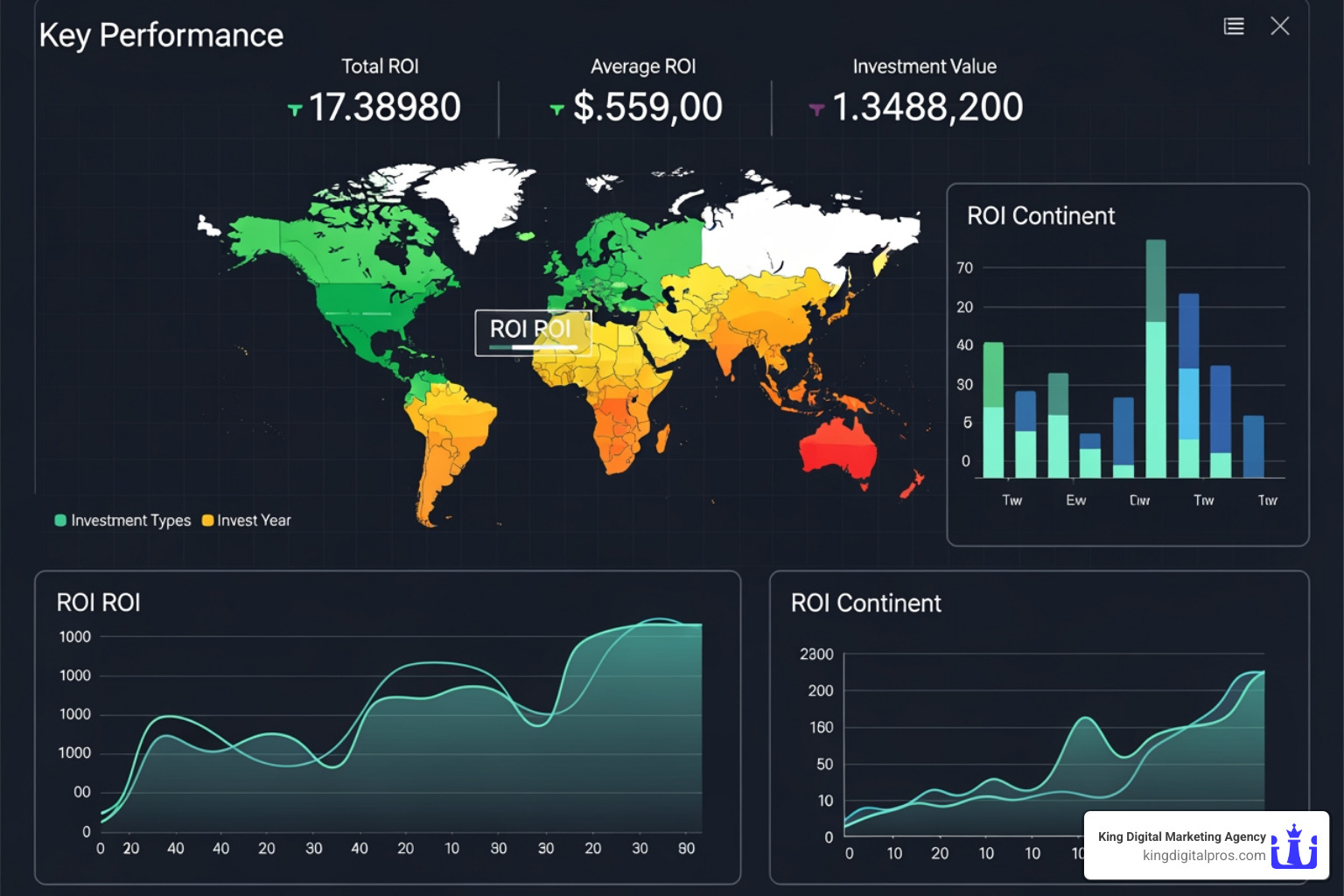
We use smart strategies to manage spending and track returns:
- Set location-specific KPIs: A new store in Edgewood might focus on awareness, while an established Santa Fe location aims to increase customer spending.
- Track Cost Per Acquisition (CPA) by region: This identifies how much it costs to acquire a customer in each market, allowing for budget adjustments to maximize efficiency. As Forrester notes, mastering ROI measurement is crucial for complex marketing environments.
- Use a hybrid budget approach: A central budget maintains brand consistency, while decentralized funds give local teams flexibility to react to market needs.
- A/B test budgets: We test different spending levels in similar markets to find the optimal allocation for the best ROI. Our How to Calculate Lead Value guide can help refine this process.
Balancing Brand Consistency with Local Creative
The goal is to maintain a consistent brand feel while connecting with each local community. As highlighted in AdWeek’s piece on “Global Brands, Local Voices: Mastering the Art of Localized Advertising“, this balance is key.
- Scalable Creative Templates: Use core ad designs with flexible areas for local details, offers, or images.
- Central Asset Repository: A digital library of approved logos, fonts, and brand guidelines prevents brand dilution and ensures consistency.
- Local Ad Variations: Encourage featuring local landmarks or events. A Taos ad might feature local pottery, while an Albuquerque ad showcases a mural.
- Localized Promotions: Create offers custom to local needs, like a “Student Discount Day” near a university campus.
- A/B Test Creative: Test different ad copy and images in similar markets (e.g., Rio Rancho vs. Santa Fe) to see which localized versions perform best. Our guide on How to Create an SEO Friendly Website Design Structure offers more tips on maintaining consistency.
Overcoming Challenges and Maximizing Local Impact
Implementing place-based advertising across multiple locations presents challenges like aligning teams, adopting new technology, and analyzing vast amounts of data. However, with clear processes and the right tools, these roadblocks become growth opportunities. Our Local SEO Best Practices guide offers solutions to many common problems.
The Synergy Between Place-Based Ads and Local SEO
Place-based advertising and local SEO work best together. Paid ads provide immediate visibility, while local SEO builds a long-term organic presence.
Clicks on location extensions, visits to localized landing pages, and interactions with geofenced ads send positive signals to search engines, telling Google your business is relevant to a specific area like Albuquerque or Santa Fe. This activity boosts your organic visibility over time.
Place-based ads drive traffic to your Google Business Profile, increasing views, clicks, and calls. This engagement helps your profile become more prominent, increasing your chances of appearing in The Local Pack – the coveted map section in local search results.
Ads can also encourage reviews. Since 98% of consumers find reviews important and nearly 70% will leave one if asked, generating more reviews boosts SEO rankings and conversion rates. Our Google Profile Management services ensure each location is optimized to capture these opportunities.
The Role of Customer Retention in Local Success
Beyond acquisition, place-based advertising is powerful for retaining customers. Acquiring a new customer costs far more than keeping an existing one. Using ads to re-engage past customers with targeted offers increases their customer lifetime value and builds brand loyalty.
The financial impact is significant. Research from Bain and Co. shows that a 5% increase in customer retention can boost profits by 25%. We can use geofencing to serve “we miss you” offers to lapsed customers when they are nearby, or run geotargeted email campaigns with exclusive events for loyal customers in Cedar Crest.
The key features of place-based advertising for multi-location businesses are about building communities around each location. Our Services: Conversion Optimization can help fine-tune these customer journeys for both acquisition and retention.
Conclusion
The key features of place-based advertising for multi-location businesses are the foundation of modern local marketing. Features like geofencing, dynamic creative, and local inventory ads allow you to deliver precise, relevant messages that drive real-world results.
By balancing a consistent brand identity with the unique character of each market – from Santa Fe to Rio Rancho – you can increase foot traffic, improve cost-efficiency, and gain a significant competitive edge. The synergy with Local SEO and a focus on customer retention further amplify these benefits, as a 5% increase in retention can boost profits by 25%.
While challenges exist, the rewards are greater. The future, with advancements in AI and automation, promises even more sophisticated local targeting. However, technology alone is not enough. Success requires a unified strategy, expertise, and ongoing optimization.
At King Digital Marketing Agency, we specialize in turning the complexity of multi-location marketing into a competitive advantage. We know the key features of place-based advertising for multi-location businesses inside and out.
Ready to stop treating all your locations the same and start dominating each local market? Unlock the power of personalized local ads for your multi-location business and let’s build something remarkable together.