Expect all-click CPC around $0.40 to $0.70, link CPC closer to $0.50 to $1.20, CPM between $4 and $16 depending on placement, and CPA anywhere from $12 to $90 or more by vertical. The single rule that matters more than any of those ranges: budget backward from your target cost per result, not forward from a daily number you picked at random. The budgeting section below shows exactly how.
TL;DR:
- Budget should be based on your target cost per result, aiming for around 50 conversions in seven days to exit the learning phase effectively.
- Link CPC typically ranges from $0.50 to $1.20, and campaigns should focus on these metrics aligned with your objectives for accurate cost control.
- Creative quality, especially the hook in the first seconds, plays a critical role in lowering costs and increasing conversion efficiency.
- Placement choices matter: Reels offer lower CPMs but may have higher CPAs, while Feed ads tend to convert better but cost more per impression.
- Minimum initial testing budgets are around $150 to $300 monthly, scaling up to $900 or more as your creative and audience targeting optimize.
Table of Contents
- Quick takeaways before you set a budget
- What CPC, CPM, CPE, and CPA actually mean in 2026
- What actually drives your cost per result
- How placement changes what you pay
- Building a real budget from your target cost per result
- A step-by-step way to lower your cost per result
- What we tell clients before they spend a dollar
- How King Digital handles your Instagram ad budget
- Where these benchmarks come from
- Sources
- FAQ
Quick takeaways before you set a budget
Every business asks the same question in a different way: “How much do I actually need to spend?” Here’s the short version, drawn from the benchmark ranges I’ll unpack in detail below.
- Match the metric to the objective: use link CPC for traffic campaigns, CPA for conversion campaigns, and CPM for pure awareness plays.
- Treat $0.40 to $1.20 CPC and $4 to $16 CPM as your 2026 planning guardrails, not guarantees.
- Budget enough to generate at least 50 conversions in seven days, the threshold Meta’s system typically needs to exit the learning phase and stabilize delivery.
- Spend under that threshold and you’re often paying to teach the algorithm rather than to get results.
- Creative quality, especially the hook in the first one to two seconds of a Reel, is one of the highest-leverage ways to lower your effective cost.
- Don’t chase the lowest CPM in isolation. A cheap click that never converts costs more than an expensive one that does.
That last point trips up more small business owners than any other. I’ll come back to it when we talk placements.
What CPC, CPM, CPE, and CPA actually mean in 2026
Instagram cost benchmarks only mean something once you know which version of each metric you’re looking at. The most common confusion, and the one that wrecks more budget conversations than any other, is the gap between all-click CPC and link (destination) CPC.
All-click CPC counts every interaction: likes, comments, profile taps, expands. WordStream’s 2026 data puts that figure around $0.40 to $0.70. Link CPC, sometimes called destination CPC, only counts clicks that actually send someone to your website or landing page. That number runs higher, roughly $0.50 to $1.20 in the same analysis. If you’re comparing your own reporting dashboard to a benchmark and the numbers don’t line up, this is usually why. Budget planning should always use the metric that matches the action that creates value for your business: a like doesn’t book an appointment, a link click might.
CPM, or cost per 1,000 impressions, behaves differently depending on how the campaign performs and where it runs. WordStream reports that better-performing campaigns often land in the $2 to $6 range, while broader industry aggregates cited by AdManage.ai show a wider $4 to $16 band once you account for placement and objective mix. That gap between “better-performing” and “average” is worth remembering: a vendor’s headline number is often the best case, not the typical case.
CPE, cost per engagement, matters mostly for brand awareness or community-building campaigns where likes, shares, and comments are the goal rather than a means to an end. It’s rarely the right metric to budget against unless engagement itself is your deliverable, for instance in a campaign built to grow social proof ahead of a launch.
CPA, cost per acquisition, is the metric that should anchor budget decisions for anything selling a product or generating a lead. AdManage.ai’s aggregated 2026 data shows CPA ranging from $12 to $90 or more, with vertical and offer complexity driving most of the spread. A $12 CPA for an ebook download and a $90 CPA for a home service estimate are both “normal”, just for different businesses.

One more thing worth flagging: different publications report different numbers because they’re measuring different things. Hootsuite’s guide tends to reflect broader platform averages, while narrower benchmark sets describe only “better-performing” campaigns. Neither is wrong. Pick the one whose measurement definition matches your own reporting, and treat all of them as guardrails rather than promises.
What actually drives your cost per result
Instagram ads run on an auction, and understanding the auction explains almost every cost swing you’ll see in your account. Meta’s system estimates total value as roughly your bid multiplied by the estimated action rate multiplied by ad quality. The practical takeaway: a lower bid can still win and win cheaply if your ad’s estimated action rate and quality are strong. This is why two advertisers targeting the same audience can pay wildly different effective CPMs. Creative quality isn’t a nice-to-have here, it’s a lever that directly reduces what you pay.
Several other factors compound with the auction mechanics:
- Audience competition: narrow audiences in crowded verticals (legal services, real estate, fitness) push CPMs and CPCs higher because more advertisers are bidding for the same eyeballs.
- Objective and event choice: a purchase-optimized campaign typically costs more per impression than a traffic or awareness campaign because Meta is optimizing for a rarer, more valuable action.
- Seasonality: costs climb around Black Friday, the holiday season, and back-to-school periods as competing advertisers flood the same auction.
- Landing page quality and load speed: a slow or confusing landing page doesn’t just hurt conversion rate, it wastes ad spend that already bought the click.
Pro Tip: Before raising your bid to fix a high CPA, test a new creative hook first. It’s usually cheaper to fix the ad than to outbid the competition.
Seasonality and vertical competition matter, but they’re the factors you can’t control. Creative relevance, audience precision, and landing page quality are the ones you can, and they’re where most of the cost reduction actually happens.
How placement changes what you pay
Reels, Feed, and Stories are not interchangeable inventory, and treating them that way is one of the more expensive mistakes small advertisers make. Each placement has a different cost profile and a different job to do in your funnel.
- Reels typically carry the lowest CPM of the three, often 30% to 50% below Feed according to placement-matched 2026 data, because Meta has more Reels inventory to fill. That cheap reach is discovery-oriented, so Reels can post a higher CPA for bottom-funnel purchase objectives even though the impressions themselves are inexpensive.
- Feed commands a premium CPM but frequently converts better for direct-response offers, since Feed audiences are often further along in a considered scroll rather than a fast swipe.
- Stories sit in the middle, useful for sequential storytelling and mid-funnel nurture sequences that build on an earlier impression.
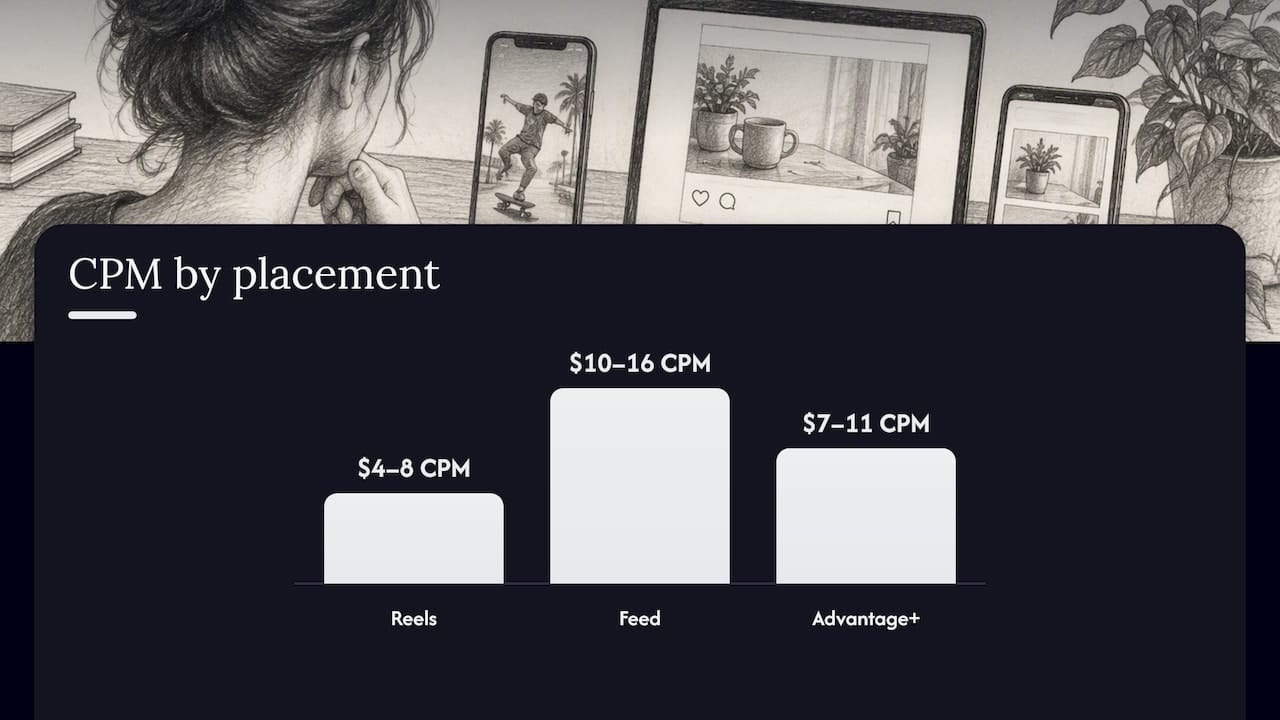
Placement-matched data from 2026 shows Reels medians around $4 to $8 CPM against $10 to $16 CPM for Feed in many consumer verticals, with blended Advantage+ placements landing in a $7 to $11 CPM band. That blended figure is worth noting on its own: automatic placement doesn’t average the two, it optimizes delivery across all of them based on where results are cheapest for your specific audience and creative, which is often a better outcome than manually restricting placements unless you have a strong reason to.
Advantage+, Meta’s automated placement and budget system, tends to help once an account has enough conversion history to optimize against. Turn it on too early, before you have signal, and it can end up spending in places that look efficient but don’t match your actual funnel goals.
Building a real budget from your target cost per result
Here’s the formula that removes the guesswork: Daily budget is roughly (50 divided by 7) multiplied by your target CPA. That’s the Meta learning-phase heuristic in practice, aiming for about 50 conversions in seven days so the algorithm has enough data to optimize.
- Set your target CPA first. If a $40 CPA is what your margins allow, your daily budget should be roughly $40 times (50/7), or about $286 a day, to hit the learning-phase threshold within a week.
- Scale that down for testing. A $5 to $10 a day budget won’t reach the learning-phase threshold on its own, but it’s enough to test creative and audience combinations before committing real spend, roughly $150 to $300 a month.
- Move to a scaled budget once creative wins. A $30 a day budget, about $900 a month, suits early conversion campaigns for businesses with a lower target CPA, while $100 a day, roughly $3,000 a month, fits businesses chasing higher-value conversions or operating in competitive verticals.
- Translate CPM and CPC into expected volume. At a $10 CPM and a $10,000 monthly budget, that’s roughly 1,000,000 impressions; at a $0.70 CPC, that same budget buys around 14,285 clicks. Use your own account’s historical numbers once you have them, these formulas are for initial planning only.
Our advertising ROI calculator can help you turn your own target CPA into an allowable monthly spend if you’d rather skip the manual math.
A step-by-step way to lower your cost per result
Getting your Instagram costs down isn’t about finding a secret setting, it’s about running a disciplined sequence and not skipping steps.
- Start from your margin, not your competitor’s benchmark. Work backward from gross margin to figure out the highest CPA you can afford, then set that as your campaign’s target CPA.
- Test creative hooks before anything else. For Reels, the first one to two seconds decides whether someone stays or scrolls past; for Feed, the thumbnail and the first line of copy carry the same weight. Our guide to ad creatives that convert walks through specific treatments worth testing.
- Run audiences in a deliberate cadence. Start broad with prospecting, layer in nurture messaging for people who engaged but didn’t convert, then retarget warm visitors with a stronger offer.
- Turn on Advantage+ once you have volume. Automated placement and bidding tend to help most after an account has built enough conversion history, generally once you’re consistently hitting that 50-conversions-in-seven-days signal; before that, manual bid control gives you more predictable spend.
- Review weekly, not daily. Cost per result needs several days of data to mean anything, so resist the urge to react to a single expensive day.
Pro Tip: If your CPA spikes for one day, check your landing page before you touch your bid. A broken form or a slow page will look like an ad problem when it isn’t.
For businesses just getting started with paid social, our step-by-step paid advertising guide for small businesses covers the groundwork before you get to Instagram specifically.
What we tell clients before they spend a dollar
I’m Bernadette King, and every Instagram ad program we scope at King Digital starts with the same four questions before a single dollar goes to Meta: what’s the objective, what’s the target CPA, what the creative testing plan looks like, and how much budget runway we have to get through the learning phase honestly.
We generally recommend a minimum of a few hundred dollars a month for stable testing, and more once a client is ready to optimize for conversions rather than just learning what resonates. Anything less and you’re often paying tuition without enough data to show for it.
Reporting cadence often includes weekly creative and audience tests, with monthly strategy reviews to decide what to scale, pause, or rebuild. It’s a rhythm that respects how the auction actually works instead of fighting it.
— Bernadette
How King Digital handles your Instagram ad budget
Planning a budget from benchmarks is one thing. Running the campaign, testing the creative, fixing the landing page, and reporting on results every week is a different job entirely, and it’s the one we do for small and medium-sized businesses every day.

Our social media advertising service covers the full loop: setting your target CPA, building and testing creative, managing placements and bids, and pairing it with conversion optimization so the clicks you’re already paying for actually turn into customers. Some agencies do not lock clients into long-term contracts, and clients retain access to their own accounts. If you’d rather see the full range of what we handle beyond paid social, our digital marketing services page covers SEO, web design, and reputation management alongside advertising. Consultations can assist in building budgets that align with business margins rather than only relying on benchmark data.
Where these benchmarks come from
- WordStream’s 2026 Instagram ads cost analysis: the clearest breakdown of all-click versus link CPC.
- Admanage: broad CPM, CPC, and CPA ranges by vertical, plus the learning-phase budget formula.
- Hootsuite’s Instagram ads guide: useful for understanding platform-wide averages versus narrower benchmark sets.
- Placement-matched cost data: Reels, Feed, and Advantage+ blended CPM figures.
- Scanza’s advertising features: background on the difference between cheap clicks and clicks that carry real business value.
Sources
- How Much Do Instagram Ads Cost in 2026? | WordStream
- Advertising Costs in 2026: CPM, CPC & CPA Benchmarks
- Admanage
- Instagram ads: Everything you need to know in 2026 | Hootsuite
FAQ
How much does it cost to show an ad on Instagram?
Instagram ads generally run $4 to $16 per 1,000 impressions (CPM) depending on placement and objective, with better-performing campaigns sometimes reaching $2 to $6 CPM. There’s no fixed minimum to launch a campaign, but Meta typically needs enough spend to generate about 50 conversions within seven days to optimize delivery reliably.
Is $10 a day good for Facebook ads?
A $10 a day budget works well for early creative and audience testing but usually isn’t enough to reach the roughly 50-conversions-in-seven-days threshold most accounts need to exit the learning phase. It’s a reasonable starting point before scaling toward a budget sized to your target cost per acquisition.
How can I avoid unnecessary fees on Instagram ads?
The main way to reduce wasted spend is matching your budgeting metric to your actual goal: use link click cost rather than all-click cost when measuring traffic value, since all-click figures include likes and profile taps that don’t drive business results. Fixing landing page speed and relevance also prevents paying for clicks that never had a chance to convert.
How much should a small business spend on Instagram ads?
A practical starting range is $150 to $300 a month for creative and audience testing, scaling to $900 or more a month once a target CPA and winning creative are established. The right number depends on your allowable cost per acquisition, which you can calculate by working backward from your gross margin per sale.
Recommended
- Paid Advertising Step by Step for Small Businesses
- Examples of Digital Ad Creatives That Actually Convert
- Ways to Maximize Advertising ROI: Data-First Steps
- Why Optimize Marketing Budgets for Better ROI
