Why Small Business Review Management Is Essential for Modern Growth
To succeed at small business review management, local companies must execute five core steps: claim and optimize profile listings, automate post-transaction request funnels, respond quickly and empathetically to all feedback, establish a structured daily management routine, and leverage positive reviews for marketing and local SEO.
While many owners view online feedback as an unpredictable scoreboard—something that happens to them rather than something they can actively lead—modern business research grounds online reputation management (ORM) in Resource-Advantage theory. From this viewpoint, a well-managed online reputation is not merely vanity PR; it is a rare, imperfectly mobile, and valuable organizational resource that delivers a distinct competitive advantage.
Academic research shows that proactive reputation management directly impacts business performance, accounting for approximately 35% of the variance in small business performance outcomes. Over 99.9% of consumers read online reviews when evaluating local goods and services. Even more telling: 96% specifically search for negative feedback to gauge worst-case scenarios, and 3.3 stars out of 5 is generally the absolute lowest baseline rating shoppers will consider before taking their business elsewhere.
Yet, a massive market gap remains. Nearly half (53%) of small businesses do not actively manage their online reputations, and 60% never ask satisfied customers to leave feedback. By implementing structured customer review management practices, you instantly pull ahead of the majority of your local competitors.
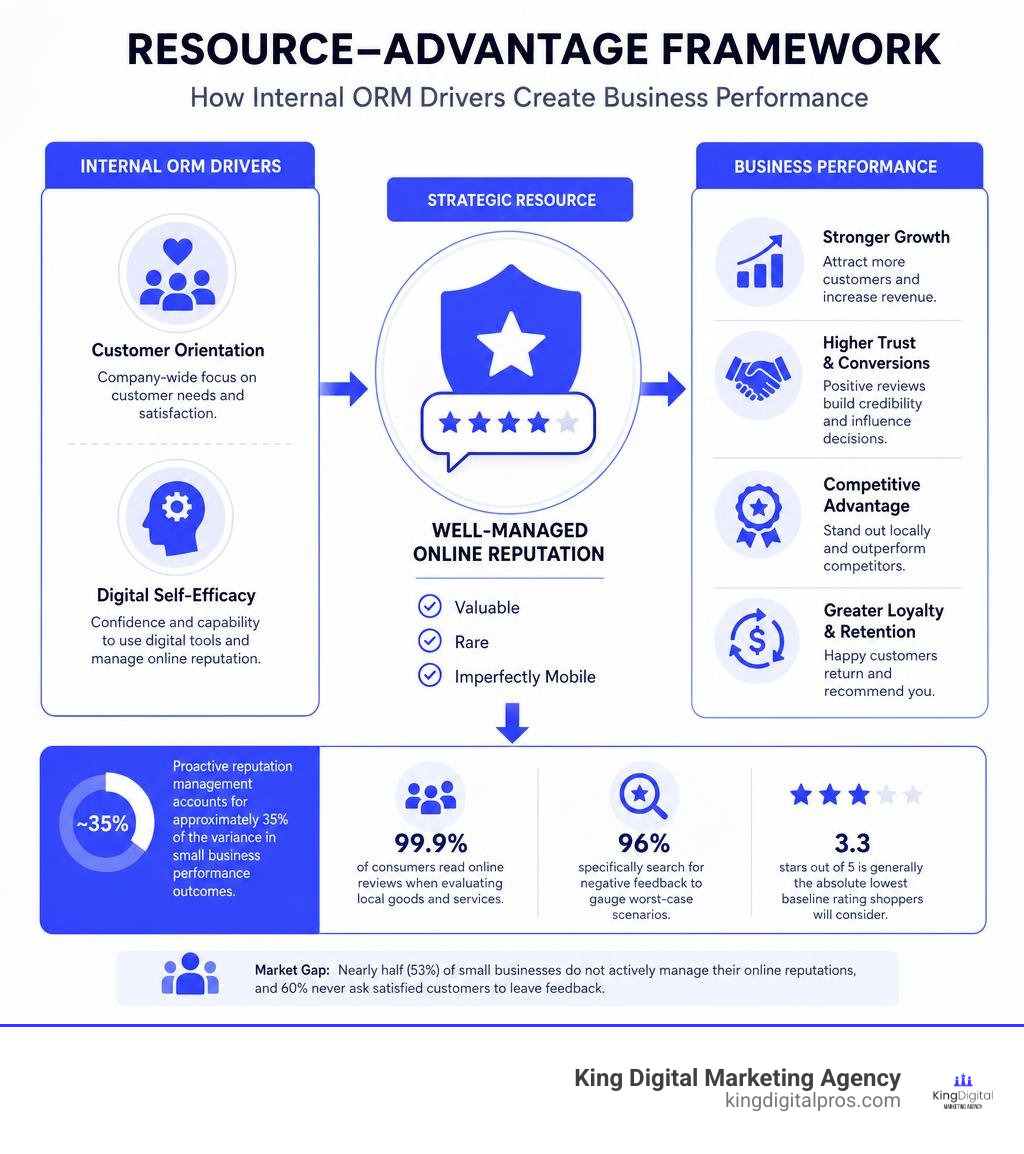
Internal Drivers: Customer Orientation and Digital Self-Efficacy
Why do some small businesses thrive online while others struggle to collect a handful of star ratings? Empirical research highlights two primary internal organizational drivers:
- Customer Orientation (Beta = 0.14, p = 0.013): A company-wide cultural mindset that puts customer needs and continuous satisfaction at the core of daily operations. When your entire team is aligned to create great experiences, collecting and analyzing customer feedback feels like a natural extension of your workflow.
- Internet Self-Efficacy (Beta = 0.50, p < 0.001): The confidence and practical competence of business leaders and their staff to navigate digital platforms, software, and online communication channels.
Internet self-efficacy is by far the strongest predictor of whether a business will successfully adopt reputation management. When staff members understand how review portals work, how to navigate dashboards, and how to request feedback easily, adoption rates skyrocket.
Building digital capabilities does not require an enterprise budget. Local organizations across our communities in Albuquerque, Rio Rancho, Santa Fe, and Los Alamos frequently leverage specialized growth programs—such as the NM Small Business Assistance Program—to upgrade digital skills, adopt modern operational tools, and strengthen overall business agility.
The Moderating Role of Competitive Intensity
The commercial value of your review management efforts is heavily moderated by the competitive intensity of your immediate market. Research indicates that competitive intensity significantly strengthens the relationship between active ORM and star ratings (Beta = 0.22), as well as overall business performance (Beta = 0.31).
In a quiet market with few alternatives, consumers might settle for a business with sparse or mediocre ratings. But in high-density markets—where dozens of service providers, clinics, or contractors compete within a few square miles—reputation equity becomes the decisive filter. In these competitive environments, a polished review profile with recent, authentic praise serves as instant trust currency, converting high-intent searchers into paying clients while neglected profiles get overlooked.
Interestingly, statistical modeling shows that an isolated star rating alone does not automatically guarantee revenue growth (Beta = 0.01, p = 0.56). Instead, it is the active management process—consistent generation, swift communication, issue resolution, and operational refinement—that creates sustainable customer acquisition and long-term financial performance.
The 5-Step Process to Master Your Online Reputation
Step 1: Claim and Optimize High-Impact Review Listings
The cornerstone of local digital visibility is taking full ownership of your primary review profiles. Google remains the undisputed market leader: 57.5% of all online reviews are written on Google, and 81% of consumers evaluate businesses on the platform.
Claiming your listings does far more than provide a place for reviews. Businesses that verify their Google Business Profile are:
- 2.7x more likely to be considered reputable by consumers
- 7x more likely to earn clicks through local search results
- 70% more likely to drive physical location visits
- 50% more likely to result in an on-the-spot purchase

To build a rock-solid foundation, follow these critical listing steps:
- Claim & Verify: Claim your official profile on Google Business Profile, Apple Maps, Bing Places, and industry-specific portals.
- Enforce NAP Consistency: Ensure your Name, Address, and Phone number (NAP) are identical across every digital directory and map ecosystem.
- Optimize Categories and Visuals: Select accurate primary and secondary categories, add high-resolution photos of your team and facility, and maintain accurate business hours.
- Deep-Dive Setup: Explore our full guide on Google Business Profile review management for detailed listing optimization tips.
Step 2: Build Automated Review Request Funnels
Hoping that customers will spontaneously open their browsers and review your business is a losing strategy. As noted earlier, 60% of businesses never ask, leaving their online presence vulnerable to the occasional dissatisfied outlier.
In reality, up to 70% of all published reviews stem directly from structured post-transactional review requests. Even better: prompted reviews consistently carry higher average star ratings than unprompted, unsolicited ones.
To build a high-converting feedback loop, implement multi-channel touchpoints:
- Timing Is Everything: Trigger automated requests within 2 to 24 hours of completing a job or product delivery, while the positive experience is fresh.
- SMS Outreach: Text messages achieve open rates exceeding 95%. Send a short, personalized text containing a direct link to your review profile.
- Post-Purchase Emails: Include clear calls to action and direct links in digital invoices, delivery receipts, and automated email sequences.
- On-Site QR Codes: For brick-and-mortar locations, place scannable QR codes on receipts, counter displays, and checkout areas to make sharing immediate and effortless.
- Proven Frameworks: Implement battle-tested positive review generation strategies that simplify the submission process for happy customers without friction.
Step 3: Implement Fast, Empathetic Review Response Protocols
Collecting reviews is only half the battle; how you engage with reviewers signals your professionalism to thousands of future buyers. Consumer expectations around communication speed have intensified: more than 50% of reviewers expect a response within 7 days, and 1 in 4 expect a direct reply within 72 hours.
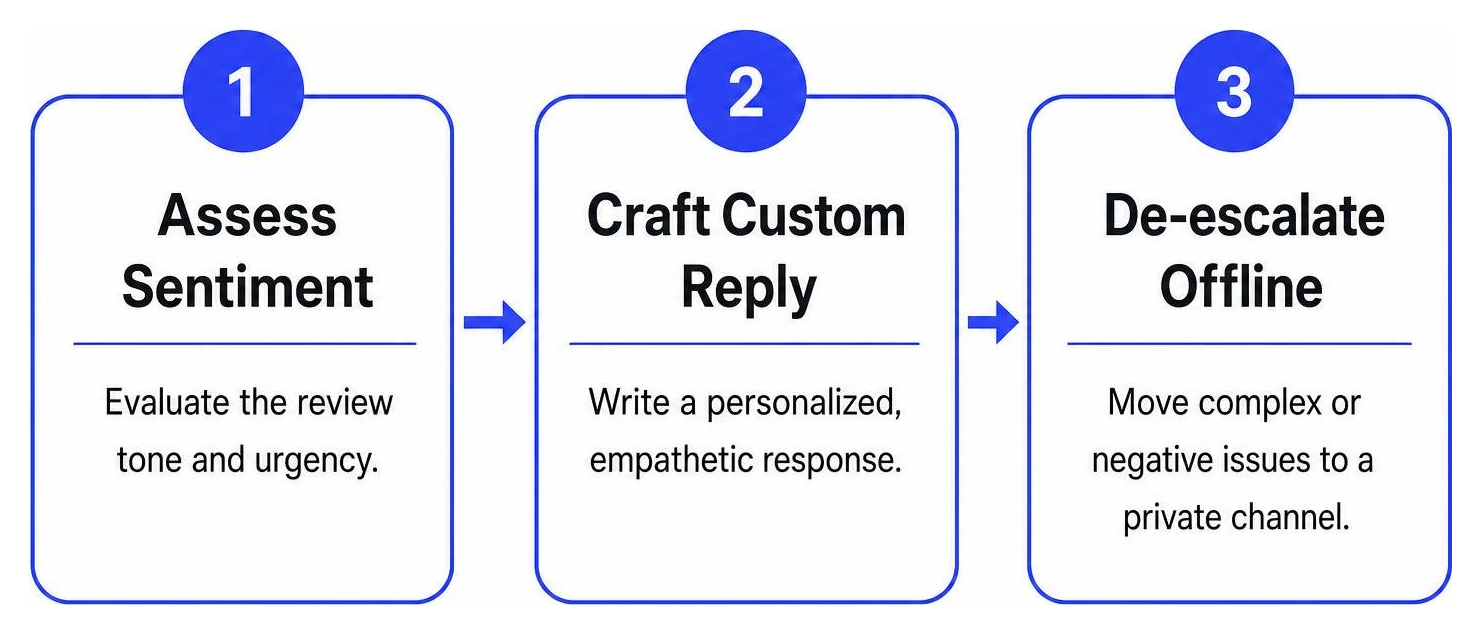
Responding to Positive Reviews
Never leave a 5-star review hanging in silence. A personalized response reinforces brand loyalty and displays your gratitude publicly.
- Best Practice: Address the reviewer by name, mention specific details they shared (such as an employee’s name or a particular service), and invite them back.
- Example: “Thank you so much, Sarah! We’re thrilled that our team made your home renovation smooth and stress-free. We will be sure to pass your kind words along to Mark and the crew!”
Responding to Negative Reviews
A critical review is an opportunity in disguise. Handled with care, it demonstrates accountability and consumer care.
- Stay Objective: Avoid emotional defenses or excuses.
- Acknowledge and Apologize: Validate their frustration with sincere empathy.
- Move the Conversation Offline: Provide a direct phone number or email address of a management team member to resolve the situation privately.
- Explore Scalable Solutions: If managing daily inbound customer communication across platforms feels overwhelming, consider a dedicated managed review response program to ensure every reviewer receives professional, on-brand attention.
Step 4: Establish a Structured Review Management Routine
Reputation management is not a one-time project; it is an ongoing operational habit. When review workflows are fragmented, negative feedback sits unaddressed, ratings drop, and local map visibility declines.
Local business support ecosystems across New Mexico emphasize operational systems as the key to sustainable scaling. For example, the municipal economic initiatives highlighted through Rio Rancho municipal business support continually emphasize that standard operating procedures are what separate stagnant operations from thriving community fixtures.
Adopt this structured cadence to keep your reputation clean and proactive:
| Frequency | Priority Tasks | Core Metric / Objective |
|---|---|---|
| Daily (15–20 mins) | • Check all incoming reviews across Google, Apple Maps, and social directories. • Respond to all new reviews within 24 hours. • Escalate urgent customer service issues to leadership. • Share wins and 5-star shoutouts with staff. |
Response Time: < 24 Hours Response Rate: > 90% |
| Weekly (30 mins) | • Audit weekly review volume and rating averages. • Identify emerging sentiment trends in comments. • Refine review request delivery timing (email vs. SMS). • Follow up on unresolved customer recovery tickets. |
Review Volume Growth Sentiment Health |
| Monthly (1 hour) | • Audit listing details (NAP, seasonal hours, services). • Update in-store QR code collateral and email footers. • Refresh canned response templates to keep replies fresh. • Calculate the direct review-to-revenue conversion impact. |
Listing Accuracy Template Variation |
| Quarterly (2 hours) | • Conduct in-depth local competitor review benchmarking. • Run staff training on digital customer experience and tools. • Review feedback insights to improve core services. • Set review generation and rating goals for the upcoming quarter. |
Local Market Share Operational CX Improvements |
For an in-depth operational checklist, review The Complete Review Management Checklist for Small Business — Opineko to keep your team aligned.
Step 5: Leverage Customer Reviews for Marketing and Local SEO
Once you have earned glowing feedback, turn that social proof into an active marketing engine. Real customer experiences are far more persuasive than self-promotional marketing copy.

Here is how to maximize your review assets across your entire marketing ecosystem:
- Embed Dynamic Testimonial Widgets: Feature live, curated Google reviews directly on your website homepage, high-intent landing pages, and contact forms to lift conversion rates.
- Implement Review Schema Markup: Structured data markup helps search engine crawlers understand your customer sentiment, making your pages eligible for rich snippet star ratings directly in organic search results.
- Amplify Across Social Channels: Turn exceptional 5-star reviews into visual social media graphics, spotlighting team members and highlighting real customer satisfaction.
- Fuel High-Converting Paid Ads: Integrate real customer quotes into your local search and paid social ads to dramatically lower cost-per-click and boost consumer trust.
- Drive Organic Local Visibility: Discover how to boost local SEO with reviews by systematically incorporating natural customer keywords and geographic terms into your review ecosystem.
Best Practices, Toolsets, and Compliance Standards
Selecting the Right Software and Automation Stack
Managing multiple listings, tracking incoming alerts, and orchestrating automated SMS funnels manually can become tedious. Modern reputation software unifies these processes into an efficient command center.
When selecting software for your business, prioritize the following core capabilities:
- Unified Multi-Platform Inbox: Aggregate Google, Facebook, Apple Maps, and industry listings into a single management interface.
- Automated Review Request Triggers: Seamless API connections with your point-of-sale (POS) or CRM system to dispatch timely SMS and email requests automatically.
- Natural Language Processing (NLP) & Sentiment Analytics: Automated text analytics that parse unstructured feedback to reveal trends—highlighting exactly what customers love and where service gaps occur.
- Customizable Response Hubs: Dynamic templates that streamline personalized, on-brand responses while preventing cookie-cutter spam.
To find a software balance that delivers high performance without enterprise bloat, explore our guide to affordable review management tools.
Avoiding Critical Small Business Review Management Mistakes
A single regulatory misstep or platform penalty can wipe out months of hard-earned reputation growth. Protect your brand by steering clear of these common pitfalls:
- Steer Clear of Review Gating: Review gating occurs when a business pre-screens customers (e.g., asking “Were you happy with us? Click Yes or No”) and only routes satisfied customers to public review sites while diverting unhappy customers to a private form. This practice violates Google’s terms of service and FTC regulations. Learn how to stay compliant by reading about review gating compliance risks.
- Never Buy or Fabricate Reviews: Purchasing fake reviews or asking employees to write glowing testimonials carries severe penalties, including listing suspension, permanent consumer warning badges, and hefty FTC fines.
- Do Not Offer Prohibited Incentives: Platforms explicitly prohibit offering discounts, gift cards, or sweepstakes entries in exchange for online reviews.
- Avoid Response Fatigue: Copying and pasting the exact same response to every reviewer looks automated and insincere. Keep replies personal, varied, and authentic.
- Prevent Delayed Customer Outreach: Waiting weeks to ask a customer for feedback causes conversion rates to plummet. Strike while the positive experience is fresh.
Frequently Asked Questions About Online Reputation
How much time should a small business spend on review management each day?
Most independent businesses need only 15 to 20 minutes per day once a structured routine is established. Using automated alerts and a centralized dashboard, you can quickly review new notifications, publish thoughtful responses, escalate customer support items, and celebrate wins with your team.
What is the minimum star rating consumers consider before choosing a business?
Consumer studies show that 3.3 out of 5 stars is the absolute minimum rating threshold most buyers will tolerate when evaluating local service providers and retailers. Businesses that drop below this benchmark experience steep declines in search click-through rates and customer inquiries. Aim to maintain an average rating between 4.5 and 4.9, which signals both excellence and authenticity.
Can negative reviews be permanently removed from Google?
Google will not remove a review simply because it is negative or because you disagree with the customer’s perspective. However, Google will remove reviews that violate its Prohibited and Restricted Content policies—including spam, fake content, hate speech, offensive language, conflicts of interest (such as reviews from competitors or former employees), and off-topic rants.
To report an illegitimate review:
- Sign in to your Google Business Profile.
- Navigate to the official Manage your Google Business reviews interface.
- Locate the specific review and click Report / Flag as inappropriate.
- Track the remediation status directly inside the reporting dashboard. If the initial request is denied, you can submit a formal appeal with supporting documentation.
Conclusion: Transform Customer Feedback into Bottom-Line Growth
Your online reputation is not a passive byproduct of doing business—it is a living, high-yield asset that directly drives local discovery, conversion rates, and sustainable revenue. By claiming your high-impact profiles, automating post-purchase requests, responding with empathy within 24 hours, maintaining an operational routine, and turning social proof into marketing collateral, you build an enduring competitive advantage in your local market.
At King Digital Marketing Agency, we specialize in helping local businesses master their map visibility, optimize their listings, and turn incoming feedback into measurable growth. Whether you operate a single storefront or manage multi-location operations across New Mexico, our dedicated Review Management Services provide the end-to-end strategy, automation, and managed support you need to dominate local search results.
Take full control of your digital presence today, elevate your local standing, and turn every customer experience into long-term bottom-line growth.
