Why Enterprise Lead Scoring Is the Backbone of B2B Revenue Growth
Enterprise lead scoring is a structured method of ranking high-value business prospects based on how well they match your ideal customer profile and how actively they’re showing buying intent.
Here’s a quick breakdown of what it involves:
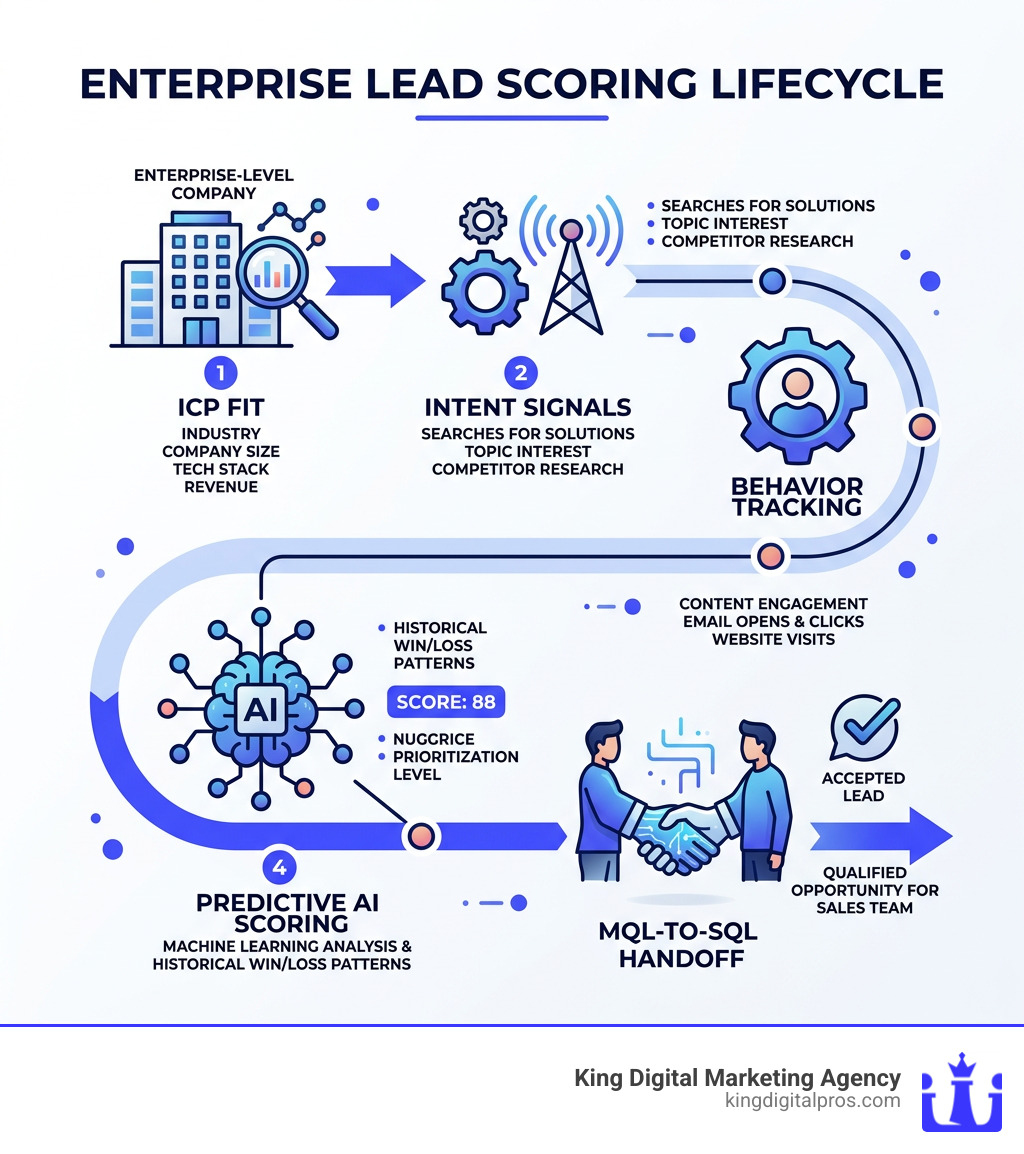
| Element | What It Means |
|---|---|
| Fit scoring | How closely a prospect matches your target company profile (size, industry, tech stack) |
| Intent scoring | How actively they’re researching solutions like yours |
| Behavior scoring | How they’re engaging with your content, emails, and sales team |
| Predictive scoring | AI-powered ranking based on historical win/loss patterns |
| Account-based scoring | Scoring the entire buying committee, not just one contact |
Enterprise sales are complex. Buying committees typically include 6 to 10 stakeholders across departments like IT, legal, finance, and executive leadership. Sales cycles stretch anywhere from 6 to 18 months. Without a reliable scoring system, sales reps end up spending precious time chasing the wrong accounts — research shows they already spend only 8% of their week actually prospecting.
Lead scoring changes that. It turns raw data into a prioritized action list, so your team focuses energy where it’s most likely to pay off.
I’m Bernadette King, founder of King Digital Marketing Agency, with years of experience helping businesses build smarter, conversion-driven strategies — including enterprise lead scoring systems that align sales and marketing around the accounts that actually close. In this guide, I’ll walk you through exactly how enterprise scoring works and how to build a model that drives real revenue.
Enterprise lead scoring vocab explained:
- Boost conversion rates
- agentic ai marketing services lead scoring segmentation conversion optimization
- inbound lead scoring
Enterprise vs. SMB: Why High-Value Deals Require a Different Lens
When we talk about lead scoring, it is easy to assume that a “lead is a lead.” However, in our experience at King Digital, we’ve seen that treating an enterprise account like a Small to Medium Business (SMB) lead is a recipe for missed quotas.

In the SMB world, the person who fills out the form is often the person who signs the check. The sales cycle might last two weeks. In the enterprise world, you aren’t just selling to a person; you are selling to an entire organization. This requires a shift toward Account-Based Marketing (ABM), where we score the “health” and “readiness” of the entire account rather than just one individual’s email clicks. For a deeper dive into these nuances, check out our more info about lead scoring services.
The Complexity of Buying Committees
In an enterprise environment, the “lead” is rarely a single hero making a solo decision. Instead, you are dealing with a buying committee. According to industry research, these committees typically involve 6 to 10 stakeholders.
When we build enterprise lead scoring models, we have to account for “multi-threading.” This means we look for engagement across different roles:
- Department Heads: Looking for ROI and operational efficiency.
- IT/Security: Checking for technical compatibility and data safety.
- Procurement/Legal: Focused on contract terms and risk mitigation.
- End Users: Concerned with ease of use and daily functionality.
If only one person from a Fortune 500 company is downloading your whitepapers, that’s a warm lead. If five people from different departments are attending your webinars, that is a “hot” account ready for an executive outreach.
Core Components of an Effective Enterprise Lead Scoring Model
Building a model that actually works requires blending different data types. We can’t just rely on who someone says they are; we have to look at what they do.
To get started, we recommend focusing on three main pillars: Fit, Intent, and Behavior. Mastering these ensures you know how to effectively manage your leads without letting high-value opportunities slip through the cracks.
| Criteria Type | Examples | Why It Matters |
|---|---|---|
| Explicit (Fit) | Job title, Company Revenue, Industry | Ensures the lead actually has the budget and need. |
| Implicit (Behavior) | Page visits, Email opens, Webinar attendance | Shows how interested they are in your specific brand. |
| Technographic | Current software stack (e.g., uses Salesforce or AWS) | Determines if your solution fits their existing tech environment. |
| Intent (Third-Party) | Searching for “Enterprise CRM” on Google or G2 | Shows they are in a “buying window” before they even visit your site. |
Defining the Ideal Customer Profile (ICP)
The foundation of enterprise lead scoring is your Ideal Customer Profile (ICP). This isn’t just a “persona”; it’s a map of the companies that provide the highest lifetime value. For our clients in New Mexico—from Albuquerque to Santa Fe—we often help define these parameters based on:
- Revenue Potential: Does the company generate enough revenue to afford your enterprise-tier pricing?
- Employee Count: Is the organization large enough to require your complex solution? (Often 1,000+ employees).
- Industry Fit: Does your software or service solve a specific pain point common in their vertical?
- Geographic Location: Even for global brands, certain regions might have higher conversion rates due to local regulations or market maturity.
Leveraging Intent Data in Enterprise Lead Scoring
Intent data is the “secret sauce” of modern enterprise sales. While behavioral data tells you what a lead does on your website, intent data tells you what they are doing across the rest of the internet.
By targeting strategic accounts that are actively researching your competitors or specific industry keywords, you can assign “bonus points” to leads who are in an active buying cycle. If a target account suddenly spikes in research activity related to your service, your scoring model should flag them immediately for sales follow-up.
Advanced Methodologies: Predictive AI and Machine Learning
Manual lead scoring (assigning +5 points for a link click) is a great start, but it doesn’t scale well for global enterprises. That’s where AI comes in.
Predictive lead scoring uses machine learning to look at your historical data—every deal you’ve won and lost over the last two years—to find patterns humans might miss. For example, the AI might discover that leads from the “FinTech” industry who visit your “Security Documentation” page twice in one week are 3x more likely to close.
Platforms like Predictive scoring in Dynamics 365 require a minimum of 40 qualified and 40 disqualified leads to start training a model. Once active, these systems can score thousands of records automatically. We also specialize in agentic AI for lead segmentation, which helps automate the more tedious parts of the conversion path.
Implementing Negative Scoring and Decay
In enterprise lead scoring, what a lead doesn’t do is just as important as what they do. To keep your CRM clean, you must implement negative scoring:
- Competitor Research: If someone from a competing firm downloads your pricing guide, subtract 100 points. They aren’t a lead; they’re “mystery shopping.”
- Spam/Personal Emails: If a lead uses a Gmail or Yahoo address for an enterprise inquiry, they often get a lower score than those using a corporate domain.
- Score Decay: This is crucial for long sales cycles. If a lead was “hot” six months ago but hasn’t opened an email since, their score should automatically decrease (decay) to reflect their lack of current interest.
Best Practices for Sales and Marketing Alignment
The biggest pitfall in enterprise lead scoring isn’t the technology—it’s the “people” part. If Marketing thinks a score of 80 is “Ready for Sales,” but Sales thinks those leads are still “too cold,” the system breaks.
We recommend setting up a Service Level Agreement (SLA) between the two departments. This agreement defines exactly what happens when a lead hits a certain threshold. For instance, an “A1” lead (high fit, high engagement) must be contacted by a sales rep within 24 hours.
To ensure this works, you need robust lead conversion tracking to see which scores actually result in closed-won revenue.
Monitoring and Optimizing Performance
Your scoring model should never be “set it and forget it.” We suggest a quarterly review of your metrics:
- MQL-to-SQL Conversion Rate: Are the leads Marketing qualifies actually being accepted by Sales?
- Win Rates by Score Tier: Do leads with higher scores actually close at a higher rate? (If not, your point values are wrong!)
- Sales Velocity: Does a higher lead score correlate with a shorter sales cycle?
By constantly refining your model, you ensure your data integrity remains high and your sales team remains productive.
Frequently Asked Questions
How does Enterprise Lead Scoring handle long sales cycles?
Enterprise deals take time—often 6 to 18 months. To handle this, we use engagement recency and score decay. If a lead is active for three months and then goes quiet, their score drops. However, we also look for “re-engagement triggers,” such as a new stakeholder from the same company entering the funnel, which can “wake up” the account score.
What are the best metrics for measuring scoring success?
The “gold standard” metrics include:
- MQL-to-SQL Conversion: The percentage of marketing leads that sales agrees are worth pursuing.
- Win Rate: The percentage of scored leads that become paying customers.
- Pipeline Coverage: Ensuring you have enough high-scoring leads to meet your future revenue goals.
How many stakeholders are involved in enterprise buying committees?
Typically, you are looking at 6 to 10 stakeholders. This is why enterprise lead scoring must be account-based. You might have one “champion” who is very active, but the deal won’t close until the “economic buyer” (the one with the budget) and the “technical buyer” (IT) also show engagement signals.
Conclusion
Enterprise lead scoring is more than just a technical setup; it is a strategic approach to revenue growth. By focusing on the right accounts, leveraging AI-driven insights, and ensuring your sales and marketing teams are speaking the same language, you can turn a cluttered CRM into a high-velocity revenue engine.
At King Digital Marketing Agency, we specialize in these complex transitions. From optimizing your local presence in Albuquerque and Rio Rancho to building sophisticated lead scoring services that work on a global scale, we are here to help you rank your way to revenue.
Ready to stop guessing and start scoring? Let’s build a model that reflects the true value of your enterprise pipeline.
