SEO Friendly Website Design: 3 Critical Pillars
Why SEO Friendly Website Design Is Your Foundation for Online Success
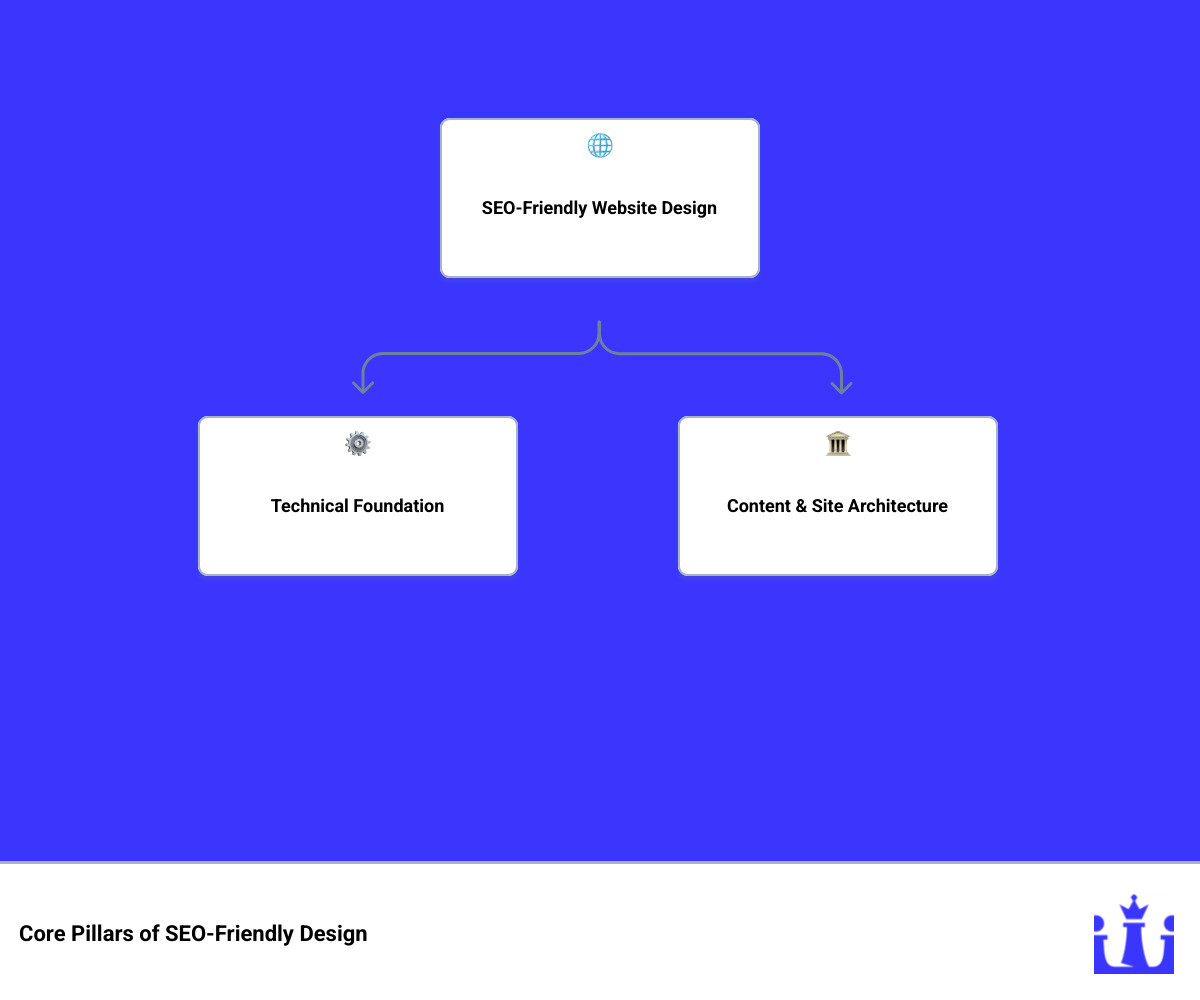
SEO Friendly Website Design is the art of building a website that’s optimized for both search engines and users from the start. It merges technical performance, smart structure, and strategic content to help your site rank higher and deliver an excellent user experience.
Core elements of SEO-friendly design:
- Technical Foundation: Mobile-first, fast, crawlable, and secure (HTTPS).
- Smart Architecture: Clear hierarchy, logical navigation, and internal linking.
- On-Page Optimization: Quality content, optimized metadata, and image SEO.
- User Experience: Readable layouts, accessible design, and intuitive pathways.
A beautiful website is useless if customers can’t find it. With the first search result getting over 25% of all clicks, visibility is everything. At the same time, a site that ranks well but frustrates visitors won’t convert. This is why good design and good SEO are now inseparable.
Building a site with SEO in mind from day one is more efficient and cost-effective than retrofitting it later. When search engines can easily crawl your content and users enjoy their visit, you get better rankings and more customers. I’m Bernadette King, and I specialize in creating strategic, SEO-friendly websites that drive real growth for local businesses.
The Technical Foundation: Making Your Site Crawlable and Fast
Think of technical SEO as your website’s engine. It’s the behind-the-scenes work that ensures search engines can find, understand, and rank your content. Without a solid technical base, even the best content may go unseen. Our goal with SEO Friendly Website Design is to make your site easily crawlable and indexable for search engine bots, just as it is for users.
Only about one-third of websites pass Google’s Core Web Vitals, and very few pages rank in the top 10 within a year. A strong technical foundation – including a mobile-first approach, speed optimization, and robust security – is crucial for beating those odds for your business in places like Albuquerque and Santa Fe.
The Critical Role of Mobile-Friendliness
With nearly two-thirds of all web traffic coming from mobile devices, mobile-friendliness is a necessity. Google recognized this with its mobile-first indexing, meaning it primarily uses the mobile version of your site for ranking. If your website in Rio Rancho or Edgewood isn’t responsive, you’re missing a massive audience and likely being penalized in search results.
A responsive design ensures your site adapts seamlessly to any screen size, providing a consistent user experience. This positive interaction signals value to Google, contributing to better rankings. Sites that neglect mobile optimization consistently underperform.
How Website Speed and Core Web Vitals Impact Rankings
Website speed is a critical ranking factor because users abandon slow-loading sites. Studies show that almost 70 percent of users say page speed impacts their willingness to buy. A slow site in Corrales or Taos means lost customers.
Google’s Core Web Vitals measure user experience through these key metrics:
- Largest Contentful Paint (LCP): Measures loading performance. Aim for under 2.5 seconds.
- Interaction to Next Paint (INP): Measures page responsiveness. Aim for under 200 milliseconds.
- Cumulative Layout Shift (CLS): Measures visual stability. Aim for a score below 0.1.
Improving these metrics can significantly boost organic traffic. We achieve this by:
- Optimizing Images: Compressing images and using modern formats like WebP.
- Minifying Code: Removing unnecessary characters from CSS and JavaScript files.
- Using Browser Caching: Storing parts of your site on a user’s browser for faster subsequent visits.
- Choosing Efficient Hosting: A fast, reliable host is essential. For more on this, explore our resources on Website Hosting and Maintenance.
You can check your site’s performance with tools like Google’s PageSpeed Insights.
Essential Technical SEO Considerations
Beyond speed and mobile-friendliness, other technical elements are vital for SEO Friendly Website Design:
- Indexable Content: Your site’s main content must be in HTML text so search engines can read it. While JavaScript adds dynamic features, core content must remain accessible.
- XML Sitemaps: This is a map of your website for search engines, listing all important pages to ensure they get crawled and indexed.
- Robots.txt: This file tells search engine bots which parts of your site to avoid, helping them focus on your valuable content.
- SSL Certificates (HTTPS): HTTPS encrypts data, building user trust and providing a small SEO boost. Google has considered it a ranking signal since 2014, making it a standard security practice.

Architecting Your Site for Users and Search Engines
Site architecture is your website’s blueprint. It’s the hierarchical structure that guides users and search engines through your content. A logical architecture is crucial for an SEO Friendly Website Design because it directly impacts user experience, crawling efficiency, and how ranking authority flows through your site.
When we design a website for a client in Los Alamos or Cedar Crest, we craft a logical journey from the start. This ensures your most important pages are easy to find and that the relationships between content are clear, which is far simpler than reorganizing a messy site later.
Choosing the Best Website Structure for SEO
While different sites have different needs, the hierarchical (or silo) structure is typically best for SEO. It organizes content from broad categories into more specific sub-pages, like a tree. This logical flow is easy for users and search engines to follow, helping establish your site’s topical authority.
Other structures include:
- Sequential: Guides users through a linear path (e.g., a checkout process).
- Database: A bottom-up model for large, searchable sites like Vrbo.
- Matrix: A highly interconnected web of links, like Wikipedia.
For most local businesses, a hierarchical structure provides the clarity needed for a strong online presence. To dive deeper, check out our guide on How to Create an SEO-Friendly Website Design Structure.
Designing Intuitive Navigation and Internal Linking
Good navigation acts as a friendly tour guide for your website. We design clear, logical menus and use breadcrumbs (e.g., Home > Services > SEO) to show users where they are. A common guideline is the 3-click rule, ensuring any important page is accessible within three clicks from the homepage.
Internal linking is the connective tissue that guides users and search engines between related pages. A strong internal linking strategy:
- Improves crawlability and helps search engines find all your pages.
- Distributes “link equity” or ranking power throughout your site.
- Improves user experience by leading visitors to more valuable content.
- Builds topic clusters, signaling your expertise to search engines.
- Prevents “orphan pages” that have no internal links pointing to them.
We use descriptive anchor text (the clickable text) for links, such as “learn more about our SEO Services” instead of a generic “click here.”
Best Practices for SEO-Friendly URL Structure
URLs are more than just web addresses; they are signals to users and search engines about a page’s content. A clean URL is a hallmark of SEO Friendly Website Design.
Best practices include:
- Keep them simple and readable: ‘yoursite.com/services/web-design’ is better than ‘yoursite.com/p?id=123’.
- Include target keywords: Reinforce the page’s topic, like ‘yoursite.com/local-seo-tips/’.
- Use hyphens to separate words: Google reads ‘web-design’ as two words, but ‘web_design’ as one.
- Prefer static URLs: Avoid dynamic URLs with parameters (‘?’, ‘=’, ‘&’) when possible, as they can cause crawling issues.
- Maintain consistency: Use lowercase letters and a consistent format across your site to prevent duplicate content issues.
A clean, descriptive URL structure improves user experience and provides clearer signals to search engines, which can improve click-through rates from search results.
Mastering On-Page SEO Friendly Website Design
With a solid technical foundation and architecture, the next step is optimizing the content on each page. On-page SEO involves refining every element – from text and images to hidden metadata – to help search engines understand your content’s relevance to specific queries. This ensures your business in Grants or Tijeras is not only compelling to users but also perfectly understood by Google’s algorithms.
Creating Readable and High-Quality Content
Content is king, but only if it’s readable and helpful. Readability is a key factor in SEO because search engines want to provide users with the best experience.
Here’s how we ensure your content shines:
- Visual Clarity: We use readable fonts (at least 16px for body text), good contrast, and ample white space.
- Scannable Structure: Short paragraphs and clear, concise language make content easy to digest. We use heading tags (H1, H2, H3) to create a logical hierarchy that helps users and search engines skim the page.
- E-E-A-T: We create content that demonstrates your Experience, Expertise, Authoritativeness, and Trustworthiness. This is a crucial element of Google’s quality guidelines and is built by showcasing testimonials, citing sources, and providing real value.
- User Intent: High-quality content directly answers the user’s search query. It should be relevant, unique, and up-to-date.
The Power of Metadata: Title Tags and Meta Descriptions
Metadata describes your page to search engines and users before they click. It’s a critical part of SEO Friendly Website Design.
- Title Tags: The clickable headline in search results. It’s arguably the most important on-page SEO element. We optimize titles to be unique, clear (around 60 characters), and include the page’s main keyword.
- Meta Descriptions: The short summary (up to 160 characters) below the title in search results. While not a direct ranking factor, a compelling meta description acts as an ad for your page, encouraging clicks with a relevant summary and a call-to-action.
Optimizing these elements helps your business in Sandia Park or Taos stand out and drive more qualified traffic.
A Guide to SEO Friendly Website Design for Images
Images engage users and offer valuable SEO opportunities. We optimize them by:
- Using Descriptive File Names: ‘albuquerque-seo-services.jpg’ is better than ‘IMG001.jpg’.
- Writing Alt Text: This description helps visually impaired users and tells search engines what an image is about. It’s a great place to include relevant keywords naturally.
- Compressing Images: We reduce file sizes using tools and modern formats like WebP to improve page speed without sacrificing quality.
- Placing Images Contextually: Images should be placed near relevant text to help search engines understand their context.
Using Schema Markup to Improve SERP Appearance
Schema markup is code that helps search engines understand your content’s meaning more precisely. For example, with schema, Google knows an event’s date and location or a product’s price and rating. This can make your page eligible for “rich results” – visually improved listings that stand out in search.
Common types include schema for articles, products, reviews, and local businesses (which is vital for showing your address, hours, and phone number). Rich results increase visibility and improve click-through rates. You can find a full list of schema types on Schema.org, and we use tools to implement it correctly for your business.
Strategy, Analysis, and Avoiding Common Mistakes
An SEO Friendly Website Design is not a one-time task but an ongoing strategy. To maximize your online presence, we integrate SEO from the beginning, continuously analyze performance, and avoid common pitfalls. This proactive approach ensures sustained growth for your local business.
Integrating Keyword Research into the Design Process
Keyword research is a foundational step that should happen before design begins. By understanding what potential customers in Albuquerque or Santa Fe are searching for, we can inform the entire website strategy.
This research dictates:
- Site Architecture: Keywords help us map out logical site categories and pages, each targeting a specific user intent.
- Content Strategy: We identify which keywords each page should target and integrate them naturally into titles, headings, and copy. For a deeper dive, explore our guide on Local SEO Keyword Research.
- Local SEO Focus: We identify location-specific keywords (e.g., “plumber Rio Rancho NM”) to attract customers in your service areas.
Using Website Analytics to Improve SEO and Design
Data guides our strategy. Once your site is live, we monitor its performance to understand user behavior and refine our approach.
Our primary tools are:
- Google Analytics: Provides insights into who your visitors are, how they find you, and how they behave on your site.
- Google Search Console (GSC): Tracks your site’s indexing status, crawl errors, and performance in Google search results.
By analyzing metrics like bounce rate, dwell time, and conversion rates, we can identify areas for improvement. For example, a high bounce rate on mobile might indicate a design issue that needs fixing. This iterative process of analysis and refinement is key to long-term SEO success.
Common Mistakes in SEO Friendly Website Design to Avoid
Even with good intentions, it’s easy to make mistakes that undermine SEO efforts. We help clients avoid these common pitfalls:
- Neglecting Mobile Optimization: With mobile-first indexing, a poor mobile site guarantees poor rankings.
- Slow Page Speeds: Users and search engines hate slow websites. Optimize images and code.
- Poor Site Structure: A confusing site makes it hard for users and crawlers to find content.
- Keyword Stuffing: Writing for search engines instead of humans will get you penalized.
- Broken Links: These create a poor user experience and signal a neglected site.
- Ignoring Technical SEO: A beautiful site is useless if it’s not technically sound.
- Thin or Low-Quality Content: Your content must be valuable, helpful, and demonstrate E-E-A-T.
- Intrusive Pop-ups: Aggressive pop-ups, especially on mobile, can harm user experience and lead to penalties.
Frequently Asked Questions about SEO and Web Design
What is the difference between website design and SEO?
Website design focuses on the visual look and user experience (UX/UI) for human visitors – the layout, colors, and ease of use. SEO focuses on the technical structure and content optimization to help search engines find, understand, and rank the site.
They are two sides of the same coin. A beautiful site no one can find is useless, and a top-ranking site that’s frustrating to use won’t convert. SEO Friendly Website Design merges both for optimal results.
How long does it take to see SEO results from a new website design?
SEO is a marathon, not a sprint. While minor technical improvements can have an impact within days, significant ranking changes take time. Generally, you can expect to see measurable results in 3-6 months as Google crawls, indexes, and evaluates your new site against competitors. Patience and continuous monitoring are key.
Can I apply SEO to an existing website, or do I need a full redesign?
Yes, you can always apply SEO to an existing website. We often improve performance through content optimization, technical fixes, and link building on established sites.
However, a full redesign is often more effective if the site has fundamental flaws, such as an outdated, non-responsive design, a convoluted site structure, or significant technical debt. In these cases, starting fresh with an SEO Friendly Website Design provides a stronger foundation for long-term success. Explore our full range of SEO Services to see how we can help.
Conclusion
The core message is clear: SEO Friendly Website Design is not an optional extra but the bedrock of online success. It’s the blend of technical performance, intuitive architecture, and compelling content that makes a website rank well with search engines and resonate with users.
By integrating SEO from the start, we build websites that Google loves to rank and customers love to visit. This proactive approach saves time and money, ensuring your local business in New Mexico stands out.
Ready to build a website that’s optimized for success from the ground up? Let’s achieve your ranking goals together. Get a professional SEO-friendly website design that works for your business.
