TL;DR:
- A local SEO case study workflow links specific actions to measurable results like calls and bookings to prove ROI.
- It requires essential tools like Google Business Profile and call tracking, along with automated dashboards for accurate insights.
A local SEO case study workflow is a documented, repeatable process that connects specific SEO actions to measurable business outcomes like calls, direction requests, and booked appointments. For Albuquerque business owners, this kind of structured approach turns guesswork into proof. It shows exactly what moved the needle and why. King Digital Marketing Agency uses this framework with local clients to build credibility, track progress, and make every SEO dollar accountable. When you follow a defined workflow, you stop reporting on rankings and start reporting on revenue.
What are the essential prerequisites for a local SEO case study workflow?
The right tools determine whether your workflow produces insight or noise. Before you run a single audit or write a single report, you need four core data sources in place: Google Business Profile, Google Analytics, Google Search Console, and a call tracking platform. Each one captures a different layer of your local search performance. Together, they give you a complete picture of how customers find and contact your business.

Centralized dashboards that pull from Google Business Profile, website analytics, and call tracking into one view directly connect marketing activity to revenue. That connection is what makes a case study credible. Without it, you are presenting isolated numbers that stakeholders cannot act on.
Setting clear KPIs before you start is equally critical. Your KPIs should map to business goals, not SEO jargon. For an Albuquerque HVAC company, the right KPI is inbound calls from the Northeast Heights neighborhood, not domain authority. For a local restaurant, it is reservation form submissions from Google Maps, not keyword position. You can find a practical starting point in this local marketing SEO guide that covers KPI selection for competitive local markets.
Tools and resources you need before starting
- Google Business Profile: Tracks profile views, calls, direction requests, and photo engagement
- Google Analytics 4: Measures website sessions, conversions, and traffic sources
- Google Search Console: Shows which queries trigger your site and your click-through rates
- Call tracking software: Attributes phone calls to specific search terms or pages
- Geo-grid rank tracking tool: Visualizes your local search visibility across Albuquerque zip codes
- Reporting template: Standardizes output so every monthly report looks and reads the same
Pro Tip: Automate your data collection from day one. Automation reduces errors and frees your time for analysis instead of spreadsheet maintenance. Set up automated exports from each platform into a single dashboard before your first reporting cycle begins.
How do you execute a local SEO case study workflow step by step?
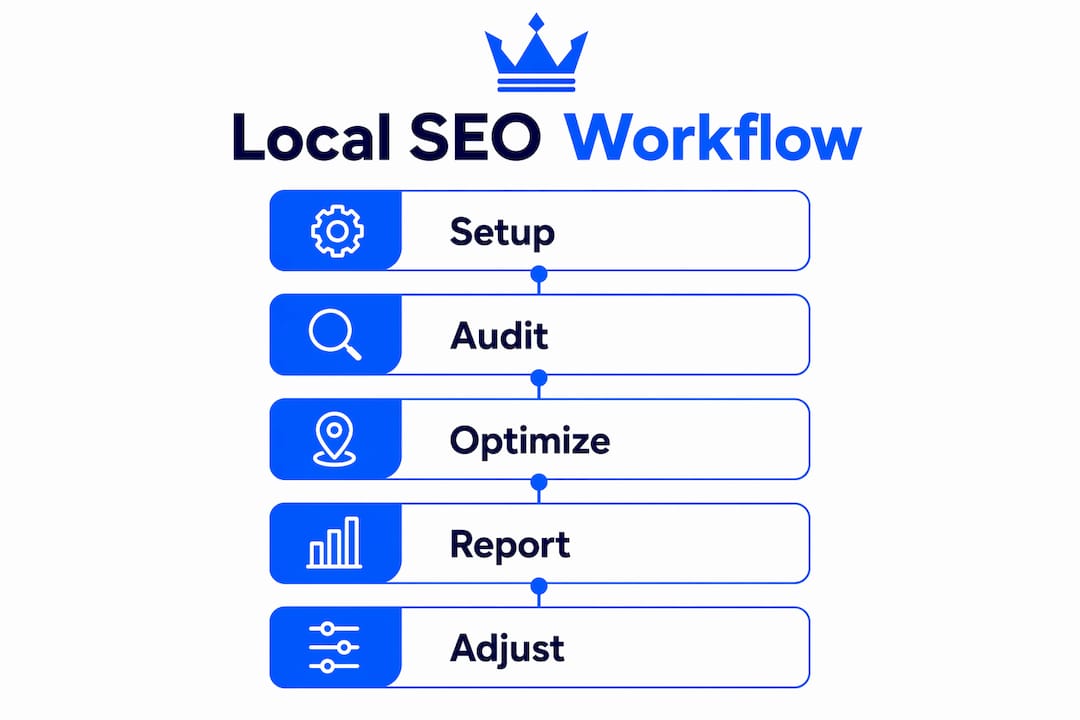
A phased workflow approach builds strong SEO foundations before scaling efforts, which produces compounding gains over time. Skipping phases produces short-term spikes with no staying power. The workflow below follows the sequence that King Digital Marketing Agency applies with Albuquerque clients.
The six-phase execution sequence
-
Run a local SEO technical audit. Check website responsiveness, page speed, schema markup, internal linking, and URL structure. Technical audits that include mobile-first design checks and structured SEO reviews are the foundation of every successful local campaign. Use the SEO checklist for small businesses to make sure nothing gets missed.
-
Optimize your Google Business Profile. Confirm your business name, address, and phone number are consistent across all directories. Add photos, update your hours, select accurate categories, and respond to every review. An incomplete profile is like a storefront with the lights off.
-
Map keywords to Albuquerque neighborhoods. Generic keywords like “plumber near me” compete nationally. Neighborhood-specific phrases like “plumber in Nob Hill” or “HVAC repair Rio Rancho” target buyers with real intent. Build a keyword map that assigns specific terms to specific pages or service areas.
-
Build and clean local citations. Audit your listings on Yelp, Bing Places, Apple Maps, and industry directories. Inconsistent NAP (name, address, phone) data confuses search engines and costs you ranking positions.
-
Publish localized content monthly. Write blog posts and service pages that reference Albuquerque landmarks, events, and neighborhoods. This signals geographic relevance to Google and builds topical authority in your market.
-
Run geo-grid rank tracking. Geo-grid tools like ProMapRanker create visual maps showing where your business ranks across specific areas, with green zones indicating visibility and red zones revealing gaps. This visual proof is far more persuasive to stakeholders than a spreadsheet of keyword positions.
Reporting frequency and depth
| Reporting cycle | Primary focus | Key output |
|---|---|---|
| Monthly | Tactical check-ins and quick corrections | KPI snapshot, GBP performance, call volume |
| Quarterly | Trend analysis and strategy review | Ranking movement, conversion trends, geo-grid comparison |
| Annual | Full case study documentation | ROI summary, year-over-year growth, next-year roadmap |
Monthly reports allow for quick course corrections, while quarterly reports provide trend-based insights that inform bigger decisions. Both cycles serve different purposes and should never replace each other.
Pro Tip: Build your reporting template before your campaign starts, not after. A standardized template cuts report production time significantly and keeps your metrics consistent across every cycle.
How do you create local SEO reports that prove ROI?
The purpose of a local SEO report is not to impress. It is to prove that your SEO investment produced real business results. Local SEO reports must focus on bottom-line metrics like calls, direction requests, and booking form submissions instead of vanity metrics like impressions or average position. Business owners care about revenue, not rankings.
“Report sections should honestly discuss any dips or issues as opportunities with planned actions. Transparency about SEO challenges and clear recommendations build client trust and provide strategic direction.”
ProMapRanker
A strong local SEO report contains these components:
- Executive summary: Two to three sentences on the biggest wins and the one challenge that needs attention
- KPI scorecard: Calls, direction requests, form submissions, and website sessions from organic search
- Google Business Profile performance: Profile views, photo views, and actions taken
- Geo-grid snapshot: A before-and-after visual showing ranking movement across Albuquerque neighborhoods
- Content and citation updates: What was published or fixed this period
- Recommendations: Three specific actions planned for the next reporting cycle
Visualizing data with geo-grid heatmaps from tools like ProMapRanker makes performance tangible. A business owner who sees a map turning from red to green understands progress instantly. That visual clarity builds trust faster than any table of numbers.
Pro Tip: Frame every challenge as an opportunity with a specific fix attached. Instead of writing “rankings dropped in the South Valley,” write “rankings dropped in the South Valley due to a citation inconsistency, which we corrected on March 14.” Narrative context turns bad news into evidence of competent management.
Tracking the right online marketing metrics from the start of your campaign makes this kind of honest reporting possible. When you know what you measured and why, you can explain every number with confidence.
What mistakes should you avoid in your local SEO case study workflow?
Most local SEO workflows fail not because of bad strategy but because of bad habits. The most common problems are predictable and preventable.
- Data fragmentation: Pulling numbers from five different platforms manually creates errors and eats hours. Integrate your sources into one dashboard from the start.
- Reporting on vanity metrics: Impressions and average position do not pay rent. If your report does not show calls or conversions, it does not show ROI.
- Ignoring Albuquerque-specific nuances: The Old Town market behaves differently from the Journal Center corridor. Treat each service area as its own micro-market with its own keyword map and content plan.
- Neglecting Google Business Profile updates: An outdated profile with wrong hours or missing photos loses customers before they ever reach your website. Audit your profile every month without exception.
- Skipping automation: Manual reporting is slow and error-prone. Automation and standardized templates are foundational to scalable, error-free local SEO workflows.
- No template standardization: When every report looks different, stakeholders cannot track progress over time. Lock in a template and stick to it.
Pro Tip: Assign one person to own each data source. When everyone is responsible for data quality, no one actually checks it. Clear ownership prevents the gaps that make reports unreliable.
Understanding search visibility fundamentals before you build your workflow helps you avoid chasing the wrong signals from the start.
Key Takeaways
A structured local SEO case study workflow connects every SEO action to a measurable business outcome, making it the most credible way to prove ROI to any Albuquerque business stakeholder.
| Point | Details |
|---|---|
| Start with the right tools | Set up Google Business Profile, Analytics, Search Console, and call tracking before any campaign begins. |
| Follow a phased workflow | Run the technical audit first, then optimize, then publish localized content, then report. |
| Report on conversions, not rankings | Focus every report on calls, direction requests, and form submissions to prove real business impact. |
| Use geo-grid tracking | Visual rank maps show Albuquerque-specific performance gaps faster than any spreadsheet. |
| Automate and standardize | Consistent templates and automated data collection reduce errors and save hours every reporting cycle. |
What I’ve learned from building local SEO workflows in Albuquerque
I’ve watched business owners spend months on SEO campaigns that produced beautiful ranking reports and zero new customers. The disconnect is almost always the same. The workflow was built around what was easy to measure, not what actually mattered to the business.
The fix is simpler than most people expect. Align your KPIs with revenue goals before you touch a single setting. If a plumbing company in the South Valley needs 20 new service calls per month to hit its revenue target, then calls are the only metric that matters. Everything else is context.
Localized content targeting specific Albuquerque neighborhoods consistently outperforms generic city-level content. A page optimized for “water heater repair Nob Hill” will outrank a page optimized for “water heater repair Albuquerque” in that neighborhood because it matches the exact search intent of someone standing in that zip code.
The other lesson I keep relearning is that technical SEO and clear communication are not separate jobs. You can run a perfect audit and lose a client because your report reads like a manual. Business owners need to see the story, not just the data. When you combine a sound technical workflow with honest, narrative-driven reporting, you build the kind of trust that keeps clients for years.
— Bernadette
King Digital Marketing Agency helps Albuquerque SMBs build SEO that delivers results
King Digital Marketing Agency works with Albuquerque small and medium-sized businesses to build local SEO workflows that connect directly to revenue. From Google Business Profile optimization to geo-grid rank tracking and monthly reporting, every service is designed to show you exactly what your SEO investment is producing.

If your website is not built to support local SEO from the ground up, your workflow will always hit a ceiling. The SEO-friendly website design guide from King Digital Marketing Agency walks you through the structural foundations that make every other local SEO effort work harder. Ready to build a workflow that proves its own value? Contact King Digital Marketing Agency for a consultation tailored to your Albuquerque market.
FAQ
What is a local SEO case study workflow?
A local SEO case study workflow is a documented, repeatable process that tracks SEO actions and connects them to measurable business outcomes like calls and direction requests. It gives business owners proof that their SEO investment is working.
How often should I run local SEO reports?
Monthly reports handle tactical adjustments, while quarterly reports reveal trends and inform bigger decisions. Both cycles serve different purposes and work best when used together.
What KPIs matter most for local SEO in Albuquerque?
Calls, direction requests, and form submissions are the metrics that prove ROI. Rankings and impressions provide context but do not demonstrate that customers are actually contacting your business.
What is geo-grid rank tracking?
Geo-grid rank tracking uses tools like ProMapRanker to create visual maps showing where your business ranks across specific geographic areas. Green zones indicate strong visibility and red zones reveal where you are losing customers to competitors.
How does automation improve a local SEO workflow?
Automation pulls data from multiple platforms into one place automatically, reducing manual errors and saving hours each reporting cycle. That time goes toward analysis and decisions instead of data entry.
Recommended
- Website content optimization steps for Albuquerque SMBs
- SEO ranking factors: Local Albuquerque guide for SMBs
- Boost leads in Albuquerque: on-page SEO best practices
