
Why Brand Identity Copywriting Is the Foundation of Every Strong Brand
Brand identity copywriting is the strategic use of words to define and express who a brand is – its personality, values, tone, and voice – across every customer touchpoint.
Quick answer: Here’s what brand identity copywriting covers at a glance:
| Element | What It Means |
|---|---|
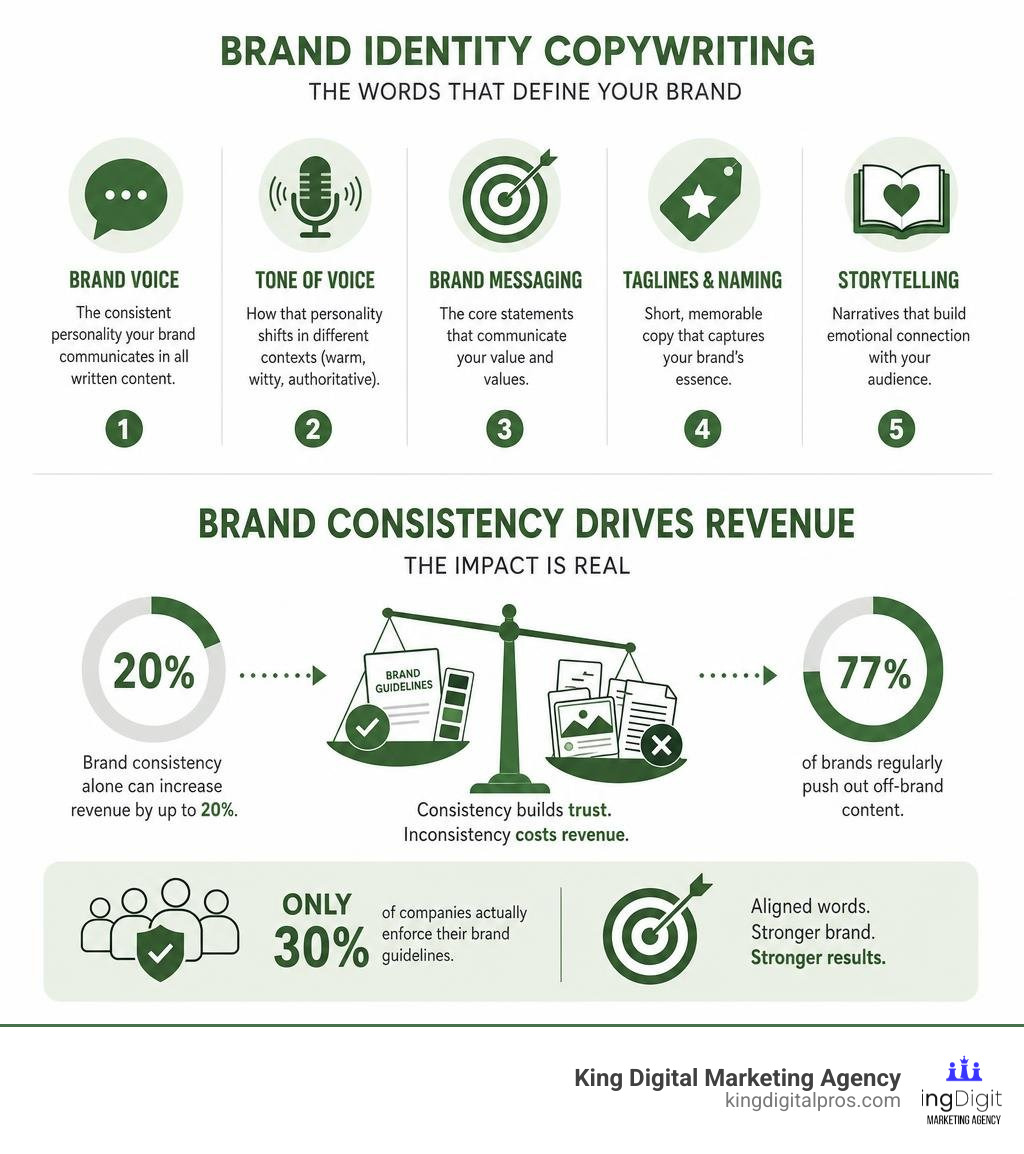
| Brand voice | The consistent personality your brand communicates in all written content |
| Tone of voice | How that personality shifts in different contexts (warm, witty, authoritative) |
| Brand messaging | The core statements that communicate your value and values |
| Taglines and naming | Short, memorable copy that captures your brand’s essence |
| Storytelling | Narratives that build emotional connection with your audience |
Most people think branding is about logos and colors. But visuals only go so far. It’s the words – the tagline, the product description, the “About” page – that make someone feel something about your brand.
And that feeling matters more than most business owners realize. According to research cited across multiple brand studies, brand consistency alone can increase revenue by up to 20%. Yet 77% of brands regularly push out off-brand content, and only 30% of companies actually enforce their brand guidelines. That gap between intent and execution costs real money.
Words are not a finishing touch on top of a brand. They are the brand.
I’m Bernadette King, founder of King Digital Marketing Agency, and I started my career as an in-house copywriter for a national jewelry manufacturer – where I learned how brand identity copywriting shapes the way customers see, feel, and trust a business. In the sections ahead, I’ll walk you through exactly how to use words strategically to build a brand that cuts through the noise.
Common brand identity copywriting vocab:
What is Brand Identity Copywriting and Why Does It Matter?
In the digital world, we often hear that “a picture is worth a thousand words.” But when it comes to defining a business, the reverse is often true. A slick logo can catch an eye, but it is a well-crafted sentence that convinces a customer to open their wallet.
So, what is brand identity copywriting? It is the art and science of translating a brand’s core strategy, positioning, and soul into written language. Unlike direct response copywriting – which focuses on securing an immediate click or sale – brand copywriting focuses on building long-term equity, recognition, and trust. It creates the “verbal world” that your company inhabits.
When we talk about brand definition, we look at both visual and verbal identity. Your verbal identity includes your brand name, your taglines, your website copy, your email campaigns, and even the microcopy inside your apps or product packaging.
For local businesses throughout New Mexico – from historic shops in Santa Fe to tech startups in Los Alamos – establishing this verbal identity is crucial. When we develop Copywriting Services for our local partners, we look at how verbal branding establishes a business in the minds of the target audience. Are you a rugged, outdoor-focused brand in Taos, or a sophisticated, modern professional service in Albuquerque? Your words must reflect that reality.
The Strategic Role of Brand Identity Copywriting
Many businesses treat copy as an afterthought. They pay a designer thousands of dollars for a beautiful website, and then write the copy themselves at 2:00 AM the night before launch. This approach ignores the strategic foundation of brand building.
In reality, brand strategy must come first. Before you choose your brand colors or design a logo, you must establish your positioning:
- Who is your target audience?
- What unique problem do you solve for them?
- How do you want them to feel when they interact with your business?
Once these questions are answered, copywriting translates those abstract strategic concepts into readable, memorable content.
This strategic alignment directly impacts your bottom line. Research shows that maintaining brand consistency across all marketing touchpoints can increase your revenue by up to 20%. When your social media ads, website copy, and local marketing materials all speak with the same unified voice, you build a compounding trust loop with your audience. You can learn more about how powerful ad copy drives this consistency in our guide on The Secret Sauce of Ad Copy Writing Success.
Building Emotional Connections Through Words
Why do words matter so much in branding? Because humans do not make purchasing decisions based on logic alone. We buy based on emotion, and then justify our decisions with logic.
According to consumer behavior statistics, 65% of consumers say that a consistent brand voice helps them build an emotional connection to a company. Furthermore, customers who feel an emotional connection with a brand have a three times higher lifetime value (LTV). They are also highly likely to recommend the company to others at a rate of 71%, compared to the average recommendation rate of just 45%.
When you write brand copy, you are not just listing features; you are crafting a feeling.
- A coffee brand isn’t just selling “caffeinated beans”; they are selling “a quiet moment of morning warmth.”
- A local tax service in Rio Rancho isn’t just selling “spreadsheet management”; they are selling “peace of mind and financial security.”
By humanizing your business through a distinct voice, you transform your company from a faceless vendor into a trusted friend.
Core Elements of an Effective Brand Messaging Framework
To build a strong brand, you need a structured framework that guides how you speak to the world. This is often compiled into a brand messaging document. This framework ensures that whether a freelance writer, an internal marketer, or a local business owner is writing copy, the output always sounds like the same brand.
Here are the primary components of an effective brand messaging framework:
| Brand Voice Dimension | What It Represents | Example (Playful vs. Professional) |
|---|---|---|
| Tone of voice | The emotional inflection applied to your words based on context | “We messed up, let’s fix it” vs. “We apologize for the inconvenience” |
| Brand personality | The human traits attributed to your brand | An adventurous trail guide vs. a trusted academic advisor |
| Brand values | The core beliefs that drive your business decisions | Environmental sustainability, radical transparency, or local community focus |
| Unique Value Proposition (UVP) | The clear, concise statement of what makes you different | “The only local agency that guarantees 100% transparent reporting” |
Developing a Consistent Brand Voice Across Channels
Maintaining an omnichannel voice is one of the hardest parts of brand building. It requires your brand to sound the same whether a customer is reading a tiny button on a mobile app, reading an email newsletter, or looking at a local billboard in Albuquerque.
To see how world-class teams handle this, we can look at the insights from The Subtext | Anthropic Brand Team Interview. The brand team at Anthropic explains that they conceptualize their brand voice as a “radio” that tunes to different frequencies depending on the context. While their master brand represents institutional trust and deep research, their user-facing AI assistant, Claude, speaks with more warmth and user expression.
One of Anthropic’s core voice principles is being “unvarnished.” This means communicating honestly and directly, without corporate gloss or empty marketing jargon. For any business, adopting an unvarnished approach builds immediate credibility. Customers in 2026 are highly skeptical of over-polished, generic corporate speak. They want real, authentic communication.
The Power of Storytelling in Brand Identity Copywriting
Storytelling is not just a buzzword; it is a biological hack. Human brains are wired to remember stories much better than they remember facts or bulleted lists of features.
According to Harvard Business Review’s research on the science of storytelling, when we read a compelling story, our brains release oxytocin – the chemical responsible for empathy, connection, and trust.
When applied to brand identity copywriting, storytelling involves structuring your copy with a clear narrative arc:
- The Hero: Your customer (not your business!).
- The Conflict: The frustrating problem your customer faces.
- The Guide: Your business, stepping in with the empathy and authority to help.
- The Resolution: The happy, improved life your customer enjoys after using your solution.
Whether you are writing a detailed history for a historic landmark in Santa Fe or crafting a simple landing page, framing your copy around the customer’s journey creates instant emotional resonance.
Balancing Authenticity with Strategic Messaging
While storytelling and emotion are vital, your copy must still serve a business purpose. The secret lies in balancing authenticity with strategic messaging.
To achieve this, you must base your copy on real audience research. Don’t guess what your customers care about; ask them.
- Send out client surveys to your email list.
- Conduct short interviews with your best customers.
- Monitor local forums and social groups to see the exact language your target audience uses to describe their problems.
When you use your customers’ own words in your copy, your brand feels instantly authentic. It shows that you truly understand their world, making your strategic value proposition feel like a natural solution rather than a hard sales pitch.
Best Practices for Maintaining Brand Consistency Across Touchpoints
Consistency builds brands. When your messaging is fragmented, your audience gets confused, and confused minds do not buy. Whether you are running digital ads, publishing blog articles, or utilizing traditional print marketing, every touchpoint must feel aligned.
For local businesses in our New Mexico service areas – from Taos down to Tijeras – maintaining this consistency is often what sets market leaders apart from the competition. If you want to understand how content management and copywriting work together to keep your brand on track, check out our guide on Copywriting and Content Management Walk Into a Bar.
Integrating Copywriting with Visual Identity and Design
A common mistake companies make is keeping their design and copywriting teams in separate silos. The copywriter writes a document in Microsoft Word, and the designer creates a layout in Adobe Illustrator, and they try to smash them together at the end. This always results in a clunky user experience.
The best creative work happens when writers and designers collaborate from day one. In the article The Subtext | How Writers Make Their Mark at Figma, the Figma brand team shares how their copywriters work directly inside Figma design files alongside visual designers.
This collaborative approach offers several massive benefits:
- Real-time spatial awareness: Writers can see exactly how a headline looks in a design layout, allowing them to adjust line breaks, word counts, and visual hierarchy instantly.
- Cohesive concepts: When a writer and a designer brainstorm together, they can create campaigns where the visual and the headline work in perfect harmony, rather than competing for attention.
- Faster iteration: Working in a shared file eliminates the endless back-and-forth email chains and copy-paste errors of traditional handoffs.
Measuring the Effectiveness of Brand Copywriting
Because brand copywriting focuses on long-term perception rather than instant sales, measuring its success can feel challenging. However, several key metrics and indicators show when your brand copy is doing its job:
- Brand recall and recognition: Are customers mentioning specific phrases, taglines, or values from your copy in their feedback?
- Engagement metrics: Are people spending more time on your key brand pages (like your “About” or “Our Story” pages)? High scroll depth and average session duration indicate that your story is engaging.
- Conversion rate improvements: When your brand copy is clear and emotionally resonant, your direct response assets (like landing pages and email sign-ups) will naturally convert at a higher rate.
- Quality of leads: When your copy clearly articulates your values and UVP, you will notice that incoming leads are better qualified and already aligned with how you do business.
Evolving Your Copywriting Strategy During a Brand Refresh
As your business grows, your brand must inevitably evolve. Whether you are expanding your services, targeting a new demographic, or simply modernizing an outdated look, a brand refresh requires a careful, strategic shift in your copywriting.
When undergoing a refresh, always start with a comprehensive brand audit. Look at all of your existing written content and identify:
- What copy still aligns with your core values?
- What messaging feels outdated, overly complex, or off-brand?
- Where is your tone of voice inconsistent across your digital platforms?
For local New Mexico businesses, a brand refresh is also the perfect time to optimize your local search presence. At King Digital Marketing Agency, we specialize in optimizing Google Business Profiles for local businesses. When you update your brand’s verbal identity, we make sure that your updated brand messaging, local target keywords, and business descriptions are seamlessly integrated into your Google Map listings. This ensures that your brand refresh doesn’t just look and sound great – it also actively drives local visibility and attracts more customers in Albuquerque, Rio Rancho, Santa Fe, and beyond.
Common Copywriting Mistakes That Undermine Brand Identity
To keep your brand strong, avoid these common copywriting pitfalls:
- Using generic jargon: Phrases like “synergistic solutions,” “world-class service,” or “disruptive paradigm shifts” mean absolutely nothing to your customers. Speak like a real human.
- Making it all about you: Your brand copy should not be a self-congratulatory speech about how great your company is. It should be about how your company helps your customer become the hero of their own story.
- Inconsistent tone: If your website copy is highly formal and academic, but your social media presence is full of casual memes and slang, you will confuse your audience and erode trust.
- Ignoring brand guidelines: If you don’t document your voice, tone, and messaging rules, your brand copy will inevitably drift and lose its cohesive identity over time.
Frequently Asked Questions about Brand Identity Copywriting
What is the difference between brand copywriting and direct response copywriting?
While both are essential marketing disciplines, they have different goals and timelines. Brand copywriting focuses on building long-term brand awareness, emotional connection, and trust. It defines the overall personality and voice of the business. Direct response copywriting, on the other hand, is highly conversion-focused. It uses persuasive, urgent language to drive an immediate, trackable action – such as clicking a link, signing up for an email list, or purchasing a product right now.
How do you create a brand voice guide for copywriters?
A great brand voice guide should be highly practical. Start by defining 3 to 4 core brand personality traits (e.g., “Warm, Intelligent, and Unvarnished”). For each trait, provide a clear explanation of what it means. Crucially, include a “Do and Don’t” spectrum with real-world examples of how to write (and how not to write) using that trait. This gives writers concrete boundaries to work within.
Why do visual design and copywriting need to be developed together?
Visual design and copywriting are two sides of the same coin; they work together to create a singular user experience. If your design and copy are developed in isolation, they will often clash or feel disconnected. Developing them together ensures that the visual elements illustrate the story that the words are communicating, creating a cohesive, high-impact brand experience.
Conclusion
At the end of the day, your brand is one of your business’s most valuable assets. It stands as a beacon that your audience can recognize, understand, and relate to. While a beautiful logo and color palette can catch someone’s eye, it is your brand identity copywriting that captures their heart, builds lasting trust, and turns casual browsers into lifelong brand advocates.
At King Digital Marketing Agency, we help local businesses across New Mexico – including Albuquerque, Rio Rancho, East Mountains, Corrales, Santa Fe, Los Alamos, Taos, Grants, Cedar Crest, Edgewood, Sandia Park, and Tijeras – build powerful, cohesive brands. By combining expert verbal strategy with our specialized Google Business Profile optimization, we ensure that your brand’s unique voice is heard by the right local customers at the exact moment they are searching for your services.
Ready to find your voice and stand out in the local market? Elevate your brand with professional copywriting services today, and let’s craft a verbal identity that truly cuts through the noise.
