Why It’s Harder Than Ever to Grow a Medical Practice (And What Actually Works)
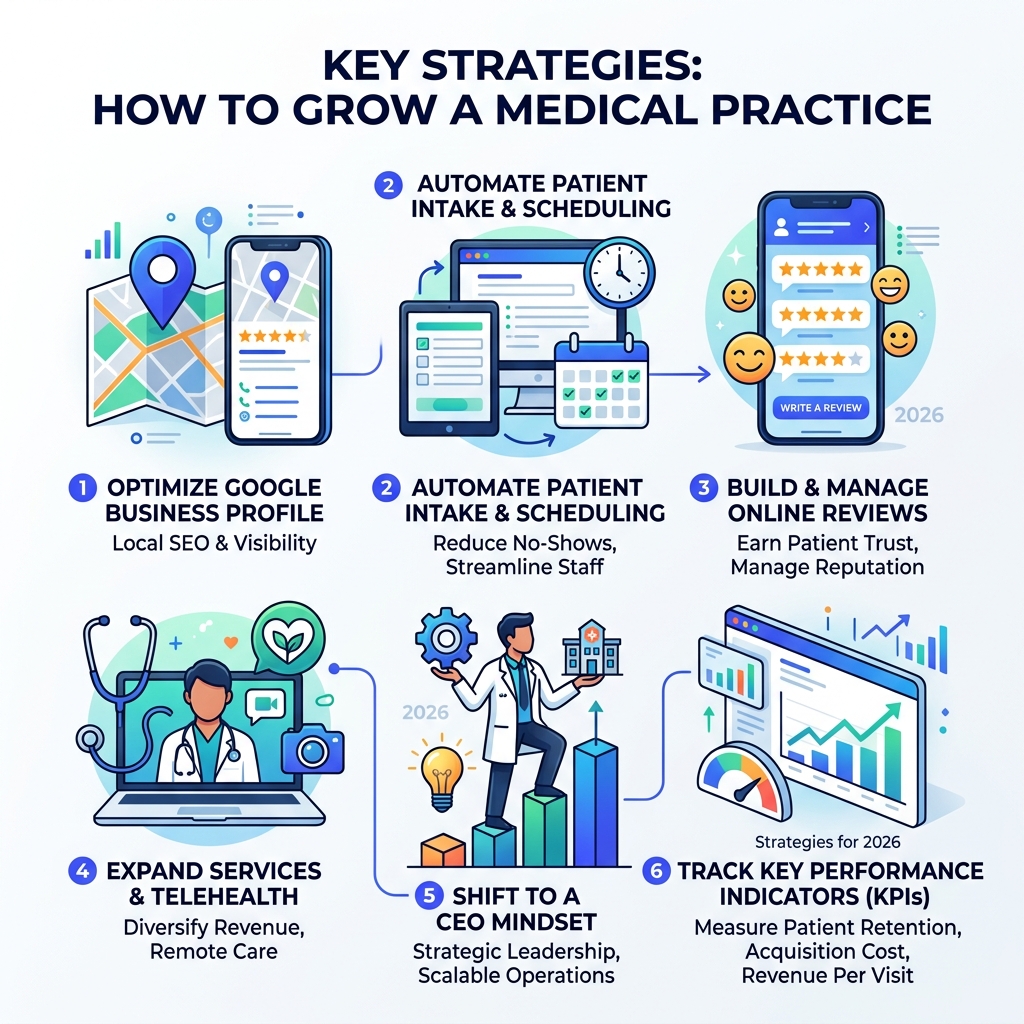
To grow medical practice revenue and patient volume in 2026, focus on these core strategies:
- Optimize your Google Business Profile so local patients can find you fast
- Automate patient intake and scheduling to reduce no-shows and staff burden
- Build and manage online reviews to earn patient trust before they call
- Expand services like telehealth or wellness programs to diversify revenue
- Shift to a CEO mindset so your practice grows even when you step away
- Track KPIs like patient retention rate, acquisition cost, and revenue per visit
Running a medical practice today is a different game than it was even five years ago. More than 100 million Americans lack routine access to a primary care physician — nearly double the number from 2014. Yet the average wait time for a new patient appointment is still around 26 days. That gap between demand and access is enormous.
And still, many practices struggle to grow.
Why? Because clinical excellence alone doesn’t fill schedules. Patients search online first. They read reviews. They book appointments on their phones at 10pm. If your practice isn’t visible, convenient, and trustworthy before a patient walks through the door, a competitor’s is.
The good news: the same gaps creating pressure on the healthcare system are creating real opportunity for practices willing to modernize how they operate and market themselves.
This guide breaks down what actually moves the needle — from local SEO and reputation management to telehealth, automation, referral networks, and the leadership mindset that ties it all together.
I’m Bernadette King, founder of King Digital Marketing Agency, where I help small businesses and healthcare practices build scalable online visibility through SEO, content strategy, and conversion-driven marketing — exactly the skills needed to grow medical practice revenue in a crowded local market. The strategies in this guide reflect what’s working right now, not five years ago.
Grow medical practice helpful reading:
Shifting from Clinician to CEO Mindset

One of the biggest “chokeholds” on a practice’s expansion isn’t the economy or the insurance companies—it’s often the owner’s own mindset. Many physicians have essentially created a high-paying job for themselves rather than a scalable business. If you don’t show up tomorrow, does the revenue stop? If so, you are a practitioner, not yet a CEO.
To truly grow medical practice operations, you must transition into an “owner-independent” model. This means building systems where the practice thrives even when you aren’t in the exam room. This shift requires developing Physician Leadership: Essential Skills for Today’s Health Care, which focuses on strategic vision rather than just clinical tasks.
Delegation and Leadership Behaviors
You cannot do it all. If you are still handling administrative tasks that could be delegated to a mid-level provider or a front-office superstar, you are stalling your own growth. Research suggests that physicians should spend at least 37 hours per week on direct patient care to maximize practice value, delegating the rest to trained staff.
Burnout Prevention: The Listen-Sort-Empower Approach
Growth is impossible if your team is exhausted. With a global healthcare worker shortage estimated to reach 14 million by 2030, retaining your staff is just as vital as attracting patients. We recommend the “Listen-Sort-Empower” approach:
- Listen: Conduct regular check-ins to hear staff frustrations.
- Sort: Identify which problems are systemic (EHR issues) versus individual.
- Empower: Give your team the tools and authority to fix “the stupid stuff” that slows them down.
By fostering a wellness-centered culture, you reduce turnover and create a more attractive environment for new hires. For a deeper look at scaling your leadership, check out our ultimate-guide-local-business-growth.
Digital Strategies to Grow Medical Practice in 2026
In 2026, your “digital waiting room” is often more important than your physical one. Patients in Albuquerque or Santa Fe aren’t looking in the phone book; they are typing “primary care near me” into Google. If you aren’t in the top three results, you effectively don’t exist to them.
Effective healthcare-local-seo is the engine that drives modern patient acquisition. It’s not just about having a website; it’s about having a mobile-responsive, fast-loading portal that answers patient questions before they even ask them.
Leveraging Local Search to Grow Medical Practice
The “Map Pack”—those three listings that appear next to a map in Google search—is where the majority of new patient clicks happen. To dominate this space, you need expert management of your Google Business Profile.
- Proximity Optimization: Ensure your address and service area are clearly defined.
- Local Keywords: Use terms specific to your New Mexico community, like “Family Medicine in Rio Rancho” or “Taos pediatric specialists.”
- Citation Consistency: Your Name, Address, and Phone Number (NAP) must be identical across the web—from WebMD to your local Chamber of Commerce.
Our team at King Digital specializes in grow-local-business strategies that ensure your practice is the first one patients see when they need care.
Reputation Management to Grow Medical Practice
Trust is the currency of healthcare. Statistics show that 41% of consumers use social media and online tools when choosing a doctor. This is why medical-online-reputation-management is no longer optional.
Positive reviews are a powerful form of “social proof.” We encourage practices to build feedback loops where satisfied patients are prompted to leave a review immediately after a successful visit. Conversely, managing negative reviews professionally—without violating HIPAA—shows prospective patients that you care about the patient experience. For a step-by-step roadmap, see our medical-practice-reputation-management-guide.
Optimizing Operations and Diversifying Revenue
To grow medical practice profits, you have to look at both what’s coming in and what’s leaking out. Inefficiency is the silent killer of growth.
Telehealth and Automation
Telehealth usage reached 78 times pre-pandemic levels at its peak, and it’s here to stay. By 2026, patients expect a hybrid model. Implementing Telehealth Resources and Information allows you to see more patients, reduce no-shows (which can drop by up to 89% with proper digital reminders), and expand your reach to rural areas of New Mexico.
| Task | Manual Process | Automated Process (2026) |
|---|---|---|
| Intake | Paper forms in the office | Online forms completed at home |
| Scheduling | Phone calls during 9-5 | 24/7 online booking |
| Payments | Mailing paper statements | SMS payment links |
| Follow-up | Staff calls each patient | Automated HIPAA-compliant texts |
Diversifying Services
Don’t rely solely on standard office visits. Adding high-demand services like computerized cognitive assessments or wellness programs can create new revenue streams. For example, nearly one in three individuals over the age of 70 lives with mild cognitive impairment. Offering remote cognitive screenings is a valuable service that also builds patient loyalty.
Mastering Patient Retention and Referral Networks
It costs much more to acquire a new patient than to keep an existing one. In fact, GrowPractice data shows that focusing on retention can lead to a 48% increase in repeat patients.
The Power of the “Raving Fan”
A “satisfied” patient might stay with you, but a “raving fan” will tell five friends. You cultivate these fans by delivering a patient-centric experience: minimal wait times, empathetic staff, and easy communication. Using HIPAA-compliant two-way texting is a great way to keep patients engaged and feeling cared for between visits.
Building Referral Networks
While digital marketing is vital, the “old school” method of physician-to-physician referrals still carries weight.
- Networking: Attend local medical events in Albuquerque or Los Alamos.
- Communication: Send personalized “thank you” notes or clinical updates to physicians who refer to you.
- Community Engagement: Participate in local health fairs or partner with New Mexico schools and businesses to become a recognized local health authority.
Measuring Success: KPIs and Overcoming Growth Challenges
You can’t manage what you don’t measure. To grow medical practice revenue sustainably, you must track Key Performance Indicators (KPIs) regularly.
Key Metrics to Track
- Patient Acquisition Cost (PAC): How much are you spending on marketing to get one new patient?
- Patient Volume: Are your provider schedules consistently full?
- Retention Rate: What percentage of patients return for follow-ups?
- Revenue per Patient: Are you maximizing the value of each visit through diversified services?
Addressing Challenges
The road to growth isn’t without bumps. Rising costs and staffing shortages are real threats. However, by implementing automation, you can reduce staff time on the phone by up to 75%, allowing your team to focus on high-value patient interactions rather than paperwork.
Short-term growth plans should focus on “low-hanging fruit” like optimizing your physician-review-management, while long-term plans should involve scaling to new locations or adding more providers.
Frequently Asked Questions about Growing a Practice
How long does it take to see results when trying to grow a medical practice?
Generally, it takes at least nine months to build significant momentum. While directory optimization and automated reminders can show results in weeks, SEO and referral network building are long-term investments that pay off over months and years.
What are the most effective social media platforms for doctors in 2026?
Visual and community-oriented platforms like Facebook and Instagram remain strong for patient engagement. However, YouTube is increasingly powerful for “Video SEO,” allowing you to explain complex health topics and build authority in your local market.
How can automation tools reduce staff burnout while increasing revenue?
Automation handles the “repetitive” tasks—like appointment reminders, intake forms, and payment collection. This reduces the “administrative burden” on your staff, allowing them to focus on patient care, which improves morale and reduces the costly turnover associated with burnout.
Conclusion
Growing a medical practice in today’s landscape requires a blend of clinical heart and CEO smarts. By embracing digital tools, optimizing your local search presence, and focusing on a stellar patient experience, you can build a clinic that isn’t just a job, but a thriving, sustainable business.
At King Digital Marketing Agency, we specialize in the “heavy lifting” of local visibility. We help practices in Albuquerque, Rio Rancho, Santa Fe, and across New Mexico dominate their local map listings and Google Business Profiles. Our goal is to ensure that when a patient needs help, your practice is the first one they see and the one they trust.
Ready to take the next step? Let us help you cultivate your clinic for long-term success.
Expand your reach today:
- SEO Services
- PPC Management
- Reputation Management
