TL;DR:
- Online reviews are the most influential trust signal small and medium-sized businesses can control, affecting search rankings, credibility, and revenue. Responding professionally to reviews, encouraging specificity, and avoiding fake reviews build authenticity and customer trust. Managing review timing and content enhances local SEO and fosters ongoing customer relationships for business growth.
Online business reviews are the single most powerful trust signal a small or medium-sized business controls. More than 99% of American consumers read reviews before making a purchase. That number alone tells you where your customers are forming their opinions about your business. Platforms like Google Reviews, Yelp, and Facebook have turned every customer interaction into a public record. The importance of online business reviews goes far beyond star ratings. Reviews shape your search rankings, your credibility, and your revenue, often before a potential customer ever visits your website or walks through your door.
Why online reviews matter for customer trust and sales
Customer trust is the foundation of every sale, and online reviews are the fastest way to build it or lose it. 88% of consumers trust online reviews as much as a personal recommendation from a friend. That is a remarkable shift in how trust is transferred. Word of mouth used to travel slowly. Now it scales instantly across Google, Yelp, and Facebook, reaching thousands of potential buyers before you ever speak to them.

The impact of customer reviews on buying decisions is direct and measurable. Displaying customer reviews boosts sales by 19.8%, and having five or more reviews increases conversion rates by 270%. Those are not marginal gains. They represent the difference between a business that grows and one that stagnates.
What surprises most business owners is that genuine customer feedback consistently outperforms polished brand messaging. A potential customer trusts a stranger’s honest account of your service more than your own marketing copy. This is the psychology of social proof at work. People reduce uncertainty by following the crowd, and reviews are the crowd’s verdict.
- Respond to every negative review. A professional, calm response to a complaint signals accountability. Silence signals indifference.
- Encourage specificity. Reviews that mention your location, service type, or staff name carry more weight than generic praise.
- Never fake reviews. Consumers spot inauthentic patterns quickly, and platforms like Google actively remove them.
- Acknowledge positive reviews too. A brief thank-you shows you are engaged and attentive.
Pro Tip: Ask for a review immediately after a positive experience, such as right after a successful service call or a completed project. That is when the customer’s satisfaction is highest and the request feels natural, not pushy.
How reviews improve local SEO and search visibility
Online reviews are not just reputation tools. They are ranking signals. Google’s local search algorithm factors in the quantity, quality, and velocity of reviews when deciding which businesses appear in the local pack, the three-business block that dominates local search results. Yelp alone helps 2.5 million consumers daily find local businesses. That reach is not something you can replicate with a paid ad alone.
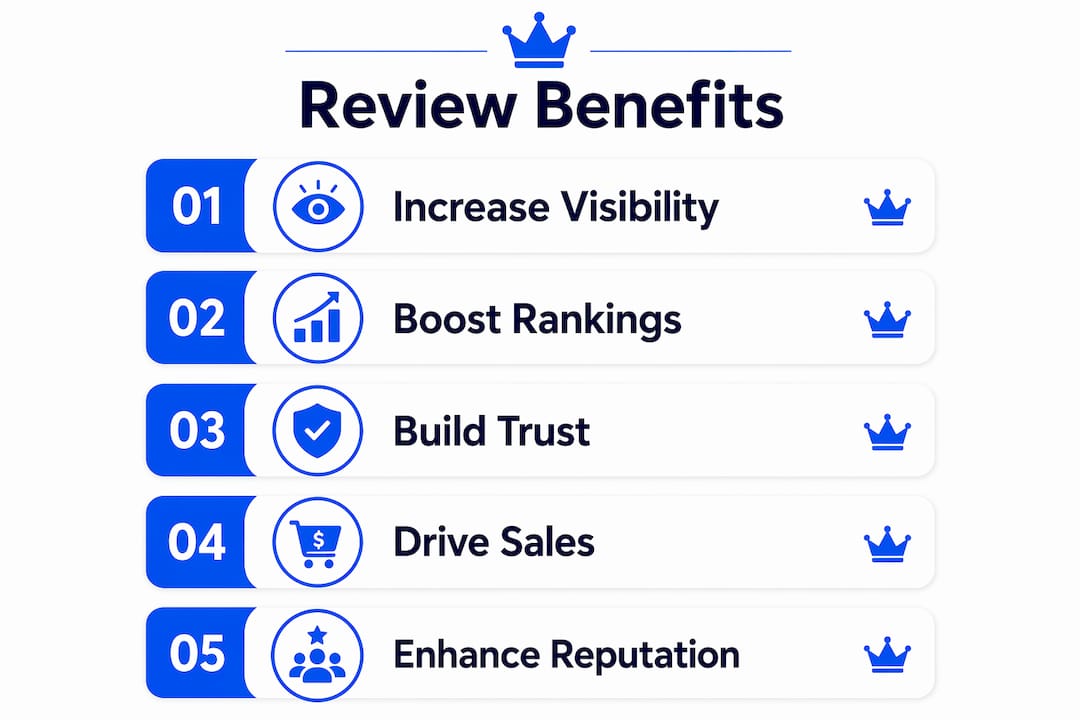
Reviews add unique, keyword-rich content to your Google Business Profile and third-party listings. Every time a customer writes about your “fast plumbing repair in Albuquerque” or your “friendly staff at the downtown location,” search engines index that language. You are essentially getting free, authentic content that reinforces your local relevance.
Here is how reviews feed directly into your local SEO performance:
- Review quantity. More reviews signal an active, legitimate business. Google rewards consistency over time.
- Review velocity. A steady stream of new reviews tells Google your business is current. A profile with 200 reviews from three years ago and nothing recent looks stale.
- Star rating average. Higher ratings improve click-through rates from search results. More clicks signal relevance to Google.
- Keyword content in reviews. Customer language that matches search queries strengthens your topical relevance.
- Platform diversity. Reviews across Google, Yelp, and Facebook create a broader footprint that reinforces your authority.
| Review signal | SEO impact | Business outcome |
|---|---|---|
| High review quantity | Stronger local pack presence | More impressions and clicks |
| Recent review velocity | Signals active business status | Higher trust from Google |
| Keyword-rich review text | Boosts topical relevance | Better match for local queries |
| High average star rating | Improves click-through rate | More qualified leads |
For SMBs working to improve search rankings, reviews are one of the few ranking factors you can influence directly through customer relationships rather than technical work alone.
Positive vs. negative vs. mixed reviews: which builds more trust?
The instinct to chase a perfect 5-star rating is understandable, but the data tells a different story. Conversion rates peak near a 4.9-star rating, not at 5.0. A flawless score with no negative reviews often reads as suspicious to experienced buyers. They know no business is perfect, and a profile without a single complaint looks curated rather than genuine.
Customers prefer mixed reviews with thoughtful responses over a silent perfect score. A 4.6-star average where the owner responds to criticism professionally builds more credibility than a 5-star profile with no engagement. The response is the signal. It tells the reader that a real person is running this business and that they care about outcomes.
| Review profile type | Consumer perception | Trust level |
|---|---|---|
| 5.0 stars, no responses | Looks fabricated or unmonitored | Low to moderate |
| 4.6 stars, professional responses | Authentic and accountable | High |
| Mixed reviews, no responses | Concerning, owner seems disengaged | Low |
| Mostly negative, some responses | Struggling but aware | Very low |
Research from Springer confirms that extreme reviews are viewed as more helpful than moderate ones. A passionate 1-star complaint or an enthusiastic 5-star endorsement gives buyers more decision-making clarity than a lukewarm 3-star review. This means your most critical reviews, handled well, can actually work in your favor.
Pro Tip: When responding to a negative review, avoid defensive language. Acknowledge the experience, offer a resolution, and invite the customer to continue the conversation offline. That three-step approach turns a public complaint into a public demonstration of your professionalism.
Practical strategies to collect and leverage reviews effectively
Collecting reviews is not about volume alone. It is about timing, authenticity, and consistency. Aggressive solicitation causes feedback fatigue, which can reduce repeat purchase rates. Customers who feel pestered after every transaction start to disengage. The goal is a steady, natural flow of genuine feedback, not a flood triggered by a mass email campaign.
Here is what works for SMBs in practice:
- Ask at the right moment. Request a review right after a positive touchpoint, such as a completed service, a successful delivery, or a resolved support issue. Timing is everything.
- Make it frictionless. Send a direct link to your Google Business Profile review page. Every extra click you remove increases completion rates.
- Train your team. Front-line staff who mention reviews naturally in conversation generate more responses than automated emails alone.
- Use review management tools. Platforms that centralize your review requests and responses save time and keep your process consistent. King Digital Marketing Agency has a detailed review management software guide that compares the leading options.
- Respond to every review, positive or negative. Businesses that engage with reviews consistently build stronger customer relationships and a more credible brand voice.
- Space out your requests. Do not ask the same customer for a review after every purchase. Once per meaningful experience is the right cadence.
Review management must be integrated into your customer experience, not treated as an afterthought. When it becomes part of your standard process, the results compound over time. Your Google Business Profile grows stronger, your local SEO improves, and new customers arrive already trusting you.
Key takeaways
Online business reviews directly determine your local search visibility, customer trust, and conversion rates, making them a core business function, not a marketing extra.
| Point | Details |
|---|---|
| Reviews drive purchase decisions | 93% of consumers say reviews influence what they buy, making them your most credible sales tool. |
| Mixed reviews outperform perfect scores | A 4.6-star average with professional responses builds more trust than a silent 5-star profile. |
| Reviews fuel local SEO | Review quantity, velocity, and keyword content all influence Google’s local pack rankings. |
| Feedback fatigue is a real risk | Over-soliciting reviews reduces repeat purchases, so time your requests to meaningful moments. |
| Responding is non-negotiable | Businesses that reply to both positive and negative reviews build stronger loyalty and credibility. |
What I’ve learned after years of watching reviews make or break local businesses
I have worked with dozens of SMBs across Albuquerque and the surrounding region, and the pattern I see most often is this: business owners treat reviews as something that happens to them rather than something they actively manage. That mindset is expensive.
The businesses that win locally are not always the ones with the best product. They are the ones with the most credible online presence. I have watched a small family-owned restaurant outperform a national chain in local search results simply because the owner responded to every review, good and bad, within 24 hours. That consistency told Google and potential customers the same thing: this business is real, active, and accountable.
The shift I encourage every client to make is to stop chasing a perfect score and start building an authentic profile. A 4.7-star rating with 80 reviews and thoughtful owner responses will outperform a 5.0-star rating with 12 reviews and zero engagement every single time. Consumers are more sophisticated than most business owners give them credit for. They read the responses. They notice the patterns.
The other thing I want you to take seriously is feedback fatigue. I have seen businesses damage their customer relationships by automating review requests after every single transaction. One client in the home services space saw their repeat booking rate drop noticeably after launching an aggressive post-visit review campaign. The fix was simple: we reduced the frequency and improved the timing. Results recovered within two months.
If you want a practical starting point, read through your existing reviews today. Look for patterns in what customers praise and what they criticize. That feedback is free market research, and most business owners never use it strategically.
— Bernadette
Ready to turn your reviews into a growth engine?
Your reviews are already working for you or against you. The question is whether you are managing them with intention. At King Digital Marketing Agency, we help SMBs across Albuquerque build review strategies that strengthen local SEO, improve reputation, and convert more visitors into customers.
From web design that builds credibility to full review management services, we combine technical SEO with reputation strategy so your business shows up and stands out. Whether you are starting from scratch or looking to sharpen what you already have, our team builds customized plans that fit your market and your goals. Let’s make your online presence work as hard as you do.
FAQ
How do online reviews affect local SEO rankings?
Google uses review quantity, velocity, and average rating as ranking signals for local search results. A consistent stream of recent, keyword-rich reviews strengthens your position in the local pack.
How many reviews does a business need to see results?
Having five or more reviews increases conversion rates by 270% compared to businesses with no reviews. The goal is a steady, growing total rather than a one-time surge.
Should I respond to negative reviews publicly?
Yes. Responding to negative reviews professionally demonstrates accountability and builds trust with future customers who read the exchange. Silence reads as indifference.
Is a perfect 5-star rating actually better for business?
No. Conversion rates peak near 4.9 stars, and a flawless profile with no negative reviews often appears fabricated to experienced buyers. A balanced profile with professional responses outperforms a silent perfect score.
How often should I ask customers for reviews?
Ask once per meaningful experience, not after every transaction. Repeated requests cause feedback fatigue and can reduce repeat purchase rates over time.
Recommended
- Top Online Marketing Metrics for SMBs in 2026
- What Is Search Visibility and Why It Matters for SMBs
- Why Update Website Content: SMB Guide for 2026
- Harness reviews to boost your business reputation online
