TL;DR:
- Developing a custom SEO strategy involves creating a tailored plan aligned with specific business goals, target audience, and local market factors. It requires thorough research, technical audits, and a detailed 12-month roadmap focusing on technical SEO, content, local optimization, and authority building. Tracking multiple high-intent conversion events every quarter is essential to refine efforts and achieve measurable lead and revenue growth.
Custom SEO strategy development is the process of building a tailored search optimization plan that reflects your specific business goals, target audience, competitive landscape, and local market dynamics. Unlike generic SEO checklists, a personalized SEO approach connects every tactic directly to outcomes you care about: more calls, more form leads, more foot traffic. This guide walks you through the full process, from baseline audits and keyword research to building a 12-month roadmap and measuring what actually moves the needle for your business.
What does custom SEO strategy development actually require?
A well-crafted custom SEO strategy document typically contains a 12-month roadmap, competitive analysis, keyword prioritization, technical and content recommendations, and team implementation guidance. That scope tells you something important: you cannot build a serious tailored SEO plan in an afternoon. The process takes 2–3 weeks when done correctly, and it starts well before you write a single piece of content.
Align goals before you touch a keyword tool
SEO goals must tie directly to business performance metrics like leads and sales. SMART goal frameworks give your strategy focus and make it measurable from day one. A goal like “rank higher on Google” is not a strategy. A goal like “generate 20 qualified service calls per month from organic search within six months” is.
Before you open Google Search Console or Semrush, answer these questions:
- What specific services or products do you want to rank for?
- Which geographic areas do you serve?
- What does a qualified lead look like for your business?
- What is your current organic traffic baseline?
Tools and data you need at the start
Your starting data set should include Google Search Console, Google Analytics 4, and a competitor research tool such as Ahrefs, Semrush, or Moz. Google Search Console shows you which queries already bring visitors to your site. Google Analytics 4 reveals what those visitors do after they arrive. Competitor tools show you what your rivals rank for that you do not.

Pro Tip: Run a technical SEO audit using Screaming Frog or Sitebulb before you finalize any keyword targets. Broken pages, slow load times, and crawl errors will undercut even the best content strategy.
How do you research keywords and analyze competitors?
Keyword research should decode search intent, find competitive gaps, and organize keywords by business fit to steer content planning and technical SEO. Intent mapping is the step most SMBs skip, and it is the one that costs them the most. A keyword with high volume but the wrong intent sends browsers to your site, not buyers.
Step-by-step keyword and competitor research process
- List your core services and locations. Start with what you sell and where you sell it. “HVAC repair Albuquerque” is more valuable than “HVAC tips” for a local service business.
- Identify search intent for each keyword. Use Google’s own search results page to classify intent as informational, navigational, or transactional. Transactional and local intent keywords drive leads. Understanding search intent signals is the foundation of smart keyword selection.
- Pull competitor keyword data. Enter your top three local competitors into Ahrefs or Semrush. Export the keywords they rank for that you do not. This gap list is your fastest path to new organic traffic.
- Score keywords by opportunity. Prioritize keywords with moderate competition, clear transactional or local intent, and monthly search volume above 50. High-volume keywords with massive competition rarely pay off for SMBs in the short term.
- Group keywords by topic cluster. Assign related keywords to a single page or content piece. This prevents keyword cannibalization and builds topical authority faster.
Pro Tip: Use Google’s “People Also Ask” boxes and autocomplete suggestions to find long-tail keywords your competitors have not targeted yet. These phrases often convert at higher rates because they reflect specific buyer questions.
Keyword priority comparison
| Keyword Type | Competition Level | Lead Potential | Priority for SMBs |
|---|---|---|---|
| Local transactional (“service + city”) | Medium | High | Highest |
| Long-tail informational | Low | Medium | High |
| Broad informational | High | Low | Low |
| Brand + competitor terms | Low | High | Medium |
Local transactional keywords are your highest-priority targets. They match the intent of someone ready to hire, not just browse.
What does a holistic SEO roadmap look like for your business?
Effective SEO strategies connect business outcomes like leads and revenue to specific SEO workstreams, rather than treating SEO as a checklist. HubSpot’s framework combines content, technical SEO, and authority signals into one integrated plan with a monthly execution cycle. That integration is what separates a real strategy from a list of tasks.
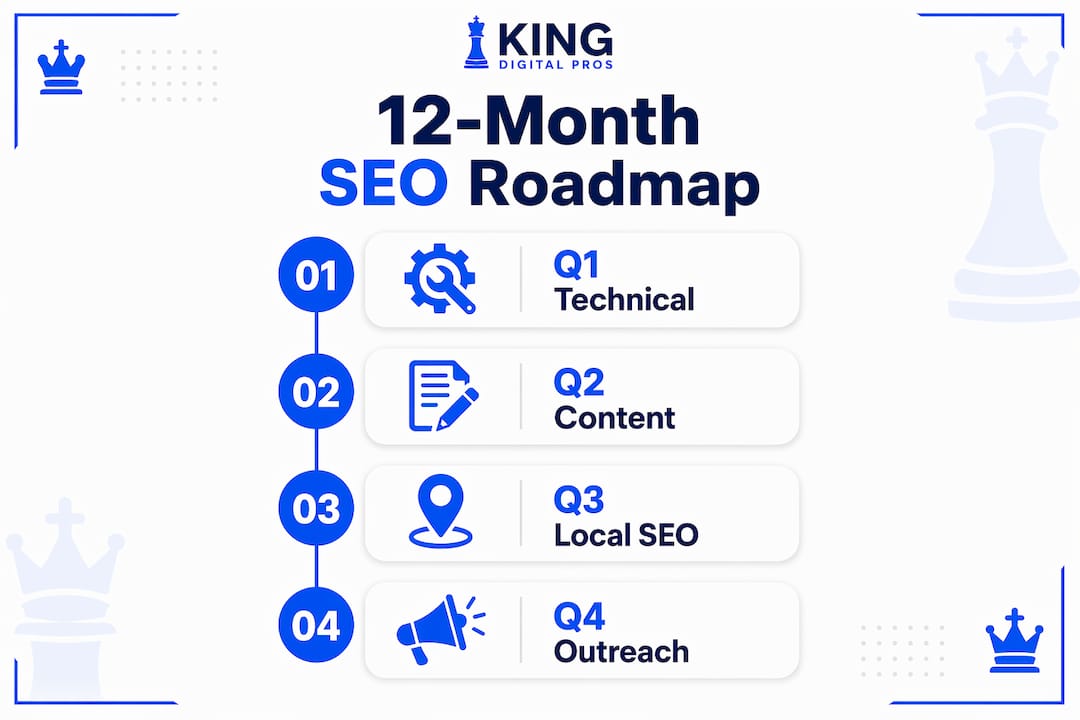
A complete 12-month SEO roadmap for an SMB covers four pillars: technical foundation, content creation, local SEO, and authority building. Each pillar has its own timeline and success metrics.
Sample 12-month SEO roadmap by quarter
| Quarter | Focus Area | Key Activities | Success Metric |
|---|---|---|---|
| Q1 | Technical Foundation | Site audit fixes, page speed, mobile optimization, schema markup | Crawl errors reduced, Core Web Vitals passing |
| Q2 | Content and Keywords | Publish service pages, blog posts targeting priority keywords, internal linking | Organic impressions up, target pages indexed |
| Q3 | Local SEO and Authority | Google Business Profile optimization, citation building, review generation, link outreach | Map pack appearances, direction clicks, reviews |
| Q4 | Measurement and Refinement | Analyze conversion data, update underperforming pages, expand content clusters | Leads from organic, keyword ranking improvements |
Why local schema markup cannot be optional
Google’s LocalBusiness schema requires properties such as name, address, telephone, and opening hours for rich result eligibility. Skipping schema is like handing Google a business card with half the information missing. Structured data like LocalBusiness schema compresses your business identity for machine readability, which directly impacts your chances of appearing in map packs and AI-generated local results.
For multi-location SMBs, schema must be audited regularly. Google’s guidelines change, and an outdated schema implementation can quietly cost you rich result eligibility without any obvious warning.
How do you track and refine your SEO strategy over time?
SMBs should track multiple SEO conversion events including calls, form submissions, direction requests, and website visits. Relying on a single metric gives you a distorted picture of your actual SEO performance. This matters more now than ever because AI is reshaping how users interact with local search results.
Rio SEO’s 2026 local search data illustrates this perfectly: total local listing views dropped 6.6% in Q4, yet direction clicks increased 6.4% year over year. That divergence means a business tracking only impressions would think its SEO was failing, when in reality high-intent user actions were growing. Track what predicts revenue, not just what is easy to measure.
The metrics that actually predict lead impact
- Direction requests: Signals someone is ready to visit your physical location. This is a high-intent action.
- Call clicks from Google Business Profile: Direct revenue signal. Track these separately from website calls.
- Form submissions from organic traffic: The clearest lead attribution you have. Set up goal tracking in Google Analytics 4.
- Keyword ranking movement for transactional terms: Rankings alone do not equal leads, but movement on your priority keywords predicts future traffic.
- Organic traffic to service pages: Measures whether your content strategy is pulling the right visitors.
AI is compressing the local customer journey, so SMBs should prioritize high-intent, frictionless actions over mere ranking visibility. This means your Google Business Profile, your review volume, and your local SEO keyword research all carry more weight than they did two years ago.
Common measurement mistakes to avoid
Most SMBs make one of three measurement errors. They track rankings but not conversions. They measure total traffic instead of traffic from their target service areas. Or they set up Google Analytics 4 but never configure conversion events. Fix these before you spend another dollar on content or link building.
Pro Tip: Set up a simple monthly reporting dashboard in Google Looker Studio that pulls data from Google Search Console and Google Analytics 4 side by side. Thirty minutes of setup saves hours of manual reporting every month.
Key takeaways
A custom SEO strategy succeeds when it connects every tactic directly to measurable business outcomes like leads, calls, and revenue.
| Point | Details |
|---|---|
| Start with SMART goals | Define lead and revenue targets before selecting keywords or creating content. |
| Prioritize local transactional keywords | These terms match buyer intent and deliver the highest lead conversion rates for SMBs. |
| Build schema markup from day one | LocalBusiness schema improves map pack eligibility and AI search visibility immediately. |
| Track multiple conversion events | Direction clicks, calls, and form leads together give an accurate picture of SEO impact. |
| Refine quarterly, not annually | Review performance data every 90 days and update underperforming pages before they drag rankings. |
What i’ve learned building SEO strategies for smbs
After working with dozens of small and medium-sized businesses, the pattern I see most often is this: owners want a strategy but underestimate the preparation phase. They jump to content creation before fixing technical issues, or they pick keywords based on volume alone without checking intent. Both mistakes waste months of effort.
The businesses that see the fastest results treat their SEO roadmap like a living document, not a one-time deliverable. They check their Google Business Profile data monthly, update service pages when rankings stall, and add new content based on what their customers are actually searching for. That discipline compounds over time in a way that no single tactic can replicate.
One more thing I want to be direct about: AI is not a threat to local SEO. It is a filter. Businesses with complete, accurate, and well-structured local data get surfaced by AI tools. Businesses with thin profiles and no reviews get ignored. The AI-driven local search trends reshaping 2026 reward the same fundamentals that have always mattered: relevance, authority, and trust.
— Bernadette
Ready to build your custom SEO strategy with King Digital Marketing Agency?
King Digital Marketing Agency works with SMBs across Albuquerque to develop personalized SEO approaches that connect directly to lead generation and local visibility goals. From technical audits and keyword mapping to SEO-friendly website structure and Google Business Profile optimization, every service is built around your specific market and competitive position. You do not have to figure this out alone or guess at what works.
If you are ready to stop guessing and start building a strategy that produces real results, the team at King Digital Marketing Agency is ready to help. Explore our local SEO services and see how a tailored plan can change your search presence in 90 days.
FAQ
What is custom SEO strategy development?
Custom SEO strategy development is the process of creating a personalized search optimization plan built around your specific business goals, audience, and local market. It includes keyword research, a technical audit, competitor analysis, and a detailed roadmap, and typically takes 2–3 weeks to complete properly.
How long does it take to see SEO results?
Most SMBs see measurable ranking and traffic improvements within 3–6 months of executing a well-structured SEO plan. Local SEO signals like Google Business Profile optimization and schema markup can produce visible results faster, often within 30–60 days.
What keywords should a local SMB target first?
Local transactional keywords combining your core service with your city or neighborhood deliver the highest lead potential. Start with terms like “service + city name” before targeting broader informational keywords.
How do i know if my SEO strategy is working?
Track multiple conversion events including direction requests, call clicks, form submissions, and organic traffic to service pages. Tracking only one metric gives a distorted view of actual performance, especially as AI changes how users interact with local search results.
Do i need schema markup for local SEO?
Yes. LocalBusiness schema with your name, address, phone number, and hours is required for Google rich result eligibility. Without it, your business is less visible in map packs and AI-generated local answers.
Recommended
- Why Update Website Content: SMB Guide for 2026
- How to Boost Organic Leads for Your SMB in 2026
- SEO ranking factors: Local Albuquerque guide for SMBs
- SEO trends that will drive Albuquerque small business growth
