TL;DR:
- A social media strategy provides a clear, structured plan focused on achieving measurable marketing goals for local businesses.
- It involves defining SMART goals, researching audiences and competitors, selecting the right platforms, creating a content calendar, and regularly reviewing performance to optimize results.
A social media strategy is a structured plan that defines precise steps for your business to reach specific marketing goals by engaging your audience across chosen platforms. Without that structure, you are essentially posting into the void and hoping something lands. The industry term for this process is “social media marketing strategy,” and the step-by-step execution model is what separates businesses that grow their local presence from those that spin their wheels. Tools like Buffer, Hootsuite, and Meta Business Suite exist precisely to support this kind of disciplined execution. This guide walks you through every phase of building a social media strategy step by step, from goal-setting to performance reviews, so your efforts translate into real visibility and real customers.
What is a social media strategy step by step?
A social media strategy step by step is a repeatable framework that moves your business from vague intentions to measurable outcomes. Think of it as the blueprint before you build. Without it, even the most creative content fails to connect with the right people at the right time.

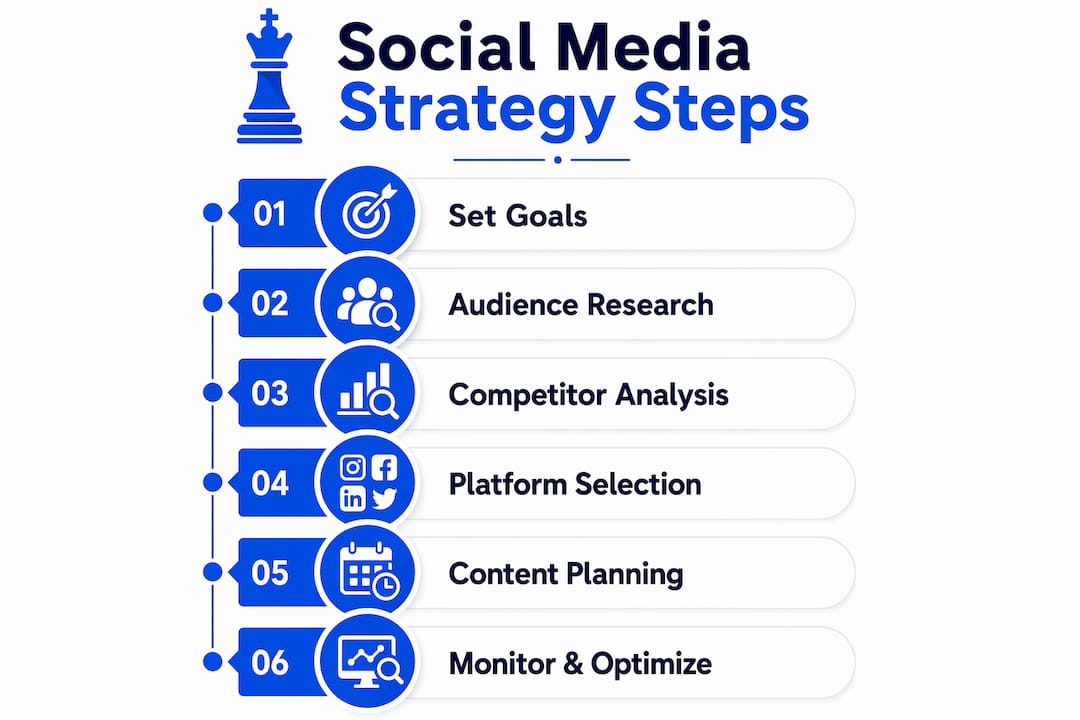
The framework covers six core phases: setting SMART goals, researching your audience and competitors, selecting platforms, building a content calendar, creating and publishing posts, and reviewing performance. Each phase feeds the next. Skip one, and the whole structure weakens.
For small and medium-sized businesses (SMBs) in competitive local markets like Albuquerque, this structure is not optional. It is the difference between social media that generates leads and social media that just consumes your time. The social media for businesses playbook confirms that practical implementation, not theory, drives results for local businesses.
How do you define clear, SMART social media goals?
SMART goals are the foundation of every effective social media plan. SMART stands for Specific, Measurable, Achievable, Relevant, and Time-bound. A goal like “get more followers” fails every one of those criteria. A goal like “grow Instagram followers by 20% in 90 days by posting four times per week” passes all five.
70% of campaigns fail without clearly defined SMART goals. That statistic means nearly three out of four businesses are wasting their budget and time because they never defined what success looks like.
Here is how to set SMART goals that actually work for an SMB:
- Specific: Name the platform, the metric, and the action. “Increase Facebook page reach” is specific. “Do better on social” is not.
- Measurable: Attach a number. Reach, engagement rate, website clicks, and lead form submissions are all trackable.
- Achievable: Base your target on your current baseline. A business with 200 followers should not target 10,000 in 30 days.
- Relevant: Tie the goal to a business outcome. More Instagram saves means nothing if your goal is phone call leads.
- Time-bound: Set a deadline. Ninety-day cycles work well because they are long enough to see trends and short enough to stay focused.
Pro Tip: Write your SMART goals before you touch any platform or content tool. Pin them somewhere visible. Every content decision you make should trace back to at least one of those goals.
Aligning social goals with broader business outcomes is where most SMBs fall short. If your business goal is to drive foot traffic to your Albuquerque storefront, your social goal should measure actions that lead there, such as “link in bio” clicks, direction requests, or event RSVPs.
How do you identify your audience and analyze competitors?
Knowing your audience is not the same as guessing at it. Audience research uses real data to map who your customers are, where they spend time online, and what problems they need solved.
Follow these steps to build a clear audience and competitor picture:
- Pull your existing customer data. Look at your CRM, Google Analytics, or even your email list. Age range, location, and purchase behavior tell you more than any persona template.
- Use platform-native analytics. Facebook Audience Insights and Instagram’s professional dashboard show you follower demographics, peak activity times, and content preferences without any third-party tool.
- Map customer pain points to your messaging. If your customers consistently ask about pricing, availability, or local delivery, those topics belong in your content.
- Identify three to five direct competitors. Search your service category on Google Maps and Instagram. Look at who ranks locally and who has an active social presence.
- Benchmark their performance. Competitive benchmarking tracks engagement rates, follower growth, and content reach against your competitors, giving you a realistic performance target and revealing content gaps you can fill.
- Note what they are not doing. If no competitor in your market posts video tutorials or behind-the-scenes content, that is your opening.
Competitive analysis is not about copying. It is about understanding the playing field so you can position your business where the gap is widest. For local SMBs, that gap is often authentic, community-focused content that larger brands cannot replicate.
How do you choose platforms and build a content calendar?
Platform selection and content planning are where your strategy becomes tangible. The rule is simple: be present where your audience already is, not where you wish they were.
For most SMBs, two to three platforms is the right number. Spreading across five platforms with thin content is less effective than owning two platforms with consistent, quality posts.
| Platform | Best for | Recommended posting frequency |
|---|---|---|
| Visual products, local lifestyle, younger adults | 4 to 5 times per week | |
| Community engagement, events, older demographics | 3 to 4 times per week | |
| B2B services, professional credibility | 3 times per week | |
| Twitter/X | Real-time updates, customer service, news | 5 to 7 times per week |
Once you have chosen your platforms, build your content calendar using this 6-step process that takes roughly 30 minutes:
- List your platforms (3 minutes): Write down each platform you will use and confirm your posting frequency for each.
- Set posting frequency (3 minutes): Use the research-backed frequencies above as your starting point, then adjust based on your capacity.
- Define your content mix (5 minutes): The most effective mix is 40% educational, 30% entertaining, 20% inspirational, and 10% promotional. Over-promotion is the single fastest way to lose followers.
- Assign monthly themes (5 minutes): Give each week or month a focus topic. For an Albuquerque restaurant, that might be “local ingredient spotlight” in October and “holiday catering” in November.
- Fill in the calendar (12 minutes): For each post slot, record the date, platform, post type (video, image, carousel, story), caption idea, and call to action.
- Schedule your posts (2 minutes): Load your calendar into Buffer, Hootsuite, or Meta Business Suite so posts go live automatically.
Pro Tip: Use a free tool like content calendar planning templates to pre-fill your calendar structure. Batch-create content for two weeks at a time so you are never scrambling for a last-minute post.
What makes a social media post actually engaging?
An effective post is not just a pretty image with a caption. Every element works together to stop the scroll, communicate value, and prompt a specific action.
The anatomy of a high-performing post includes:
- A strong opening line: The first sentence of your caption must earn the next read. Ask a question, state a bold fact, or lead with the benefit.
- Emojis and mentions: Emojis and mentions increase visibility and engagement by making posts feel more human and by triggering platform notifications for tagged accounts.
- A clear call to action: Every post needs one. “Book your free consultation,” “Tag a friend who needs this,” and “Click the link in bio” are all specific and low-friction.
- Relevant hashtags: Use a mix of broad category hashtags and hyper-local ones. For an Albuquerque business, “#AlbuquerqueEats” or “#NMSmallBusiness” reaches a local audience that generic hashtags miss.
- Quality visuals: Blurry photos or generic stock images signal low effort. Canva and Adobe Express let you create branded visuals without a design background.
Beyond the post itself, community engagement is what converts followers into customers. Shifting from broadcasting to two-way engagement is the defining factor for social media success. That means replying to every comment within 24 hours, responding to DMs, and proactively engaging with local accounts and customers. Follower count is a vanity metric. Engagement rate and conversation quality are what drive business outcomes.
Avoid the most common mistake SMBs make: treating social media as an advertising channel. If every post is a sales pitch, your audience will tune out. The 10% promotional rule in your content mix exists for a reason.
How do you monitor and optimize your strategy over time?
Measurement without a review process is just data collection. You need a structured habit of looking at what the numbers mean and adjusting accordingly.
Follow this quarterly review process to keep your strategy on track:
- Pull your 90-day rolling averages. Look at reach, engagement rate, follower growth, website clicks, and any goal-specific metrics like lead form submissions or phone calls.
- Compare against your SMART goals. Did you hit your targets? If not, was the gap in content quality, posting frequency, or platform choice?
- Identify your top three and bottom three posts. The top performers tell you what your audience wants more of. The bottom performers reveal what to stop doing.
- Adjust your content mix and themes. If educational posts consistently outperform promotional ones, shift your ratio. If Instagram Reels drive more reach than static images, produce more video.
- Reset your goals for the next 90 days. Use your new baseline to set targets that are ambitious but grounded in actual performance.
A 90-minute quarterly audit prevents “strategy drift,” which is the gradual disconnection between your social media activity and your actual business goals. Without this review, businesses often find themselves six months in, posting consistently, but with nothing to show for it in revenue or leads.
Pro Tip: If you use AI tools to generate captions or visual content, build a branded prompt library that encodes your brand voice, colors, and tone. Generic AI prompts produce generic content. Specific prompts produce content that sounds like you.
Key takeaways
A social media strategy built on SMART goals, audience research, disciplined content planning, and quarterly performance reviews is the only reliable path to measurable local visibility and engagement for SMBs.
| Point | Details |
|---|---|
| SMART goals are non-negotiable | Without clear goals, 70% of campaigns fail before they gain traction. |
| Platform focus beats platform volume | Choose 2 to 3 platforms based on where your audience actually is. |
| Content mix drives engagement | Use 40% educational, 30% entertaining, 20% inspirational, and 10% promotional content. |
| Quarterly reviews prevent drift | A 90-minute audit every 90 days keeps your strategy aligned with business outcomes. |
| Engagement quality beats follower count | Two-way community interaction converts followers into paying customers. |
What I have learned building social media strategies for local businesses
After working with SMBs across Albuquerque and the surrounding region, the pattern I see most often is this: business owners start strong, post for three weeks, see modest results, and then quietly abandon the plan. The problem is almost never the content. It is the absence of a feedback loop.
The businesses that win on social media treat it like a conversation, not a broadcast. They show up consistently, they respond to comments, and they adjust based on what their audience actually responds to rather than what they assumed would work. One local service business I worked with shifted from polished promotional graphics to simple behind-the-scenes phone videos and saw their engagement triple within 60 days. The content was less “professional” by traditional standards, but it was more human, and that is what local audiences respond to.
The other thing I push back on is the obsession with being on every platform. I have seen businesses stretch themselves across Instagram, Facebook, LinkedIn, TikTok, and Pinterest simultaneously, producing mediocre content everywhere instead of excellent content in one or two places. Pick your two strongest platforms, master them, and expand only when you have the capacity to maintain quality.
The social media strategies for local businesses that generate real leads share one trait: they are built around the community, not around the brand. When your content serves your audience first, the business results follow.
— Bernadette
Ready to build your strategy with expert support?
Building a social media strategy step by step takes time, consistency, and the right expertise. If you are an SMB owner in Albuquerque who wants a strategy that actually generates leads and local visibility, King Digital Marketing Agency is ready to help.
At King Digital Marketing Agency, we develop tailored social media marketing plans built around your specific business goals, your local audience, and the platforms where your customers spend their time. From content calendar creation to community management and performance reporting, our in-house team handles the execution so you can focus on running your business. Explore our social media marketing essentials to see exactly how we help Albuquerque SMBs grow their online presence and turn followers into customers.
FAQ
What is a social media strategy?
A social media strategy is a structured plan that defines your goals, target audience, platform choices, content approach, and performance metrics. It gives every post a purpose tied to a measurable business outcome.
How many platforms should an SMB use?
Two to three platforms is the recommended starting point for most SMBs. Focusing on fewer platforms with consistent, quality content outperforms spreading thin across five or more channels.
How often should a small business post on social media?
Research-backed posting frequencies are 4 to 5 times per week on Instagram, 3 to 4 times on Facebook, and 3 times on LinkedIn. Consistency matters more than volume.
How do you measure social media success?
Track metrics aligned with your SMART goals, including reach, engagement rate, website clicks, and lead form submissions. Conduct a 90-day rolling review quarterly to assess performance and adjust your approach.
What content mix works best for small businesses?
The most effective mix is 40% educational, 30% entertaining, 20% inspirational, and 10% promotional. Over-promotion is the leading cause of audience disengagement for SMBs.
Recommended
- Social media marketing essentials for Albuquerque SMBs
- Social media marketing tips to boost Albuquerque SMBs
- Paid Advertising Step by Step for Small Businesses
- Build a winning content strategy process for Albuquerque SMBs
