TL;DR:
- Understanding search intent is crucial because it determines whether content satisfies user goals and maintains ranking longevity.
- Marketers should classify intent types, align content format and angle accordingly, and use SERP signals to tailor strategies effectively.
You can rank for a keyword and still lose. That is the uncomfortable truth most SEO guides skip. Understanding what is search intent separates marketers who build sustainable organic traffic from those who chase rankings that evaporate in weeks. Search intent is the actual goal behind a user’s query. Not the words they typed. The reason they typed them. When your content answers that reason precisely, Google rewards you. When it does not, no amount of technical optimization saves you. This article breaks down the types of search intent, how to identify them, and how to put that knowledge to work in your SEO campaigns right now.
Table of Contents
- Key Takeaways
- What is search intent: the foundation of SEO
- How intent changes your SEO strategy
- AI-driven search and generative intent
- A practical framework for identifying search intent
- My honest take on search intent in 2026
- How King Digital Marketing Agency helps you put intent to work
- FAQ
Key Takeaways
| Point | Details |
|---|---|
| Search intent is the “why” | Every query has a goal behind it; matching that goal is what earns and keeps rankings. |
| Four traditional intent types exist | Informational, navigational, commercial, and transactional each require different content formats and angles. |
| A fifth type is emerging | Generative search intent, driven by AI tools, demands synthesized, direct answers rather than long-form pages. |
| SERP features are your blueprint | What appears on the results page tells you exactly what format and depth Google expects for that query. |
| Metrics reveal intent mismatches | High bounce rates and pogo-sticking signal that your content is not satisfying the real intent behind a search. |
What is search intent: the foundation of SEO
Search intent, also called user intent, is the underlying goal behind any search query. Think of it as the difference between the words someone types and the outcome they actually want. Someone searching “best running shoes” is not ready to buy. They want to compare options. Someone searching “buy Nike Air Zoom size 10” is done comparing. Same product category, completely different intent.
Search intent is the “why” behind every search, and it shapes content strategy far more powerfully than keywords alone. Google’s algorithm has grown sophisticated enough to detect when a page technically matches a keyword but fails to serve the actual intent. The result? Short-lived rankings that fall off as soon as user behavior signals pile up.
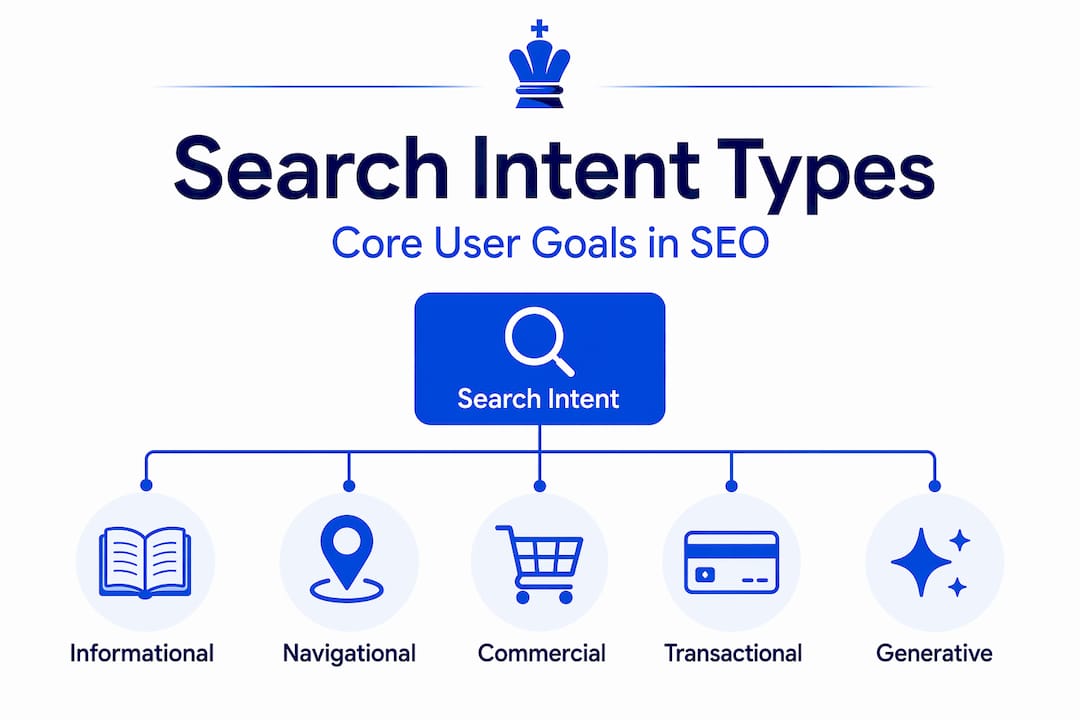
The four traditional types of search intent
Most search intent falls into four categories:
- Informational intent: The user wants to learn something. Examples include “how does SEO work” or “what causes high bounce rates.” Informational intent accounts for just over 50% of all search volume, making it the dominant intent type by far.
- Navigational intent: The user wants to reach a specific website or page. “Gmail login” or “King Digital Marketing Agency SEO services” are classic examples. Navigational searches make up roughly 33% of search volume.
- Commercial investigation intent: The user is considering a purchase and researching options. “Best CRM for small businesses” or “SEO agency Albuquerque reviews” signal this mode.
- Transactional intent: The user is ready to act. “Schedule a free SEO consultation” or “buy SEO audit tool” signal clear transactional intent.
The emerging fifth type: generative search intent
A sixth intent type is emerging as AI tools reshape how people search. Generative search intent describes queries where users want a synthesized, immediate answer rather than a list of links to explore. Tools like ChatGPT and Google’s AI Overviews serve this behavior directly, giving users a composed response rather than a traditional results page. This is not a minor trend. It is a structural shift in how intent manifests, and your content strategy needs to account for it.
Here is a quick reference for how intent types compare:
| Intent Type | User Goal | Typical Content Format |
|---|---|---|
| Informational | Learn something | Blog posts, how-to guides, FAQs |
| Navigational | Find a specific site | Branded pages, homepages |
| Commercial | Compare options | Reviews, listicles, comparison pages |
| Transactional | Take action | Product pages, landing pages |
| Generative | Get a direct synthesized answer | Structured, concise, authoritative content |
How intent changes your SEO strategy
Here is a mistake I see constantly: marketers start with a keyword list, then figure out what content to write. That sequence is backward. Search intent should precede keyword research as the foundational starting point for any content strategy. You identify the goal first. Then you find the keywords that reflect it.

Content optimized only for keywords achieves brief ranking before falling off. Google’s algorithm does not just reward keyword density. It evaluates whether users got what they came for. If they did not, your page drops.
The 3 Cs of intent alignment
When crafting content for a specific intent, use this framework:
- Content type: What format does Google surface for this query? Blog posts, product pages, videos, or local map packs each signal a specific expectation. If the SERP for your keyword shows video results and shopping carousels, publishing a long-form text article will not satisfy that intent.
- Content format: How is the information structured? Step-by-step guides serve “how to” queries. Comparison tables serve commercial queries. Direct answers serve informational queries with featured snippet potential.
- Content angle: What perspective does the user expect? “Best” implies a curated opinion. “How to” implies practical instruction. “What is” implies a clear, authoritative definition.
Pro Tip: Before writing a single word, run your target keyword in Google and read the SERP as a requirements document. The “People Also Ask” boxes and featured snippets reveal exactly what questions users want answered. Build your content around those signals.
For business owners and marketers working on local SEO content strategy, this matters even more. Local intent queries like “plumber near me” or “Albuquerque digital marketing agency” carry transactional intent. A blog post will not rank there. A well-optimized local landing page will.
AI-driven search and generative intent
The SEO world looked very different three years ago. Search terms were relatively predictable. Match the keyword, satisfy the intent, earn the ranking. AI has complicated that picture significantly.
Intelligent AI-powered search now personalizes results using behavioral history, location, and context to infer intent beyond what keywords alone reveal. Google knows not just what you searched but what you tend to search before and after. Your content needs to serve the full context of intent, not just the surface-level keyword.
The implications for paid search are equally striking. AI-mediated search engines now show AI-intent approximations in search term reports rather than the exact queries users typed. That means the data marketers have relied on for years is becoming less precise. Keyword-level reporting is giving way to intent-cluster reporting.
“AI and personalized search mean that fixed keyword strategies are increasingly obsolete and should be replaced by behavioral context optimization.” — Tech Observer on intelligent search
What does that mean practically? A few clear shifts:
- Move from tracking individual keywords to tracking intent clusters. Group keywords by the goal they represent, not just by topic or volume.
- Optimize for questions and direct answers. AI Overviews and generative responses pull from content that states answers clearly and early.
- Invest in AI-driven SEO trends awareness. The marketers adapting to generative intent now will have a structural advantage over those waiting to see how things settle.
- Audit your existing content for generative intent readiness. Does each page give a clear, complete answer within the first two paragraphs? If not, revise.
The brands succeeding in this environment treat their content less like a catalog of keyword-stuffed pages and more like a trusted reference resource. That shift in mindset is what the algorithm is rewarding.
A practical framework for identifying search intent
Understanding search intent conceptually is one thing. Applying it to actual campaigns is where most marketers stall. Here is a repeatable process you can use right now.
- Pull your target keyword and search it live. Do not guess. Look at what actually ranks. The format, depth, and angle of the top five results tell you precisely what Google believes satisfies that intent.
- Classify the intent type. Based on what you see, assign one of the five intent categories. If you see product pages and “buy now” language, that is transactional. If you see long guides with headers and FAQs, that is informational.
- Apply the 3 Cs framework. Confirm the content type, format, and angle the SERP signals. Then match those in your own content.
- Create or revise your content accordingly. A blog post targeting a transactional keyword needs a landing page rewrite. A product page targeting an informational keyword needs supporting educational content.
- Monitor behavioral metrics post-publish. High bounce rates and pogo-sticking are strong signals that your content failed to satisfy intent. If users return to Google immediately after landing on your page, the content did not match what they were looking for. Revise the format or angle before assuming the problem is technical.
Pro Tip: Use SERP features as a content blueprint. Video packs, map modules, and shopping carousels are not decorative. They signal exactly what content type Google expects for that query. Building content that mirrors those formats puts you in direct competition with what is already working.
For a deeper look at how this connects to content planning for local businesses, the content strategy guide from King Digital Marketing Agency walks through how to sequence intent analysis before keyword selection in practical terms.
My honest take on search intent in 2026
I have been in this field long enough to watch the same mistake repeat itself across hundreds of campaigns. A business owner sees a competitor ranking for a high-volume keyword, so they write a page targeting that same keyword. They get a brief ranking bump, then traffic stalls or disappears. Every time I diagnose that pattern, intent mismatch is the culprit.
What I have learned is that search intent is not a checkbox in your SEO process. It is the lens through which every content decision should be made. When I shifted my own approach to start every campaign with intent classification rather than keyword volume, content performance improved measurably. Pages started holding their rankings longer. Engagement metrics improved. Clients saw real lead flow, not just impressions.
The industry misconception that bothers me most is the belief that technical SEO and keyword density are the primary ranking factors. They matter. But Google’s real north star is whether a user’s intent was satisfied. I have seen technically imperfect pages outrank polished competitors simply because they delivered exactly what the user came for.
The rise of AI search is not a threat to good SEO practitioners. It is a filter that removes those who were gaming keywords without serving intent. If your content genuinely answers what people are looking for, AI-mediated search surfaces it more often, not less. Staying adaptable and keeping your focus on the user’s actual goal is not a soft recommendation. It is the only durable strategy I have seen work consistently over time.
— Bernadette
How King Digital Marketing Agency helps you put intent to work
If you have read this far and realized your current content is not aligned with search intent, you are not alone. Most small and medium-sized businesses in Albuquerque are publishing content built around keywords rather than goals, and the gap between their rankings and their competitors keeps growing.
At King Digital Marketing Agency, we build SEO strategies around intent from the ground up. That means your website architecture, your page content, and your local keyword targeting are all structured around what your customers actually want when they search. Our SEO-friendly website design process starts with intent mapping before a single page is built. We also offer search ranking improvement services for businesses that already have a site but need content realigned to what their audience is truly searching for. And for local businesses specifically, our local keyword research approach targets the intent behind local queries, not just the volume. Ready to stop guessing and start ranking with purpose? Let’s talk.
FAQ
What does search intent mean in SEO?
Search intent refers to the underlying goal a user has when typing a query into a search engine. In SEO, matching your content to that goal is what determines whether your page earns and keeps its ranking.
What are the main types of search intent?
The four traditional types are informational, navigational, commercial, and transactional. A fifth type, generative search intent, has emerged as AI-powered search tools reshape how users seek and receive information.
How do I identify search intent for a keyword?
Search your target keyword and study the top results. The content format, depth, and angle of what ranks tells you exactly what Google has determined satisfies the intent behind that query.
Why does search intent matter more than keyword research?
Keywords tell you what people type. Intent tells you why they type it. Content that matches intent keeps users engaged and satisfied, which sends positive signals to Google and produces rankings that hold over time.
How does AI affect search intent optimization?
AI-powered search now personalizes results using context and behavioral signals beyond just keywords. Marketers need to optimize for intent clusters and provide direct, well-structured answers that AI Overviews and generative tools can surface reliably.
Recommended
- How website design drives SEO success for your business
- Designing for Discovery: Integrating SEO with Your Website | King Digital Marketing Agency
- How user experience drives SEO results for Albuquerque businesses
- Improve Search Ranking: Master Success 2025
