TL;DR:
- Paid advertising provides immediate visibility, with clicks achievable within 24 to 48 hours, unlike organic SEO that takes weeks or months. Success depends on thorough preparation, including clear goals, audience research, proper tracking, and dedicated landing pages, before launching campaigns. Regular optimization and strategic platform selection are crucial for sustainable growth and profitability in paid advertising campaigns.
Organic search can take months to move the needle. If you’re running a small or medium-sized business and you need leads now, paid advertising is the fastest path from invisible to in front of your ideal customer. Paid ads deliver clicks within 24 to 48 hours, while organic SEO takes weeks or months to show results. This paid advertising step by step guide walks you through everything: what to set up before you spend a dollar, how to launch your first campaign, and how to manage it so your budget actually works.
Table of Contents
- Key takeaways
- What you need before launching paid ads
- Launching your first paid ad campaign
- Optimizing and managing campaigns over time
- Choosing the right platforms and expanding your strategy
- What I’ve learned from running paid ads for SMBs
- Ready to stop guessing and start growing?
- FAQ
Key takeaways
| Point | Details |
|---|---|
| Prepare before you spend | Set up conversion tracking and a conversion-ready website before launching any paid campaign. |
| Start small and test | Begin with a modest daily budget and “Maximize Clicks” bidding to gather clean data first. |
| Platform selection matters | Choose your ad platform based on where your audience is, not where everyone else is advertising. |
| Optimize consistently | Weekly and monthly reviews of keywords, bids, and creative keep campaigns profitable over time. |
| Failure is data, not defeat | Most campaigns need iteration. Testing variables systematically is what separates winners from wasted spend. |
What you need before launching paid ads
Running ads before you have the right foundation is like opening a store before you’ve stocked the shelves. You’ll pay for traffic that has nowhere useful to go. Before you touch a single ad platform, lock in these prerequisites.
Define your goal first. Are you trying to generate phone calls, form submissions, product purchases, or foot traffic? Your goal shapes every decision downstream: which platform you use, what you say in your ad, and how you measure success. Vague goals like “get more business” will get you vague results.
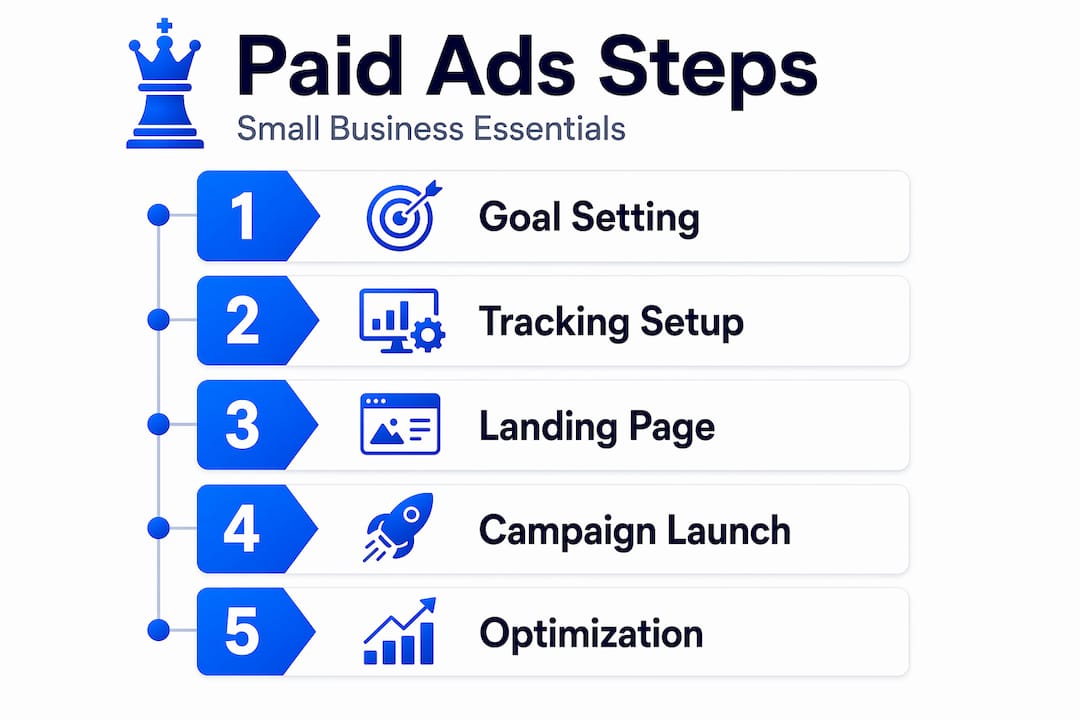
Know your audience. Build a basic buyer persona. Include age range, location, job role or life situation, what problem they’re trying to solve, and what they typically search for online. The more specific you are here, the less you waste in targeting.
Get your technical tools in place. Here’s what you need before day one:
- A website with a clear call to action (phone number, form, or buy button above the fold)
- A Google Analytics 4 account connected to your site
- A Google Ads or Meta Business account depending on your platform
- Conversion tracking installed and verified. Tracking implementation quality is arguably the single biggest factor in paid media success or failure
- Confirmation that your landing page loads in under 3 seconds on mobile
Server-side tracking can increase attributed conversions by 15 to 30% compared to standard tag-based setups, which means better data and smarter bidding decisions from your platform’s algorithm.
| Requirement | What you need | Why it matters |
|---|---|---|
| Clear business goal | Written objective with measurable outcome | Guides every campaign setting |
| Buyer persona | Age, location, intent, pain points | Sharpens targeting and ad copy |
| Conversion tracking | Google Tag Manager + GA4 + platform pixel | Tells you what’s working |
| Budget baseline | Minimum $5-$14/day for Google Ads testing | Avoids overspending before data is in |
| Landing page | Fast, clear, mobile-friendly page | Converts clicks into leads |
Pro Tip: Don’t send paid traffic to your homepage. Create or use a dedicated landing page matched to the exact offer in your ad. Mismatched expectations between the ad and the page are one of the top reasons campaigns fail.
Launching your first paid ad campaign
Now you’re ready to actually build something. Here’s a paid advertising step by step walkthrough that gets you from zero to live campaign.
-
Create your ad platform account. Go to Google Ads or Meta Ads Manager and set up your business account. Add your billing information, business name, and website URL. If you’re targeting a local area like Albuquerque, set your geographic radius before anything else.
-
Choose your campaign objective. Google Ads offers objectives like “Sales,” “Leads,” and “Website Traffic.” For most SMBs starting out, choose “Leads” if you want form fills or calls, or “Website Traffic” if you’re still warming up your conversion tracking. Meta follows the same logic with its campaign objectives.
-
Do basic keyword or audience research. In Google Ads, use the Keyword Planner to find terms your customers actually type. Look for high-intent, local phrases like “plumber in Albuquerque” or “best accountant near me.” In Meta, research your audience by interest, behavior, and demographic before building your ad sets.
-
Write ads matched to search intent. Your headline should answer what the searcher is looking for. Your description should give them a reason to click. Include your location, a specific benefit, and a clear call to action. “Free same-day quotes for Albuquerque homeowners” beats “We provide quality service” every single time.
-
Set your budget and bidding strategy. Start with the recommended entry-level daily budget of $5 to $14 for Google Ads. For bidding, begin with Maximize Clicks until you hit 15 conversions in 30 days, then move to Maximize Conversions, and eventually Target CPA or Target ROAS once your data is solid.
-
Launch with a phased testing approach. Start with one campaign, two to three ad groups, and two to three ad variations per group. Don’t run ten campaigns at once. You won’t have enough data to learn from any of them.
| Step | Objective | Common pitfall |
|---|---|---|
| Platform account setup | Business account with billing and geo settings | Skipping location targeting for local businesses |
| Campaign objective | Match to your measurable goal | Choosing “Awareness” when you need leads |
| Keyword research | High-intent, local, specific phrases | Targeting too broad or too niche |
| Ad writing | Headline + benefit + call to action | Generic copy that doesn’t match intent |
| Budget and bidding | Start small, manual or Maximize Clicks | Jumping to automation without conversion data |
| Launch | One campaign, few ad groups, multiple ad variants | Over-complicating the structure from day one |
Pro Tip: Give each campaign at least two weeks and $200 in spend before making major changes. Making daily tweaks based on two days of data is one of the most common and costly beginner mistakes.
Optimizing and managing campaigns over time
Launching is just the beginning. The real work in paid advertising happens in the weeks after you go live. Campaigns reward consistent management, not “set it and forget it” thinking.

Automated bidding strategies need clean, conversion-rich data to perform well. Performance Max, for example, requires 30 to 60 days of manual campaign data before automation stops pulling in low-quality traffic. Rushing this phase is expensive.
Here’s how to build your ongoing optimization rhythm.
Weekly tasks:
- Review search terms reports and add irrelevant queries as negative keywords. Negative keyword management regularly recovers 10 to 20% of wasted ad spend, which compounds quickly
- Check click-through rate (CTR) by ad. Anything below 2% on Google Search needs a rewrite
- Confirm your conversion tracking is still firing correctly. Pixels break more often than you’d expect
Monthly tasks:
- Analyze cost per lead or cost per acquisition against your target
- Rotate in at least one new ad creative per ad group to prevent performance decay
- Review and adjust bids for top-performing and underperforming ad groups
- Use your ROI calculator to verify your campaigns are returning more than they cost
One underrated optimization move: retargeted visitors are 70% more likely to convert than cold audiences. Once you have site visitors coming in from your campaigns, set up a remarketing audience and layer on a secondary campaign targeting people who visited but didn’t convert.
Common mistakes to avoid:
- Scaling budgets before your cost per acquisition is profitable
- Pausing campaigns after only a few days because results look slow
- Ignoring mobile ad performance, which often differs significantly from desktop
- Running the same creative for months without testing new angles
- Adding too many keywords to one ad group, which dilutes relevance and quality score
Pro Tip: Never scale spend on a campaign that hasn’t proven it can convert at a profitable rate. Double the budget only after you’ve confirmed your cost per lead is within target for at least two consecutive weeks.
Choosing the right platforms and expanding your strategy
Not every platform is right for every business. Spreading your budget across five channels before you’ve mastered one is a reliable way to get mediocre results everywhere. The right move is to treat your platform selection as its own step by step ad campaign decision.
The Core Three platforms for SMBs are Google, Meta (Facebook and Instagram), and LinkedIn. Each serves a different purpose.
| Platform | Strength | Best for | Typical monthly budget |
|---|---|---|---|
| Google Ads | Active search intent | Service businesses, local queries | $300-$1,500 |
| Meta Ads | Broad reach, visual storytelling | B2C, e-commerce, local awareness | $200-$1,000 |
| LinkedIn Ads | Professional targeting | B2B, high-ticket services | $500-$2,000 |
Start with Google Ads if your customers are actively searching for what you offer. A roofing company, a dental practice, or a law firm all benefit most from capturing existing search demand. Move to Meta when you want to build awareness or retarget website visitors with visual content. LinkedIn comes into play when your customer is a business decision-maker.
When you’re ready to explore additional ad channels, YouTube and Reddit can work well for specific audiences. YouTube rewards businesses with strong video content and a clear brand story. Reddit suits niche B2B or tech audiences. Neither is where you start.
A few guidelines for multi-platform expansion:
- Prove profitability on your primary platform before adding a second
- Keep your messaging consistent across platforms even if the format changes
- Allocate at least 70% of your budget to your best-performing channel
- Test new platforms with 10 to 15% of total spend before committing more
What I’ve learned from running paid ads for SMBs
I’ve watched dozens of small business owners burn through their first ad budget in two weeks and conclude that paid advertising “doesn’t work.” What actually happened was they launched before their offer was proven, their landing page wasn’t ready to convert, and they expected profitability from day one.
Starting paid ads too early, before offer-market fit is confirmed, is one of the most consistent patterns I see in struggling campaigns. Paid traffic amplifies what’s already there. If your offer is unclear or your page is weak, ads just show you that problem faster and at a cost.
The other thing I tell every client: your first campaign will probably not be profitable. That’s not failure. That’s the cost of learning what your customers actually respond to. About 90% of campaigns initially fail, and the businesses that succeed are the ones who treat early data as a research investment, not a disappointment.
My practical advice: test one variable at a time. Change the headline, not the headline and the audience and the landing page simultaneously. When you find what works, then scale aggressively. Patience during the messy early phase and boldness when data supports it, that combination is what separates businesses that grow through paid advertising from those that give up on it.
— Bernadette
Ready to stop guessing and start growing?
If this paid advertising guide gave you clarity but you’d rather have an expert manage the execution, King Digital Marketing Agency is built for exactly that. We specialize in paid advertising for small and medium-sized businesses in Albuquerque and beyond, handling everything from account setup and keyword research to ongoing optimization and reporting.
Whether you need paid search campaign management or want to combine paid ads with a stronger local SEO foundation, our team builds strategies that match your budget and your goals. We don’t hand you a generic playbook. We build a plan around your business. Explore our local marketing services or reach out directly to get a clear picture of what your ad spend could actually return.
FAQ
How long does paid advertising take to show results?
Paid advertising delivers clicks within 24 to 48 hours of going live, making it significantly faster than organic SEO. However, profitable results typically emerge after two to four weeks of optimization.
What is a good starting budget for paid ads?
A daily budget of $5 to $14 is commonly recommended for small businesses testing Google Ads for the first time. Meta Ads can work at similar entry points, though $15 to $20 per day produces more reliable data faster.
Which platform should I start with for paid advertising?
Start with Google Ads if your customers actively search for your service. The Core Three platforms for SMBs are Google, Meta, and LinkedIn, and most businesses get the fastest return by mastering one before expanding.
What is conversion tracking and why does it matter?
Conversion tracking records when someone takes a desired action after clicking your ad, such as filling out a form or calling your business. Without it, you’re spending money without knowing which ads are generating real leads.
When should I switch my bidding strategy from Maximize Clicks?
Switch from Maximize Clicks to Maximize Conversions once your campaign has accumulated at least 15 conversions within a 30-day period. From there, move to Target CPA or Target ROAS when you have consistent conversion volume and a stable cost per acquisition.
Recommended
- Small business advertising steps: boost visibility and leads
- Online advertising examples that drive local business growth
- Paid Search Ads Management: Master 2025 Guide
- Powerful Place Based Advertising 2025
