TL;DR:
- Responding to reviews alone is insufficient for comprehensive online reputation management in Albuquerque businesses. Reviews influence local search rankings and customer trust but require a layered approach, including monitoring, generating new reviews, and managing all platforms. An integrated reputation strategy actively shapes your narrative, builds trust, and enhances visibility beyond simple review responses.
Many Albuquerque business owners believe that replying to every Google review is solid reputation management. It feels productive, it shows customers you care, and it checks a box. But that assumption leaves a significant gap. Review engagement is a layer of your online reputation, not the whole picture. In this article, we’ll walk through what reviews actually do for your local visibility, why responses alone won’t protect your reputation, and what practical steps you can take right now to make your reviews work harder for your Albuquerque business.
Table of Contents
- Why online reviews matter for Albuquerque businesses
- The many layers of online reputation: More than just responses
- Edge cases: When responding isn’t enough
- Practical steps for Albuquerque SMBs to leverage reviews
- Why reputation is more than reviews: Our hard-won lessons
- Connect your review strategy with full reputation success
- Frequently asked questions
Key Takeaways
| Point | Details |
|---|---|
| Reviews drive reputation | Online reviews are critical for building trust and shaping how your business appears in local searches. |
| More than just replies | Simply responding to reviews isn’t a full reputation strategy—control your broader search narrative. |
| Broaden review efforts | Engage across all major sites and ensure messaging is consistent to avoid reputation blind spots. |
| Act with purpose | Integrate review management into operations and use both automation and personal touches for maximum effect. |
Why online reviews matter for Albuquerque businesses
Let’s get specific about the stakes. If you run a restaurant in Nob Hill, a plumbing company in the Northeast Heights, or a dental practice in the North Valley, your potential customers are searching locally before they ever call you. Reviews are front and center in those results. They don’t just influence how people feel about you. They directly influence where you appear in local search results.
Google uses review signals, including quantity, recency, and average rating, as ranking factors in its local search algorithm. That means a business with 200 recent, positive reviews is more likely to appear in Google’s local “three pack” (the top three map results) than a competitor with 40 reviews, even if that competitor has been in business longer. For Albuquerque SMBs competing in tight local markets, this difference in visibility can translate directly to revenue.
Here’s a quick look at how reviews affect local search performance:
| Review Factor | Impact on Local Search | Impact on Customer Trust |
|---|---|---|
| Number of reviews | Higher volume improves ranking signals | More reviews signal an established business |
| Average star rating | Ratings above 4.0 improve click-through rates | Customers filter for 4+ stars before clicking |
| Review recency | Fresh reviews signal an active business | Old reviews feel stale and less trustworthy |
| Owner responses | Signals engagement to Google’s algorithm | Reassures prospects that you care |
| Keyword-rich reviews | Supports topical relevance in local search | Helps customers identify your specialty |
Reviews also serve as a filtering mechanism for potential customers. Think about the last time you searched for a contractor. You probably scrolled past businesses with fewer than 10 reviews or a 3.2-star average without a second thought. Your customers do the same thing. They use reviews to eliminate options before they even consider reaching out.
Here is what that filtering process looks like in practice:
- A prospect searches “best HVAC repair Albuquerque”
- Google shows a local pack with three businesses
- The prospect checks star ratings and reads recent comments
- Businesses with consistent 5-star reviews and thoughtful responses get the click
- Businesses with unaddressed 1-star reviews or sparse review counts get skipped entirely
As one industry analyst put it, reviews are part of an “online reputation layer” that shapes both search narratives and buyer trust. They are not just testimonials. They are live data points that influence your rankings and your first impression simultaneously. Understanding local SEO and reviews as an interconnected system is the first shift you need to make.
The many layers of online reputation: More than just responses
Now that you understand why reviews matter, let’s address the biggest mistake we see Albuquerque business owners make: treating review responses as a complete reputation strategy.
Responding to reviews is necessary. We are not arguing against it. But “responding to reviews is a narrow function rather than full narrative control.” True online reputation management (ORM) covers a much wider territory. ORM is the practice of monitoring, influencing, and shaping everything that appears about your business across search engines, social platforms, directories, and third-party review sites.
Here is a direct comparison between basic review response and full ORM:
| Activity | Review Response Only | Full ORM Strategy |
|---|---|---|
| Google reviews | Reply to each review | Monitor, respond, and generate new reviews systematically |
| Third-party sites | Often ignored | Actively managed across Yelp, BBB, Bing, Healthgrades, etc. |
| Search results | No control | Optimized content pushes positive results to the top |
| Social mentions | Not addressed | Monitored and engaged across all relevant channels |
| News and press | Not considered | Proactively built through PR and content outreach |
| Negative content | Responded to only | Flagged, reported, and strategically buried with positive content |
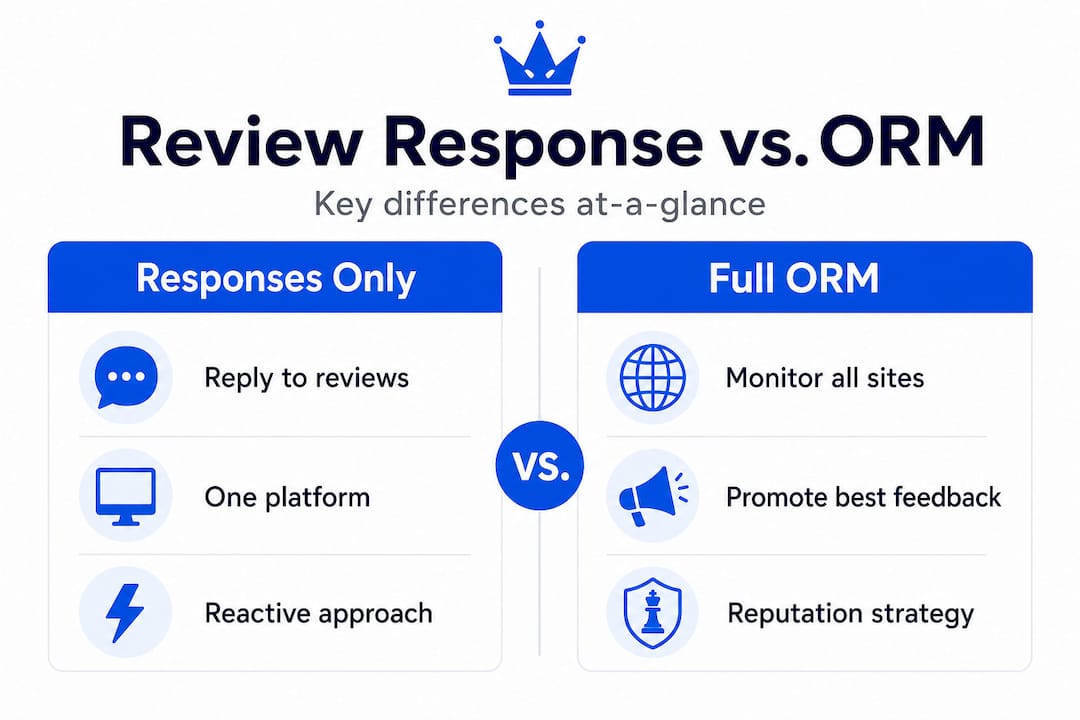
The concept of a search narrative is important here. When someone searches your business name, the results that appear, whether that is your website, your Google profile, a Yelp listing, a news article, or an old negative forum post, collectively form your search narrative. Most business owners have no idea what their narrative looks like from the outside.
To build real reputation equity, you need a layered approach. Here is what that looks like in practice:
- Monitor all channels where your business is mentioned, not just Google
- Respond to reviews and comments promptly and professionally
- Generate fresh reviews consistently through systematic outreach
- Create positive content that ranks for your brand name
- Address and suppress negative content that distorts your narrative
Pro Tip: Search your own business name in an incognito browser window every month. The results you see are what new customers see. If the third or fourth result is a negative review or an old complaint, that is your search narrative problem, and review responses won’t fix it alone.
Understanding full online reputation management as a system, rather than a task, changes how you approach your digital presence. You can also explore how review management and business growth connect more deeply when you treat your reputation as a living, evolving asset.
Edge cases: When responding isn’t enough
Let’s get concrete. There are specific situations where even the most diligent review responses won’t protect your business reputation. Knowing these edge cases helps you spot the warning signs before they become expensive problems.
Consider these real-world scenarios that local SMBs face:
- A competitor posts fake negative reviews. You respond professionally to each one, but new prospects reading a string of one-star reviews don’t know they’re fake. Your responses help, but the damage to first impressions is already done without a broader suppression strategy.
- A negative blog post ranks on page one. A local blogger or news outlet writes something critical about your business two years ago. It still appears in search results. No amount of Google review responses touches that article.
- You’re invisible on Yelp or the Better Business Bureau. Customers who find you on those platforms see outdated or missing information. Your strong Google reputation doesn’t carry over automatically.
- An old, low-rating review has more “helpful” votes than recent ones. Platforms can surface older content when it receives engagement. One prominent bad review can overshadow twenty newer positive ones if you haven’t optimized for recency or volume.
“Don’t assume review responses alone will fully solve online reputation if broader third-party and search narrative gaps exist.”
The critical lesson here is consistency across channels. If your Google profile is polished but your Yelp listing has four unanswered complaints, customers who find Yelp first form a completely different opinion. Messaging consistency means presenting the same quality of care and communication everywhere your business is visible.
Here are the most commonly overlooked review channels for Albuquerque businesses:
- Yelp (especially relevant for restaurants, salons, and home services)
- Bing Places reviews
- Facebook recommendations
- TripAdvisor (for hospitality and tourism businesses)
- Healthgrades or Zocdoc (for healthcare providers)
- Houzz or Angi (for contractors and home improvement)
- Better Business Bureau accreditation and reviews
Pro Tip: Set up Google Alerts for your business name so you are notified whenever a new article, forum post, or mention appears. This is a free tool that gives you early warning when something outside of review platforms enters your narrative.
If you want to improve how you handle managing review response systematically, that is a solid first step. For situations where the narrative has already taken a hit, knowing how to repair your online reputation properly is equally important.
Practical steps for Albuquerque SMBs to leverage reviews
All of the above is context. Here is your actual playbook. These steps are designed to integrate into how you already run your business without requiring a full-time marketing hire.
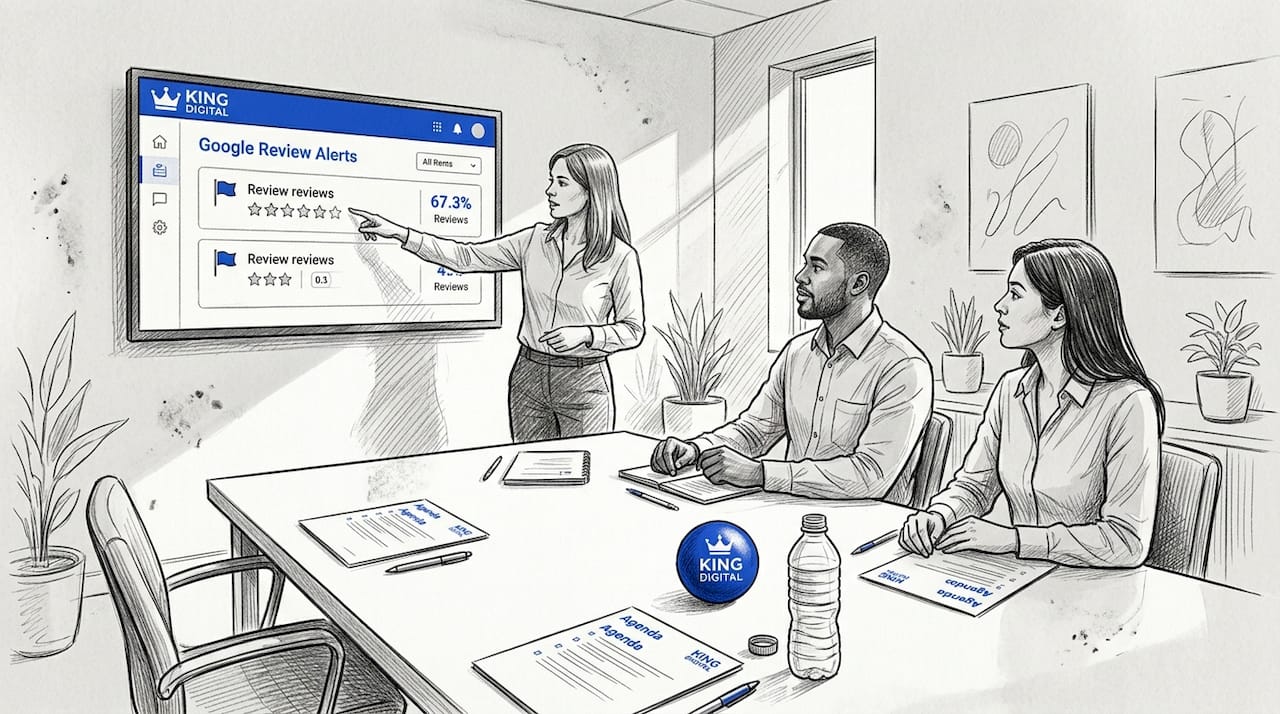
Step 1: Build a monitoring system for all review channels.
You cannot manage what you don’t track. Set up a weekly or automated review monitoring process that covers Google, Yelp, Facebook, and any industry-specific platforms. Note patterns in the feedback you receive. If three customers in one month mention slow response times, that’s an operational signal, not just a reputation issue.
Step 2: Create a consistent review request process.
Satisfied customers rarely leave reviews on their own. You need to ask, and you need to ask at the right moment. The best time is immediately after a positive experience, whether that is right after a completed job, following a successful medical visit, or at the end of a great meal. A simple follow-up text or email with a direct link to your Google review page dramatically increases review volume. Review engagement integrated into operations, rather than treated as a separate marketing task, produces the most consistent results.
Step 3: Respond to every review with context and care.
Generic responses feel hollow. “Thanks for your review!” tells the reader nothing. Instead, acknowledge specifics. Reference the service they received. If a customer praises your team member by name, thank them for recognizing that person. For negative reviews, acknowledge the concern, offer a resolution, and take the conversation offline. Avoid being defensive.
- Acknowledge the experience described
- Express genuine appreciation or concern
- Offer a resolution or next step for negative feedback
- Keep it brief, professional, and specific
Step 4: Cascade positive reviews into your broader marketing.
Your best reviews are free marketing content. Pull standout quotes and use them on your website, in email newsletters, on social media posts, and even in paid ad copy. A five-star quote from a local Albuquerque customer adds authenticity that no amount of polished ad copy can replicate.
Step 5: Use technology to stay efficient.
Managing reviews across multiple platforms manually becomes unmanageable fast. Dedicated review management solutions aggregate all your reviews in one dashboard, automate review request messages, and alert you when new reviews come in. If you want to evaluate your options, a clear breakdown of how to compare review management software helps you make a smarter investment decision. For business owners who need to simplify the process even further, exploring automated review management tips can shave hours off your weekly workflow.
Pro Tip: Add your Google review link to your email signature, your invoices, and your post-service follow-up texts. These passive placements generate reviews without requiring active effort every single time.
Why reputation is more than reviews: Our hard-won lessons
Here is a perspective that took us a while to articulate, even though we saw it play out repeatedly with our Albuquerque clients. A surprising number of business owners set up review responses on a kind of autopilot. They use a template, rotate a few variations, and consider it done. The box is checked. The task is complete. And honestly, it feels reasonable from the outside.
But autopiloted review responses rarely move the needle in any meaningful way. They satisfy a process requirement without building reputation equity. The difference between a business that simply manages reviews and one that actively shapes its narrative is visible in the search results, in customer retention, and in word of mouth.
The businesses that genuinely dominate their local markets in Albuquerque are doing something different. They treat every piece of customer feedback as a signal that feeds into a broader story they are consciously telling. A glowing review about a plumber’s punctuality becomes a social post. A constructive complaint about wait times triggers an operational change and a public response that demonstrates accountability. A cluster of five-star reviews about a specific service line becomes proof of specialization, something that can be amplified in content and advertising.
That integration, between reviews, operations, content, and search visibility, is what creates lasting trust. Reputation monitoring strategies are part of that picture, but only part. The deeper shift is organizational. It’s about treating your reputation as something you actively build, not something that just happens as a byproduct of good work.
The uncomfortable truth is that good work alone doesn’t guarantee a strong reputation online. You need to be intentional, consistent, and willing to look at the full picture of what appears when someone searches your name.
Connect your review strategy with full reputation success
You now have a clear picture of why reviews matter, where response-only strategies fall short, and what a real reputation-building playbook looks like. Putting it all into practice takes the right systems and support, and that’s exactly what we’re here for at King Digital.

We help Albuquerque SMBs build reputation strategies that go well beyond review responses. Whether you need top review management services to streamline your workflow, a local marketing SEO service to improve your search visibility, or a practical starting point with our local visibility checklist, we have tools built specifically for businesses in your market. Reach out today and let’s build a reputation strategy that actually moves your business forward.
Frequently asked questions
Do review responses improve my search ranking?
Engaging with reviews signals activity to Google and supports local search rankings, but responses are only one layer of a complete reputation strategy.
How often should I monitor my business reviews?
You should check reviews on all major platforms at least once a week, since timely engagement with feedback helps you spot trends and address concerns before they grow.
Can just answering every review fix a negative reputation?
No. Responding to reviews addresses visible feedback, but repairing a damaged reputation also requires fixing third-party and search narrative gaps that responses alone can’t reach.
Should I use automated tools for review management?
Automated tools save significant time by centralizing alerts and streamlining outreach, but combining them with genuine, personalized responses produces far better trust and results.
Recommended
- Leveraging Your Reputation | King Digital Marketing Agency
- Mastering Your Brand: The Essential Guide to Online Reputation Management | King Digital Marketing Agency
- Detailed Guide to Review Management Software Comparison | King Digital Marketing Agency
- Local business reputation: Secure Your 2025 Legacy
