Why Local Map SEO Is the Most Valuable Real Estate in Search
Local map SEO is the practice of optimizing your business so it appears in Google’s Map Pack — the top three local results that show up on Google Maps and Search when someone searches for a nearby service.
Here’s a quick-start answer if you’re looking to improve your rankings right now:
- Claim and verify your Google Business Profile
- Complete every field — description, categories, hours, services, and photos
- Generate reviews consistently and respond to every single one
- Keep your business name, address, and phone (NAP) identical across every directory and website
- Optimize your website with local keywords, schema markup, and location pages
- Post to your profile weekly to signal activity to Google
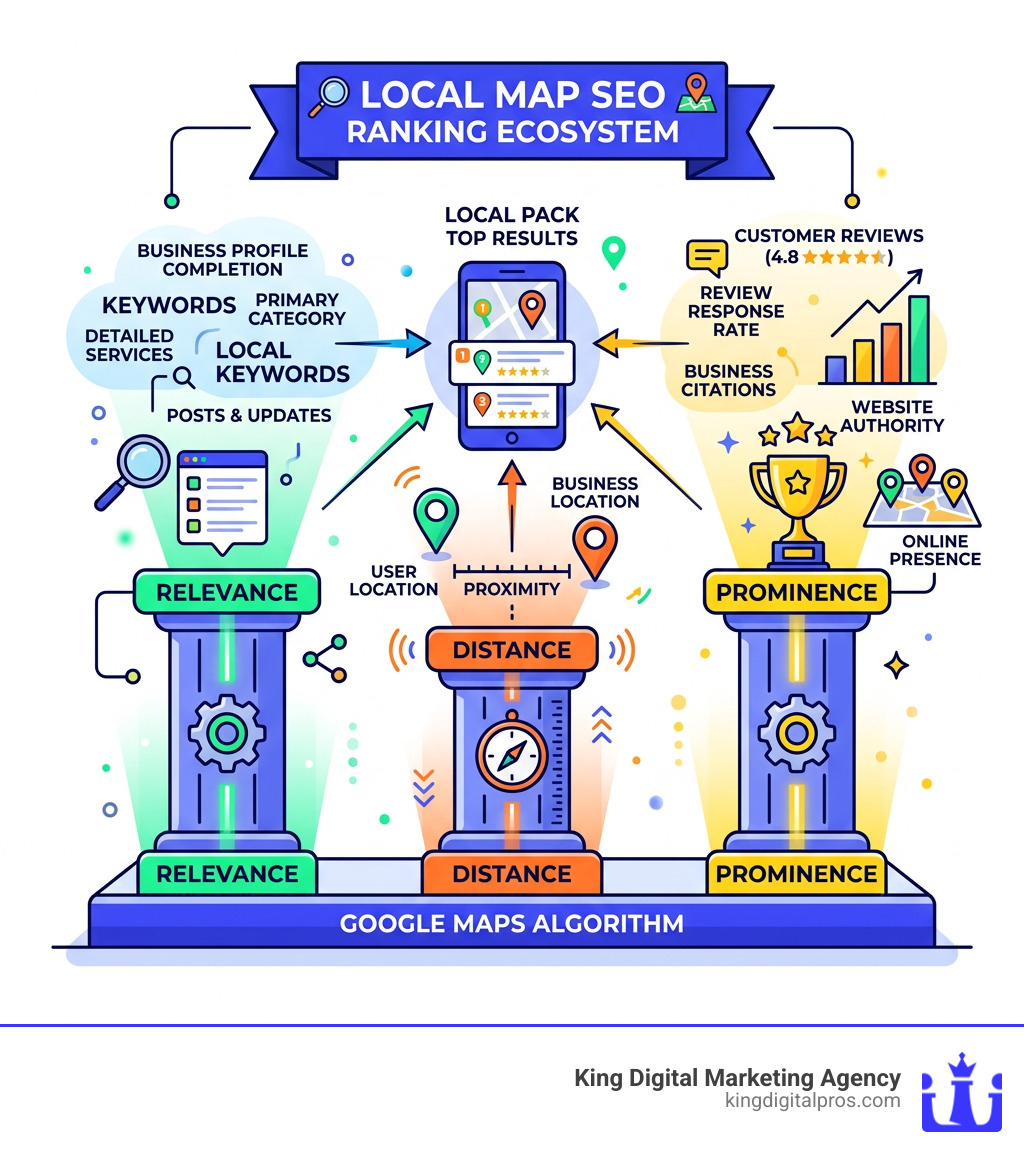
The stakes are high. According to Google, local results are driven by three factors: relevance, distance, and prominence. And the Map Pack sitting at the top of those results captures 70% of all clicks in local searches. If your business isn’t in those top three spots, most nearby customers will never find you.
Consider this: 46% of all Google searches carry local intent. That means nearly half of everyone searching Google right now is looking for something near them. And 50% of all calls to local businesses come directly from the Map Pack. This isn’t a nice-to-have — it’s where customers are making decisions.
Yet roughly 11% of Google Business Profiles are still unclaimed. Many more are incomplete, inconsistent, or simply ignored after setup.
I’m Bernadette King, founder of King Digital Marketing Agency, and I’ve spent years helping franchise owners and small businesses turn invisible map listings into top-ranking local assets through local map SEO strategies that drive real, measurable growth. In this guide, I’ll walk you through exactly what works — no fluff, no guesswork.
The Core Pillars of Local Map SEO
When we talk about ranking on Google Maps, we aren’t just tossing keywords at a screen and hoping for the best. Google uses a specific, sophisticated algorithm to decide which three businesses in Albuquerque or Santa Fe deserve those coveted top spots. To master local map SEO, we must understand the three core pillars: Relevance, Distance, and Prominence.
Relevance is all about how well your business profile matches what the user is looking for. If someone in Rio Rancho searches for “emergency plumber,” Google isn’t going to show them a general handyman unless that handyman has explicitly listed emergency plumbing as a primary service. This is why adding detailed business information is so vital.
Distance is exactly what it sounds like—how far your business is from the person searching. However, this changed significantly with the Vicinity Update impact. Before this update, businesses could sometimes rank across an entire city if they were “prominent” enough. Now, Google places a much heavier weight on proximity. This means a smaller shop in Taos might outrank a bigger competitor simply because it’s two blocks closer to the user.
Prominence refers to how well-known your business is. This is calculated based on information Google finds across the web, like links, articles, and directories. It’s also heavily influenced by your review count and score. Interestingly, only about 7.9% of local searches currently trigger a Google AI Overview, meaning traditional Map Pack rankings are still the primary way people find you.
By focusing on these pillars, we create a foundation for Local Map SEO that stands the test of time. Whether you are in Los Alamos or Grants, these rules remain the same.
Optimizing Your Google Business Profile for Dominance
Your Google Business Profile (GBP) is the “home base” for your local presence. It’s not just a listing; it’s a living document that tells Google—and your customers—who you are.

The first rule of thumb we follow at King Digital is completeness. A study found that businesses with fully completed profiles are 2.7 times more likely to be viewed as reputable. Google rewards businesses that provide a 750-character description that highlights the unique aspects of the location without being “spammy” or over-promotional.
Don’t ignore the “Attributes” section. Are you a veteran-owned business in Edgewood? Do you offer wheelchair-accessible seating in Corrales? These small tags help users filter results and can significantly increase your click-through rate.
We also recommend treating your GBP like a social media feed. Weekly posts about offers, events, or new products keep your profile fresh. Additionally, seeding your Q&A section with common questions—and answering them yourself—provides immediate value to potential customers in Sandia Park or Tijeras. For a deeper dive, check out our guide on Business Profile Optimization.
Choosing Categories for Local Map SEO
Choosing your categories is perhaps the most critical technical decision you’ll make. Your primary category carries the most weight, while secondary categories help fill in the gaps. If you’re a “Dental Clinic” in Albuquerque, but you also offer “Teeth Whitening” and “Cosmetic Dentistry,” you need to list those specifically.
To see what’s working for your competitors, we suggest using the GMB Spy extension. It allows you to peek behind the curtain and see which categories the top-ranking businesses are using. Another fantastic resource is the PlePer tool, which helps you identify the most relevant categories for your niche. For more help, visit our Google Business Listing Help page.
Visual and Engagement Signals
People eat with their eyes first—and they shop that way, too. Listings with high-quality photos see a massive jump in calls and direction requests. We suggest uploading at least 30 to 50 photos, including shots of your building’s exterior (to help people find you), the interior, your team, and your products.
Research on photo impact suggests that geotagged photos—images that contain the GPS coordinates of your business—can reinforce your location signals to Google. While Google’s AI is getting better at recognizing what is in a photo, providing that extra data never hurts.
Encourage user-generated content (UGC) as well. When a customer in Taos posts a photo of their meal or your handiwork directly to your profile, it acts as a powerful “trust signal” that no amount of professional photography can replicate. Managing these visuals is a core part of Google Profile Management.
The Role of Reviews and Behavioral Signals
Reviews are the lifeblood of local map SEO. It’s not just about having a 5-star rating; Google looks at volume, recency, and keyword-rich feedback.
If a customer leaves a review saying, “Best HVAC repair in Rio Rancho,” that keyword “HVAC repair” actually helps you rank for that specific term. We always encourage our clients to respond to every review—even the tough ones. Responding shows Google that you are active and shows customers that you care.
According to BrightLocal review statistics, 76% of consumers who are asked to leave a review actually do so. The “ask” is the most important part!
| Feature | Passive Listing | Active Review Management |
|---|---|---|
| Review Velocity | Stagnant | Consistent Growth |
| Keyword Usage | Accidental | Strategic in Responses |
| Trust Factor | Low/Average | High (2.7x more reputable) |
| Ranking Impact | Minimal | Significant Boost |
Behavioral signals also play a role. When people click your “Call” button or request “Directions” to your shop in Santa Fe, Google sees that as a vote of confidence. The more people interact with your listing, the higher you’ll climb. To learn more, read our guide: Unlock Local Success: Master Your Google Business Profile for Top Map Rankings.
On-Page, Off-Site, and AI Strategies
While your GBP is the star of the show, your website acts as the supporting cast. To truly dominate local map SEO, your website must be optimized to “talk” to Google’s map algorithm.
One of the most important steps is maintaining NAP consistency. This stands for Name, Address, and Phone number. If your business is listed as “King Digital” on your website but “King Digital Marketing” on a directory, Google gets confused. Inconsistency breeds distrust in the algorithm.
You should also target high-priority directories and local sources. A link from the Albuquerque Chamber of Commerce or a mention in a local news story about an event in Cedar Crest carries much more weight than a random link from a blog in another state.
In 2025, we also have to think about AI. Tools like ChatGPT and Google’s AI Overviews are changing how people discover businesses. By having a robust, data-rich website and profile, you increase the chances of being the “recommended” option when someone asks an AI, “Where is the best coffee in Taos?” Stay updated with Local SEO Best Practices 2025.
Technical Foundations for Local Map SEO
On the technical side, we use LocalBusiness schema markup. This is a bit of code you add to your website that tells search engines exactly where you are and what you do in a language they understand perfectly. It includes your geo-coordinates, hours, and service area.
If you serve multiple areas, like both Grants and Albuquerque, you need dedicated Local SEO Location Pages. Each page should have unique content—don’t just copy and paste! Mention local landmarks, specific services offered in that area, and embed a Google Map.
Finally, make sure your site is mobile-responsive. Nearly 60% of Google searches happen on mobile, and for local intent, that number is often higher. If your site takes forever to load on a phone in Tijeras, customers will bounce before they ever see your address. Start with Local SEO Keyword Research to find the terms your mobile users are actually typing.
Frequently Asked Questions and Conclusion
At King Digital Marketing Agency, we believe that local map SEO is a marathon, not a sprint. It requires sustained maintenance, regular audits, and a keen eye on your Share of Local Voice (SoLV). By following the steps in Your Google Maps Optimization Playbook, you can ensure your business doesn’t just show up—it stands out.
Can I pay for better local rankings?
The short answer is: you can’t pay Google to move your organic map listing higher. The algorithm is designed to be fair. However, you can use Google Local Services Ads or Promoted Pins to appear at the very top of the map results as a “Sponsored” listing. This is a great way to get immediate visibility while you work on your organic local map SEO.
How long does it take to see results?
For a brand-new business in a place like Rio Rancho, you might see basic profile improvements in 2 to 4 weeks. However, in competitive industries (like law or home services), it typically takes 3 to 6 months of consistent effort—collecting reviews, posting updates, and building local links—to see a significant climb into the top three spots.
What are the most common GBP mistakes?
The biggest mistakes we see are:
- Keyword Stuffing: Adding “Best Albuquerque Plumber” to your business name when it’s just “Smith Plumbing.” This can get your account suspended.
- Inaccurate Info: Having the wrong holiday hours or an old phone number.
- Ignoring Reviews: Letting negative feedback sit without a professional response.
- Duplicate Listings: Having more than one profile for the same location, which confuses Google’s algorithm.
By avoiding these pitfalls and staying active, you can turn your map listing into your most profitable marketing channel. If you’re ready to stop hiding and start ranking, we’re here to help you navigate the ever-changing world of local search.
