Why Ad Copy Writing Can Make or Break Your Business
Ad copy writing is the art and science of crafting persuasive text that drives people to take action—whether that’s clicking an ad, making a purchase, or calling your business. Here’s what you need to know:
Key Elements of Effective Ad Copy:
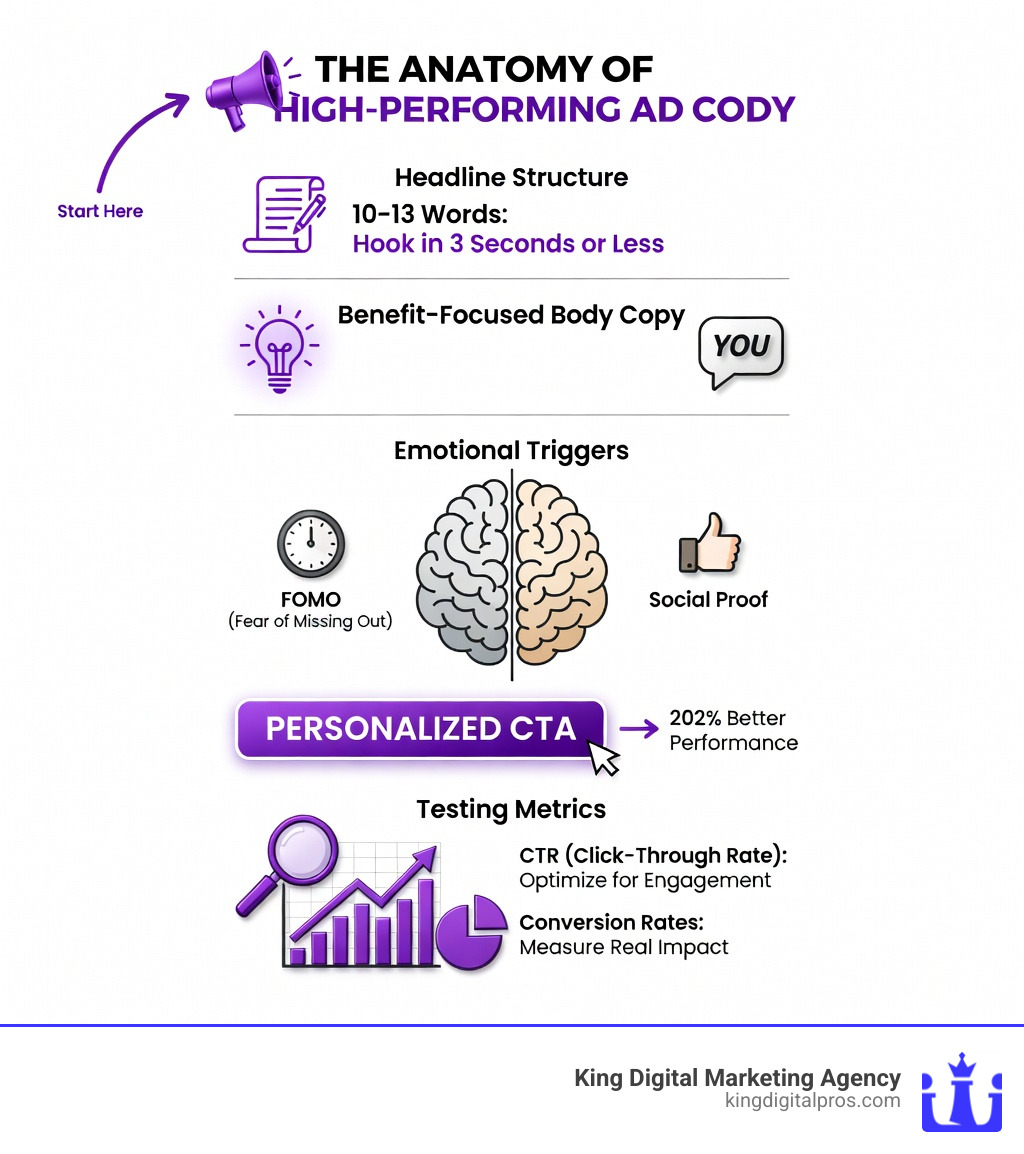
- Headlines that grab attention in 3 seconds or less
- Benefits-focused messaging that solves customer problems
- Clear calls-to-action (CTAs) that tell people exactly what to do next
- Emotional triggers that connect with your audience
- Testing and optimization to improve performance over time
If you’re a local business owner trying to attract more customers online, your ad copy is often the first impression potential clients have of your business. And with global ad spending crossing the $1 trillion mark for the first time—75% of which goes to digital ads—competition for customer attention has never been fiercer.
The stakes are high. Research shows that 80% of people will read a headline, but only 20% will read the rest. That means you have just seconds to capture interest and convince someone to choose your business over competitors. Even small improvements matter: advertisers who boost their Ad Strength from “Poor” to “Excellent” see 12% more conversions on average.
Despite these numbers, many business owners struggle with ad copy. They know they need to advertise, but they’re not sure how to write words that actually convert clicks into customers. Generic phrases like “call us today” don’t cut it anymore. Today’s consumers expect personalized, benefit-driven messaging that speaks directly to their needs—and they can tell when they’re not getting it.
I’m Bernadette King, and I’ve spent my career mastering the art of ad copy writing, starting as an in-house copywriter for a national jewelry manufacturer before building my own results-driven agency. Through years of testing, refining, and measuring what actually works, I’ve learned that great ad copy isn’t about clever wordplay—it’s about understanding your audience and speaking directly to what they need.
In this guide, we’ll break down the proven strategies and psychological principles that turn ordinary ad copy into high-performing campaigns that drive real business results.
Ad copy writing glossary:
The Core Pillars of Effective Ad Copy Writing
When we sit down to craft a campaign, we view ad copy writing as a structural challenge. It isn’t just about putting pretty words on a screen; it’s about building a bridge between a customer’s problem and your business’s solution. Every ad has specific components that must work in harmony: the headline, the description, and the call-to-action (CTA).
One of the most sobering statistics in our industry is that only 20% of readers engage with content beyond the headline. This means your “hook” has to do 80% of the heavy lifting. If the headline fails, the most brilliant description in the world won’t be seen.
To ensure your ad doesn’t fall into the 80% “ignore” pile, we focus on three core pillars:
- Unique Value Propositions (UVPs): What makes you different? If you’re a plumber in Albuquerque or a real estate agent in Santa Fe, you aren’t just selling “plumbing” or “houses.” You’re selling “24/7 emergency peace of mind” or “the fastest closing in New Mexico.”
- Brand Consistency: Your ad copy must sound like your brand. If your website is professional and clinical, a “wacky” social media ad will create a trust gap. Consistency builds the recognition necessary for conversion.
- Platform Constraints: We have to be masters of the “character count.” Whether it’s the 30-character limit for Google Search headlines or the punchy brevity required for a Facebook News Feed, every character must earn its keep.
Our specialized Copywriting Services are designed to navigate these pillars, ensuring that your messaging remains sharp, relevant, and compliant with platform policies.
Mastering Headlines and Personalization in Ad Copy Writing
If the headline is the front door to your business, you want it to be wide open and inviting. Data suggests that headlines with 10-13 words generate twice the amount of site traffic and 1.5 times more shares compared to shorter, vague headlines.
Why? Because 10 to 13 words provide enough room to offer a specific benefit while remaining scannable. We also know that the most shared headlines on platforms like Facebook are roughly 11 words and 65 characters long.
To master your headlines, we recommend:
- Using Action Verbs: Start with “Discover,” “Save,” “Build,” or “Get.”
- Including Numbers: “Save 20%” or “Join 5,000+ Happy Customers” provides tangible proof.
- Matching User Intent: If someone searches for “best landscaping in Rio Rancho,” your headline should mirror that intent: “Award-Winning Landscaping in Rio Rancho – Free Quotes.”
Personalization is the “secret sauce” here. Creating personalized ad copy can lead to a 35% lift in marketing performance. When a user feels like you are speaking directly to their specific situation, their “skepticism radar” drops.
Crafting High-Performance CTAs
The Call-to-Action is where the rubber meets the road. Surprisingly, many businesses spend hours on the headline and then slap a generic “Click Here” at the bottom. This is a missed opportunity.
Research indicates that personalized calls-to-action actually perform 202% better than generic ones. Instead of “Submit,” try “Get My Free Quote.” Instead of “Buy Now,” try “Start My Transformation.”
Effective CTAs use “earned urgency.” This means you don’t just say “Hurry!”—you give them a reason why. “Offer ends Friday” or “Only 3 spots left for June” creates a genuine reason to act. In ad copy writing, directness beats cuteness every time. Your customer should never have to wonder what happens after they click.
Psychology and Formulas: The Science of Persuasion
At King Digital, we don’t guess—we use psychology. One of our favorite frameworks for ad copy writing is the PAS formula: Problem-Agitate-Solution.
- Problem: Identify a pain point your customer is facing (e.g., “Tired of your website being buried on page 10 of Google?”).
- Agitate: Rub salt in the wound by explaining the consequences (e.g., “Every day you aren’t on the map, your competitors are stealing your local leads.”).
- Solution: Present your business as the hero (e.g., “Our Google Business Profile optimization puts you front and center.”).
This works because humans are biologically wired to avoid pain. In fact, we are more motivated by the fear of losing out than gaining something. This is known as loss aversion. By highlighting what a customer loses by not acting (like a limited-time discount or a competitive edge), you trigger a powerful drive to convert.
We also leverage FOMO (Fear of Missing Out) and Social Proof. Including a snippet like “Join 300+ Albuquerque businesses” or “Rated 5 stars by Taos locals” provides the safety in numbers that modern consumers crave. If you want to dive deeper into how this applies to direct messaging, check out our guide to Elevate Your Email Game: A Guide to Better Copywriting.
Benefits Over Features in Ad Copy Writing
A common mistake in writing the body of your ad is focusing on features. A feature is what your product is; a benefit is what your product does for the customer.
| Feature | Benefit |
|---|---|
| 24/7 Monitoring | Sleep soundly knowing your home is safe. |
| 100% Organic Cotton | Feel incredible in skin-friendly, soft fabric. |
| Local SEO Optimization | Get found by customers in your neighborhood today. |
| 10-Year Warranty | Never worry about replacement costs again. |
Notice the shift to “you” language? By focusing on user needs and life improvement, you move from being a salesperson to being a problem-solver. Empathy is the ultimate persuasion tool. When you show the customer you understand their struggle, they are much more likely to trust your solution.
Tailoring Your Message Across the Marketing Funnel
Not every customer is ready to buy the moment they see your ad. This is why we tailor our ad copy writing to different stages of the marketing funnel:
- Top of Funnel (TOFU) – Awareness: Here, the goal is education and brand recognition. Use ads that ask questions or share helpful tips. “Did you know 90% of local searches happen on Google Maps?”
- Middle of Funnel (MOFU) – Consideration: The customer knows they have a problem and is looking at options. This is where you prove your USP. “Why Albuquerque businesses trust King Digital for their map listings.”
- Bottom of Funnel (BOFU) – Conversion: The customer is ready to pull the trigger. Use high-urgency, benefit-heavy copy and strong CTAs. “Claim your free audit today—only 5 available this month!”
Whether you’re running a Content Writing Business or a local retail shop in Corrales, matching your message to the user’s stage can result in a 35% lift in performance. A search ad (high intent) needs to be more direct than a social media ad (interruption-based), where you need to “stop the scroll” with high-quality visuals and punchy hooks.
Testing, AI, and Optimization Strategies
The best copywriters in the world don’t get it right the first time—they test until they do. We use A/B testing (comparing two versions of an ad) and multivariate testing to see which headlines, images, and CTAs resonate most with your New Mexico audience.
A recent HubSpot survey found that 43% of marketers now use AI to write copy. While AI is a fantastic tool for brainstorming and overcoming “blank page syndrome,” it often produces generic results. At King Digital, we use AI for the “heavy lifting” of generating variations, but we always apply human refinement.
According to Attentive’s 2025 Consumer Trends Report, 96% of consumers are likely to purchase from brands that send personalized messages. AI can’t replace the local touch—knowing the difference between what a customer in Los Alamos needs versus someone in Edgewood requires local expertise.
We constantly monitor Ad Strength and Click-Through Rate (CTR). If an ad has “Low” performance, we replace it with a new variation based on our “Best” performing assets. This iterative process ensures your budget is always being spent on the messages that work.
Frequently Asked Questions about Ad Copy
What is the PAS formula in copywriting?
PAS stands for Problem-Agitate-Solution. It is a framework where you first identify a customer’s problem, “agitate” it by explaining why it’s a significant issue, and then present your product or service as the perfect solution. It is highly effective because it taps into the psychological drive to resolve discomfort.
How long should an ad headline be for maximum engagement?
For search ads, you are limited by character counts (usually 30 characters per headline). However, for social media and display ads, headlines between 10-13 words tend to perform best. This length allows you to be specific enough to provide a benefit while remaining short enough to be read in under three seconds.
How does ad copy impact conversion rates?
Ad copy is the primary driver of conversion because it sets the expectation for the user. If the copy is relevant to the user’s search intent and clearly explains the benefit of clicking, you will see higher CTRs. Furthermore, ads with “Excellent” Ad Strength ratings see an average of 12% more conversions because they are more relevant to the audience.
Conclusion
Writing effective ad copy is both an art and a science. It requires a deep understanding of your local audience, a firm grasp of psychological triggers, and a commitment to constant testing. Whether you are in Albuquerque, Rio Rancho, or Taos, your business deserves messaging that doesn’t just fill space—but actually fills your calendar.
At King Digital Marketing Agency, we specialize in making sure your business doesn’t just exist online, but thrives. From our expert Copywriting to our industry-leading Google Business Profile optimization, we help local businesses dominate their map listings and attract more customers.
Don’t let your “secret sauce” go to waste with generic ads. Let us help you craft the persuasive, high-converting copy your brand needs to stand out. Ready to elevate your local visibility? Let’s get to work.
