Local SEO for Doctors: Attracting Patients, One Click at a Time
Why Healthcare Local SEO Is Your Practice’s Most Powerful Patient Acquisition Tool
Healthcare local SEO is the process of optimizing your medical practice’s online presence to appear prominently when potential patients search for healthcare services in your area. Here’s what you need to know to boost local visibility:
Key Components of Healthcare Local SEO:
- Google Business Profile – Your digital storefront that appears in local search results and maps.
- Patient Reviews – Build trust and influence 16% of local rankings.
- Website Optimization – Mobile-friendly, fast, with location-specific pages.
- Local Citations – Consistent practice information across medical directories.
- Content Marketing – Answer patient questions with locally-relevant health content.
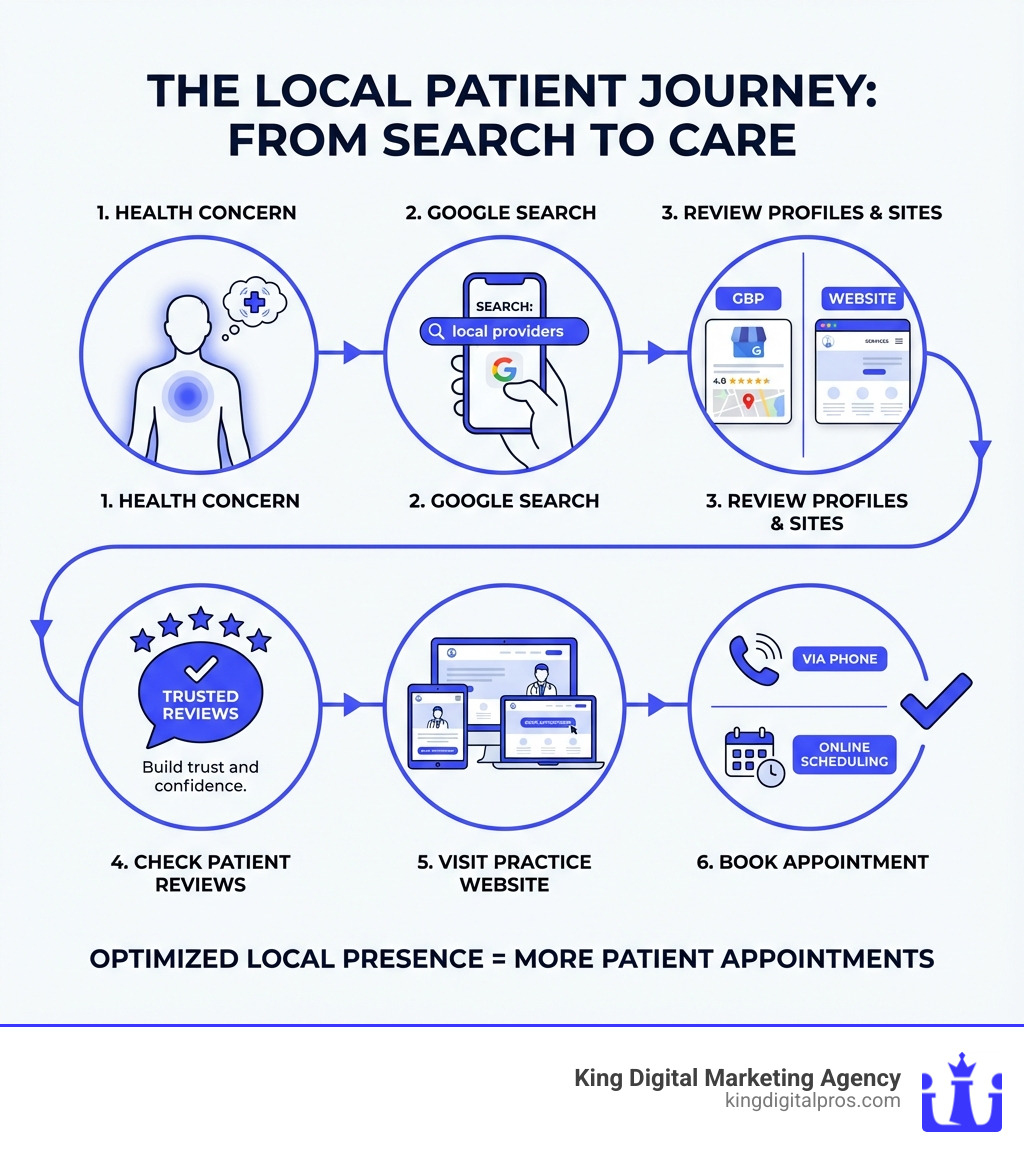
Over 70,000 health-related searches happen on Google every minute. Most of these are from potential patients looking for a nearby provider. In fact, around 80% of patients research you online before their first visit, often starting with a Google search.
The challenge is that most healthcare providers aren’t visible where these patients are looking. When someone searches “cardiologist near me” or “urgent care in [City],” Google displays a “local pack” – the top three map listings. If you’re not in that local pack, you’re invisible to the majority of these patients.
Healthcare local SEO is different from traditional SEO. Instead of competing nationally, you’re optimizing to be found by patients in your specific geographic area. It’s about becoming the top choice for nearby patients seeking your specific services. Unlike paid ads, local SEO builds long-term visibility that compounds over time, making it a sustainable growth strategy.
Mastering Your Digital Front Door: GBP & Patient Reviews
Your Google Business Profile (GBP), formerly Google My Business, is often a potential patient’s first interaction with your practice. It’s your digital storefront. When someone searches for a local healthcare provider, Google’s local pack – the prominent block of three listings with a map – is where they look first. Exclusion from this block means missing a significant opportunity.
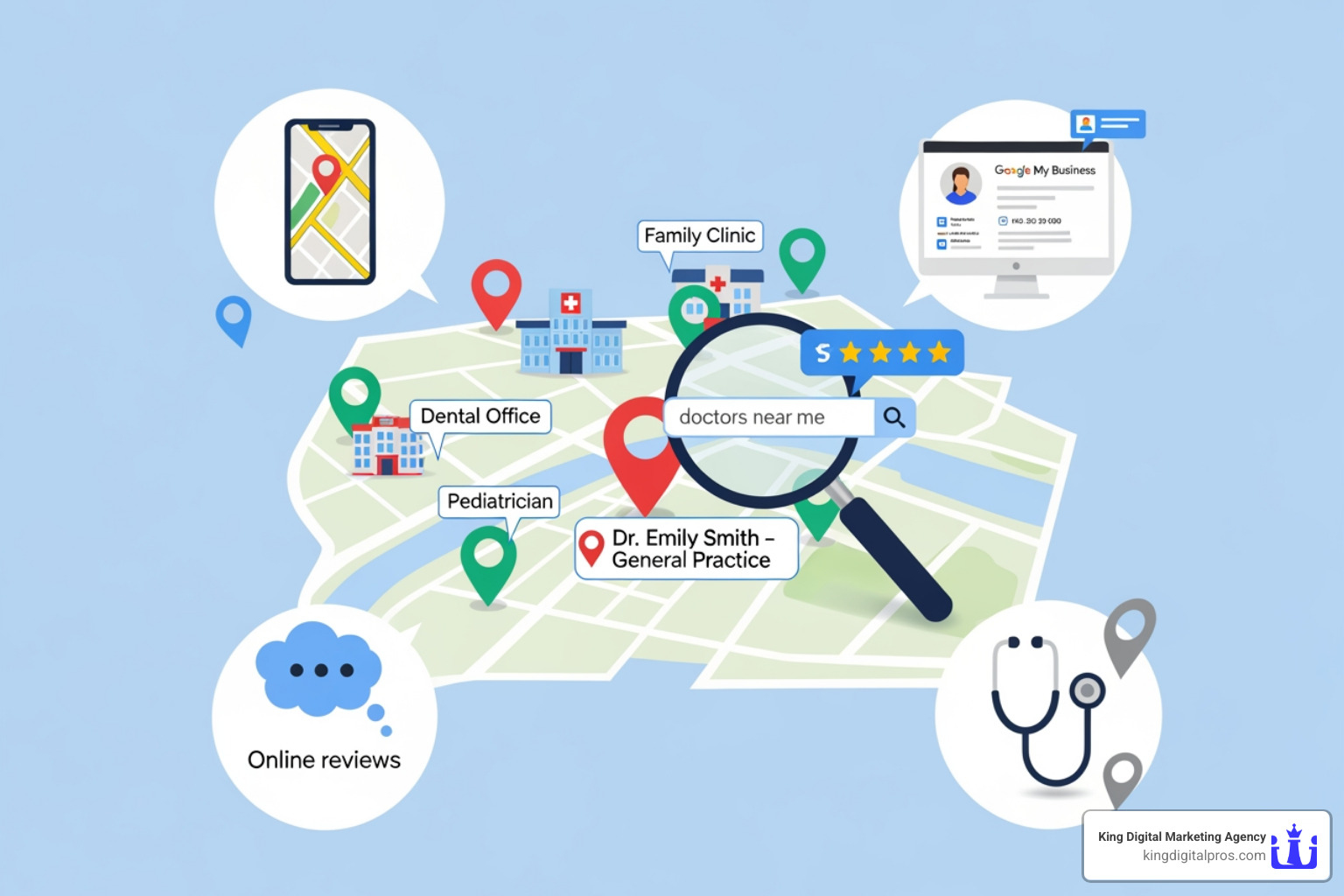
Google’s local search algorithm relies on three factors: Proximity, Prominence, and Relevance (PPR).
- Proximity is the physical distance between your practice and the searcher.
- Prominence is how well-known your practice is, influenced by reviews, your GBP’s completeness, and overall online presence.
- Relevance is how well your practice matches the search query (e.g., your GBP is categorized as “Pediatrician” for a “pediatrician in Albuquerque NM” search).
Mastering your GBP significantly influences these factors, helping you appear in the local pack and on Google Maps. With a 25% influence over local search ranking, an optimized GBP doesn’t just get you found; it builds the immediate trust and credibility essential in healthcare. You can find additional background on how local search works in Google’s own guide to improving local ranking.
Optimizing Your Google Business Profile
The first step is to claim and verify your Google Business Profile. Once claimed, your GBP requires consistent attention.
Fill out every detail on your GBP, including:
- NAP Consistency: Your practice’s Name, Address, and Phone number must be identical everywhere online to avoid confusing search engines and harming your rank.
- Correct Categories: Choose a specific primary category (e.g., “Orthopedic Surgeon” not “Doctor”) and add relevant secondary categories.
- High-Quality Photos and Videos: Post professional photos of your office, staff, and a virtual tour to increase engagement and create a welcoming impression.
- Google Posts: Regularly publish updates, health tips, or news (like flu shot availability in Santa Fe) to boost visibility.
- Appointment Booking Links: Integrate a direct booking link to make scheduling easy, which can increase bookings by up to 40%.
- Complete Information: Include hours, accepted insurance, accessibility features, and a detailed service description. A comprehensive profile signals authority to Google.
It’s also vital to monitor your GBP, as any user can “suggest an edit.” Your team or marketing partner should remain vigilant to ensure all information stays accurate. For expert assistance, explore our services in Google Business Profile Management.
The Power of Patient Reviews
Online patient reviews are a cornerstone of healthcare local SEO, influencing about 16% of your local search ranking. Critically, around 80% of consumers trust online reviews as much as personal recommendations. In healthcare, where trust is paramount, a strong online reputation is non-negotiable. A high volume of authentic reviews (e.g., a 4.3/5 rating from 500 reviews) is often more credible than a perfect score from a few.
Independent research from BrightLocal shows that patients routinely read multiple reviews before choosing a provider, reinforcing how vital review management is for clinics and hospitals.
Encouraging Patient Feedback: Actively encourage satisfied patients to leave reviews through:
- Post-appointment emails or texts with a direct review link.
- In-office signage with QR codes.
- Training front desk staff to politely ask for reviews.
Responding to Positive and Negative Reviews: Responding to all reviews shows you are attentive.
- For positive reviews: A simple “Thank you for your kind words!” builds goodwill.
- For negative reviews: This is where HIPAA compliance is paramount. Never reveal Protected Health Information (PHI) or even acknowledge that someone is a patient. Responses must be generic, empathetic, and offer to take the conversation offline. For example: “We are sorry to hear you had an unsatisfactory experience. Please contact our office manager directly at [phone number] so we can address your concerns privately.” This shows you care without violating privacy laws.
For comprehensive guidance, we recommend our Medical Practice Reputation Management Guide, and you can review additional privacy expectations directly from the U.S. Department of Health & Human Services.
Your Digital Practice: Website & Content Optimization
Your website is the central hub of your digital presence. While your GBP is the storefront, your website is the entire practice, offering in-depth information and connecting with patients. For effective healthcare local SEO, your website needs optimization for search engines and user experience (UX).

This means following on-page SEO best practices (optimizing titles, meta descriptions, headings, image alt tags, and internal links) and building E-A-T: Expertise, Authoritativeness, and Trustworthiness. Google emphasizes E-A-T, especially in medicine, to gauge the reliability of your health information. A professional, easy-to-steer, and informative website builds this trust.
Website Optimization for Local Search
With most local searches happening on mobile, a mobile-first design is essential. Your website must be responsive, loading quickly on any screen. A poor mobile experience can deter 26% of potential patients from booking an appointment.
Page speed is also critical. Slow pages lead to high bounce rates, signaling a poor user experience to Google. We use tools like Google PageSpeed Insights to analyze and improve performance.
To excel in local search in areas like Albuquerque NM or Santa Fe NM, we recommend:
- Location-Specific Pages: Create a unique page for each office with its address, phone number, hours, services, provider bios, and an embedded Google Map. These are crucial for ranking in each respective area. Learn more with our Local SEO Location Pages guide.
- Provider Bio Pages: Individual pages for each medical professional detailing their specialties and experience help patients connect with doctors and boost “doctor name + city” searches.
- Service Pages: Dedicate pages to specific services or conditions (e.g., “Physical Therapy in Santa Fe NM”) to target specific keywords and provide detailed information.
- Schema Markup: Implement structured data like
MedicalOrganizationorPhysicianschema to give search engines more context. This can improve your search listings with details like star ratings or hours. Google’s Structured Data Markup Helper is a useful tool for this.
Content Marketing for Patient Engagement
Content marketing drives your healthcare local SEO by addressing patient concerns, building authority, and integrating local keywords. The goal is to create valuable content for your local community in places like Grants NM or Los Alamos NM.
- Local Keyword Research: We identify location-based keywords patients use (e.g., “pediatrician for allergies in Corrales NM”). For a deeper dive, see our Local SEO Keyword Research guide.
- Answering Patient Questions: Creating blog posts or FAQs that answer common questions (“What to do for cold symptoms in Sandia Park NM”) captures informational searches and builds trust. This also increases your chance of winning a “Google Snippet.”
- Blog Posts on Local Health Topics: Write content specific to your area, such as “Managing seasonal allergies in Albuquerque NM.” This targets local keywords and shows community connection.
- Service-Specific Content: Create detailed articles for each service, like “Skin cancer screening in Taos NM.”
- Video Content: Videos are highly engaging. Consider short videos introducing doctors or explaining procedures. Ensure they are transcribed and optimized with keywords in their titles and descriptions.
Building Authority with Citations and Local Signals
A robust healthcare local SEO strategy involves building your practice’s authority across the web, known as off-page SEO. This means ensuring your practice information is consistent and widespread, signaling to Google that your practice is legitimate and prominent, which boosts local search rankings.
Building and Managing Local Citations
Local citations are online mentions of your practice’s Name, Address, and Phone number (NAP). NAP consistency is crucial. Even minor discrepancies (e.g., “Street” vs. “St.”) can confuse search engines and weaken your local SEO.
We focus on building and managing citations on platforms like:
- General Business Directories: Yelp, Bing Places, Apple Maps, and local chambers of commerce in areas like Albuquerque or Santa Fe.
- Healthcare-Specific Directories: These are highly relevant and valuable. Top directories include:
- WebMD’s Physician Directory: A powerful citation source with over 7 million monthly visits.
- Healthgrades Doctor Directory: A top directory and review site offering free listings.
- The American Medical Association Doctor Directory: Features over 800,000 physicians, boosting SEO and connecting you with patients.
- ZocDoc: Offers appointment booking and extensive physician listings.
- US Health News: Provides detailed information for patients.
- Caredash Doctor Directory: A free, detailed profile that can drive strong organic traffic.
- Vitals Doctor Directory: Boasts a large database of patient reviews, doctors, and facilities.
- RateMds.com Directory: A free site with over 2 million reviews to secure a citation.
- Realself Physician Directory: Crucial for practices specializing in cosmetic procedures.
Regularly auditing and updating these citations is an ongoing process to maintain accuracy.
Leveraging Social Media and Local Links
Social media is a powerful tool for healthcare local SEO and community building. Regular posting on platforms like Facebook or Instagram boosts local SEO by:
- Community Engagement: Share health tips relevant to your community in Taos NM or Los Alamos NM and post practice updates.
- Sharing Practice Updates: Announce new services, hours, or local event participation.
Building backlinks from local businesses or community sites is another highly effective strategy. A backlink is a link from another website to yours, acting as a “vote of confidence.” For local SEO, links from other local, reputable organizations are especially valuable. This could include:
- Partnerships: Collaborating with local gyms or pharmacies in Grants NM.
- Sponsorships: Sponsoring local teams or events and getting listed on their websites.
- Community Involvement: A link from a local little league team’s website is a fantastic local backlink.
As SEO experts at Ahrefs emphasize, inbound links remain a crucial ranking factor. Demonstrating local involvement through these channels builds online authority and strengthens community ties.
The Healthcare Local SEO Blueprint: Strategy, Measurement, and Compliance
A successful healthcare local SEO strategy is an ongoing process requiring continuous monitoring, adjustment, and awareness of industry regulations.
Measuring Your Healthcare Local SEO Performance
To ensure a positive return on investment, we track key metrics to adapt our strategy and capitalize on successes.
Key metrics we focus on include:
- Google Business Profile Insights: This tool shows how patients interact with your GBP, including:
- Findy vs. Direct Searches: Whether people find your business by searching for a category/service or by your name.
- User Actions: Website clicks, calls, and direction requests.
- Photo Views: How your photos perform compared to competitors.
- Google Analytics: Provides deep insights into website traffic, user behavior, and conversion rates (e.g., appointment requests).
- Google Search Console: Monitors search performance, keywords driving traffic, and technical issues.
- Local Search Rankings: We use geo-grid trackers to monitor your rank for target keywords across locations like Albuquerque or Taos.
Authoritative resources such as Google Analytics Help and Search Console documentation are useful for understanding and validating these metrics.
While healthcare local SEO is a powerful long-term strategy, it is helpful to understand how it compares to paid search (PPC):
| Feature | Local SEO | Paid Search (PPC) |
|---|---|---|
| Cost | No direct cost to search engines for placement; involves cost of labor and expertise. | Pay-per-click; costs can be high (e.g., healthcare keywords $1-$5.19+ per click). |
| Duration | Long-lasting effects; builds compounding value over time; results take 3-6 months to materialize. | Short-lived; ads disappear when you stop paying. |
| Trust/Credibility | Builds organic trust and authority; users often trust organic results more. | Users know it’s an ad; may be perceived as less credible. |
| Visibility | Appears in local pack, organic results, and Maps. | Appears at top/bottom of SERPs as “Ad.” |
| Control | Less direct control over immediate ranking, more holistic strategy. | High control over ad placement, targeting, and budget. |
| Goal | Sustainable patient acquisition, brand building, long-term online presence. | Immediate traffic, quick lead generation. |
For a deeper dive into measuring financial impact, refer to our Local Marketing ROI Complete Guide. You can also compare with the frameworks outlined by the American Marketing Association to align your KPIs with broader marketing best practices.
Navigating HIPAA Compliance in Your Healthcare Local SEO
The Health Insurance Portability and Accountability Act (HIPAA) presents specific considerations. Protecting patient privacy is a legal and ethical obligation that shapes every aspect of your online presence.
Here is how HIPAA impacts local SEO:
- HIPAA-Compliant Review Responses: As discussed, never disclose or imply patient-specific information in review responses. Responses must be generic and direct the individual to an offline channel. Ignoring the complex HIPAA regulations explained can lead to severe penalties.
- Secure Contact Forms and Online Scheduling: Any website forms collecting patient information must be HIPAA-compliant, using secure, encrypted platforms. The Office for Civil Rights guidance on HIPAA security outlines key technical safeguards.
- Website Content: Patient stories or testimonials must be fully anonymized or have explicit, written consent, without revealing any PHI.
- Social Media: Maintain professional boundaries and never discuss patient cases publicly. Direct all health-specific inquiries to private, secure channels.
Navigating these regulations requires specialized expertise. Our Medical Online Reputation Management services help your practice shine online while remaining fully compliant.
Frequently Asked Questions about Local SEO for Healthcare
How long does it take for healthcare local SEO to show results?
SEO is a long-term strategy. While initial improvements in Google Business Profile visibility can appear in weeks, significant and consistent results typically take 3 to 6 months to materialize. Google often recommends at least four months to a year for SEO to build consistent organic traffic. The benefits are compounding; the longer you invest, the stronger and more sustainable your patient acquisition becomes.
What is the most important factor in local SEO for doctors?
Successful healthcare local SEO is a synergistic effort. However, if one factor stands out, it’s Google Business Profile optimization, which influences 25% of local ranking factors. It’s the first point of contact for many patients. Beyond GBP, patient reviews (16% influence) and a fast, mobile-friendly website are also critical. These elements work together to address Google’s core ranking factors of Proximity, Prominence, and Relevance.
How is local SEO for a multi-location practice different?
For a multi-location practice in communities like Albuquerque, Rio Rancho, or Santa Fe, healthcare local SEO requires a granular approach. Each physical location needs:
- A Unique Google Business Profile Listing: Each office must have its own verified GBP with a specific address, phone number, and hours to appear in local searches for its area.
- Dedicated Location Pages on the Website: Your site should have separate, optimized pages for each location, including unique content, local provider bios, and an embedded Google Map.
- Localized Content for Each Service Area: Create unique, locally-focused content that addresses the specific health concerns of each community (e.g., a blog post on “Common respiratory issues in Tijeras NM”). This geo-targeting helps each branch attract patients from its immediate vicinity.
Grow Your Practice with Expert Local SEO
The path to attracting new patients begins with a local search. Healthcare local SEO is a fundamental strategy for growth, building trust, and connecting with patients who need your services. From optimizing your Google Business Profile and cultivating a stellar online reputation to building a mobile-friendly website with localized content, every step is vital.
We understand the intricacies of the healthcare industry, including the critical importance of HIPAA compliance. Our expertise in local search optimization, particularly in managing map listings, positions your practice to thrive.
Ready to attract more patients and grow your practice in Albuquerque NM, Rio Rancho NM, East Mountains NM, Corrales NM, Santa Fe NM, Los Alamos NM, Taos NM, Grants NM, Cedar Crest NM, Edgewood NM, Sandia Park NM, or Tijeras NM? Do not let your competition capture patients who are looking for you. Learn how we can manage your online reputation with our Physician Review Management services and help you build a dominant local presence.
To discuss a strategy custom to your practice, contact King Digital through our website to schedule a consultation.
