
Geo-Targeted TV Advertising: Boost 10x ROI
Beyond Broadcast: A New Era for TV Ads
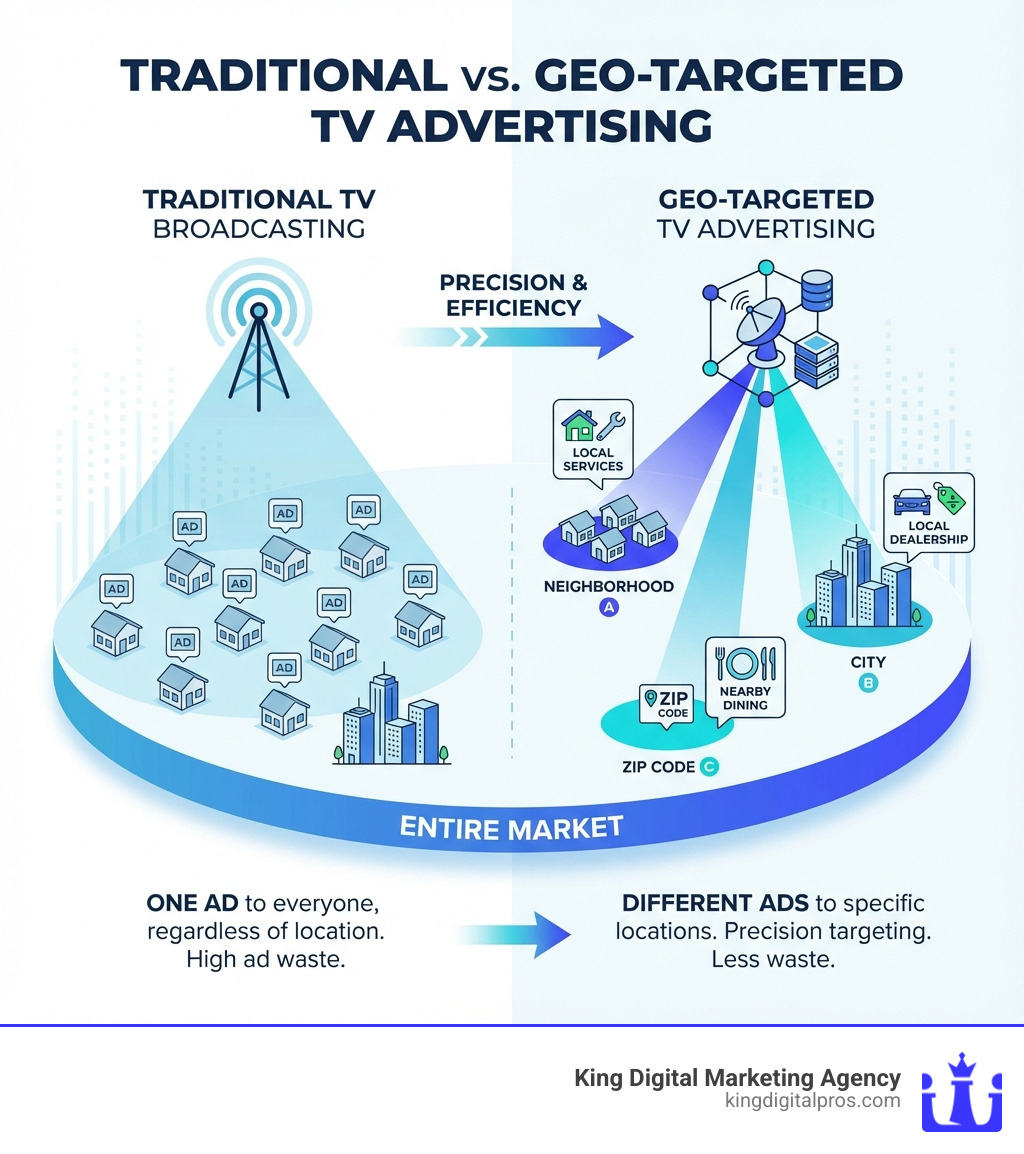
Geo-targeted TV advertising is a method that delivers different ads to different households watching the same program, based on their specific geographic location–from broad regions down to individual ZIP codes. Unlike traditional TV that broadcasts the same ad to everyone in a market, geo-targeting uses data like GPS signals, IP addresses, and set-top box information to show locally relevant messages only to viewers who can actually act on them.
Quick Answer: What You Need to Know
- What it is: Technology that serves customized TV ads based on viewer location
- How it works: Uses GPS, IP addresses, and subscriber data to identify household locations
- Targeting levels: Country -> State -> DMA -> City -> ZIP code -> Radius around a location
- Key benefit: 89% of marketers report higher sales after adopting location-based advertising
- Best for: Local businesses, regional brands, and anyone wanting to eliminate wasted ad spend
- Where it runs: Traditional cable/satellite TV, Connected TV (CTV), and streaming platforms like YouTube TV
For decades, TV advertising meant paying to reach everyone in a market–even if only 10% of viewers could actually visit your store or use your service. That’s like buying a billboard in Chicago to advertise your Albuquerque restaurant.
Geo-targeted TV advertising changes everything. A local car dealership can now show ads only to households within 30 miles of their lot. A regional furniture chain can serve different promotions to different cities based on local inventory. Two neighbors watching the same show can see completely different ads–one for a nearby gym, the other for a local home services provider.
The technology pulls from multiple data sources. GPS signals from mobile devices pinpoint locations within 3 meters. Set-top boxes from cable providers offer 95% match rates to physical addresses. Even IP addresses, while less accurate, help streaming platforms target specific households.
The impact is measurable. According to industry research, 84% of marketers report increased engagement after adopting location-based targeting. Addressable TV campaigns are 27% more likely to reach light or no-TV households compared to traditional linear campaigns. When addressable TV joins a multiscreen campaign, it increases total frequency by 75%.
The real magic? Local businesses finally have access to the emotional power of television without the waste of mass-market buying. You’re not paying for impressions in neighborhoods you don’t serve. You’re not advertising winter tires to viewers in warm climates. Every impression counts because every viewer is in your service area.
I’m Bernadette King, founder of King Digital Marketing Agency. Throughout my career building scalable digital strategies for local and franchise businesses, I’ve seen how geo-targeted TV advertising transforms what was once a “brand awareness” medium into a genuine performance channel that delivers measurable local results.
What is Geo-Targeted TV Advertising?
At its heart, geo-targeted TV advertising is about delivering the right message to the right person at the right location, on the biggest screen in their home. Imagine a local plumber in Rio Rancho wanting to reach potential customers only in Rio Rancho and Corrales, not across the entire state. Traditional linear TV advertising, where the same commercial is broadcast to everyone watching a particular channel, simply couldn’t offer that level of precision. Instead, it would typically target a broad Designated Market Area (DMA), like the Albuquerque-Santa Fe DMA, meaning a lot of your ad budget would be spent on viewers outside your service area.
This modern approach to TV advertising drastically reduces ad waste by ensuring that your commercials are seen primarily by audiences who are geographically relevant to your business. For us, this means helping our clients in Albuquerque, Santa Fe, and surrounding New Mexico communities connect directly with their local customers. It’s about making every advertising dollar work harder by focusing on reaching relevant audiences who can actually walk through your doors or use your services.
| Feature | Traditional TV Advertising | Geo-Targeted TV Advertising |
|---|---|---|
| Reach | Broad, covers entire DMAs or national audiences | Precise, targets specific households, ZIP codes, or radii |
| Targeting | Program-centric, demographic estimates | Data-driven, location-based, household-level |
| Cost-Efficiency | Higher waste due to irrelevant impressions | Lower waste, higher ROI due to relevant impressions |
| Measurement | Broad viewership metrics, difficult to link to sales | Granular, linkable to online/offline conversions and foot traffic |
Understanding the basics of geo-targeted TV advertising
The core concept is simple yet powerful: instead of broadcasting to the masses, we zero in on specific households. This isn’t about guessing; it’s about using sophisticated technology and data to identify where your potential customers live or spend their time. This allows for household-level targeting, meaning different ads can be served to different homes watching the exact same program.
Think of it this way: a family in Santa Fe might see an ad for a local art gallery during their favorite show, while a family in Los Alamos watching the same show sees a commercial for a nearby outdoor gear store. This level of precision is often facilitated by programmatic ad buying, an automated process that uses data and algorithms to buy and sell ad impressions in real-time. The result? Massively increased relevance for the viewer, making your ad feel less like an interruption and more like a helpful suggestion.
To dive deeper into how local strategies can transform your business, explore our guide on More info about local marketing.
Geo-Targeting vs. Addressable TV: What’s the Difference?
While often used interchangeably, it’s helpful to clarify the relationship between geo-targeting and addressable TV. Think of geo-targeting as the broader strategy of delivering ads based on geographic location. Addressable TV advertising is a highly advanced form of geo-targeting that takes precision to the household level.
Addressable advertising uses rich household data–often first-party data from cable providers or streaming services–to deliver unique ads to individual homes. This data can include demographics, interests, purchase history, and, crucially, precise location. Unlike probabilistic data (which estimates location based on various signals), addressable TV often relies on deterministic data, which is real, authenticated information tied to physical addresses, offering best accuracy. For instance, Comcast Advertising, which serves many of our New Mexico communities, leverages deterministic data from millions of households, yielding a 95% initial match rate for physical addresses.
So, while all addressable TV is geo-targeted, not all geo-targeted TV is addressable at the individual household level (some might target a broader ZIP code). These two strategies are highly complementary, with geo-targeted TV advertising, especially through addressable TV, representing the future of targeted TV campaigns.
The Technology Powering Precision TV Ads
The magic behind precise geo-targeted TV advertising isn’t really magic at all–it’s incredibly sophisticated technology and data working in harmony. This is truly data-driven advertising, where every decision about who sees what ad is informed by a wealth of information. Modern ad serving technology automates this complex process, ensuring that the right ad reaches the right screen at the right time.
How Location Data is Collected: GPS, IP, and Set-Top Boxes
To understand how your ads find their way to specific homes in Grants or Edgewood, we need to look at how location data is gathered:
- GPS Signals: This is the gold standard for accuracy. GPS-powered geo-targeting is incredibly precise, capable of pinpointing a device’s location down to at most 3 meters (about 10 feet). This data often comes from mobile app location services, with user consent, and allows us to target individuals who have been in a specific area, or even follow them back to their home for household-level targeting.
- IP Addresses: Every device connected to the internet has an IP address, which broadly indicates its geographic location. Streaming platforms and websites use IP addresses to deliver geo-targeted content and ads. However, IP addresses can be less precise than GPS, and they frequently change or can be masked by VPNs, making them less reliable for pinpoint accuracy over time. In fact, IP-based targeting’s accuracy can drop significantly over 90 days without refresh.
- Wi-Fi Signals: Similar to IP addresses, Wi-Fi network data can contribute to location determination, especially in densely populated areas.
- Set-Top Box (STB) Subscriber Data: This is a powerhouse for accuracy in traditional cable and satellite TV. Providers like Comcast have authenticated information tied to physical addresses for their millions of households. This deterministic data offers initial match rates of around 95%, making it incredibly reliable for household-level targeting.
Geo-Targeting in the Age of CTV and Streaming
The rise of Connected TV (CTV) and Over-the-Top (OTT) platforms has revolutionized where and how we can implement geo-targeted TV advertising. CTV refers to any TV that can connect to the internet and access streaming content, while OTT is the content delivered over the internet, bypassing traditional broadcast. Platforms like YouTube TV, Hulu, and Peacock are prime examples.
In this environment, targeting works differently than traditional linear TV. CTV devices have unique identifiers, and through technologies like device graphs, we can connect various devices within a household. This allows us to target ads based on household IP, ensuring that a consistent message reaches all relevant screens in a home in Cedar Crest or Tijeras.
YouTube TV, for instance, offers robust geo-targeting capabilities. For our clients, this means we can target ads at the state, Designated Market Area (DMA), and even ZIP code level on YouTube TV. This is incredibly powerful for reaching specific communities within the larger Albuquerque-Santa Fe DMA. For more details on how this works, you can check out Google’s guide on About YouTube TV targeting.
Combining this with other location-based strategies, like geofencing, can create a truly comprehensive local marketing approach. If you’re curious about geofencing and how it complements TV advertising, our A complete guide to geofencing marketing has all the details.
Levels of Targeting Granularity: From Country to ZIP Code
One of the most impressive aspects of geo-targeted TV advertising is the sheer range of targeting granularity available. We can cast a wide net or focus with laser-like precision, depending on your business goals:
- Country: While less relevant for local businesses in New Mexico, this is the broadest level, useful for national campaigns.
- State/Region: Targeting all of New Mexico, or specific regions within it (like Northern New Mexico vs. Central New Mexico).
- Designated Market Area (DMA): This is a common level for TV advertising, covering a metropolitan area and its surrounding communities. For us, this often means the Albuquerque-Santa Fe DMA, which includes areas like Rio Rancho, Corrales, and Los Alamos.
- City: Targeting specific cities like Albuquerque, Santa Fe, or Taos.
- ZIP Code/Postal Code: This offers a highly granular focus, allowing us to reach specific neighborhoods or areas within a city. YouTube TV, for example, supports ZIP code targeting.
- Radius Targeting (Geofencing): This is the most precise, allowing us to draw a virtual circle (a “geofence”) around a specific point of interest, like your business location in Grants or a competitor’s store. We can set a radius as small as a few blocks or as wide as needed to capture local customers.
Key Benefits: Why Local Targeting Delivers Global Impact
The shift to geo-targeted TV advertising isn’t just a technical upgrade; it’s a strategic game-changer for businesses of all sizes, especially those with a local focus like many of our clients in New Mexico. The benefits translate directly into improved ROI, a significant competitive advantage, and a better experience for your potential customers.

Skyrocket Relevance and Boost Ad Recall
Imagine seeing an ad for a charming local cafe in Santa Fe while watching your favorite show, rather than a generic ad for a national fast-food chain. That’s the power of personalization. Geo-targeted TV advertising allows us to tailor ad content to local audiences, making messages resonate more deeply.
By using local signifiers–elements specific to a location like mentioning the Sandia Mountains in an Albuquerque ad or the historic Plaza in Santa Fe–we create a sense of familiarity and connection. This hyper-relevance isn’t just nice; it’s effective. Research shows that 84% of marketers reported increased engagement after adopting location-based marketing and geotargeting ads. When ads feel like they’re speaking directly to you and your community, they become more memorable. A study even found a 74% image recall rate for addressable ads, compared to 68% for standard TV spots.
We make sure your ads speak to the unique spirit of places like Taos, Grants, or Edgewood, fostering a stronger connection with viewers. This increased engagement and recall means your ad spend isn’t just seen; it’s remembered and acted upon.
You can learn more about how increased engagement benefits marketers here: 84% of marketers reported increased engagement. For insights into ad memorability, see this Study on ad recall.
Maximize Your Budget and Reduce Wasted Ad Spend
One of the most compelling benefits of geo-targeted TV advertising is its ability to stretch your marketing budget further. Traditional TV advertising often means paying for impressions that reach people outside your service area, leading to significant ad waste. But with geo-targeting, every impression is delivered to a highly relevant household.
This efficient budget allocation means you’re focusing your spend on people most likely to take action. This leads to lower effective CPMs (cost per thousand impressions), with some addressable TV campaigns delivering up to 15% lower effective CPMs than traditional TV. It also helps us reach those “light TV viewers” or “no-TV households” who might be missed by traditional linear campaigns; addressable campaigns are 27% more likely to reach them. By focusing on high-intent areas, like specific neighborhoods in Corrales or Sandia Park that match your ideal customer profile, we ensure your message lands where it matters most.
For more strategies on attracting local customers and optimizing your budget, check out our guide on Attract local customers with these tips.
Driving Foot Traffic and Local Promotions
For businesses with physical locations, like a boutique in Santa Fe or a restaurant in Albuquerque, geo-targeted TV advertising is a powerful tool for driving in-store visits. We can track the impact of your TV ads on actual foot traffic, providing tangible proof of your campaign’s effectiveness.
Imagine promoting a special event at your Rio Rancho store, or a time-sensitive offer for a service in Los Alamos. With geo-targeting, we can ensure these ads are seen by people within a specific radius of your location, or even those who have recently visited a competitor (a strategy known as geo-conquesting). This allows for highly effective local promotions that convert viewers into customers. One regional furniture brand, for example, saw a 13.5 times return on ad spend, generating over $6 million in sales by incorporating addressable TV. This demonstrates the incredible potential for local businesses to see significant ROI.
If you’re looking to boost your local visibility and attract more customers to your physical location, our guide on Boost your local visibility offers valuable insights.
From Strategy to Success: Best Practices for Your Campaign
Implementing a successful geo-targeted TV advertising campaign involves more than just picking a location on a map. It requires careful planning, strategic goal setting, smart audience segmentation, creative versioning, and continuous optimization. Think of it as a finely tuned orchestra, where every instrument plays a crucial role in creating a harmonious, impactful performance.
Best practices for implementing and optimizing geo-targeted TV advertising campaigns
To get the most out of your geo-targeted TV ads, we recommend following these best practices:
- Define Clear Objectives: What do you want to achieve? Is it increased brand awareness in Taos, more website visits from Albuquerque, or higher foot traffic in Los Alamos? Specific, measurable goals will guide your strategy.
- Understand Your Audience: Beyond just location, who are you trying to reach? What are their demographics, interests, and viewing habits? The more we know, the more precise your targeting can be.
- Use Local Signifiers in Creative: Tailor your ad copy and visuals to include elements specific to the target location. Mentioning local landmarks, cultural references, or even local slang can significantly increase relevance and engagement. This applies whether you’re advertising in Grants or Corrales.
- A/B Test Your Campaigns: Don’t put all your eggs in one basket. Test different ad creatives, messaging, and even targeting parameters in smaller, controlled campaigns to see what resonates best before scaling up.
- Double-Check and Exclude Poor-Performing Areas: Regularly review your campaign data. If certain ZIP codes in the Albuquerque-Santa Fe DMA are consistently underperforming, exclude them to optimize your ad spend. Conversely, if a specific neighborhood in East Mountains is performing exceptionally well, consider increasing your focus there.
- Optimize Timing and Frequency: Use dayparting to show ads at specific times (e.g., during lunch hours for restaurants) and set frequency caps to avoid ad fatigue, especially in smaller target areas like Cedar Crest or Tijeras.
While TV is the focus here, many of these principles apply across digital channels. For example, our expertise in More on social media advertising also emphasizes localized content and audience understanding.
Measuring Success: KPIs for Geo-Targeted TV
Measuring the effectiveness of geo-targeted TV advertising is crucial for understanding your return on investment and optimizing future campaigns. Unlike traditional TV, which offered limited direct attribution, modern platforms provide robust Key Performance Indicators (KPIs):
- Impressions: The total number of times your ad was displayed.
- Video Completion Rate (VCR): For streaming platforms, this tells us how many viewers watched your entire ad. A high VCR indicates engaging content.
- Click-Through Rate (CTR): For CTV ads with interactive elements, this measures how many viewers clicked on your ad.
- Unique Household Reach: How many distinct households saw your ad, preventing over-counting.
- Conversion Lift: This is the big one. Did households exposed to your ad visit your website, make a purchase, or sign up for a service more often than those who weren’t?
- Return on Ad Spend (ROAS): The ultimate measure of profitability, comparing the revenue generated to the cost of the campaign. As mentioned, some addressable campaigns have seen ROAS upwards of 13.5x.
- Foot Traffic Analysis: For physical businesses, we can use location data to see if exposed households later visited your store in Santa Fe or Albuquerque.
Navigating Common Challenges: Data Accuracy and Privacy
While incredibly powerful, geo-targeted TV advertising isn’t without its problems. We work to steer these complexities to ensure your campaigns are effective and compliant:
- Platform Fragmentation: The CTV landscape is vast, with many different streaming services and devices. This fragmentation can make it challenging to ensure consistent campaign delivery and measurement across all platforms. We overcome this by working with unified platforms and trusted partners.
- Data Freshness: Location data, especially IP addresses, can change. IP-based targeting match rates can drop from 60% to 24% over 90 days without being refreshed. We prioritize data hygiene and work with providers who maintain high match rates (like the 95% from MVPDs).
- IP Masking (VPNs): Viewers using Virtual Private Networks (VPNs) can mask their true IP address, making IP-based geo-targeting less accurate. We use multi-signal approaches (combining IP with other data) to improve accuracy.
- Privacy Compliance: With granular targeting comes increased responsibility. We ensure all campaigns comply with stringent privacy regulations like GDPR and CCPA. User consent for data collection is paramount, and we work with data clean rooms for privacy-compliant measurement and data sharing. Transparency and ethical data practices are at the forefront of our strategies.
Conclusion: Make Every Ad Dollar Count with Local Precision
The era of mass-market television advertising is evolving. Today, geo-targeted TV advertising empowers businesses, from local shops in Corrales to regional service providers across New Mexico, to connect with their most valuable customers with unprecedented precision. It’s a shift from broadcasting to everyone to engaging with the right people, where every ad dollar truly counts.
We’ve seen how this technology transforms TV from a broad awareness tool into a measurable performance channel. By leveraging advanced data, from GPS signals to set-top box information, and by delivering ads across Connected TV and streaming platforms, we ensure your message is relevant, engaging, and impactful. The benefits are clear: skyrocketing relevance, maximized budgets, and tangible results like increased foot traffic and sales.
At King Digital Marketing Agency, we specialize in empowering local businesses to thrive in the digital landscape. Our expertise in local marketing, combined with the power of geo-targeted TV advertising, means we can help you reach potential customers in Albuquerque, Rio Rancho, Santa Fe, and all our New Mexico communities with messages that truly resonate. It’s about bringing the global impact of TV advertising right to your local neighborhood.
Ready to put the power of location to work for your business? Learn more about our geofencing software and how we can help you capture your local market.
