Website designer and SEO: #1 Blueprint
Why Web Design and SEO Are Two Sides of the Same Coin
In the digital marketplace, a website’s success hinges on two critical components: web design and search engine optimization (SEO). For years, these disciplines were treated as separate, leading to a frustrating disconnect. Businesses had sites that were either visually stunning but invisible to search engines, or highly ranked but offered a poor user experience. Today, that division is obsolete. Modern SEO and web design work in tandem, creating a seamless experience that satisfies both human visitors and search engine algorithms.
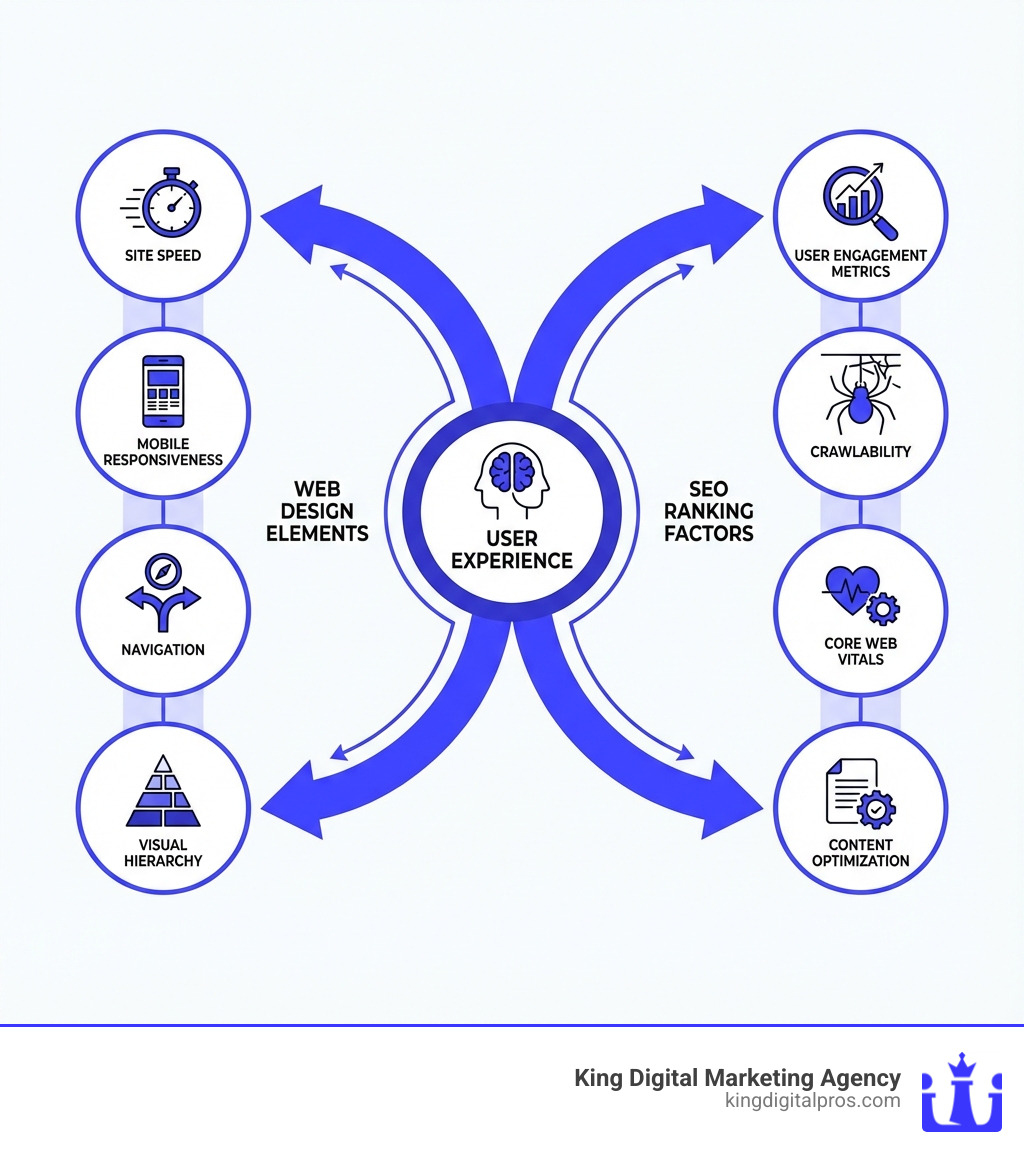
Effective design builds the user experience through intuitive layouts, fast load times, and clear navigation. SEO provides the technical foundation that makes the site visible and rankable. The bridge connecting them is user experience itself. Google’s algorithms have evolved to prioritize websites that offer genuine value and a positive experience to users. This shift means good design is no longer just an aesthetic choice-it’s a core SEO requirement.
Consider the data: 48% of people cite a website’s design as the number one factor in deciding a business’s credibility. A site that is slow, confusing, or outdated will cause visitors to leave in seconds, signaling to Google that your page isn’t a good result. Conversely, a well-designed, technically sound website can dramatically improve business outcomes. Research shows that a project integrating best practices in design, development, and content can increase leads by as much as 250%.
At King Digital Marketing Agency, I’m Bernadette King, and I’ve dedicated my career to helping local businesses merge expert web design with powerful SEO. We create online platforms that don’t just look good-they attract qualified customers and drive growth. This guide will walk you through how to achieve this essential synergy for your own business.
The Foundation: How Website Design Directly Impacts SEO Performance
Every design choice, from layout to loading speed, sends a signal to search engines about your website’s quality. A visually appealing site without technical SEO is like a beautiful storefront with locked doors. Conversely, a technically optimized site that is slow or confusing will fail to retain visitors. To succeed, design and SEO must be built on a shared foundation of user experience, mobile-friendliness, speed, and accessibility. These are not just design principles; they are direct SEO ranking factors. For more information on how a strong online presence can benefit your business, check out our insights on Small Business Web.

User Experience (UX): The Heart of Modern SEO
At King Digital Marketing Agency, we view user experience as the core of modern SEO. Google’s goal is to provide users with the best possible results, and that includes a positive on-page experience. When visitors land on your site and quickly leave (a high bounce rate) or can’t find what they need, Google interprets this as a low-quality signal. To quantify this, Google uses a set of metrics called Core Web Vitals which measure page experience:
- Largest Contentful Paint (LCP): Measures how quickly the main content of a page loads.
- Interaction to Next Paint (INP): Measures how quickly the page responds to user interactions like clicks and taps.
- Cumulative Layout Shift (CLS): Measures visual stability, penalizing pages where elements shift unexpectedly during loading.
Optimizing for these vitals improves user satisfaction and sends powerful positive signals to search engines, directly influencing your rankings.
Site Speed, Readability, and Accessibility
Beyond Core Web Vitals, several other design elements are critical for both users and SEO.
- Site Speed: Modern users expect speed. If a page takes more than a few seconds to load, 42% of people will leave, hurting your bounce rate and conversions. We ensure our clients’ sites in Albuquerque and Santa Fe load quickly by optimizing images, leveraging browser caching, and using reliable hosting. You can monitor performance with tools like Google PageSpeed Insights.
- Readability: Clear and legible content is essential. We use appropriate font sizes (at least 16px for body text), clean typography, ample white space, and strong color contrast. This encourages visitors to stay longer, a key engagement metric for SEO.
- Accessibility: An accessible website is inclusive and provides a better experience for everyone. With an estimated 1 billion people globally living with a disability, creating a site that everyone can use is crucial. Search engines reward accessible sites. We follow the Web Content Accessibility Guidelines (WCAG), implementing features like descriptive alt text for images and keyboard navigation to ensure a broader audience can access your information.
The Critical Role of Mobile-Friendliness
With approximately 59% of global website traffic coming from mobile devices, a mobile-friendly design is non-negotiable. Since 2016, Google has used mobile-first indexing, meaning it primarily uses the mobile version of your site for indexing and ranking. A poor mobile experience will directly harm your search visibility. We build responsive websites for our clients across New Mexico, ensuring a seamless experience on any screen. This includes large, thumb-friendly buttons and clear content layouts, so users in Rio Rancho and Los Alamos can easily steer your site on any device.
Building for Crawlers and Users: SEO-Friendly Website Structure
A well-structured website is essential for both user experience and SEO. It provides a clear path for visitors to steer your content and allows search engine crawlers to efficiently index your pages. A logical structure is a cornerstone of any effective web design and SEO strategy. To learn more about creating a solid foundation, read our guide on How to Create an SEO-Friendly Website Design Structure.
Information Architecture & Intuitive Navigation
Information architecture (IA) is the practice of organizing and labeling website content so users can easily find what they need. A strong IA begins with a logical site hierarchy, starting with the homepage and branching out into main categories and subpages. This helps both users and search engines understand the relationships between different pieces of content.
Key components of a well-structured site include:
- Intuitive Navigation: Main menus should be clean, simple, and predictable. A common best practice is the “four-click rule,” ensuring users can reach any page on your site in four clicks or less. We also implement breadcrumb navigation (e.g., Home > Services > Web Design) to help users orient themselves.
- XML Sitemaps: An XML sitemap is a file that acts as a roadmap for your website. We create and submit these to search engines to ensure all important pages are found and indexed correctly. This is a foundational element of our Albuquerque Website Development Services.
URL Structure and Internal Linking Best Practices
Your site’s URLs and internal linking strategy significantly impact SEO performance.
- Clean, Descriptive URLs: URLs should be simple, readable, and include relevant keywords. For example,
yourwebsite.com/services/local-seois far more effective for users and search engines than a generic URL likeyourwebsite.com/pageID=123?cat=5. - Strategic Internal Linking: Linking between pages on your own website is a powerful SEO tactic. It guides users to related content, distributes page authority (or “link equity”) throughout your site, and helps search engines find new pages. We use internal links to create topic clusters, establishing authority on a subject by linking related content back to a central “pillar” page.
- Descriptive Anchor Text: The clickable text of a link, or anchor text, should accurately describe the destination page’s content. Using descriptive phrases instead of generic terms like “click here” provides valuable context for both users and search engines. This is a core part of our approach to SEO Friendly Website Design.
On-Page Essentials for the Modern Website Designer and SEO Pro
With a solid structure in place, the next step is to optimize the individual elements on each page. On-page SEO ensures that every piece of content, from text and images to structural tags, clearly communicates your page’s purpose to both users and search engines. An experienced web designer and SEO professional knows these details are opportunities to boost engagement and visibility.
Content Strategy: The Bridge Between Design and SEO
High-quality content is the fuel for any successful website. Our strategy prioritizes creating user-first content that answers questions, solves problems, and provides original value. This includes formats like blog posts, service pages, and video, which is increasingly popular-89% of consumers want to see more videos from brands.
Google assesses content quality using its E-E-A-T framework: Experience, Expertise, Authoritativeness, and Trustworthiness. We build content that showcases our clients’ deep knowledge, establishing credibility with users and search engines alike. For a business in Santa Fe, this could mean highlighting years of local service or unique craftsmanship, all while maintaining a consistent brand voice that builds trust.
Mastering On-Page Elements: Titles, Headers, and Metas
These technical elements are critical for communicating relevance to search engines and encouraging clicks from users.
- Title Tags: The clickable headline in search results. We write unique, compelling titles (50-60 characters) that include target keywords and accurately describe the page.
- Meta Descriptions: This short summary (around 155-160 characters) acts as an ad in the search results. While not a direct ranking factor, a well-written meta description boosts click-through rates.
- Header Tag Hierarchy (H1, H2, H3): Headers structure content for readability and signal the page’s main topics to search engines. Each page should have a single H1 for the main topic, with H2s and H3s for subtopics.
- Image Alt Text: This descriptive text makes images accessible to visually impaired users and provides context to search engines. This is especially important for businesses in visual-centric areas like Taos or Grants.
Building Trust: The Role of Social Proof and Brand Messaging
Trust is a valuable currency online. With 63% of consumers finding it hard to trust companies, building credibility is essential. We achieve this through social proof and consistent brand messaging.
Social proof, such as testimonials and reviews, is highly effective; an estimated 88% of consumers trust online reviews as much as personal recommendations. We strategically feature testimonials, case studies, trust badges, and user-generated content to build confidence. This, combined with a clear brand message, fosters loyalty and encourages positive user engagement signals (like lower bounce rates), which indirectly helps Improve Search Ranking over time.
Measuring Success and Choosing the Right Partner
Once your site is live, how do you measure the impact of your integrated design and SEO strategy? Tracking key metrics is essential for understanding performance, making data-driven decisions, and ensuring a strong return on investment.
Key Metrics for Tracking Website Designer and SEO Success
To gauge progress, we focus on a combination of data points that tell a complete story:
- Organic Traffic Growth: An increase in visitors from search engines is a primary indicator of SEO success.
- Keyword Rankings: Monitoring your site’s position for target keywords shows your growing visibility for terms relevant to your business in areas like Edgewood or Sandia Park.
- Conversion Rates: This is the ultimate measure of success. Are visitors completing desired actions, such as filling out a contact form or making a purchase? This metric connects your website’s performance directly to business goals.
- User Engagement Metrics: Data like bounce rate, time on page, and pages per session indicate whether your content is valuable and engaging to visitors.
- Core Analytics Tools: We use Google Analytics to understand user behavior and Google Search Console to monitor how Google views the site, identify technical issues, and track search queries.
A data-driven approach is fundamental to improving your Digital Marketing Conversion Rate.
The Benefits of Integrating SEO from Day One
Integrating SEO into the web design process from the start is a strategic advantage. It is far more cost-effective to build SEO into a site’s foundation than to retrofit it later. This approach ensures your site’s architecture, navigation, and technical elements are optimized from launch, creating a stable base for future growth and avoiding the costly “technical debt” that comes from neglecting SEO early on. A strategically designed and optimized website builds long-term brand authority, establishing your business as a trusted resource in your industry, whether you’re serving clients in Corrales or Tijeras.
How to Choose the Right Website Designer and SEO Agency
Selecting the right partner is critical for your online success. Look for an agency that demonstrates:
- An Integrated Approach: They should treat design and SEO as inseparable parts of a single, holistic strategy.
- A Proven Track Record: Ask for a portfolio with case studies and client testimonials that show demonstrable results, especially for local businesses.
- Deep Technical SEO Knowledge: A capable agency understands the complexities beyond keywords, including site speed, schema markup, and mobile-first indexing.
- A Focus on Business Goals: The right partner prioritizes metrics that impact your bottom line-leads, sales, and revenue-over vanity metrics.
- Transparent Reporting: They should provide clear, regular reports that track progress toward your goals.
At King Digital Marketing Agency, we embody this integrated approach. We combine the skills of an expert website designer and SEO specialist to build sites that are not only visually impressive but also high-performing engines for business growth.
Frequently Asked Questions about Website Design and SEO
What is the relationship between website design and SEO?
Web design and SEO are fundamentally intertwined. Good design creates a positive user experience (fast speeds, easy navigation), which is a major ranking factor for search engines like Google. SEO ensures the technical structure and content of that design are visible and understandable to search engines, allowing users to find the site in the first place.
Why is mobile-friendliness so crucial for SEO?
With over half of all web traffic coming from mobile devices, Google now uses “mobile-first indexing.” This means it primarily looks at the mobile version of your website to determine its rank. A site that is not mobile-friendly will offer a poor user experience and rank significantly lower in search results.
Can I do SEO after my website is designed?
While you can implement some SEO tactics after a site is built, it is far less effective and more expensive. Integrating SEO from the start ensures the site’s core architecture, navigation, URL structure, and speed are optimized from day one. Retrofitting SEO onto a poorly designed site is like trying to fix a building’s foundation after it’s already been constructed.
Conclusion: Design a Website That Gets Found
A successful online presence requires more than just a beautiful design; it needs to be findable. By integrating SEO principles into the web design process from the very beginning, you create a powerful, user-friendly website that attracts and converts visitors. This holistic approach ensures your investment not only looks great but also delivers measurable results. For businesses looking to master this synergy, the experts at King Digital Marketing Agency provide strategies that turn websites into powerful growth engines. Ready to build a website that ranks? Explore our SEO Services.
