Paid Search Ads Management: Master 2025 Guide
Why Paid Search Ads Management Matters for Local Business Growth
Paid Search Ads Management is the process of creating, optimizing, and monitoring paid advertisements on search engines like Google and Bing. It allows businesses to drive targeted traffic to their websites by appearing at the top of search results when potential customers are actively looking for their services.
Unlike organic SEO, which can take months to yield results, paid search ads offer immediate visibility. You bid on keywords related to your business, create compelling ads, and pay only when someone clicks. It’s a targeted, measurable, and cost-effective way to generate new leads and customers.
However, mastering paid search is complex. With fierce competition, poor strategy can drain your budget quickly. A well-managed campaign, on the other hand, can deliver an average of $2 in revenue for every $1 spent. The difference lies in strategy, continuous optimization, and expertise.
I’m Bernadette King, founder of King Digital Marketing Agency. With years of experience in Paid Search Ads Management, I help local businesses achieve measurable growth. This guide will walk you through everything from setting up your first campaign to advanced optimization techniques.
Paid Search vs. Organic SEO
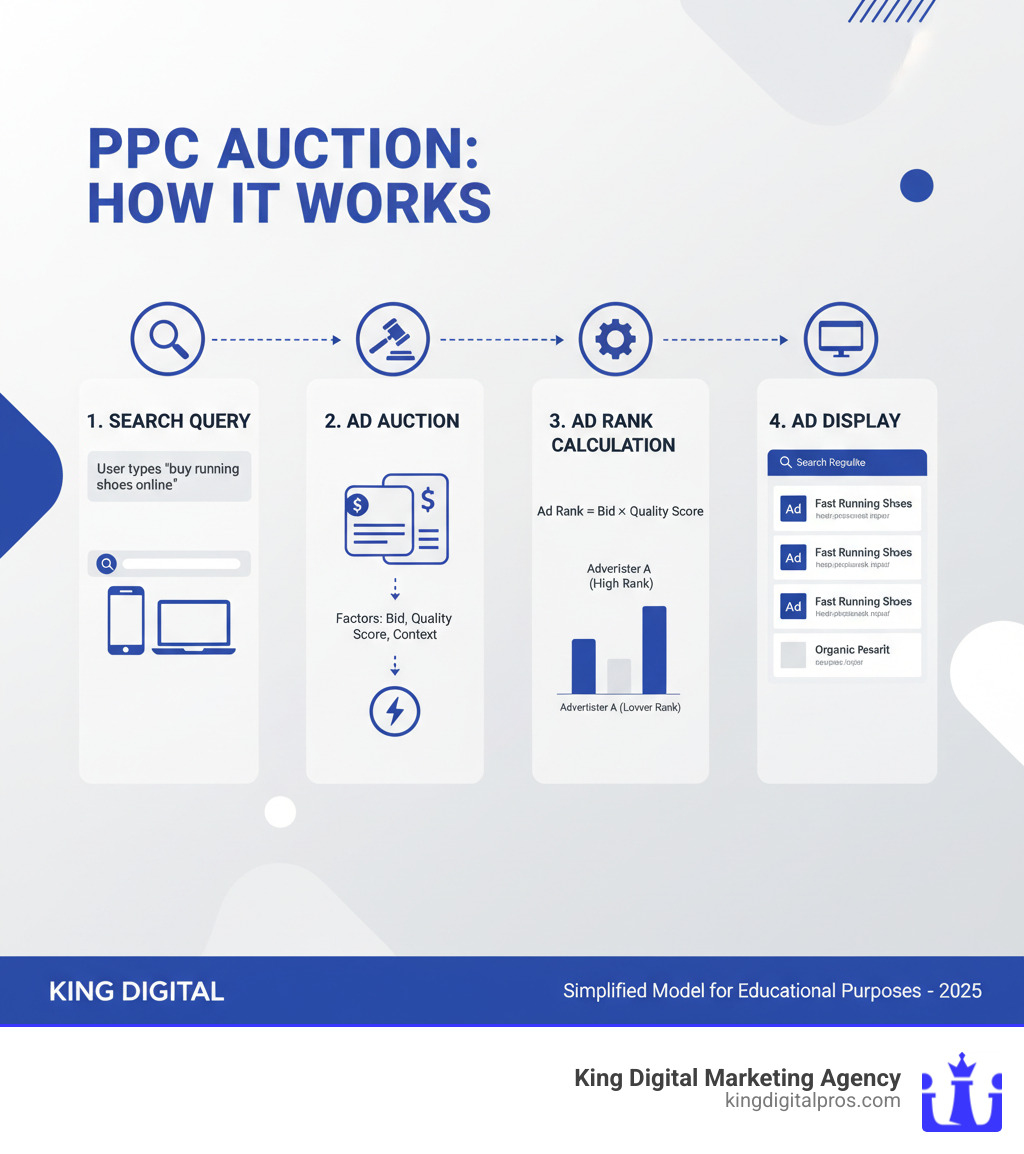
Both paid search and organic search (SEO) aim to get your business found on search engines, but they operate differently.
- Paid Search: These are the ads at the top of the results page, marked with an “Ad” label. You pay per click (PPC) and can achieve instant visibility. It’s like renting a billboard on a busy highway-immediate exposure for a fee.
- Organic SEO: These are the “earned” listings below the ads. Ranking here requires a long-term investment in content, technical optimization, and building authority. It’s like building a landmark that naturally attracts visitors over time.
For a comprehensive strategy, both are vital to Improve Search Ranking and capture all available traffic.
The Core Benefits of Paid Search for Your Business
For local businesses in areas like Albuquerque, Santa Fe, and Taos, Paid Search Ads Management offers a powerful toolkit:
- Targeted Audience Reach: Pinpoint your ideal customers based on their search queries, location, demographics, and interests. This ensures your ad for HVAC services in Rio Rancho only shows to people searching for that service in that area.
- Measurable Results: Track impressions, clicks, cost-per-click (CPC), and conversions (leads or sales). This allows you to calculate your Return on Investment (ROI) with precision and see tangible results, often within weeks.
- Budget Control: Set a daily budget that the platform will not exceed. You can start small, test performance, and scale up as you see positive results, giving you complete control over your spending.
- Brand Visibility: Appear on the first page of Google almost immediately, which is invaluable for building brand awareness in competitive local markets.
- Fast Traffic Generation: While SEO builds long-term authority, paid search drives qualified traffic to your website within hours, helping you Attract More Customers and fill your sales funnel quickly.
Types of Paid Search Channels
Effective Paid Search Ads Management involves using various channels to reach different audiences:
- Google Search Network: Text-based ads that appear on Google’s search results pages, targeting users with high purchase intent.
- Google Display Network (GDN): Visual ads that appear on millions of websites, apps, and videos. Excellent for brand awareness and remarketing to previous visitors.
- Shopping Campaigns: For e-commerce businesses, these ads display product images, prices, and store names directly in search results.
- Video Ads: Engaging ads run on YouTube and partner sites, ideal for brand storytelling and product demonstrations.
- Local Service Ads (LSAs): For eligible service businesses (plumbers, electricians), these ads appear at the very top of search results and are “Google Guaranteed,” building immediate trust.
- Social Media Advertising: While not strictly “search,” ads on platforms like Facebook and Instagram complement search efforts by targeting users based on detailed demographics and interests. Learn more about our Social Media Advertising services.
Building Your First High-Impact Paid Search Campaign
Building a successful paid search campaign requires a clear plan before you spend a single dollar. Once you understand the foundational steps, launching a campaign that drives real results becomes straightforward. Let’s walk through the process.
Step 1: Defining Campaign Goals and Structure
Before anything else, answer this question: What do we want this campaign to accomplish? Your goals-whether generating sales, leads, or website traffic-determine your entire strategy. For most local service businesses in Albuquerque or Santa Fe, the primary goal is lead generation, such as phone calls or form submissions.
Once your goal is clear, organize your account logically. The structure is: Account > Campaigns > Ad Groups.
- Campaigns should align with major business services (e.g., “Emergency Plumbing Services”).
- Ad Groups within a campaign should contain tightly related keywords and their corresponding ads (e.g., “Burst Pipe Repair,” “Drain Cleaning”).
A well-structured account makes Paid Search Ads Management easier, improves performance, and is rewarded by Google.
Step 2: Mastering Keyword Research and Selection
Keywords connect what people search for with the services you offer. Getting this right is crucial.
First, understand user intent. A search for “how to fix a leaky faucet” is informational. A search for “emergency plumber near me” shows commercial intent-that person is ready to hire. We target keywords with commercial intent.
Tools like the Google Keyword Planner help you find what people in your area are searching for. Focus on long-tail keywords-longer, more specific phrases like “affordable family law attorney Rio Rancho.” These searches have lower volume but much higher intent and are often less expensive.
Equally important are negative keywords, which tell Google which searches not to show your ads for. If you’re a residential plumber, you’d add “commercial” and “jobs” as negative keywords to avoid wasting money on irrelevant clicks. This is a critical part of efficient Paid Search Ads Management and integrates with our Local SEO for Service Businesses approach.
Step 3: Understanding and Using Keyword Match Types
Match types control how closely a user’s search must match your keyword to trigger your ad.
- Broad Match: Casts a wide net, showing your ad for related searches, synonyms, and variations. It offers high reach but can lead to irrelevant clicks if not managed carefully.
- Phrase Match: Shows your ad for searches that include your keyword phrase in the correct order, with other words before or after. It offers a good balance of reach and relevance.
- Exact Match: Provides the most control, showing your ad only for searches that are an exact match or a very close variant.
We recommend starting with phrase match and exact match to ensure relevance and control costs. As you gather data from your Search Terms Report, you can refine your strategy and add negative keywords. This ongoing optimization is a hallmark of professional Paid Search Ads Management.
Step 4: Crafting Compelling Ad Copy
Your ad copy must stand out and persuade users to click. It needs to be clear, relevant, and compelling.
- Headlines: Use your main keyword, highlight unique selling points (“24/7 Emergency Service,” “Licensed & Insured”), and address the searcher’s immediate need.
- Descriptions: Expand on your value. Mention benefits like “Free Estimates,” “Family-Owned,” or “Serving Santa Fe & Surrounding Areas.” Solve the user’s problem.
- Call-to-Action (CTA): Tell users exactly what to do next: “Call Now for Fast Service” or “Get Your Free Quote Today.”
Crucially, your ad copy must align with both your keywords and your landing page. If your ad promises a “Free Roof Inspection,” the landing page must deliver on that promise. This relevance is key to a good user experience and a higher Quality Score.
Always be A/B testing. Create multiple ad versions to see which headlines, descriptions, and CTAs perform best. Continuous testing is how good campaigns become great. For more details on ad creation, Google’s guide on what a text ad is is a useful resource.
The Mechanics of the Ad Auction: Bidding, Quality Score, and Ranking
Understanding how Google decides which ads to show is fundamental to effective Paid Search Ads Management. It’s not just about who bids the most; it’s a dynamic auction that rewards relevance and quality.
How the Bidding Process Works
Every Google search triggers an instantaneous ad auction. We start by setting a Maximum CPC bid (Cost-Per-Click), which is the most we’re willing to pay for a click.
Google’s auction then considers our bid alongside our ad’s Quality Score and other factors to determine ad placement. The winner doesn’t always pay their maximum bid. Your Actual CPC is typically just enough to beat the rank of the advertiser below you, making the system fair and efficient.
We can use different bidding strategies. Manual bidding gives us full control, while automated bidding uses Google’s AI to optimize for goals like clicks or conversions. The right strategy depends on your campaign objectives and the competitiveness of keywords in your service areas like Rio Rancho or Edgewood.
What is Quality Score and Why It’s Crucial
Quality Score is Google’s 1-to-10 rating of the quality and relevance of your ads, keywords, and landing pages. A high Quality Score is critical because it leads to lower costs per click and better ad positions. It’s Google’s way of rewarding advertisers who provide a great user experience.
Quality Score is based on three main components:
- Expected Click-Through Rate (CTR): The likelihood your ad will be clicked.
- Ad Relevance: How well your ad matches the user’s search query.
- Landing Page Experience: The relevance and usability of your landing page.
A high score (we aim for 8+) can significantly reduce your costs. Improving it is a continuous process of refining keywords, ad copy, and landing pages. Google offers guidance on how to improve your Quality Score.
How Ads are Ranked in the SERP
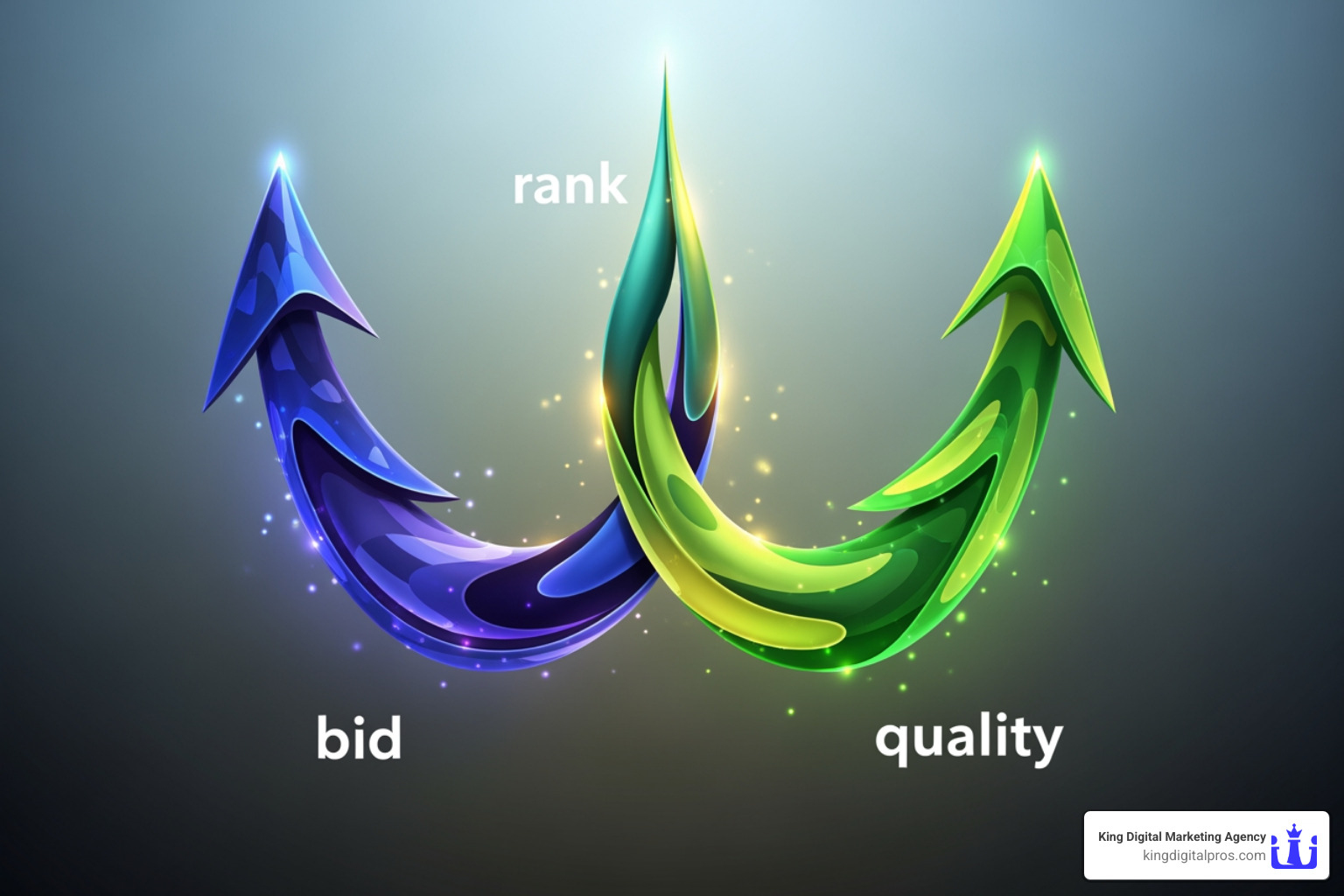
Google uses a metric called Ad Rank to determine ad position. The formula is simple but powerful:
Ad Rank = Max CPC Bid x Quality Score
This means an advertiser with a high Quality Score can achieve a better ad position than a competitor with a higher bid but a lower Quality Score. Quality and relevance can be more impactful than a large budget.
Google also considers other factors, such as the context of the user’s search (location, device, time of day) and certain quality thresholds. A higher Ad Rank leads to better visibility and more clicks from potential customers in places like Santa Fe or Los Alamos. For a deeper dive, review Google’s guide on how Ad Rank is determined.
The Role of Ad Extensions
Ad extensions (now called “assets”) are extra pieces of information that expand your ad, making it more noticeable and useful. They improve visibility, boost CTR, and contribute to a higher Quality Score.
Key extensions for local businesses include:
- Sitelink Extensions: Add links to specific pages like “Our Services” or “Contact Us.”
- Callout Extensions: Highlight unique selling points like “24/7 Service” or “Free Estimates.”
- Call Extensions: Add a clickable phone number for mobile users, which is incredibly valuable for service businesses.
- Location Extensions: Show your business address and proximity to the searcher, driving local traffic and calls.
Advanced Paid Search Ads Management and Optimization
Launching a campaign is just the beginning. True success in Paid Search Ads Management comes from continuous monitoring, data analysis, and optimization. Think of it as tending a garden-it requires constant attention to thrive.
Measuring Success: Key Metrics and ROI
To know if your campaigns are working, you must track the right metrics:
- Click-Through Rate (CTR): The percentage of people who click your ad after seeing it. A high CTR indicates your ad copy is resonating.
- Cost-Per-Click (CPC): The average amount you pay for each click. This helps manage budgets and efficiency.
- Conversion Rate: The percentage of clicks that result in a desired action (a lead or sale). This connects ad spend to business outcomes.
- Cost-Per-Acquisition (CPA): How much you spend to acquire one lead or customer. This is crucial for determining profitability.
- Return On Ad Spend (ROAS): The revenue generated for every dollar spent on advertising. A ROAS of 5:1 means you made $5 for every $1 spent.
We track these metrics to translate data into clear, actionable insights. You can use our Tools Marketing ROI Calculator to see how these calculations work.
The Critical Role of Landing Page Optimization
A great ad can be wasted if it leads to a poor landing page. Your landing page is where conversions happen, and it must be optimized.
- Message Match: The landing page headline and content must match the promise of your ad.
- User Experience: The page should be clean, easy to steer, and free of friction.
- Fast Loading Speed: A page that takes more than a few seconds to load will lose a significant portion of its visitors.
- Clear Call-to-Action (CTA): Make it obvious what you want visitors to do, whether it’s calling you or filling out a form.
- Mobile-Friendliness: With many local searches happening on phones, your page must function flawlessly on mobile devices.
For a deeper dive, explore our Conversion Optimization Complete Guide.
Leveraging AI and Automation in Paid Search Ads Management
Artificial intelligence has transformed Paid Search Ads Management. When used strategically, AI-powered tools can significantly improve results.
- Smart Bidding: Uses machine learning to optimize bids in real-time based on your goals, such as Target CPA or Maximize Conversions.
- Responsive Search Ads (RSAs): Google’s AI tests different combinations of headlines and descriptions to find the best-performing ad variations for different users.
- Performance Max Campaigns: These all-in-one campaigns use AI to run your ads across Google’s entire ecosystem (Search, Display, YouTube, etc.) to maximize conversions. According to Google’s research, advertisers using Performance Max see an average of 18% more conversions at a similar cost per action.
Combining human expertise with AI’s processing power allows for optimization at a scale that would be impossible to achieve manually.
Common Mistakes to Avoid in Paid Search Ads Management
Years of experience have shown us common pitfalls that can sink a campaign. Knowing what to watch for can save you time and money.
- Ignoring Negative Keywords: This is the biggest budget-waster. Without them, you pay for irrelevant clicks from searches like “plumber jobs” or “plumber jokes.”
- Poor Landing Page Experience: A slow, confusing, or mismatched landing page will kill your conversion rates, even if your ads are perfect.
- Not Tracking Conversions: If you don’t measure which clicks turn into leads, you’re flying blind. Proper conversion tracking is non-negotiable for effective optimization.
- Using Only Broad Match Keywords: Without a strong negative keyword list, broad match can attract a lot of irrelevant traffic. A balanced mix of match types is usually best.
- Failing to Test and Optimize: Paid search is not “set it and forget it.” Constant testing of ad copy, bids, and targeting is required to stay ahead.
- Neglecting Mobile Optimization: A huge portion of local service searches happen on mobile. A poor mobile experience means lost customers.
Frequently Asked Questions about Paid Search
How long does it take to see results from paid search?
One of the biggest advantages of Paid Search Ads Management is speed. Unlike organic SEO, which can take months, paid search provides immediate visibility. We can have your ads live and driving traffic to your website within hours of launching a campaign.
While initial traffic is fast, optimizing for consistent, profitable results typically takes 30 to 90 days. During this initial period, we gather crucial data to refine keywords, test ad copy, and improve your return on investment. This is significantly faster than the 4 to 12 months often required to see substantial results from SEO.
How much should I budget for a paid search campaign?
There is no one-size-fits-all budget. The right amount depends on your industry, goals, and location.
- Industry Competition: Highly competitive industries like law or home services have higher costs-per-click (CPCs) and require a larger budget.
- Keyword Costs: CPCs can range from a few dollars to over $50 for highly competitive terms.
- Business Goals: A small test campaign will require less budget than an aggressive growth campaign.
- Geographic Targeting: A campaign targeting all of New Mexico will need a larger budget than one focused solely on Rio Rancho.
Most businesses budget for two components: the ad spend paid directly to Google and a management fee for expert oversight. We work with you to determine a budget that aligns with your goals and focuses on maximizing your return. When managed correctly, Google Ads is an investment that can pay for itself, with businesses making an average of $2 for every $1 spent.
What is the difference between SEM and PPC?
These terms are related but distinct. Here’s a simple breakdown:
- SEM (Search Engine Marketing): This is the broad umbrella term for all marketing efforts on search engines. It includes both paid and unpaid strategies.
- SEO (Search Engine Optimization): This is the unpaid component of SEM, focused on earning high rankings in organic search results over time.
- PPC (Pay-Per-Click): This is the paid advertising model used in paid search campaigns, where you pay each time someone clicks your ad.
In short, PPC is a type of paid advertising that falls under the larger category of SEM. Our Paid Search Ads Management service focuses on strategically managing your PPC campaigns to drive the best possible results.
Propel Your Growth with Expert Ad Management
We’ve covered the entire landscape of paid search, from basic principles to advanced optimization. The key takeaway is this: Paid Search Ads Management is a strategic investment that, when handled with expertise, can transform your business’s growth.
You gain immediate visibility when customers are actively searching for your services. You can target people in specific communities across New Mexico, from Albuquerque to Taos. And unlike traditional advertising, every result is measurable, giving you clear data on what’s working.
However, achieving sustained, profitable results requires more than just launching a campaign. It demands constant vigilance, data-driven decisions, and the expertise to steer a constantly shifting digital landscape. This is where professional Paid Search Ads Management makes all the difference.
At King Digital Marketing Agency, we’ve spent years mastering these complexities for local businesses like yours. We understand the unique challenges of competing in New Mexico markets and leverage cutting-edge tools and AI-powered strategies to build campaigns that generate not just clicks, but customers and revenue.
We act as your strategic partner, continuously refining your campaigns, eliminating wasted spend, and ensuring every dollar of your ad budget works as hard as you do. We help you avoid costly mistakes and focus on what truly drives growth.
Your future customers are searching on Google right now. The question is: will they find you, or your competition?
If you’re ready to capture that demand and see a measurable return on your advertising, we’re here to help. Let’s put the strategies from this guide into action for your business. Get started with our PPC Management Services today, and let’s propel your growth together.
