

Online reputation management for financial advisors Top 1
Why Online Reputation Management for Financial Advisors is Your Most Valuable Asset
Online reputation management for financial advisors is the strategic practice of monitoring, influencing, and protecting how clients, prospects, and the public perceive you online. In an industry built on trust, your digital presence is now your primary business card-and it can make or break your practice.
Key Reputation Management Strategies for Financial Advisors:
- Monitor your digital footprint – Set up Google Alerts and regularly search your name to know what prospects see
- Optimize Google Business Profile – Claim and complete your profile with accurate information, photos, and service details
- Generate compliant reviews – Ask satisfied clients for testimonials following SEC Marketing Rule guidelines
- Publish thought leadership content – Share valuable insights through blogs and social media to demonstrate expertise
- Respond professionally to all feedback – Address both positive and negative reviews promptly and compliantly
- Maintain compliance – Archive all communications and ensure testimonials meet regulatory requirements
The stakes are incredibly high. Research shows that 83% of investors research an advisor’s reputation before making contact, considering online reviews and awards. Even more striking: 96% of people who receive a referral still research that advisor online before reaching out. A single negative search result or poor review can cost you clients you’ll never even know about-45% of people decide not to do business with someone based on negative online information.
Trust is currency in financial services, yet over half of financial services consumers report low trust in their providers. Your online reputation directly impacts whether prospects become clients, whether existing clients stay loyal, and ultimately, the long-term value of your practice.
I’m Bernadette King, founder of King Digital, and I’ve spent my career helping local businesses master their digital presence. Through working with financial advisors on online reputation management for financial advisors, I’ve seen how a strategic approach to reviews, search visibility, and content transforms client acquisition and retention.
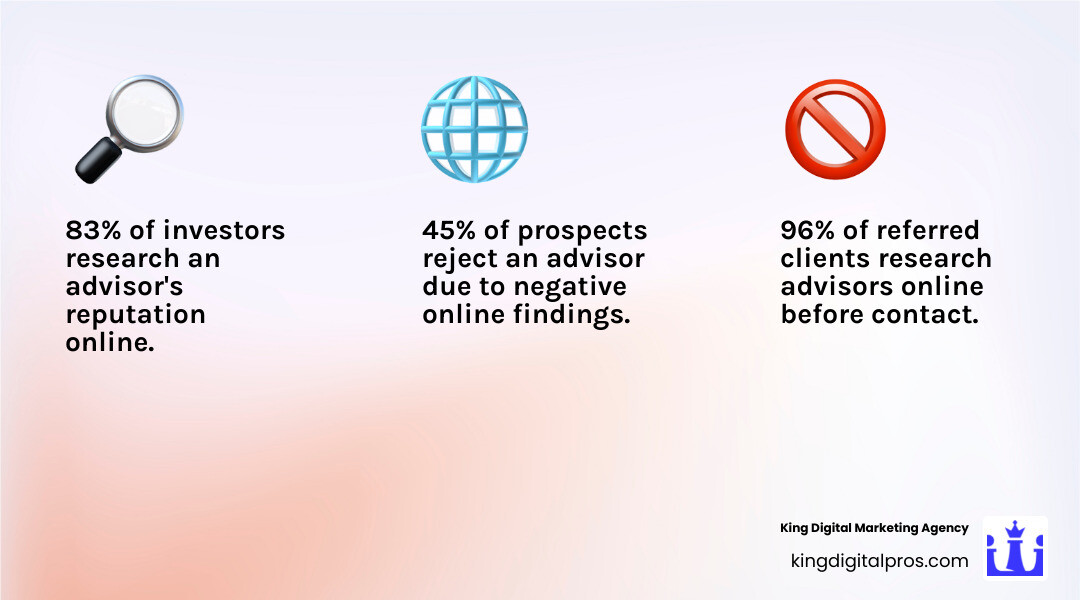
Infographic Details: Visual representation showing: 83% of investors research advisor reputations (source: Wealthtender study), 96% of referred clients research online before contact, 45% decide NOT to do business based on negative findings, 74% trust brands more with positive reviews, 95% don’t look past Google’s first page. Center graphic shows a financial advisor profile with branching elements for reviews, search results, social media, and content, illustrating the ecosystem of online reputation.
Why Your Digital Reputation is Your Most Valuable Asset
In today’s interconnected world, your digital reputation is a fundamental asset that directly influences your financial advisory practice’s growth. For financial advisors, where trust is the cornerstone of every client relationship, a strong online presence is paramount.
Online reputation management for financial advisors is crucial because it directly impacts client acquisition and retention. Consider this: 83% of households earning over $100,000 research an advisor’s reputation, including online reviews and awards, before considering working with them. Even if a potential client is referred by a trusted friend, 96% will still conduct their own online research before making contact. Your first impression is now happening online, long before you ever shake a hand.
The benefits of a strong online reputation are multifaceted. It fosters trust and credibility, essential in an industry where over half of consumers report low trust in financial providers. A stellar online reputation can differentiate you from competitors, attract new clients, and allow for higher fee realization. By consistently presenting a professional and trustworthy image across digital platforms, you can increase your revenue potential by almost 25%. It’s about demonstrating reliability and integrity to build an unshakable foundation for your business.
Conversely, neglecting online reputation management for financial advisors has severe consequences. A staggering 45% of people have decided against doing business with a professional based on negative online findings. This means negative reviews, outdated information, or a lack of online presence can directly translate into lost opportunities. Public complaints, inaccurate claims, or noncompliant marketing can trigger scrutiny from bodies like the SEC or FINRA, leading to fines and irreparable damage to your professional standing. A poor online reputation reduces inbound leads, increases client churn, and undermines your competitive advantage. As we like to say, your online reputation is truly your most valuable asset.
For more insights on leveraging your digital presence, explore our guide on Leveraging Your Reputation.
The Core Components of Online Reputation Management for Financial Advisors
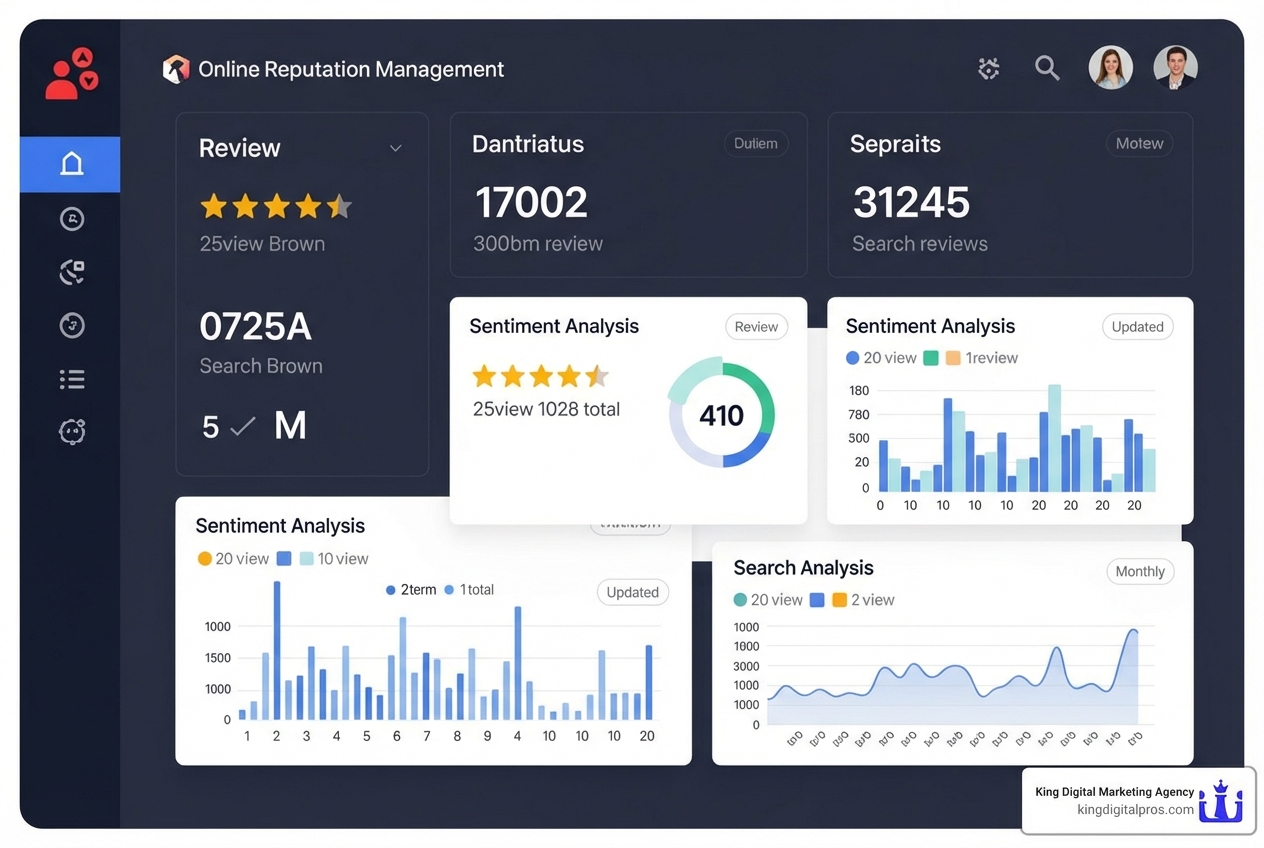
Effective online reputation management for financial advisors is a comprehensive strategy with several interconnected elements that shape public perception, attract new clients, and build lasting trust.
At King Digital, we pay particular attention to how these pieces show up in local search results and map listings in markets like Albuquerque, Rio Rancho, Santa Fe, Los Alamos, and other New Mexico communities.
The Power of Online Reviews and Testimonials
Online reviews serve as social proof, validating your expertise for potential clients. Research shows that 74% of consumers say positive reviews increase their trust in a brand. Independent research from Pew Research Center and BrightLocal confirms that most people trust online reviews almost as much as personal recommendations.
We recommend actively monitoring reviews across various platforms, including industry-specific sites, Google, and social media. Responding to reviews is crucial-while the average response time in financial services is 3.44 days, industry leaders respond in just 1.59 days. Prompt responses show dedication and can turn negative experiences into positive ones.
Since 70% of consumers will leave a review when asked, implement a compliant process for requesting them from satisfied clients. Testimonials can be prominently displayed on your website to build credibility, but always be mindful of compliance regulations.
To dig deeper into managing online feedback, check out our Review Management Services.
Search Engine Optimization (SEO) and Your Money or Your Life (YMYL)
SEO ensures that when potential clients search for financial advisors in their area-like Albuquerque, Rio Rancho, Santa Fe, or Los Alamos-you appear prominently. Statistics show 95% of people don’t look past Google’s first page, and 93% of website traffic comes from search engines.
For financial advisors, SEO is linked with Google’s E-A-T guidelines: Experience, Authority, and Trustworthiness. These are crucial for “Your Money or Your Life” (YMYL) content-information that can impact a person’s financial well-being. As a financial advisor, your content falls under YMYL, meaning Google holds it to higher quality standards.
To improve your E-A-T signals and search rankings:
- Demonstrate Expertise: Showcase credentials, certifications, and experience through detailed author bios
- Build Authority: Earn high-quality backlinks from reputable financial sites and establish thought leadership
- Ensure Trustworthiness: Maintain a secure website (HTTPS) with clear privacy policies and transparent service descriptions
Owning your search results means filling the first page with positive, relevant content when someone Googles your name. This is achieved through optimized social media profiles, a strong website, accurate local listings, and consistent content creation.
For a deeper dive into how Google evaluates content, refer to Google’s Quality Rater Guidelines. For expert assistance with your digital presence, consider our Digital Marketing Agency for Small Businesses.
Content and Social Media as Trust-Building Tools
Content creation and social media are powerful tools for building trust and demonstrating expertise. Authority blogging establishes you as a thought leader-53% of investors want financial education from their advisors. While only 44% of advisors currently share personalized content, 42% of investors prefer it.
Social media platforms, particularly LinkedIn and Twitter, are essential for financial professionals. These platforms often have high domain authority, meaning they rank well in search results and provide direct engagement opportunities.
Valuable content ideas for financial advisors include:
- Market updates and analysis
- Retirement planning guides
- Tax strategy articles
- Estate planning basics
- Educational videos on financial concepts
- Compliant case studies
- Q&A sessions
- Investment infographics
- Personal stories that build connection
For more on how reviews, content, and local listings influence nearby prospects, explore our overview of Local Business Reputation.
A Proactive Blueprint for Building and Protecting Your Reputation

Protecting your online reputation is an ongoing commitment. A proactive approach is always more effective than reactive, especially in the digital world. In the tightly regulated financial sector, a proactive strategy helps you spot and address potential compliance issues early, before they escalate into formal complaints or attract regulatory attention from the SEC or FINRA.
Proactive Strategies for Online Reputation Management for Financial Advisors
Here’s how to build and improve your online reputation:
- Monitor Your Presence: Set up Google Alerts for your name and firm. Regularly search yourself on Google to see what prospects see.
- Optimize Your Google Business Profile: For New Mexico communities including Albuquerque, Rio Rancho, Santa Fe, and Los Alamos, claim your listing, ensure accuracy, add photos, and encourage reviews.
- Create Professional Social Media Profiles: Establish active LinkedIn profiles that occupy prime search result real estate.
- Publish SEO-Optimized Content: Create high-quality content addressing client pain points using relevant keywords.
- Compliantly Request Reviews: 70% of consumers will leave reviews when asked-develop a compliant process following your firm’s procedures.
- Conduct Regular Audits: Review your entire online footprint periodically to ensure consistency.
- Plan for Reputation Risk: Develop written protocols for responding to serious complaints or negative articles.
For more detailed strategies on handling client feedback, explore our guide on Manage Customer Feedback.
Best Practices for Responding to Online Reviews
Responding to reviews shows you’re engaged and value client feedback.
Responding to Positive Reviews:
- Express gratitude: “Thank you for your kind words”
- Reinforce strengths: “We’re glad we could help with your retirement plan”
- Keep it concise and professional
- Invite continued engagement
Responding to Negative Reviews:
- Respond within 24-48 hours
- Acknowledge and empathize: “We’re sorry to hear about your experience”
- Maintain professionalism-never argue or get defensive
- Avoid disclosing client specifics or account details
- Offer to take conversation offline with direct contact information
- Document everything for compliance
- Learn from feedback to improve services
Review Response Do’s and Don’ts:
DO’S:
- Respond to every review
- Be polite and professional
- Use reviewer’s name if appropriate
- Thank positive reviewers
- Apologize for negative experiences
- Offer offline resolution paths
- Keep responses concise
- Proofread before posting
DON’TS:
- Get defensive or argue
- Disclose confidential information
- Use generic responses
- Blame the client
- Make promises you can’t keep
- Delay responses
- Create fake reviews
For advisors under strict compliance oversight, create a library of pre-approved response templates that can be customized while meeting regulatory expectations.
The Compliance Tightrope: Navigating SEC Rules and Regulations
For financial advisors, online reputation management is intertwined with strict regulatory compliance. Navigating the rules from the SEC (Securities and Exchange Commission) and FINRA requires careful attention, as ignoring them can lead to significant penalties, reputational damage, and even loss of licensure.
Navigating Compliance in Online Reputation Management for Financial Advisors
The SEC’s Marketing Rule, updated in 2020, significantly changed how investment advisors can use testimonials and endorsements. Historically, testimonials were largely prohibited in advertising. However, the rule now permits the use of testimonials and endorsements, provided certain conditions are met, including disclosure requirements and oversight. This evolution allows advisors to share reviews posted on third-party platforms, but with strict limitations. For example, you generally cannot cherry-pick only favorable reviews in a misleading way, and you must avoid actions that could make independent third-party sites appear to be producing sponsored or curated content.
Key compliance considerations for your online reputation management for financial advisors efforts include:
- The SEC Marketing Rule: Understand the nuances of this rule, especially regarding testimonials and endorsements. Any review or statement used in your advertising (which includes your website, social media, and other public-facing digital assets) must comply. This means disclosing if the testimonial is from a current or former client, any compensation paid, and potential conflicts of interest. Statements must be accurate, fair, and balanced, without false or misleading language or guarantees of future performance. You can review the rule and related guidance directly on the SEC website.
- Recordkeeping Requirements: All marketing, reviews, and public communications must be archived according to SEC/FINRA recordkeeping rules. This means every tweet, every blog post, every review response, and any use of client testimonials needs to be captured and stored for a specified period. This is crucial for demonstrating compliance during audits.
- Disclosures for Testimonials: If you feature client testimonials, ensure they are accompanied by clear disclosures as required by the SEC. These typically state whether the person is a client, if they were compensated, and that their experience may not be representative of others.
- Avoiding Misleading Statements: Never make claims that guarantee specific returns or imply that your services are without risk. All communications must be factual and not misleading. FINRA’s guidance on communications with the public, available at finra.org, is a useful companion reference for broker-dealer representatives.
- Working with a Compliance Department: Before posting anything online or implementing a new review strategy, always consult with your firm’s compliance department. They can provide guidance specific to your practice and ensure all your online reputation management for financial advisors activities meet regulatory standards. Pre-approval workflows for external communications are highly recommended to reduce regulatory risk.
The SEC provides guidance on these matters, and staying informed is vital. You can find more detailed information directly from the source, such as the SEC guidance on testimonials and social media. Navigating this complex landscape is essential for protecting your practice. For additional support in managing your online presence while adhering to regulations, consider our services on how to Clean Up Internet Reputation.
Frequently Asked Questions about Advisor Reputation Management
We understand that online reputation management for financial advisors can seem daunting. Here are some of the most common questions we hear, along with our expert insights.
Should I manage my reputation in-house or hire a service?
This is a common dilemma, and the answer often depends on your resources, expertise, and the complexity of your needs.
In-house management requires significant internal capacity and discipline. You’ll need dedicated staff with skills in SEO, content creation, social media management, PR, and review solicitation. Crucially, they must also possess a strong understanding of financial industry compliance regulations. For a small firm, dedicating the necessary time and expertise can be challenging, as it pulls resources away from core advisory services. While it offers direct control, the learning curve and time commitment can be substantial.
Hiring a specialized service, like King Digital, offers several advantages. We bring specialized knowledge, proven methodologies, and a deep understanding of the unique challenges financial advisors face, including compliance. A reputable service can provide objectivity, accelerate content creation, manage crisis situations effectively, and free up your valuable time to focus on your clients. Costs for retained programs for small to mid-sized advisory firms typically range from $2,000-$10,000 per month, which can be a strategic investment when weighed against the potential loss of clients due to a poor online reputation. As the saying goes, “Don’t let unqualified hands manage a bank account”-the same applies to your reputation.
If your schedule prevents you from paying close attention to your online reputation, or if you encounter issues that seem beyond your grasp, hiring an online reputation management for financial advisors specialist is often the right solution to boost your business.
How can I measure the success of my reputation management efforts?
Measuring the success of your online reputation management for financial advisors efforts is crucial to ensure your strategies are yielding positive results and demonstrating a return on investment. Here are key performance indicators (KPIs) we track:
- Search Engine Rankings: Monitor your position for your name, your firm’s name, and relevant service keywords (e.g., “financial advisor Albuquerque”). Improved rankings, especially on the first page of Google, indicate better visibility.
- Review Volume and Sentiment: Track the number of new reviews you receive and your average star rating across platforms. An increase in positive reviews and a higher average rating are strong indicators of success. We also analyze the sentiment of mentions (positive vs. negative ratio).
- Lead Growth: Are you seeing an increase in qualified leads coming through your website or direct inquiries that mention finding you online? This is a direct measure of your reputation’s impact on client acquisition.
- Website Traffic: Look at organic search traffic to your website. An increase suggests that more people are finding you through search engines, often as a result of improved SEO and content. Also monitor branded search volume (how many people are searching specifically for your name or firm).
- Media Mentions and Placements: Track any positive news articles, interviews, or features about you or your firm.
- Net Promoter Score (NPS) and Client Retention Rate: While not purely online, these metrics can be influenced by your online reputation. Happy clients who are proud to refer you are often the result of a strong overall perception.
- Share of First-Page SERP Assets: This measures how many of the results on Google’s first page for your name are positive and under your control (e.g., your website, LinkedIn, reputable directories).
Combining SEO metrics with business outcomes provides the most accurate picture of your online reputation management for financial advisors impact.
How long does it take to improve an online reputation?
Patience is a virtue, especially in online reputation management for financial advisors. While some changes can be seen relatively quickly, meaningful and durable improvements take time.
- Quick Wins (Days to Weeks): You can see immediate results by optimizing your Google Business Profile, setting up Google Alerts for monitoring, and responding promptly to existing reviews. Correcting inaccurate listings and updating social media profiles can also have a rapid impact on your immediate online presence.
- Meaningful Improvement (3-6 Months): Significant shifts in search results and the establishment of new trust signals typically begin to appear within 3 to 6 months of consistent effort. This phase involves regular content creation, active review generation, and strategic social media engagement. Search engines need time to crawl and index new content, and for new positive assets to gain authority.
- Durable, Long-Term Shifts (6-18 Months+): Building a truly robust and resilient online reputation is an ongoing process. Durable changes, where negative content is effectively suppressed and a strong, positive narrative is firmly established, often require 6 to 18 months of sustained online reputation management for financial advisors efforts. This is about building long-term authority and trust, which takes consistent vigilance and adaptation.
It’s important to approach reputation management with a long-term mindset, recognizing that consistent effort and strategic execution are key to sustained success.
Conclusion: Secure Your Practice’s Future with a Sterling Reputation
In the high-stakes world of financial advisory, your online reputation is not just a reflection of your practice—it’s a powerful engine for growth, a shield against adversity, and the very foundation of client trust. From the critical importance of glowing reviews and strategic SEO to the nuanced navigation of SEC compliance, effective online reputation management for financial advisors is a holistic and ongoing endeavor.
We’ve explored how a strong digital footprint attracts new clients and retains existing ones, changing casual browsers into loyal advocates. We’ve digd into the core components, from mastering online reviews and using the power of SEO’s E-A-T guidelines, to leveraging content and social media as trust-building tools. And we’ve walked the compliance tightrope, ensuring your online activities are not only effective but also fully compliant with strict financial regulations.
The internet’s influence on client decisions is only going to continue increasing. By proactively monitoring your presence, thoughtfully responding to feedback, consistently generating positive sentiment, and adhering to compliance, you can take control of your online narrative.
At King Digital, we specialize in building strong local digital presences, expertly managing map listings, and optimizing online reputations for businesses like yours in our local communities across New Mexico. We understand the unique challenges financial advisors face and are here to help you turn your online reputation into your most valuable asset.
Don’t let your digital presence be left to chance. Take the reins of your online narrative and secure your practice’s future with a sterling reputation.
Get started with professional Reputation Management.
