

Online Reputation for Doctors: Essential 5-Star
Why Your Online Reputation Matters More Than Your Medical Degree
Online reputation for doctors is the digital reflection of your practice that patients see before they ever walk through your door. In today’s healthcare landscape, managing your online presence is no longer optional-it’s essential for practice growth and patient trust.
Quick answer: To manage your online reputation effectively, you need to:
- Monitor reviews across Google, Healthgrades, Vitals, and other platforms
- Respond professionally to all feedback (positive and negative) while maintaining HIPAA compliance
- Encourage satisfied patients to share their experiences through simple, ethical review requests
- Optimize your digital presence by claiming and updating all online listings
- Train your staff to deliver consistently excellent patient experiences
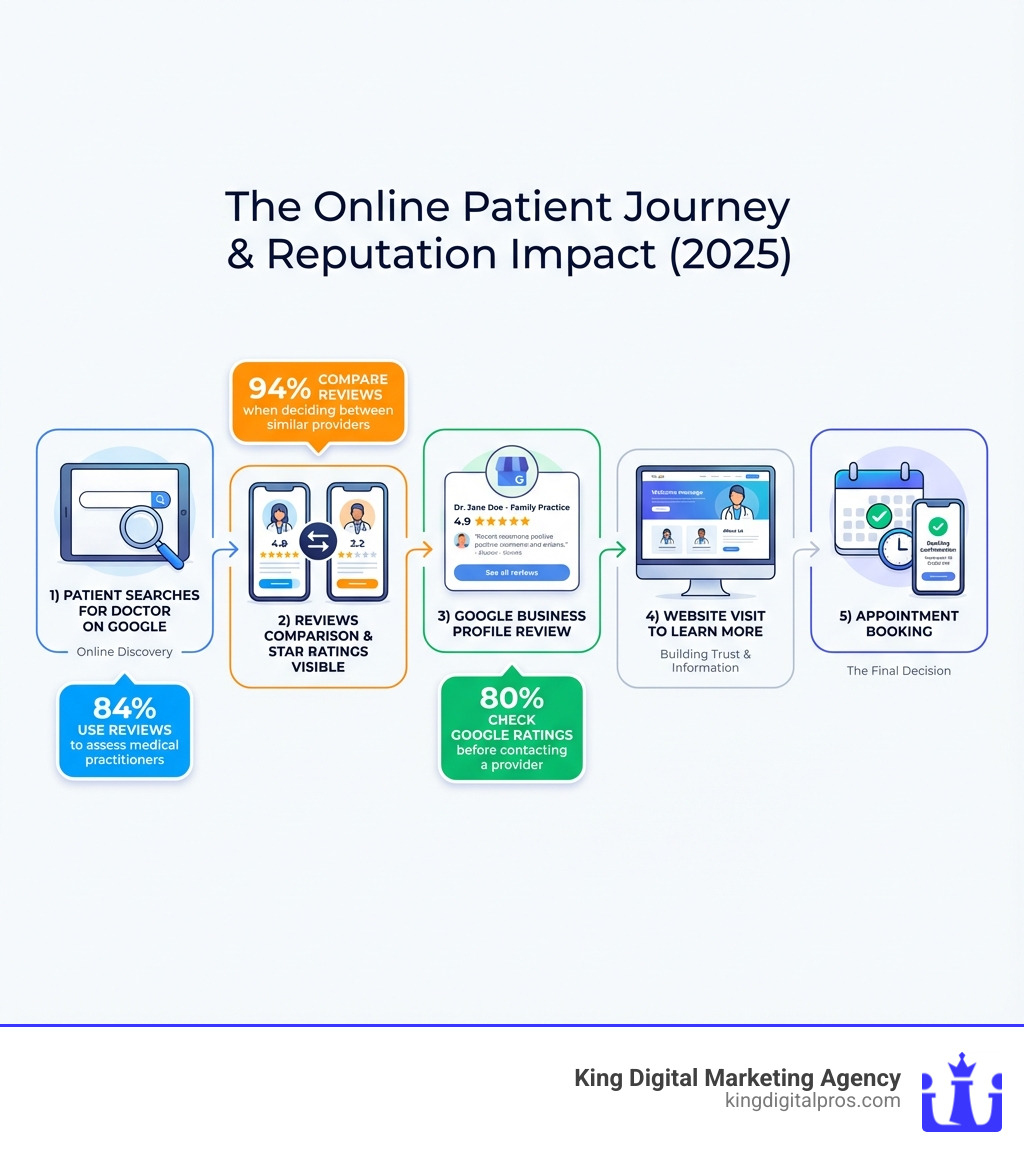
The numbers tell a compelling story. Almost 84% of patients rely on online reviews to assess medical practitioners, and 94% consider reviews when deciding between similar providers. Even more striking: 64% of patients are willing to pay more to see doctors with higher quality ratings.
Your online reputation impacts more than just patient acquisition. It directly affects your practice’s visibility in local search results, with 80% of patients checking Google review ratings before making a decision to contact a provider. Reviews are one of the top three factors that impact local SEO, meaning they determine whether patients even find you in the first place.
The stakes are clear. A single neglected negative review can damage your practice, while a thoughtfully managed online presence can drive a 30% boost in new patient traffic and a 50% increase in organic traffic to your website.
I’m Bernadette King, founder of King Digital Marketing Agency, and I’ve spent years helping healthcare practices build and protect their digital presence through strategic online reputation for doctors. This guide will show you exactly how to take control of your practice’s narrative and turn patient feedback into your most powerful marketing asset.
The Critical Impact of Online Reputation for Doctors
In our increasingly digital world, your practice’s online reputation is the cornerstone of its success. It influences everything from patient acquisition and trust to your visibility in local search results. We’ve seen how a strong digital presence can transform a medical practice in areas like Albuquerque, Rio Rancho, or Santa Fe.
Patient acquisition is undeniably tied to what prospective patients find when they search for a healthcare provider. The statistics are staggering: almost 84% of patients rely on online reviews to assess medical practitioners, and a remarkable 94% consider reviews when deciding between similar providers. This means that if you have a competitor with a better online presence and more positive reviews, you’re likely losing potential patients to them. Patients need trust, and for many, that trust begins with what they read online.
Beyond attracting new patients, a robust online reputation builds and reinforces patient trust. When patients see a consistent stream of positive feedback, it validates their choice and makes them more comfortable with your practice. Conversely, a poor or neglected online presence can erode trust, making patients question the quality of care or the professionalism of your staff.
Your online reputation also plays a crucial role in your local SEO and search engine rankings. We know that 80% of patients looking for providers look at the Google review overall ratings and consider these ratings on Google search before making a decision. Positive reviews, especially on platforms like Google, signal to search engines that your practice is credible and relevant, boosting your visibility. This is vital for any local business, including medical practices, as it directly impacts how easily patients in your community can find you. For a deeper dive into how online visibility impacts your practice, explore our guide on Local Business Reputation.
Neglecting your online reputation for doctors can have severe consequences. It can lead to diminished patient trust, reduced clinic growth, and a significant drop in new patient inquiries. If your practice isn’t actively managing its online presence, someone else-whether it’s a disgruntled patient or an outdated listing-will define your narrative for you.
How Online Reviews Influence Patient Choice
Online reviews are the new word-of-mouth. They are powerful testimonials that can sway a patient’s decision long before they ever step into your office. We’ve seen patients in Corrales and Taos make healthcare decisions based almost entirely on what they read online.

When patients compare doctors online, they’re not just looking at star ratings; they’re analyzing several factors:
- Star Ratings: This is often the first thing a patient notices. While a perfect 5.0 rating might seem ideal, some research suggests that patients don’t always believe them. Instead, ratings between 4.5 to 4.9 often yield the best ROI, as they appear more authentic.
- Review Volume: A higher number of reviews indicates a more established and trusted practice. A study found that physicians with more than 100 reviews had a greater average numerical rating than physicians with fewer than 50 reviews. This implies that practices actively managing their reputation tend to accumulate more positive feedback.
- Review Recency: Patients want current information. Recent reviews reassure them that the feedback is still relevant and that the practice maintains its standards.
- Patient Testimonials: Beyond just stars, the content of reviews matters. Patients look for specifics about the quality of care, the doctor’s bedside manner, staff friendliness, and ease of scheduling. These qualitative insights provide reassurance.
- Quality of Care Perception: Most patients believe a doctor’s online reputation correlates to their quality of care. This perception, whether accurate or not, is a powerful driver of patient choice.
- Out-of-Network Choices: The influence of reviews is so strong that 43% of patients would go out-of-network for a provider with more favorable reviews. Furthermore, 64% of patients are willing to pay more to see doctors who have higher quality ratings. This underscores the immense value of a stellar online reputation.
The Connection Between Reviews and Local SEO
For practices in Edgewood, Grants, or Los Alamos, being visible in local search results is paramount. When a patient searches for “family doctor near me” or “orthopedic surgeon Santa Fe,” you want your practice to appear at the top. This is where local SEO, heavily influenced by online reviews, comes into play.
Google’s local search algorithm considers three main factors when ranking local businesses:
- Relevance: How well your practice’s information matches the patient’s search query. A comprehensive Google Business Profile (GMB) listing with detailed services, specialties, and hours helps Google understand your relevance.
- Distance: How far your practice is from the searcher’s location. While we can’t change geography, optimizing your GMB ensures Google accurately identifies your location and serves it to nearby patients.
- Prominence: How well-known and authoritative your practice is online. This is where user-generated content, particularly online reviews, shines. Search engine optimization (SEO) experts agree that user-generated content, such as reviews, is heavily weighted by search engines. A high volume of positive reviews from various sources boosts your prominence.
Your Google Business Profile is the front door for many patients. Optimizing it with accurate information, photos, and regular updates, coupled with a consistent flow of positive reviews, significantly increases your practice’s visibility. We’ve helped practices achieve a 50% increase in organic traffic by improving their SEO through positive reviews. This means more patients finding your practice naturally, without expensive paid advertising. To understand more about how Google ranks local businesses, we encourage you to review their official guidance on how Google determines local ranking.
Proactive Strategies to Build a 5-Star Reputation
Building a stellar online reputation for doctors isn’t about magic; it’s about implementing consistent, proactive strategies that focus on patient experience, staff training, and optimizing your digital presence. It’s about leveraging every touchpoint to showcase the exceptional care you provide. This proactive approach is a cornerstone of Leveraging Your Reputation for sustained growth.
Best Practices for Encouraging Positive Patient Reviews
We know that satisfied patients are your best advocates, but they often need a gentle nudge to share their experiences online. Here are our tried-and-true methods for ethically encouraging positive reviews:

- Personalized Review Requests: Directly ask happy patients for reviews. This can be done via a follow-up email or SMS after their appointment. Software solutions can automate these requests, making it seamless for both your team and your patients.
- In-Office Prompts: Make it easy for patients to leave reviews while they’re still in your office. This could involve small cards with QR codes at the front desk, or even an iPad in the waiting room for immediate feedback.
- Patient Satisfaction Surveys: Implement patient satisfaction surveys, such as a Net Promoter Score (NPS) survey. These surveys help you identify your “promoters”-patients who are highly satisfied and likely to recommend your practice. You can then follow up with these individuals with a direct request for an online review. This is a fantastic way to gather feedback and funnel positive experiences into public reviews. Learn more about how these solutions work with our Online Feedback Solutions.
- Explain the “Why”: Briefly educate patients on why their feedback matters. Explain that reviews help other patients find quality care and that their input helps you improve. This can make them more likely to take the time to write a review.
The key is to make the process as easy and ethical as possible. Never offer incentives for positive reviews, as this can be seen as manipulative and may violate review platform guidelines.
Optimizing Your Digital Footprint
A strong digital footprint ensures that when patients search for you, they find accurate, compelling information that reflects positively on your practice.
- Claiming and Optimizing Your Google Business Profile: This is non-negotiable. Claim your GMB listing and fill out every single section completely. Include detailed descriptions of your services, specialties, hours, contact information, high-quality photos, and even a virtual tour if possible. Keep it updated with posts about practice news, health tips, or special events. An optimized GMB is a powerful local SEO tool.
- Website Optimization: Your website is your digital storefront. Ensure it’s visually appealing, easy to steer, mobile-responsive, and accessible. Optimize your web copy with relevant keywords (e.g., “family doctor Albuquerque NM,” “pediatrician Santa Fe”) to improve your Google ranking. Include patient testimonials directly on your site to showcase positive experiences.
- Social Media Profiles: Maintain professional social media profiles (e.g., LinkedIn, Facebook) that align with your brand. These platforms allow you to engage with your community, share valuable health information, and humanize your practice.
- Top Physician Directories: Beyond Google, there are numerous industry-specific directories where patients search for doctors. Claiming and optimizing your profile on these sites is crucial for visibility and consistent NAP (Name, Address, Phone) information, which further aids local SEO. Some of the top directories include:
- WebMD’s Physician Directory
- Healthgrades Doctor Directory
- The American Medical Association Doctor Directory
- ZocDoc
- US Health News
- Caredash Doctor Directory
- Vitals Doctor Directory
- RateMds.com Directory
- Realself Physician Directory (especially for cosmetic doctors)
Ensure your NAP is identical across all these listings. Inconsistent information can confuse search engines and harm your local ranking.
The Role of Staff Training in Patient Satisfaction
Your staff is the backbone of your practice and often the first point of contact for patients. Their interactions directly impact patient satisfaction, which, in turn, influences online reviews. We’ve observed that many negative reviews stem from non-physician-related issues like billing problems, long wait times, or perceived rudeness from front desk staff.
- Front Desk Etiquette and Communication Skills: Train your front desk team to be welcoming, empathetic, and efficient. Clear communication about wait times, insurance, and procedures can prevent frustration.
- Empathy and Handling Complaints: Equip your staff with the skills to listen actively and respond empathetically to patient concerns, even if they can’t immediately solve the problem. Knowing how to de-escalate a situation can prevent a negative experience from turning into a scathing online review.
- Reducing Wait Times: Long wait times are a common complaint. Streamline your check-in processes, optimize scheduling, and communicate proactively with patients about any delays.
- Creating a Welcoming Environment: From the cleanliness of your waiting room to the tone of voice used by your nurses, every detail contributes to the patient experience. Doctor’s visits are rarely something people look forward to; in fact, 3% of the population has a true iatrophobia (fear of doctors). A warm, consistent, and reassuring environment can make a significant difference.
Investing in staff training is an investment in your online reputation for doctors. It ensures that every patient interaction reinforces the positive image you want to project.
Navigating Negative Feedback with Professionalism and Compliance
Even with the best intentions and proactive strategies, negative reviews are an inevitable part of doing business in the digital age. What truly defines your online reputation for doctors is how you handle them. We view negative feedback not as a threat, but as an opportunity for growth and to demonstrate your commitment to patient care. This approach is central to effective Manage Customer Feedback.
A Step-by-Step Guide to Responding to Negative Reviews
Responding to negative reviews requires a thoughtful, strategic approach. Here’s how we advise our clients to do it:
- Acknowledge Promptly: Aim to respond within 24-72 hours. A timely response shows that you are attentive and take patient feedback seriously.
- Empathize Without Admitting Fault: Express regret that the patient had a negative experience. Use phrases like, “We’re sorry to hear that your visit didn’t meet your expectations.” Avoid specific details that could admit liability or violate HIPAA.
- Take the Conversation Offline: Always invite the patient to contact your office directly to discuss their concerns further. Provide a specific contact method, such as a phone number or email for your office manager. This moves the discussion to a private channel where you can address the issue in detail.
- Avoid Specifics: Do not mention patient names, dates of service, medical conditions, or any other Protected Health Information (PHI) in your public response.
- Document the Complaint: Internally, investigate the complaint thoroughly. Review patient notes, speak with staff members involved, and identify any areas for improvement.
- Follow Up Internally: If possible, resolve the issue directly with the patient offline. A successful resolution can sometimes lead the patient to amend or remove their original review. Even if they don’t, your thoughtful response is visible to other potential patients, and 36% of patients overlook negative reviews if the provider responded thoughtfully.
Your response isn’t just for the original reviewer; it’s for every potential patient who reads it. A professional, empathetic response can turn a negative into a positive, showcasing your practice’s dedication to patient satisfaction.
Maintaining HIPAA Compliance in Your Responses
HIPAA compliance is paramount when responding to online reviews. Violating patient privacy can lead to severe penalties and further damage your reputation. We understand that 37% of physicians think doctor-patient confidentiality is the biggest threat to their reputation when engaging online.
- Protected Health Information (PHI): Under no circumstances should you disclose any PHI in a public response. This includes patient names, diagnoses, treatments, or even confirmation that someone is a patient of your practice.
- General Responses: Keep your responses generic. Focus on your practice’s commitment to quality care and patient satisfaction, and always direct the conversation offline. For example, “We value all patient feedback and are committed to providing the best possible care. Please contact our office directly so we can address your concerns privately.”
- Avoiding Patient Identification: Even if a reviewer identifies themselves, you cannot acknowledge them as a patient publicly. Your response should remain general.
- Legal Risks: Ignoring HIPAA can lead to significant legal and financial repercussions. It’s crucial to be well-versed in these regulations. For official guidance and comprehensive information, consult the official guidance on HIPAA from the U.S. Department of Health & Human Services.
- Consulting Legal Counsel: If you are ever in doubt about how to respond to a specific review, especially one that is particularly sensitive or potentially defamatory, always consult your legal department or an attorney specializing in healthcare law. It’s better to be safe than sorry.
Tools, Measurement, and Advanced Strategies
Managing your online reputation for doctors is an ongoing process that benefits greatly from specialized tools, diligent measurement, and advanced strategies custom to your practice. From Albuquerque to Santa Fe, we help practices leverage these elements for maximum impact.
How King Digital Helps Manage Online Reputation for Doctors
At King Digital Marketing Agency, we specialize in empowering healthcare providers to take control of their digital narrative. Our solutions are designed to simplify the complexities of online reputation for doctors, allowing you to focus on what you do best: providing excellent patient care.
- Review Monitoring: We provide comprehensive monitoring across all major review platforms, including Google, Healthgrades, Yelp, and more. This ensures you’re always aware of what patients are saying about your practice in real-time.
- Automated Review Requests: We implement ethical, automated systems to solicit reviews from your satisfied patients. This can include post-visit emails or SMS messages, making it easy for patients to share their positive experiences.
- Feedback Management: Our tools help you gather and organize patient feedback, whether it’s through direct surveys or public reviews. This allows you to identify trends and areas for improvement efficiently.
- Reporting and Analytics: We provide clear, actionable reports on your online reputation performance. You’ll see trends in star ratings, review volume, and patient sentiment, giving you valuable insights into your practice’s digital health.
- Centralized Dashboard: Our solutions offer a centralized dashboard where you can view all your reviews, manage responses, and track your reputation metrics from a single, easy-to-use interface. This takes the guesswork out of reputation management and streamlines your efforts.
Our goal is to give you the clarity and control you need to build and maintain a thriving online reputation for doctors.
Measuring the ROI of Your Reputation Management Efforts
Understanding the return on investment (ROI) of your reputation management efforts is crucial. It helps you see the tangible benefits of your hard work and justify continued investment.
- Tracking New Patient Sources: Ask every new patient how they heard about your practice. You’ll likely see a significant increase in those who mention online reviews or search engines.
- Increase in Appointment Bookings: Monitor your appointment scheduling data. A well-managed online reputation often correlates with a noticeable uptick in new patient bookings.
- Website Traffic Analysis: Use tools like Google Analytics to track organic website traffic. A boost in search rankings driven by positive reviews should lead to more visitors to your site, potentially indicating a 50% increase in organic traffic.
- Improved Search Rankings: Regularly check your practice’s position in local search results for key terms. As your reputation improves, you should see your practice climb higher in Google’s local pack and organic listings.
- Patient Satisfaction Survey Trends: If you use patient satisfaction surveys, track trends over time. Improvements in satisfaction scores often precede or coincide with an increase in positive online reviews.
By consistently measuring these metrics, you can clearly demonstrate how investing in your online reputation for doctors directly contributes to your practice’s growth and financial health.
Differentiating Strategies: Specialists vs. General Practitioners
While the core principles of online reputation for doctors apply to all medical professionals, there can be subtle differences in strategy between specialists and general practitioners (GPs). A study examining physician rating websites provided some interesting insights into these differences.
- Higher Review Volume for Specialists: The study found that orthopedic surgeons (specialists) were more likely than family medicine physicians (GPs) to have a large number of reviews and an average numerical rating greater than 3. In fact, out of 192 physicians with more than 100 reviews, 178 were orthopedic surgeons, compared to only 14 family medicine physicians. This might suggest that specialists are more actively engaged in reputation management or that patients are more inclined to review a specific procedural experience. You can read more about this in the research article, “A Large Number of Reviews on Physician Rating Websites May Reflect Reputation Management.”
- Focus on Procedural Outcomes (Specialists): For specialists like orthopedic surgeons or cardiologists, reviews often highlight successful procedures, positive outcomes, and technical expertise. Your reputation management strategy should emphasize these successes, perhaps through patient stories or testimonials focusing on their journey and recovery.
- Broader Focus for GPs (General Practitioners): For GPs, reviews tend to focus more on ongoing relationships, communication, accessibility, and the overall patient experience. Building community trust, consistency of care, and staff friendliness become even more critical. Your strategy should highlight your role as a trusted family health partner and the comprehensive nature of your care.
Regardless of your specialty, the goal remains the same: to curate an online presence that accurately reflects the quality of your care and attracts the right patients to your practice, whether they’re looking for a specialist in Los Alamos or a family doctor in Tijeras.
Conclusion: Take Control of Your Practice’s Narrative
Your online reputation for doctors is no longer a passive byproduct of your practice; it’s an active, dynamic asset that requires consistent attention and strategic management. In today’s competitive healthcare landscape, patients in Albuquerque, Rio Rancho, Santa Fe, and beyond are turning to the internet first to make crucial decisions about their health.
By embracing proactive management, you’re not just reacting to feedback; you’re building a narrative that showcases your expertise, compassion, and commitment to patient care. A stellar online reputation fosters patient trust, drives new patient acquisition, and ultimately becomes a long-term asset that secures the future and growth of your practice. It cultivates patient loyalty and ensures that your practice remains a guide of quality in your community.
At King Digital Marketing Agency, we’re passionate about helping healthcare providers like you steer this digital world with confidence. By optimizing your digital presence and actively managing feedback, we can help you build a reputation that attracts new patients and secures the future of your practice.
Don’t let your online story be written by chance. Take control of your practice’s narrative today. If you’re ready to transform your online presence and attract more patients, we’re here to help. Get expert help with your Physician Review Management and let us help you build the 5-star reputation your practice deserves.