

Doctor online presence: Mastering 2026
The New Front Door to Your Practice
A doctor online presence is your practice’s digital waiting room-where patients form their first impression before ever stepping through your door. Here’s what you need to establish an effective online presence:
- Claim and optimize your Google Business Profile – This is where most patients will find you first
- Build a professional, mobile-friendly website – Fast, clear, and easy to book appointments
- Get listed on key directories – Healthgrades, Zocdoc, and other review platforms
- Gather and respond to patient reviews – 90% of patients read them before choosing a doctor
- Keep your information consistent – Same name, address, and phone number everywhere
- Share your care philosophy – Professional photos, detailed bio, and what makes you unique
The healthcare landscape has shifted dramatically. 70% of patients now shop for physicians online before making a decision. More than 3 million people search for a doctor online every single day. The digital space isn’t just a marketing channel-it’s where patients begin their healthcare journey.
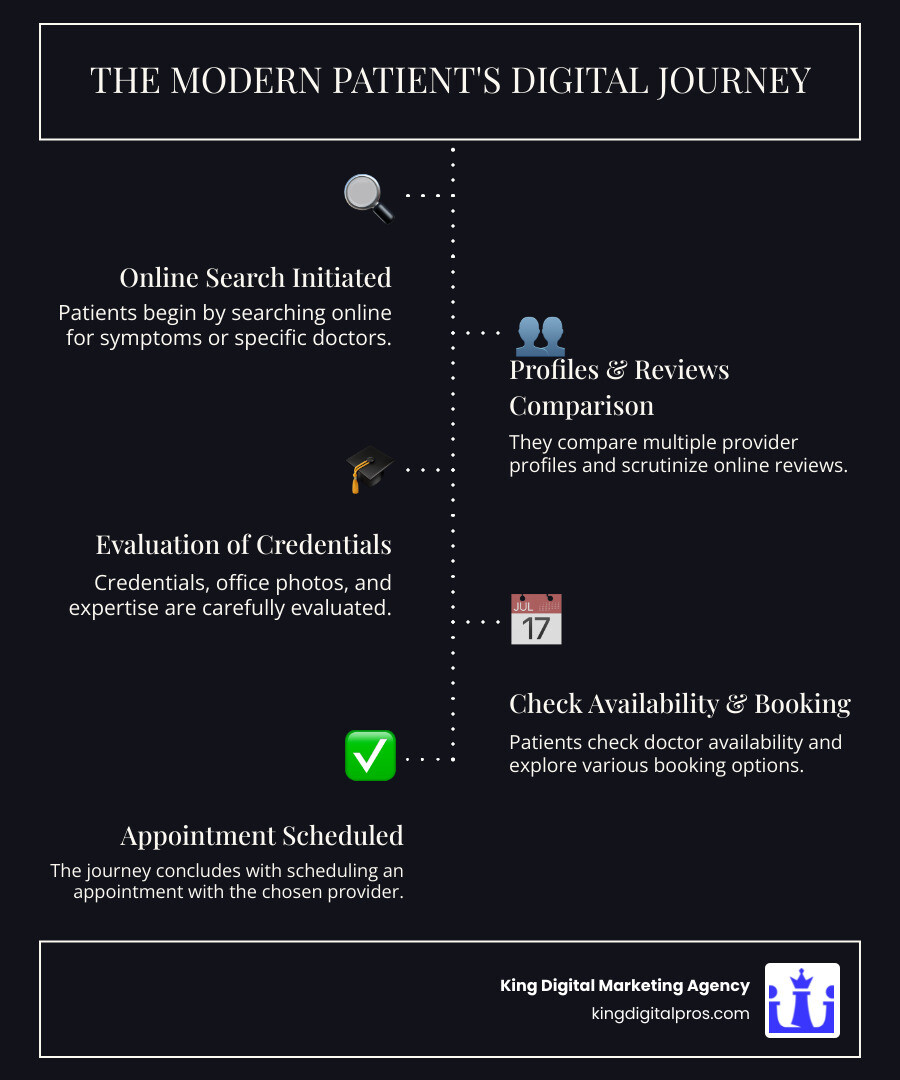
Traditional word-of-mouth recommendations still matter, but they’ve moved online. Patients now look at an average of 26 provider options before booking an appointment. They read reviews, compare credentials, study office photos, and evaluate your entire digital footprint. In fact, 63% of Americans will choose one provider over another solely because of a strong online presence.
The rise of telemedicine has only intensified this shift. Virtual consultations have become standard care, making your digital accessibility not just a convenience but an expectation. Patients want to find you easily, understand who you are, and trust you-all before they ever make contact.
I’m Bernadette King, and through King Digital Marketing Agency, I’ve helped dozens of healthcare providers transform their digital presence and attract more local patients. Building a strong doctor online presence isn’t about complex marketing tactics-it’s about making it simple for patients to find you, trust you, and choose you when they need care.
Why Your Digital Handshake Matters in Modern Healthcare
The days of relying solely on referrals or a listing in the Yellow Pages are long gone. Today, patients are empowered. They have a world of information at their fingertips, and they’re not afraid to use it to make informed decisions about their health. Your doctor online presence is your practice’s digital handshake, often the very first interaction a potential patient has with you. It’s where trust is built, questions are answered, and appointments are made.

Patients are actively seeking out healthcare providers, and search engines are their primary tool. They aren’t just looking for a doctor; they’re looking for the right doctor for them. Online reviews and social proof have become paramount in this decision-making process. Over 90% of patients consult reviews when searching for a doctor, and 76% of people say a positive online reputation influenced their decision to choose one physician over another. This isn’t just about attracting new patients; a strong online presence also plays a significant role in patient retention, reinforcing confidence in existing patients. Your online first impression is often the only first impression you get.
How Patients Find and Choose Doctors Today
Imagine someone in Albuquerque, NM, needs a new primary care physician. What’s the first thing they do? They likely pull out their smartphone and type “doctor near me” or “best family doctor Albuquerque” into a search engine. This simple act triggers a cascade of online activity.
Patients are remarkably thorough. They look at an average of 26 provider options before booking an appointment. This means they’re not just clicking on the first result; they’re comparing, contrasting, and evaluating. Their journey often includes:
- Review Sites: Physician review sites frequently rank at the top of search results. Patients are looking for star ratings and what other patients have to say. 59% of patients surveyed indicated that patient experience ratings are very or somewhat important in selecting a physician.
- Your Website: Once they’ve narrowed down their options, they’ll visit your website. Is it professional? Easy to steer? Does it provide clear information about your services, philosophy, and how to book an appointment?
- Social Media: While perhaps not the primary booking channel, social media can influence perception. It’s a place where patients might look for educational content, community engagement, or simply to get a feel for your practice’s personality.
To truly attract and retain patients in our local communities like Santa Fe, Rio Rancho, or Los Alamos, we need to understand this intricate patient journey. It’s about being visible, credible, and approachable wherever patients are looking. For more insights on how to capture this local audience, check out our guide on attracting local customers.
The Impact of Virtual Care on Your Digital Footprint
The shift towards virtual care and telemedicine has fundamentally altered the healthcare landscape, making your doctor online presence more critical than ever. What was once a niche offering has become a mainstream expectation, especially after recent global events. Patients in Corrales, Edgewood, or any of our service areas now routinely expect the option for virtual consultations.
This means your digital footprint isn’t just about showcasing your physical practice; it must seamlessly integrate your virtual services. Digital accessibility is key. Can patients easily find information about your telemedicine options? Is the booking process straightforward? A seamless online experience for virtual care is no longer a luxury but a necessity. The ability to connect with patients remotely means your online presence needs to clearly communicate these capabilities. For deeper insights into best practices for virtual consultations, including written online exchanges, consider this authoritative resource on how to conduct written online consultations with patients in primary care. This evolution demands that our online presence is not only robust but also adaptable to these new modes of care delivery.
The Core Components of a Winning Doctor Online Presence
Think of your doctor online presence as a living, breathing digital ecosystem. Every element-from your website to your social media profiles, and every directory listing-works together to create a cohesive image of your practice. The goal is to establish trust signals, ensure consistency, and maintain accuracy across all platforms. When these components are carefully managed, they collectively improve the patient experience and reinforce your professional reputation.

The Foundation: A Professional Website and Accurate Listings
Your professional website is the digital hub of your practice. It’s often the first place potential patients go after finding you on a search engine or directory. A well-designed website isn’t just aesthetically pleasing; it’s functional, informative, and built with the patient journey in mind.
Key essentials for your website include:
- Mobile-Friendliness: With nearly 85% of all mobile searches happening on Google, your website must look and perform flawlessly on smartphones and tablets.
- Fast Loading Speed: Patients are impatient. If your site takes too long to load, they’ll bounce.
- Clear Contact Information: Your Name, Address, and Phone Number (NAP) should be prominently displayed and easy to find on every page.
- Online Booking Functionality: Offering patients the convenience of booking appointments directly through your website can significantly increase conversions.
- Detailed Service Information: Clearly outline the conditions you treat, your specialties, and the services you offer.
Beyond your website, accurate and consistent listings across the web are paramount. This includes directories, social media profiles, and especially your Google Business Profile. For local practices in Grants, Cedar Crest, or Tijeras, consistent NAP information is a cornerstone of effective Local SEO strategies. We specialize in optimizing these crucial listings. Proper Google Business Profile Management ensures your practice shows up reliably in local search results and on Google Maps, guiding patients directly to your door.
Building Authority: Online Directories and Patient Review Platforms
While your website is your home base, online directories and patient review platforms are critical outposts for your doctor online presence. These third-party sites act as powerful amplifiers, extending your reach and building authority. Platforms like Healthgrades and Zocdoc are visited by millions of people each month actively searching for healthcare providers.
The benefits of a strong presence on these platforms are clear:
- Increased Visibility: These sites often rank highly in search results, placing your practice directly in front of patients actively seeking care.
- Search Engine Rankings: A complete and active profile on reputable directories can positively impact your overall search engine optimization.
- Profile Completeness: The more information you provide, the better. This includes professional headshots, detailed bios, accepted insurance plans, and even office photos. Our research shows that providers with 4 or more office photos receive 4.8x as many bookings on average compared to those with no photos.
- Hospital Affiliations: Listing your hospital affiliation status on your profile is another significant trust signal that can lead to more bookings.
- Multilingual Capabilities: If you or your staff speak multiple languages, highlight this! Providers who speak 3 or more languages get 3x as many bookings as those who speak only one.
Managing your presence on these platforms is a vital aspect of your overall online reputation for doctors. It’s about ensuring that every digital touchpoint reinforces your expertise and commitment to patient care.
Expressing Your Philosophy: Personal Branding and Social Media
Your doctor online presence isn’t just about listing facts; it’s about conveying your unique skills, your approach to patient care, and your personal philosophy. This is where personal branding truly shines. Patients are looking for more than just a medical degree; they’re looking for a human connection.
- Professional Headshots and Bios: These are foundational. 92% of healthcare seekers read a clinician’s bio before booking, and 77% rely on visual cues-such as a professional headshot-to build confidence in their choices. Your bio should tell your story, highlight your expertise, and explain your care philosophy.
- Social Media: While requiring careful management, social media can be a powerful tool to connect with patients and the community. Different platforms cater to different audiences: Instagram for younger demographics and visual content, Facebook for broader community engagement (especially for those 35+), LinkedIn for professional networking, and YouTube for educational videos. The key is to choose platforms that align with your goals and target audience.
- Content Strategy: Use social media to share educational posts, debunk common health myths, and offer insights into your specialty. Video content, in particular, is highly engaging; studies show that 84% of people say a brand’s video has convinced them to buy a product or service. This approach helps you become a trusted resource and fosters a deeper connection with potential patients.
Building a personal brand online can be a powerful advocacy tool, helping to dispel biases and educate the public. For more guidance on cultivating your unique professional identity online, explore how to create a personal online physician brand that works. It’s about letting your authentic self shine through while maintaining professionalism.
Mastering Your Reputation: The Art and Science of Online Reviews
Online reviews are the lifeblood of your doctor online presence. They are the digital equivalent of word-of-mouth, amplified and accessible to millions. A strong collection of positive reviews is arguably the most powerful trust signal you can have.
Consider this: 76% of people said a positive online reputation influenced their decision to choose one physician over another. Patients are actively looking for social proof, and good reviews provide exactly that. The quantity and quality of your reviews directly impact patient acquisition. For instance, doctors with 7–12 reviews receive five times more appointment requests than those without reviews. Furthermore, physicians with an average rating of 4+ stars attract 17% more profile views than those rated between 3.5 and 3.99. This clearly demonstrates that patients are not only reading reviews but are also heavily swayed by star ratings.
Strategies to Encourage Positive Patient Reviews
Encouraging patients to leave reviews doesn’t have to feel awkward or pushy. It’s about making the process simple, convenient, and a natural extension of your patient care. Here are some effective strategies we recommend:
- Automated Feedback Requests: Implement systems that send personalized SMS or email reminders to patients after their appointments, with direct links to your preferred review platforms. This frictionless approach significantly increases participation.
- In-Office Signage: Display QR codes in your waiting room, at the checkout desk, or on discharge papers. A quick scan can take patients directly to your review page.
- Staff Training: Empower your front-office staff to politely and professionally encourage patients to share their feedback. A simple “We’d love to hear about your experience online!” can go a long way.
- Make it Easy: The easier you make it for patients to leave a review, the more likely they are to do so. Remove any barriers, provide clear instructions, and offer multiple options.
Effectively managing this feedback loop is crucial for your practice. Our customer review management software complete guide provides comprehensive strategies for streamlining this process. Every positive review is a testament to your excellent care and a guide for new patients. It’s all part of leveraging your reputation to its fullest potential.
How to Manage Your Doctor Online Presence and Feedback
Managing online feedback is a delicate art, especially in healthcare. It’s not just about getting good reviews; it’s about handling all feedback with grace and professionalism.
- Responding to Positive Reviews: Always acknowledge and thank patients for their kind words. A simple, sincere “Thank you for your feedback, we appreciate you!” shows that you’re engaged and value their input. This reinforces their positive experience and demonstrates to others that you care.
- Handling Negative Feedback Professionally: This is where your practice’s true character shines. Never engage in arguments or reveal patient-specific information. Instead, respond thoughtfully and empathetically, acknowledging their concern and offering to discuss the matter privately. For example, “We’re sorry to hear you had a less than satisfactory experience. Please contact our office directly so we can address your concerns.” This demonstrates transparency and a commitment to patient satisfaction.
- HIPAA Compliance: This is non-negotiable. When responding to reviews, you absolutely cannot disclose any protected health information (PHI). Keep responses general and focus on the overall patient experience or your practice’s commitment to quality care.
- Turning Criticism into Improvement: View negative feedback not as an attack, but as a valuable opportunity to identify areas for improvement within your practice. This proactive approach can lead to better patient experiences down the line.
Navigating the complexities of online reviews requires a strategic approach. Our comprehensive medical practice reputation management guide offers in-depth advice on maintaining a stellar online image and handling feedback effectively.
Measuring Success and Navigating Digital Ethics
Building a robust doctor online presence isn’t a “set it and forget it” task. It requires continuous effort, monitoring, and adaptation. To ensure your digital efforts are yielding real results, we need to accept data-driven decisions and constantly measure the effectiveness of our strategies. Just as important is navigating the complex ethical landscape that comes with an online presence, ensuring we uphold professional standards while engaging with patients digitally.
Tracking Your Digital Pulse: Key Metrics and KPIs
How do we know if our online presence is truly working for practices in areas like Taos or Sandia Park? We track key performance indicators (KPIs). These metrics provide valuable insights into what’s resonating with potential patients and where adjustments might be needed.
Essential KPIs for your doctor online presence include:
- Website Traffic: How many people are visiting your site? Where are they coming from? Tools like Google Analytics can provide a wealth of information about user behavior on your site.
- Search Engine Rankings (SERPs): For crucial keywords like “pediatrician Albuquerque” or “dermatologist Santa Fe,” where do you appear in search results? Less than 1% of users click past the first page of Google search results.
- Google Business Profile Insights: This dashboard offers invaluable data on how patients are interacting with your listing. Are they calling your office directly, requesting directions, or clicking through to your website?
- Conversion Rates: Are your online efforts leading to appointments? This is the most important metric. Track how many website visitors or profile views translate into actual patient bookings.
- Review Quantity and Quality: Monitor the number of new reviews you’re receiving and your average star rating. Are they trending positively? Are patients highlighting specific aspects of your care?
By regularly reviewing these metrics, we can make informed decisions, optimize our strategies, and ensure your digital presence is a powerful engine for patient growth.
Ethical Considerations for Your Doctor Online Presence
While the benefits of a strong online presence are immense, doctors must steer a unique set of ethical and legal considerations. The medical profession holds a sacred trust, and maintaining that trust online is paramount.
- Patient Privacy (HIPAA): This is the golden rule. Any online interaction must strictly adhere to HIPAA regulations. Never discuss patient cases, even anonymously, or disclose any protected health information.
- Avoiding Online Doctor-Patient Relationships: Be very careful not to offer specific medical advice or diagnoses through public online platforms (social media, comments sections). This can inadvertently create a physician-patient relationship, with all its associated legal and ethical responsibilities.
- Disclaimers: Always include clear disclaimers on your website, social media profiles, and any online content, stating that the information provided is for educational purposes only and not a substitute for professional medical advice.
- Professionalism in All Communications: Maintain a high level of professionalism in all your online interactions, just as you would in your clinic. Your online persona should reflect the integrity and compassion of your medical practice.
- Misinformation: In an age of widespread misinformation, healthcare professionals have a unique responsibility to share accurate, evidence-based health information.
- Federal Anti-Kickback Statute: Be mindful of legal restrictions, such as the Federal Anti-Kickback Statute, which prohibits offering anything of value in exchange for referrals involving federal insurance programs. This is particularly relevant if you consider any type of patient referral program.
Managing these ethical nuances is a critical part of comprehensive medical online reputation management. It’s about protecting your practice, your patients, and your professional integrity in the digital field.
Conclusion: Your Prescription for a Thriving Online Presence
In today’s healthcare landscape, a robust doctor online presence is not merely an advantage; it’s a fundamental necessity. We’ve explored why this digital handshake matters, how patients find and choose their providers online, and the core components-from professional websites to actively managed review platforms-that form the backbone of a winning digital strategy. We’ve also digd into the crucial art of managing online reviews and the ethical considerations that safeguard your practice.
The journey of building and maintaining a strong online presence is an ongoing process of cultivating trust, ensuring accuracy, and continuously adapting to patient needs and technological shifts. It’s about making it effortless for patients in communities like Albuquerque, Rio Rancho, and Santa Fe to find your expertise, understand your care philosophy, and ultimately, choose you as their trusted healthcare provider.
For expert help in managing your reviews, optimizing your local visibility, and ensuring your practice stands out in the crowded digital space, the team at King Digital Marketing Agency is here to help. We understand the unique challenges and opportunities facing healthcare providers and are dedicated to changing your digital footprint into a powerful patient acquisition tool.
Ready to take control of your digital waiting room? Get started with expert Physician Review Management today, and let us help your practice thrive online.
