
Location Marketing: 2025’s Ultimate Guide to Growth
Why Location Marketing Is the Key to Connecting with Customers Where They Are
Location marketing uses geographic data from mobile devices to deliver targeted messages to customers based on where they are. Instead of generic ads, businesses can reach people at the exact moment they’re most likely to take action – like when they’re near your store or at a competitor’s location.
This strategy leads to personalized messaging, higher engagement rates (up to 5x better than broad campaigns), increased foot traffic, and better ROI by reducing wasted ad spend. You’ve likely seen it in action when you get a push notification for a discount as you pass a coffee shop.
With almost 74% of smartphone owners using location-based services, this is a massive opportunity for any local business to appear in local search, send timely offers, and understand customer behavior.
This guide will break down everything you need to know, from the basics of how location data works to proven strategies for increasing foot traffic and measuring results. As the founder of King Digital, I’ve seen how businesses that master location marketing consistently outperform competitors who rely on outdated advertising.
Understanding the Fundamentals: What It Is and How It Works
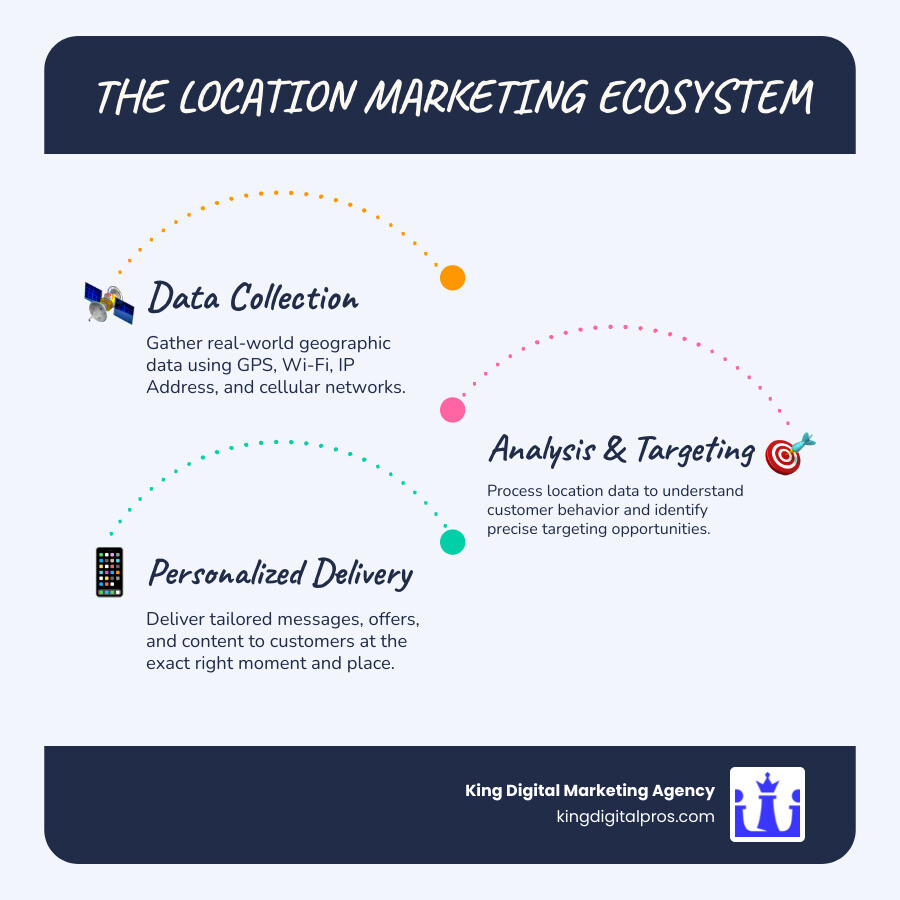
Location marketing works by collecting location data and using it to deliver timely messages. Your smartphone provides this data through several methods:
- GPS (Global Positioning System): Highly precise for outdoor tracking, powering features like geofences.
- Wi-Fi Triangulation: Estimates indoor location by measuring signal strength from multiple Wi-Fi access points.
- Bluetooth Low Energy (BLE) Guides: Offer precision down to a few feet, ideal for in-store promotions.
- IP Addresses & Cellular Data: Provide broader regional or city-level location information.
For a deeper dive into one key technology, see our complete guide to geofencing marketing.
Once a location is known, messages are delivered through channels like push notifications (for immediate offers), in-app messages (for engaged users), SMS marketing (for direct, urgent promotions), and location-based ads on websites and social media.
Location-Based Marketing vs. Proximity Marketing
These terms are often confused but refer to different scales of targeting. Location-based marketing casts a wider net (neighborhoods, cities), while proximity marketing is hyper-local (a specific aisle in a store).
| Feature | Location-Based Marketing (LBM) | Proximity Marketing (PM) |
|---|---|---|
| Scope | Broader geographic areas (cities, neighborhoods, large zones) | Highly localized, micro-level areas (inside a store, specific aisle) |
| Primary Technology | GPS, IP addresses, Wi-Fi triangulation, cellular data | Bluetooth guides, NFC (Near Field Communication), sometimes Wi-Fi |
| Accuracy | Generally less precise (tens of meters to kilometers) | Highly precise (centimeters to a few meters) |
| Use Case | Geotargeting ads, geofencing for regional campaigns, local search | In-store offers, product info, indoor navigation, real-time engagement |
| Trigger | Entering/exiting a larger virtual boundary, or general location | Close physical proximity to a specific device/point |
Often, the best strategy uses both: LBM brings customers to your area, and PM engages them once they’re close.
The Technology Behind the Message
Geofencing creates virtual perimeters that trigger actions when crossed, while geotargeting delivers ads to people based on their current or past locations. Combining these technologies allows for sophisticated campaigns. For example, you can use geofencing to send a push notification to a nearby customer, then use Bluetooth guides to trigger in-app messages with product recommendations once they enter your store.
Core Strategies and Use Cases of Location Marketing
Location marketing turns geographic data into business results by increasing foot traffic and boosting sales. By delivering relevant messages at the right moment, you improve the customer experience and make their lives easier. Research from McKinsey shows that effective personalization can boost conversions by up to 27%. This precision targeting bridges the gap between a customer’s online search and their physical visit to your store.
Key types of location marketing strategies

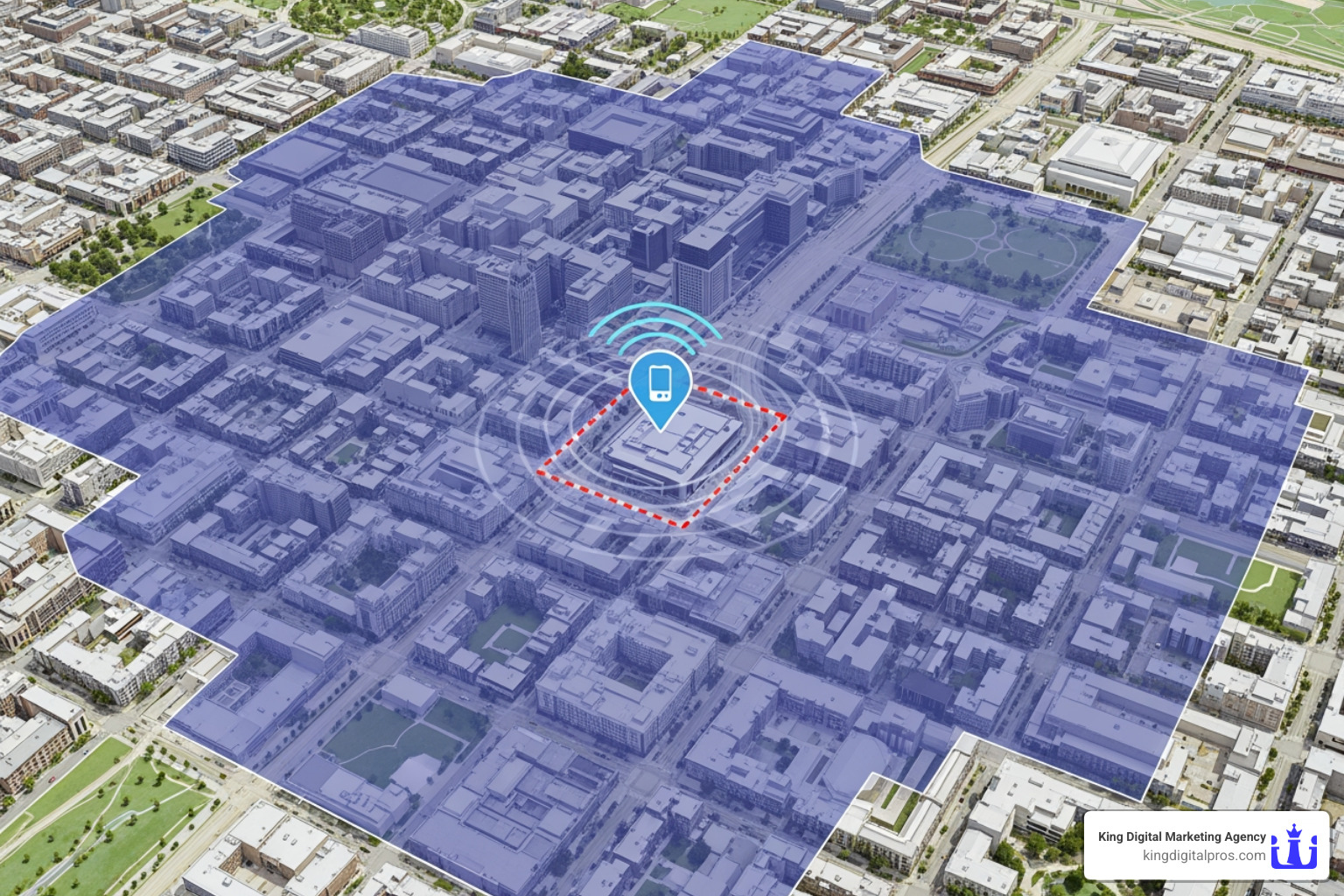
- Geofencing: Creates a virtual boundary around a location. When a user crosses it, an action (like a push notification) is triggered. It’s ideal for reaching people when they are already in a buying mindset nearby. Our Geofencing Marketing Complete Guide offers a deep dive.
- Geotargeting: Delivers ads based on a user’s general location (current or past) without requiring them to cross a specific boundary. It’s about relevance at scale, like ensuring local searchers see your business.
- Guideing (Proximity Marketing): Uses small Bluetooth devices (guides) to send hyper-relevant messages to customers in a specific, small area, like a store aisle.
- Geo-conquesting: A competitive strategy where you set up geofences around competitors’ locations to send your offers to their potential customers.
Real-World Examples Across Industries
Location marketing is versatile and effective across many sectors:
- Retail: A clothing store can send a sale notification to anyone walking past their storefront. Adidas used location extensions in search ads, leading to a 680% increase in ROI as one in five ad viewers visited a physical store.
- Restaurants: Burger King’s famous “Whopper Detour” campaign geofenced McDonald’s locations, offering a 1-cent Whopper to users of the BK app nearby. This drove 3.2 million app downloads.
- Food & Grocery: Whole Foods combined geofencing around its stores with geo-conquesting at competitor locations, achieving a 4.69% post-click conversion rate – well above the industry average.
Other industries like hospitality, events, automotive, and healthcare also use these strategies to improve customer experiences, from sending welcome messages at hotels to helping patients steer large hospitals.
Best Practices, Measurement, and Future Trends
Effective location marketing requires a focus on trust, measurement, and future trends. Approaching it with thoughtfulness and respect for the user is paramount.
Privacy, Consent, and Building Trust
Location marketing can feel intrusive if handled poorly. While nearly 90% of consumers will share location data for discounts, they are wary of unwanted tracking. Success hinges on transparency and value exchange.
- Obtain Explicit Consent: Users must actively opt-in to location sharing. Clearly explain the benefit they’ll receive, such as “Allow location access to receive exclusive in-store deals.”
- Ensure Data Security: Comply with regulations like GDPR and CCPA, which mandate transparency, consent, and data protection. Anonymize data for analytics whenever possible.
- Provide Real Value: Avoid bombarding users with notifications. Focus on sending timely, helpful messages that improve their experience. Building trust is the foundation of a successful campaign.
Measuring the ROI of your location marketing efforts
To prove value and refine your strategy, track these key performance indicators (KPIs):
- Foot Traffic Attribution: Measures how many people visited your physical location after seeing a location-based ad.
- Store Visit Lift: Compares your target audience to a control group to determine the incremental visits generated by your campaign.
- Conversion Rate: Tracks the percentage of people who took a desired action, like redeeming a coupon.
- Cost Per Visit: Calculates how much you spend to bring one person into your store.
- Return on Ad Spend (ROAS): The ultimate metric, measuring the total revenue generated for every dollar spent. For example, Adidas saw a 680% increase in ROI from its location-enabled ads.
Consistently tracking these metrics allows for real-time optimization. For more on reaching local customers, see our ultimate guide to attracting local customers.
The Future of Location Marketing
The technology is evolving quickly, opening up new possibilities:
- AI and Machine Learning: Will enable predictive analytics to anticipate customer needs based on location patterns and behavior.
- Augmented Reality (AR): Will blend digital content with the physical world, allowing users to see virtual offers or reviews overlaid on a storefront.
- Hyper-personalization: Will move beyond targeting neighborhoods to understanding individual micro-contexts and habits.
- Voice Search & IoT: The rise of voice assistants and connected devices will generate richer location data, creating more opportunities for seamless, context-aware marketing. With almost 74% of smartphone owners using location-based services, adapting to these trends is crucial.
Frequently Asked Questions about Location Marketing
Here are answers to the most common questions business owners have about location marketing.
How effective is location-based marketing?
It is highly effective because it reaches people at the perfect time and place. The data shows that location-based marketing can improve response rates by up to 5x and boost conversions by up to 27%. It’s a proven way to drive foot traffic and gain valuable insights into customer behavior. With average location opt-in rates at 62%, consumers are receptive when they see clear value in exchange for sharing their location.
What is the difference between geofencing and geotargeting?
Though often confused, the difference is simple:
- Geofencing is about real-time action. It creates a virtual boundary (a “fence”) around a specific place. When someone crosses it, an immediate action is triggered, like a push notification.
- Geotargeting is about audience building. It delivers ads to people based on their general location or location history, without requiring a real-time boundary cross.
For example, a bakery in Corrales could use geofencing to send a “fresh bread” alert to people walking by right now. It could use geotargeting to show ads to everyone in Los Alamos who has previously searched for “bakeries near me.”
Are there privacy concerns with location marketing?
Yes, and addressing them is critical. While nearly 90% of consumers will share location data for a discount, they are wary of being tracked without permission. Best practices are non-negotiable:
- Get Explicit Consent: Always ask for permission before collecting location data.
- Be Transparent: Clearly explain how and why you are using the data.
- Provide Value: Ensure your messages are helpful and relevant, not intrusive.
By respecting user privacy and complying with regulations like GDPR and CCPA, you can build trust and run effective campaigns that benefit both your business and your customers.
Grow Your Business with a Hyper-Local Strategy
You’ve seen how location marketing connects your online presence to your physical storefront. You understand the technology, the strategies, and the potential for growth. Now it’s time to put it to work for your business.
Your customers are on their phones, searching for local businesses right now. The companies that appear in that moment of need are the ones that win.
At King Digital Marketing Agency, we specialize in making sure you’re the business they find. We build hyper-local strategies custom to your service area, whether in Albuquerque or Santa Fe, optimizing your Google Business Profile and implementing geofencing campaigns that drive real foot traffic. We measure everything, so you see a clear return on your investment.
Location marketing gives local businesses the competitive edge they need to thrive, but it requires a strategic approach that respects customer privacy and delivers genuine value. The opportunity is here.
If you’re ready to dominate local search and turn nearby browsers into loyal customers, we can show you how. Learn more about how we can help you optimize your local search presence or harness the power of our geofencing marketing services.
Let’s put your business on the map – literally. Connect with us today to get started.